
Chuyên mục: Năng lượng – Energy
ADB – Vietnam Energy Sector Assessment, Strategies and Roadmaps
Bac Lieu Offshore Wind Farm
Project Type: Offshore wind farm, Bac Lieu Province, Vietnam
Developer: Cong Ly Construction-Trade-Tourism
Capacity: 99.2MW

Developed on a 540ha site in the East Dam region of Bac Lieu province, Vietnam, the 99.2MW Bac Lieu near-shore wind farm is Asia’s first offshore wind farm in the Mekong Delta region. Tiếp tục đọc “Bac Lieu Offshore Wind Farm”
Will a carbon tax be imposed on coal-fired thermal power plants?
Last update 07:30 | 04/12/2017
VietNamNet Bridge – Experts believe that if Vietnam imposes a carbon tax on coal-fired plants, ‘clean power’ will be able to compete with thermal power.

There are 12 operating thermal power plants
Ngo Duc Lam, an energy expert from VSEA (Vietnam Sustainable Energy Alliance), has applauded the government’s resolution on developing the Mekong Delta in a sustainable way by restricting coal-fired thermal power.
No more coal-fired power plants will be designed for the Delta, except the 14 plants mentioned in the seventh plan on electricity generation development. Tiếp tục đọc “Will a carbon tax be imposed on coal-fired thermal power plants?”
Japanese firm gets nod to build US$2.58-billion thermal power plant
Japan’s Sumitomo Corporation has gained an investment certificate to develop Van Phong 1 thermal power project worth US$2.58 billion in the central coast province of Khanh Hoa.

Minister of Industry and Trade Tran Tuan Anh (L) presents a letter approving Van Phong 1 thermal power project to Kuniharu Nakamura, chairman of Sumitomo Corporation, in this file photo dated May, 2017
Before receiving the investment certificate, Sumitomo signed an investment agreement with the Ministry of Industry and Trade in May 2017. Work will start next year on the 1,320 MW station. Tiếp tục đọc “Japanese firm gets nod to build US$2.58-billion thermal power plant”
Sao lại tăng giá điện vào cuối năm?
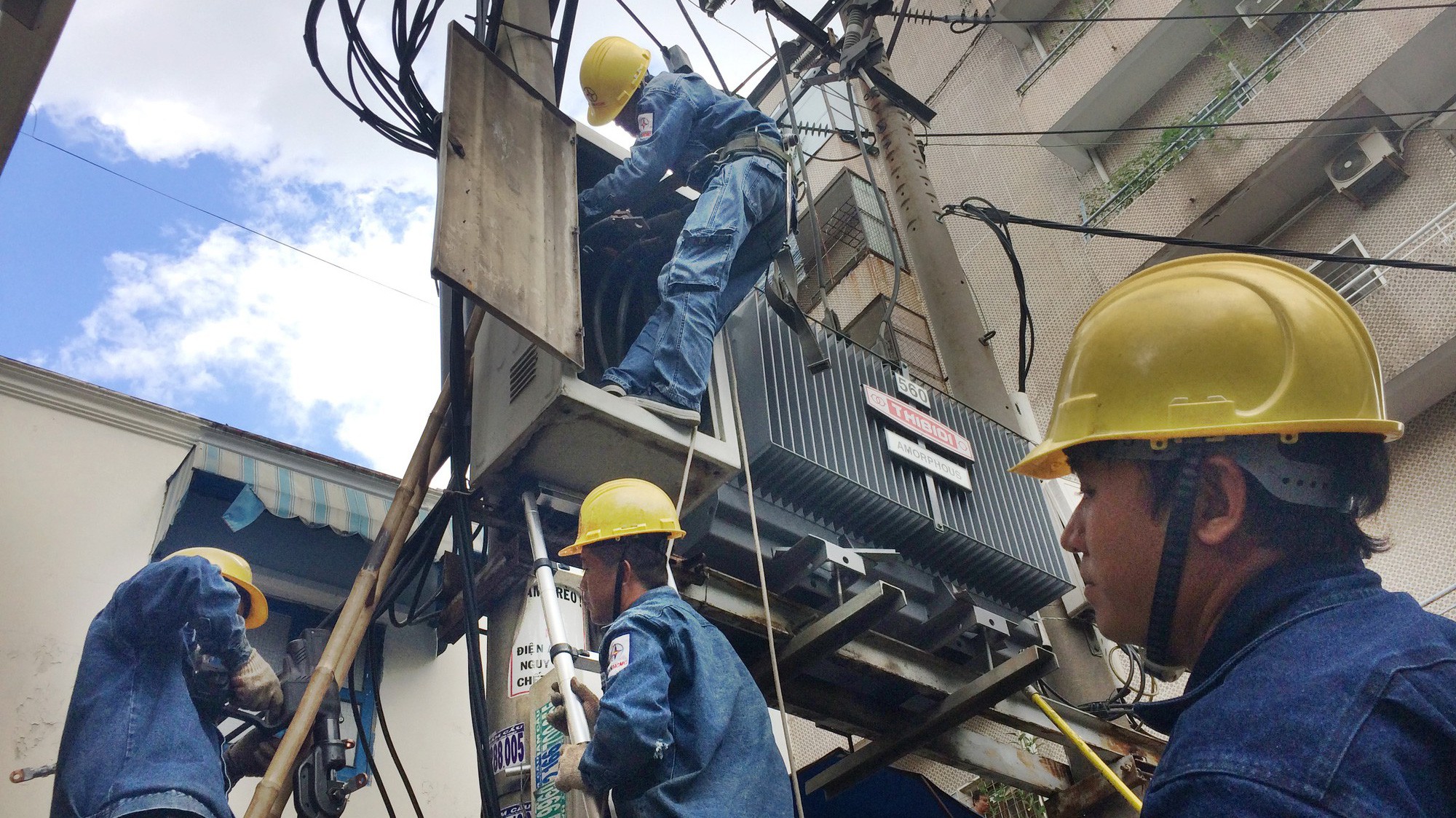
Thi công lắp đặt điện trên đường Vũ Huy Tấn (Q.Bình Thạnh, TP.HCM) – Ảnh: Châu Anh
TTO – Nhiều chuyên gia đề nghị phải giải trình minh bạch, thuyết phục lý do tăng giá điện cũng như có lộ trình để doanh nghiệp (DN), người dân có sự chuẩn bị.
tuoitre.vn_Việc tăng 6,08% giá điện được đánh giá là phù hợp trong bối cảnh nhu cầu đầu tư ngành điện tăng cao.
Buổi họp báo về tăng giá điện do Bộ Công thương tổ chức chiều 1-12 trở nên nóng hơn khi hàng loạt câu hỏi của báo chí đặt ra về tính hợp lý, cơ sở của việc tăng giá điện 6,08% cũng như đề nghị làm rõ các khoản lỗ, chênh lệch tỉ giá…
Tăng giá để xử lý lỗ tỉ giá
Tại buổi họp báo, ông Võ Quang Lâm, phó tổng giám đốc Tập đoàn Điện lực Việt Nam (EVN), chỉ cho biết khoản lỗ tỉ giá sẽ được phân bổ dần dần nhằm giảm bớt áp lực tăng giá điện, nhưng không giải trình cụ thể khoản lỗ gần 600 tỉ đồng xuất phát do đâu.
Cũng theo ông Lâm, việc tăng giá điện sẽ tác động đến chỉ số giá tiêu dùng là 0,1% và tăng trưởng GDP là 0,166% trong năm 2018.
Đại diện của Kiểm toán Deloitte giải thích thêm về khoản chênh lệch tỉ giá lên tới 9.500 tỉ đồng là do EVN phải vay vốn nước ngoài để đầu tư nhà máy nên phát sinh chênh lệch tỉ giá, dù điều hành tỉ giá của Ngân hàng Nhà nước đã khá ổn định.
Theo vị này, nếu khoản lỗ chênh lệch tỉ giá được phân bổ ngay vào giá thành, chắc chắn tình hình sản xuất kinh doanh chung sẽ bị lỗ, nhưng quan điểm điều hành của Chính phủ là chưa phân bổ tỉ giá vào giá thành để giảm áp lực tăng giá.
Ông Nguyễn Anh Tuấn, cục trưởng Cục Điều tiết điện lực, cũng cho rằng theo chỉ đạo của Chính phủ, khoản lỗ tỉ giá sẽ chỉ được hạch toán một phần hoặc giãn ra đưa vào giá thành để tránh tạo áp lực đến việc tăng giá bán lẻ điện.
Do đó, đợt điều chỉnh giá điện lần này chỉ đưa một phần vào khâu truyền tải điện, khâu phát điện… Cũng theo ông Tuấn, EVN đã tiết kiệm 1.266 tỉ đồng chi phí thường xuyên, giảm giá thành trong khâu truyền tải điện, chi phí sửa chữa lớn tiết kiệm 5%, tốc độ tăng lương thấp hơn năng suất lao động…
Australia in plans to export colossal amounts of wind and solar energy to Southeast Asia
An international consortium of energy companies has presented its plans to develop a 6 gigawatt (GW) solar and wind hybrid project in Western Australia, designed to export clean energy to Indonesia through subsea cables.

Western Australia is set to take advantage of its significant solar and wind resources to export renewable energy to Indonesia, contributing significantly to the country’s clean energy future and energy security through reducing reliance on imported fossil fuels.
The proposed project is called Asian Renewable Energy Hub (AREH) and is another mega energy project which underlines the significant opportunities that domestic renewable resources can provide for countries to become the ‘new’ energy exporters.
The hybrid power plant would be spread over 14,000 square km in flat desert land on the north-west coast of Australia.
It would comprise approximately 1,200 wind turbines supplied by Vestas, and 10 million solar panels with an aggregated capacity of 6GW – enough electricity to power more than 7 million households. Tiếp tục đọc “Australia in plans to export colossal amounts of wind and solar energy to Southeast Asia”
Hướng dẫn tài chính cho người làm chính sách: Năng lượng tái tạo và hạ tầng xanh (P1)
>> Phần 1: Giới thiệu về Hướng dẫn Tài chính cho người làm chính sách: Năng lượng tái tạo và hạ tầng xanh
>> Phần 2: Thẩm định tính khả thi cho dự án năng lượng tái tạo ở thị trường mới nổi
Giới thiệu về Hướng dẫn Tài chính
bloomberg_Hiệp định Khí hậu Paris vào tháng 12 năm 2015 tập trung chú ý vào nhu cầu huy động các dòng vốn tư nhân lớn cho vào các giải pháp khí hậu với tốc độ và quy mô cần thiết để chống lại biến đổi khí hậu ở mức độ cấp thiết.
Việc thực hiện các kế hoạch quốc gia về năng lượng sạch hoặc cơ sở hạ tầng “xanh” sẽ đòi hỏi mức độ đầu tư chưa từng có, không chỉ vì lý do khí hậu, thông qua quyết tâm đóng góp quốc gia (Nationally determined contributions – NDC), mà còn đảm bảo an ninh năng lượng và tiếp cận năng lượng cho những người thiếu thốn, cũng như cho phát triển bền vững.
Bây giờ, hơn bao giờ hết, một điều vô cùng quan trọng là các nhà hoạch định chính sách và các bên khác không-phải-nhà-tài-trợ phải cần hiểu và giao tiếp với cộng đồng tài chính để thiết lập các điều kiện hiệu quả ở cấp quốc gia, cấp mà việc đầu tư sẽ phải được thực hiện.
Là một đóng góp thực tiễn, Hướng dẫn Tài chính cung cấp cái nhìn tổng quan thực tiễn về bối cảnh tài chính – nguồn vốn, cách thị trường hoạt động, cách các giao dịch vận hành và rộng hơn nữa để thiết lập các điều khoản tài chính chung trong bối cảnh đặt ra.
Hướng dẫn này phản ánh những thay đổi gần đây về điều kiện thị trường, cơ cấu tài chính và các cuộc tranh luận chính sách có liên quan. Các chủ đề của Hướng dẫn bao gồm:
Tiếp tục đọc “Hướng dẫn tài chính cho người làm chính sách: Năng lượng tái tạo và hạ tầng xanh (P1)”
Vietnam’s Homegrown System for Saving Water


October 24, 2017
A young man returned home to invent an internet-integrated system that helps farmers produce more food with less water.
Tri Nguyen, CEO of MimosaTEK, was born and raised in Dalat, a city in the Central Highlands region of Vietnam, where the land is mountainous and fertile. He grew up surrounded by local farmers who planted a rich variety of products — from bell peppers and flowers to coffee and bananas. Tri moved to Ho Chi Minh City to work in the information technology sector as a young man, but when the opportunity came, he decided to return to his roots and start a strawberry farm with his friends in Dalat.
Tri turned to the local farmers to learn everything he could about growing strawberries. But he kept hearing something that didn’t seem right: The farmers instructed him to irrigate until water dripped out of the soil when he picked it up in his hands.
Tri did some research that confirmed his instincts: The farmers didn’t need to be using that much water. But when he told his neighbors, they insisted on continuing to overwater their crops. It was how they were taught and how they had farmed all their lives.
“I realized then that the farmers based their decisions on experiences instead of scientific data,” says Tri.
Smallholder and family farmers in Dalat water their crops based on what they see and feel. They don’t consult data on the weather or rainfall because they were never taught to do so. This is leading to excessive irrigation, which can stunt growth or kill crops, and deplete limited groundwater. Furthermore, Vietnam is still recovering from its strongest-ever drought, and every drop counts. Many of Dalat’s farmers are already suffering from water shortages. Tiếp tục đọc “Vietnam’s Homegrown System for Saving Water”
Vietnam crude oil imports to hit record as refinery gets ready to start
* Vietnam’s second refinery has started importing crude
* Imports jump as country’s crude production stalls
* Kuwait, Brunei and Azerbaijan supplying Vietnam with crude
By Henning Gloystein
SINGAPORE, Aug 18 (Reuters) – Vietnam’s crude oil imports will soar to record highs in August as the country ramps up fuel refining at a time when local crude output is dwindling.
August will mark the first month on record in which Vietnam is a net importer of crude oil, according to shipping data in Thomson Reuters Eikon, with the trend set to continue in coming months as the Southeast Asian nation’s refinery capacity grows.
The surge in overseas orders comes as Vietnam’s 200,000 barrels per day (bpd) Nghi Son refinery, its second such facility, prepares to produce liquefied petroleum gas, gasoline, diesel, kerosene and jet fuel, mainly for the domestic market, likely starting later this year or in early 2018.
With local oil production stalling, traders said the country of over 90 million people and 6-percent annual economic growth would gradually increase its crude imports.
“We expect to send bigger and more frequent volumes of crude to Vietnam in the future. Vietnam is one of the key new centres of oil demand growth, and we wouldn’t want to miss this opportunity,” said a senior oil trading manager. He asked not to be identified as he was not allowed to discuss trading strategies.
Shipping data in Thomson Reuters Eikon shows that Vietnam will import around 100,000 bpd of crude in August, on three tankers, versus exports of 70,000 bpd. September tanker imports are scheduled at similar levels.
Vietnam’s orders are still small compared with Asian’s top buyers, China and India, which import around 8 million and 4 million bpd of crude per day respectively.
“But in an environment of oversupply, this incremental new demand is very welcome for crude suppliers,” the trading manager said. Tiếp tục đọc “Vietnam crude oil imports to hit record as refinery gets ready to start”
Vietnam seeks higher-quality FDI: experts
Last update 17:00 | 27/11/2017
VietNamNet Bridge – While Vietnam needs foreign capital to develop the economy, it also requires advanced technologies to become involved more deeply in the global supply chain.

The FDI capital would exceed the $30 billion threshold by year end
At a meeting with Japanese investors recently, director of the Binh Duong Planning and Investment Department Nguyen Thanh Truc said foreign investors pledged to invest $2.171 billion in the province this year.
Meanwhile, HCMC is leading the country in FDI (foreign direct investment) with total committed capital of $5 billion this year. Tiếp tục đọc “Vietnam seeks higher-quality FDI: experts”
Trong khi Bắc Kinh phát triển Năng lượng tái tạo, thì các công ty Trung Quốc xây nhiệt điện than ở Việt Nam và các nước nghèo – As Beijing Joins Climate Fight, Chinese Companies Build Coal Plants

nytimes_Workers at a construction site at the Sahiwal coal power plant, owned by China’s state-owned Huaneng Shandong Ruyi Group, in Pakistan. The country’s coal capacity is set to grow 15,300 megawatts from 190.CreditAsad Zaidi/Bloomberg
When China halted plans for more than 100 new coal-fired power plants this year, even as President Trump vowed to “bring back coal” in America, the contrast seemed to confirm Beijing’s new role as a leader in the fight against climate change.
But new data on the world’s biggest developers of coal-fired power plants paints a very different picture: China’s energy companies will make up nearly half of the new coal generation expected to go online in the next decade.
HSBC accused of breaking EU sanctions rules by co-financing Vietnam coal plant
HSBC might be breaking European Union rules on working with Russian banks by funding a new 1,200 megawatt coal-fired power station in Vietnam. The bank, which recently announced a US$100 billion fund to fight climate change, denies this.

eco-business_HSBC, one of the world’s largest financial services groups, may have broken European Union (EU) sanctions regulations by working with a Russian bank on the financing of a new coal-fired power plant in Vietnam, according to an investigation by Market Forces, an environmental group that campaigns against the funding of fossil fuel power projects.
The London-based global banking giant is the lead arranger and global coordinator for the financing of LongPhu1, a 1,200 megawatt coal-fired power station that is also being funded by Russian development bank Vnesheconombank. Tiếp tục đọc “HSBC accused of breaking EU sanctions rules by co-financing Vietnam coal plant”
Skills and occupational needs in renewable energy and Green Buildings – Kỹ năng và nghề nghiệp cần thiết trong ngành năng lượng tái tạo và công trình xanh
Renewable energy
The renewable energy sector is growing fast: about half of the new electricity-generating capacity added globally in 2008 and 2009 came from renewable energy additions. Fast deployment has led to skill shortages in technical occupations such as solar installers and electrical engineers, but also in more general occupations, such as sales and finance specialists, inspectors, auditors and lawyers.
This report brings together the findings from 33 countries and arises from a joint EC/ILO project on Knowledge sharing in early identification of skill needs.
This report brings together the findings from 33 countries and arises from a joint EC/ILO project on Knowledge sharing in early identification of skill needs.
Green Building
Download: Skills and occupational needs in green buildingpdf – 1.8 MB
Demand for workers in retrofitting and new green construction is expected to grow over the coming years but the lack of appropriate skills in the workforce can hamper the development of the sector and its potential benefits. New skill needs related to energy efficiency, water management and renewable energies in buildings are emerging. Skills-led strategies can drive the green building sector forward.
This report brings together the findings from 34 countries and arises from a joint EC/ILO project on Knowledge sharing in early identification of skill needs.
This report brings together the findings from 34 countries and arises from a joint EC/ILO project on Knowledge sharing in early identification of skill needs.
</div
Renewable Energy: Finance guide for policy-makers – Hướng dẫn tài chính cho người làm chính sách: Năng lượng tái tạo và hạ tầng xanh
About the Finance Guide
bloomberg_The Paris UN Climate Agreement in December 2015 refocused attention on the need to mobilize substantial private capital flows into climate solutions at the pace and scale required to combat climate change with the required urgency.
Implementation of national clean energy or ‘green’ infrastructure plans will require unprecedented levels of private investment, not only for climate reasons, through NDCs, but also to deliver energy security and access to energy for those who lack them, as well as creating the conditions for sustainable development.
Now, more than ever, it is critically important for policy-makers and non-financiers to understand and interface with the financial community to establish effective conditions at national level, where the investment case will have to be made.
As a practical contribution, the Finance Guide provides a factual overview of the landscape of finance – sources of capital, what the capital markets do, how transactions work – and more broadly to set common finance terms in context.
Tiếp tục đọc “Renewable Energy: Finance guide for policy-makers – Hướng dẫn tài chính cho người làm chính sách: Năng lượng tái tạo và hạ tầng xanh”

