The Paris-based International Energy Agency was born in a crisis. In the wake of the 1973 oil shock, as Arab petroleum producers withheld supply from countries that supported Israel in the Yom Kippur war, the then US secretary of state, Henry Kissinger, called on the OECD to set up a new body to ensure its members would always have the reliable and affordable energy they needed.
Over time, as the agency has expanded its focus to map broader energy trends, it has sometimes faced accusations of conservatism – that it has underestimated the uptake of renewable energy, and has been overly bullish about the future of fossil fuels. But last month it released a report that pointed to a rupture more far reaching than the 70s oil embargo.
It suggested investment in new coal power across the globe has peaked and is on the verge of a steep decline. In a coinciding media briefing, the IEA chief economist, Laszlo Varro, declared the “century of coal” that started in 2000 – evident in the extraordinary wave of investment by emerging Asian nations – may already be over.
“It is becoming clear that Chinese coal demand has peaked,” he went on. “The outlook for imports [to] India and other countries is uncertain.”
What does this mean for Australia, producer of about 30% of the world’s coal, as it plans a vast expansion in production in outback Queensland?
The future of coalmining is really two separate questions, with their own answers. Neither is clear-cut, but thermal coal – burned in power stations to provide electricity – is on a different trajectory to higher-quality metallurgical coal, mainly used in producing steel.
About 55% of the coal Australia exports is thermal, but the 45% metallurgical coal is more lucrative, reaping nearly two-thirds of the revenue. The bulk of the thermal coal is exported from the Hunter Valley of New South Wales; most of the metallurgical product comes from Queensland. Combined, coal exports were worth $55bn last financial year. Only iron ore brings in more.
Until last year, coal prices had been on a steep downward trajectory since 2011. The surge in demand last decade prompted investment in mines across the globe but demand had slowed by the time they became operational, resulting in oversupply. By 2014, global coal use had stopped growing. In 2015, it started to decline.
Several factors were at play, many of them long-term trends. China stopped growing as rapidly, took steps to limit choking air pollution, and began to shift its economy from relying on industrial exports to a greater emphasis on services and consumption. Climate change policies began to cut into coal’s market share in developed countries. In the US, the rapid development of cheap shale gas projects made coal uneconomic before the introduction of Barack Obama’s emissions policies.
By early 2016, the IEA was reporting that 80% of Chinese coalmining operations were losing money and the companies responsible for about half of US coal production were bankrupt.
It triggered a reaction. The Communist party forced the closure of some mines, restricted operation at others, to cut Chinese production by more than 10%. The global thermal coal price quickly doubled. The price of metallurgical coal surged further, tripling in April this year after Cyclone Debbie ravaged large parts of Queensland, reducing supply from some mines. Australia’s export revenue from coal exports soared 57% in a year. Both events illustrated the potential for volatility in coal markets owing to the weather or government fiat. But the bounce was brief.
Market analysts at Citi Research last month warned investors that the outlook for coal stocks was pessimistic: major banks were financing fewer projects; Donald Trump’s much-vaunted pro-coal and anti-climate change stance was having little impact in the US.
In a report for the Australian Conservation Foundation, consultants ACIL Allen agreed. “At present, there is considerable pessimism regarding the long-term outlook for prices of thermal coal in international markets,” it said. “This is reflected in forecasts by credible Australian and international agencies.”
Citi forecasts modest growth in Australian thermal coal exports in the near term, including the potential expansion of a couple of mines. But with prices expected to fall to US$60 a tonne by the end of the decade, down from a US$110 peak late last year, it sees no incentive for investment in new major projects – especially given public opposition and investor apathy towards coal.
It makes for an unlikely environment in which to develop a mega-mine backed by public money. But that is what Australia is considering.
The Indian billionaire Gautam Adani’s $21bn proposal to build a giant mine in the Galilee basin, about 340km south-west of Townsville, dates back to 2010. It has outlasted three Australian prime ministers and survived the signing of a global deal to combat climate change. Unsuccessful court battles have been waged and lost by opponents, promised imminent start dates have come and gone, and government support has steadily increased.
Though known as the Carmichael mine, if fully developed it will actually be 11 mines: six of them open-cut and five underground, spread over a length of 50km. Eventually, the company says, it could yield up to 60m tonnes a year to be shipped to burn in Indian coal plants. The rail and port infrastructure necessary would open up the possibility of reviving some of the dormant coalmining plans in the basin, with a total potential additional output of about 150m tonnes of coal a year.
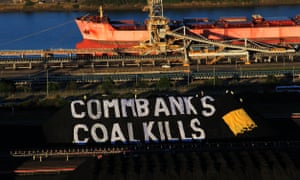
To put that into context, Australia now exports about 200m tonnes. It is, by any measure, a massive expansion that could push the world measurably closer to breaching the goals of the Paris climate agreement.
The details of the Adani proposal have moved over time. It was initially proposed to run for 150 years but that has been scaled back to 60. The company promised it would create 10,000 jobs; an ACIL Allen Consulting economist contracted by the company later conceded in court a more likely figure was 1,464. And the project is promised to initially start on a smaller scale, producing 25m tonnes a year.
It has environmental approval, has been granted access to groundwater from the Great Artesian Basin, and won a four-year deferment before it has to start paying royalties to the state. In June Adani announced it had made a final investment decision and was ready to go ahead. In truth, this was spin – it was still yet to secure finance for the project (Australian banks have not been willing) – but it was ramping up pressure on the Australian government to approve a $900m low-cost loan through its Northern Australia Infrastructure Facility to help to fund a railway that Adani would own and operate for itself and other potential Galilee basin miners.
Adani’s biggest champion has been the recently resigned resources minister Matt Canavan, who argued the mine should go ahead on economic, humanitarian and, most audaciously, environmental grounds. Specifically: bring jobs and growth to struggling north Queensland; help improve the lives of the 240 million Indians living without electricity; and be better for the planet given that India is building coal plants anyway, and Australian coal is a cleaner product than what is dug up in other parts of the world.
All three points have been contested. There has been significant pushback against the idea that, in a world where the demand for coal is flat at best, existing Australian mines would not lose out if the Galilee basin were developed. The coal consultancy Wood Mackenzie was commissioned to look at the issue by the $2bn Infrastructure Fund, which owns a stake in the coal-reliant Port of Newcastle, and found existing mines in southern Queensland and NSW would be hit. “Put simply, either the $1bn loan to Adani will have a significant impact on coal production and jobs in the Hunter Valley, Bowen basin and Surat basin, or the business case for the Adani rail line is deeply flawed and the promised jobs for north Queensland unlikely to materialise,” it reported.
Testing the humanitarian and environment arguments requires a closer look at the changes under way in the Indian electricity market. India is the world’s second largest importer of thermal coal. It doesn’t want to be. Its coal minister, Piyush Goyal, has repeatedly said he wants to cut imports completely. It won’t happen in the short term – some of the country’s plants were built to run using higher-quality coal, which is not available domestically – but a shift is under way. Reuters reported that demand for imported thermal coal in India fell 13% in the first seven months of this year.
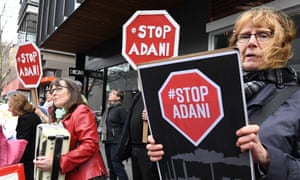
Meanwhile, the country is seeing extraordinary reductions in the cost of large-scale solar power – 40% in a year – to the point where it is cheaper than domestic coal for the first time. There are questions over whether this is sustainable, but India has set an ambitious solar target of 100 gigawatts within five years. A draft national electricity plan released in December found no new coal-fired plants would be needed for a decade, and proposed coal plants with a capacity of 13.7GW – more than half Australia’s total coal fleet – were cancelled in May alone.
What does this mean for the Carmichael mine? Goyal says India does not need it, but will use the coal. Tim Buckley, of the Institute for Energy Economics and Financial Analysis, says a two-week trip he took to India to meet energy executives and government officials suggested a different story. “There was almost zero discussion on Carmichael,” he says. “The project is not on the radar, not expected to happen, immaterial for India’s energy plans given the progressive move away from imported thermal coal and just unbankable for Indian banks given excessive Adani group debt.”
India is not the only country rethinking the scale of its coal commitment. China has not cut imports – it is more focused on closing inefficient domestic mines – but its coal consumption peaked three years ago. It has an incredibly large fleet of generators likely to operate for decades to come, but they are running at less than 50% capacity. It cancelled 103GW of proposed coal-fired plants (more than twice the capacity of Australia’s east coast grid) this year.
Government officials note what is happening – the chief scientist Alan Finkel’s independent review of Australia’s electricity security noted that China is diversifying its energy mix, India limiting imports and South Korea cutting coal power to reduce pollution – but this shift receives little clean air in the Australian political debate, where the Minerals Council is an influential player and the major parties are supportive of a long-term source of jobs and revenue.
Misinformation is rife. Peter Freyberg, the head of coal at the mining giant Glencore, claimed that the IEA had projected that fossil fuels would provide almost 70% of energy in 2030, even if the world got its act together to limit global warming to an increase of less than 2C. He was making a point about coal’s longevity but, in reality, the IEA paints a different picture.
Yes, it estimates 64% of energy would come from fossil fuels in 2030 under this scenario – if you count electricity generation, industrial processes, transport, heating and cooking, and if you assume carbon capture and storage suddenly becomes viable. Even then, the biggest chunk would be expected to come from natural gas, which is considered a cleaner transitional fuel. The IEA found burning coal to generate electricity would decline sharply, with wind and solar providing more than half the world’s needs within 13 years. Traditional coal-fired power would be gone by mid-century.
Metallurgical coal is not expected to decline as quickly – in simple terms, there is not the readymade alternative to coal in steel manufacturing that there is in electricity generation. The IEA has forecast only a 15% drop in global trade of metallurgical coal by 2040 should the world deliver on the headline Paris agreement goals. Australia has about a fifth of the global market, and higher quality coal than many competitors, suggesting its market share should more or less hold up.
As the government points out, Australia also offers higher quality thermal coal than its competitors. But Tony Wood, energy program director at the Grattan Institute, says the numbers are compelling even once this is factored in.
“Malcolm Turnbull says coal will be part of the energy mix for the next several decades, and this is true, but it is a declining part of that mix,” Wood says.
“We may have a bigger share, but it is still a bigger share of a declining market. Unless someone does something with carbon capture and storage – or the world turns away from acting on climate change, which doesn’t seem likely – this is not an industry with a long-term future.”
• Support our independent journalism and critical reporting on energy and the environment by giving a one-off or monthly contribution


/about/177680720-56a2ad2a3df78cf77278b56e.jpg) (
(