
|
||||||||||||||||||||||||
|
||||||||||||||||||||||||
|
||||||||||||||||||||||||
Chuyên mục: Môi trường – Environment


11 Facts About Pollution
Welcome to DoSomething.org, one of the largest orgs for young people and social change! After you’ve browsed the 11 facts (with citations at the bottom), take action and volunteer with our millions of members. Sign up for a campaign and make the world suck less.
- Pollution is one of the biggest global killers, affecting over 100 million people. That’s comparable to global diseases like malaria and HIV.
- Cleanups can save animals’ lives and discourage people from littering in the future. Take initiative and host a cleanup — wearing anything but clothes! — at a park near you. Sign up for ABC Cleanup.
Policy: Four gaps in China’s new environmental law
21 January 2015
Implementation and accountability will remain challenging, especially at the local level, warn Bo Zhang and Cong Cao.
Article tools PDF Rights & Permissions
Subject terms:Law Government Conservation biology

STR/AFP/Getty
Nature – A resident of China’s Hubei province clears the Fuhe river of dead fish, thought to have been poisoned by high levels of ammonia.
On 1 January, a new environmental protection law (EPL) took effect in China. It is the nation’s first attempt to harmonize economic and social development with environmental protection.

The EPL is perceived as the most progressive and stringent law in the history of environmental protection in China. It details harsher penalties for environmental offences — for example, for acts of tampering and falsifying data, discharging pollutants covertly and evading supervision. It contains provisions for tackling pollution, raising public awareness and protecting whistle-blowers. It places more responsibility and accountability on local governments and law-enforcement agencies and sets higher standards for enterprises. Tiếp tục đọc “Policy: Four gaps in China’s new environmental law”
Vice premier prefers Vietnam to better cope with natural disasters
Updated : 09/15/2015 16:33 GMT + 7

Boats are anchored on the Han River in the central city of Da Nang during the landfall of tropical storm Vam Co in central Vietnam on September 14, 2015.
Competent agencies should review their precautionary work to better respond to natural disasters, which have killed 98 people, and caused damage totaling nearly US$243 million in Vietnam in the past eight months, Deputy Prime Minister Hoang Trung Hai has said.
Tiếp tục đọc “Vice premier prefers Vietnam to better cope with natural disasters”
Google lays bare overlooked deforestation ‘hotspots’
Last updated on 2 September 2015, 1:25 pm
Search giant and researchers map emerging clusters of tropical forest loss in Southeast Asia, South America and Africa

By Alex Pashley
Forests are being cut down at a rapid clip in previously spared territories, data from the University of Maryland and Google reveals.
RCCT – New hotspots are appearing in Southeast Asia’s Mekong Basin, South America’s Gran Chaco region and Madagascar, high-resolution satellite mapping released by Global Forest Watch shows.
The world lost more than 18 million hectares of forest in 2014, an area twice the size of Portugal.
Over 2012-14, the three-year average was the worst since records began in 2001, in a troubling trend as rates reverse after years of decline.

Carbon-rich forests hacked down for cash crops, such as beef, soy and palm oil, together with weak governance, are the main drivers of tree cover loss, said Nigel Sizer at the World Resources Institute. Tiếp tục đọc “Google lays bare overlooked deforestation ‘hotspots’”
Large-scale illegal trade in hundreds of wild-collected ornamental plants in Southeast Asia
Date:September 14, 2015
Source:National University of Singapore
Sciencedaily – Southeast Asia is a widely recognised centre of illegal wildlife trade — both as the source region for species ranging from seahorses to tigers, and as a global consumer of ivory carvings, wild pets, and traditional Chinese medicinal products.
While there are mounting efforts to tackle illegal wildlife trade, including within Singapore to reduce demand for wildlife products, the illegal trade in some species still remains undocumented.
Associate Professor Edward L. Webb, from the Department of Biological Sciences at the National University of Singapore (NUS), and NUS PhD graduate Dr Jacob Phelps, have uncovered a previously little recognised Southeast Asian wildlife trade — the illegal sale of wild-collected ornamental plants, especially orchids.
Their findings were recently published in the journal Biological Conservation in June 2015.
Uncovering the “invisible” orchid trade
The researchers conducted extensive surveys of wildlife markets across Thailand, including border markets with Laos and Myanmar, and identified more than 400 species of ornamental plants in illegal trade — species widely prized by plant enthusiasts for their beauty, fragrance and/or rarity. Over 80% of these plants traded at the markets are wild orchids. Some of these were even listed in published literature as threatened. Tiếp tục đọc “Large-scale illegal trade in hundreds of wild-collected ornamental plants in Southeast Asia”
Những nông dân bị “bắt” làm giám đốc
(LĐ) – Sau một đêm thức trắng, ông Trần Ngọc Huỳnh (Hai Huỳnh) ở ấp 12, xã Khánh Thuận, huyện U Minh (tỉnh Cà Mau) quyết định mình phải làm… giám đốc bằng cách thành lập công ty.
Ông thanh minh: “Không phải kinh doanh làm giàu, cũng không phải để dựt le với bà con, tui làm giám đốc chỉ với mục đích duy nhất là để được thuê lại chính đất rừng của mình thay vì phải hợp tác với Cty TNHH MTV U Minh Hạ và bị họ phát canh thu tô suốt 15 năm nay…”.
 Người trồng tràm theo hình thức LDLK ở rừng U Minh Hạ đang bị “phát canh thu tô”. Ảnh: H.V.M Tiếp tục đọc “Những nông dân bị “bắt” làm giám đốc”
Ministry to issue incinerator criteria
Updated September, 07 2015 08:52:00
 |
| A small-scale incinerator in Central Ha Tinh Province. he Ministry of Natural Resources and Environment will issue a set of criteria for small-scale incinerators burning daily household waste in October. — Photo tinmoitruong.vn |
HA NOI (VNS) — The Ministry of Natural Resources and Environment will issue a set of criteria for small-scale incinerators burning daily household waste in October, an official said.
Hoang Duong Tung, deputy head of the ministry’s Viet Nam Environment Administration, made the announcement at the ministry’s monthly press conference. Under the criteria, an incinerator could be run if the fumes it discharged were treated and safe for the environment. Tiếp tục đọc “Ministry to issue incinerator criteria”
Environment experts discuss dam dangers
Updated September, 09 2015 09:05:00
 |
| Thirty-five experts from environmental organisations in Cambodia, Laos and Viet Nam gathered yesterday to discuss water management and the effects of hydropower dams. — Illustrative photo thoidai.com.vn |
DONG THAP (VNS) — Thirty-five experts from environmental organisations in Cambodia, Laos and Viet Nam gathered yesterday to discuss water management and the effects of hydropower dams.
They participated in a one-day seminar held in Dong Thap Province in the Mekong Delta and discussed the impacts that dams built on rivers in the Indochina region have on local communities, including those along the Mekong River. Tiếp tục đọc “Environment experts discuss dam dangers”
Loss from dead fish reaches US$241,000
Updated September, 10 2015 17:09:00
 |
| Fish breeding cages in Cha Va River. Total initial loss following a mass death of fish five days ago in the river has amounted to VND5.3 billion (US$241,000). — Photo dantri.com |
BA RIA-VUNG TAU — A joint team of investigators from Long Son Commune People’s Committee and Agriculture Department reported the total initial loss following a mass death of fish five days ago in Cha Va River in has amounted to VND5.3 billion (US$241,000). Tiếp tục đọc “Loss from dead fish reaches US$241,000”
Eat in style – Know the origin: A joint mission to better Vietnam’s environment and consumers’ health
WWF – August 14th – 24th 2015, seafood certified as responsibly farmed in Vietnam will be officially available for the domestic market at many eateries. The certification denotes the seafood has met strict standards that ensure food safety and minimize environmental impact. This is part of Sustainable Seafood Week 2015, organized by WWF-Vietnam, to introduce the world’s newest trend in stylish dining: sustainability.
In support of responsible production and products, which have gained worldwide popularity and become a significant indicator of a modern, healthy and positive lifestyle, the Sustainable Seafood Week with the message “Eat in style – Know the origin”, is urging Vietnamese consumers to join the international call for products from responsible sources.

During the 10 days, besides introducing Vietnam’s responsibly farmed seafood to the domestic market, the program will engage consumers in an array of exciting activities to raise awareness about sustainable seafood, through a display of informative artworks, a theme-inspired flash mob and exciting mini-games at Crescent Mall, District 7, Ho Chi Minh city. Consumers can visit www.cabenvung.vn to find the full list of restaurants participating in the program, and also pledge their support online to the demand for sustainable seafood in Vietnam. Tiếp tục đọc “Eat in style – Know the origin: A joint mission to better Vietnam’s environment and consumers’ health”
Sustainable Fishing in Vietnam
WWF– Tram Chim National Park is one of the most important remaining expanses of wetlands in Vietnam. While most fishing in the park is forbidden, some locals exercise traditional rights to fish for food and a living. WWF works in Tram Chim to restore natural water flows, fisheries and wildlife.
- Related to this Video:
Bac Ninh gets waste treatment plant
Updated September, 08 2015 08:40:00
 |
| Deputy Prime Minister Hoang Trung Hai and delegates visit the Tu Son Town waste water treatment plant which became operational on Sunday. — VNA/VNS Photo Thai Hung |
BAC NINH (VNS) — The Tu Son Town wastewater treatment plant became operational on Sunday after its construction was completed in 18 months, six months ahead of schedule.
The plant is expected to help treat wastewater from the town’s inner area of about 1,890ha, comprising six wards – Dong Ngan, Dinh Bang, Dong Nguyen and Tan Hong, besides Trang Ha and Chau Khe — that are home to about 100,000 people. Tiếp tục đọc “Bac Ninh gets waste treatment plant”
‘Báu vật’ ở quê lúa Nghệ An
VE – Tại xã Lăng Thành (Yên Thành, Nghệ An) hiện có hơn 100 ha rừng lim cổ thụ được người dân xem như “báu vật”.
Là huyện nửa trung du miền núi, nửa đồng bằng, Yên Thành được biết đến là vựa lúa của Nghệ An. Trong 39 đơn vị hành chính của huyện, Lăng Thành là xã rất đặc biệt, được bao bọc bởi 106 ha rừng lim. Từ trung tâm xã đến rừng lim gần nhất chỉ một cây số, đó là Rú Chùa, xa hơn nữa là Hóc Nông, Đồng Bàu, Vệ Thạng…
 |
|
Khu rừng lim tại xã Lăng Thành. Ảnh: Phan Ngọc. |
Bốn thử thách khi thực hiện dân chủ trong các vấn đề môi trường
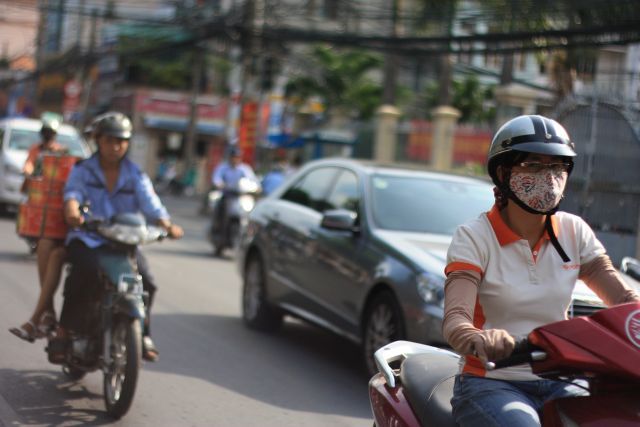
Ô nhiễm không khí ngoài trời gây ra cái chết của 3,7 triệu người ở độ tuổi dưới 60 trên toàn thế giới trong năm 2012. Ảnh: Leo Fung / Flickr.
Chỉ số Dân chủ về môi trường (Environmental Democracy Index – EDI) – đã được đưa ra hồi tháng 5 này – theo dõi các nước trong tiến trình ban hành luật quốc gia nhằm phát triển tính minh bạch, sự tham gia của công chúng và khả năng tiếp cận công lý của cộng đồng trong quá trình đưa quyết định về môi trường. Có bằng chứng cho thấy rằng các nhà làm luật quốc gia đang dần nhận ra tầm quan trọng của các quyền này. Lấy ví dụ, trong 102 điều luật về Quyền Thông tin trên thế giới, 42 điều luật đã được ban hành trong 10 năm qua. Tuy nhiên, có luật nghiêm chưa chắc đảm bảo rằng luật đó được tôn trọng trong thực tế. Tiếp tục đọc “Bốn thử thách khi thực hiện dân chủ trong các vấn đề môi trường”
 CVD
CVD 