Nhìn lại các công trình ngăn mặn hiện có ở ĐBSCL

Hòa Tân lược ghi – Thứ Hai,  1/10/2018, 14:48 

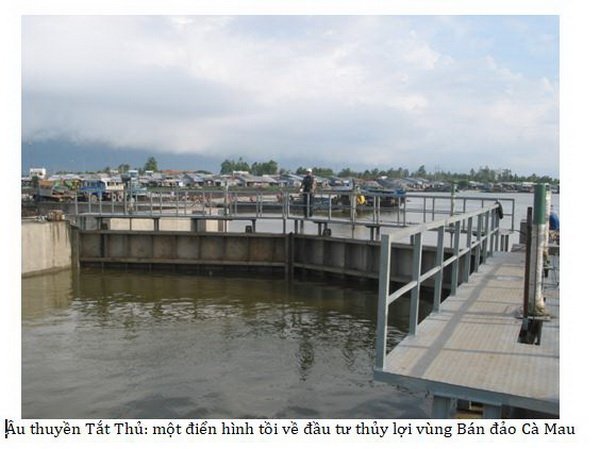
(TBKTSG Online) – LTS: Thời báo Kinh tế Sài Gòn Online đã nhận được bản thảo về “Đánh giá các hệ thống ngăn mặn vùng ven biển châu thổ Cửu Long và dự án thủy lợi sông Cái Lớn – Cái Bé” của nhóm nghiên cứu gồm Lê Anh Tuấn – Nguyễn Hữu Thiện – Dương Văn Ni – Nguyễn Hồng Tín – Đặng Kiều Nhân.

Xem toàn bộ thông tin mà báo đã đăng về đại dự án thủy lợi Cái Lớn – Cái Bé tại đây

Đây là một công trình khoa học dài hơn 15.000 chữ với 37 trang, xét thấy phần đánh giá tác động các công trình ngăn mặn phù hợp với tờ báo, nên tòa soạn xin được lược đăng. Tựa đề chính và các tựa phụ do tòa soạn đặt.

Ngọt hóa bán đảo Cà Mau

Tiếp tục đọc “Nhìn lại các công trình ngăn mặn hiện có ở ĐBSCL”

Doanh nghiệp đua nhau xin “nhận chìm vật chất” xuống biển

Hòa Tân – Thứ Hai,  17/9/2018, 14:14 

(TBKTSG Online) – Ngày 11-9, ông Trần Ngọc Căng, Chủ tịch UBND tỉnh Quảng Ngãi ký công văn gửi Thủ tướng, nhờ Thủ tướng xem xét và chỉ đạo việc cấp phép nhận chìm ở biển và giao khu vực biển cho dự án đầu tư Khu liên hợp sản xuất gang thép Hòa Phát Dung Quất.

Xem công văn của UBND tỉnh Quảng Ngãi tại đây
Xem Nghị định số 40/2016/NĐ-CP tại đây
Sau Vĩnh Tân 1: Nguy cơ nguồn tài nguyên hải sản bị xóa sổ
Cho phép xả bùn xuống biển Vĩnh Tân: Những thắc mắc chờ giải đáp

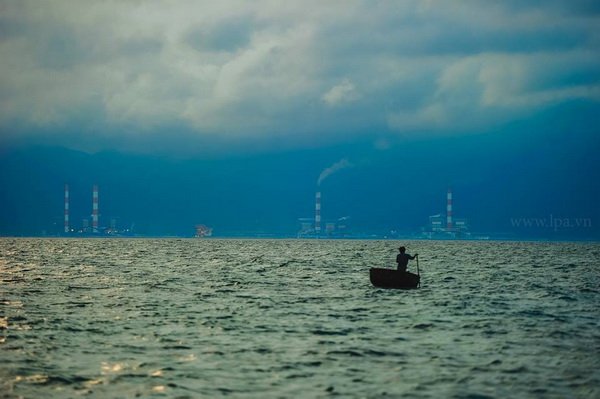
Các nhà máy nhiệt điện Vĩnh Tân, Bình Thuận nhìn từ đảo Hòn Cau. Ảnh: Lekima Hùng

Tiếp tục đọc “Doanh nghiệp đua nhau xin “nhận chìm vật chất” xuống biển”

Gold mining suspected as cause of Cambodian mass poisonings

Air pollution tanks South Asia’s cities in liveability rankings

eco-business.com 

Bad air has pulled South Asian cities down The Economist Intelligence Unit’s Global Liveability Ranking while political stability has nudged Hong Kong above Singapore. How did the rest of the region fare?

A man carries firewood past the smoking stacks of brick kilns Dhaka

A man carries firewood past the smoking stacks of brick kilns in Dhaka, Bangladesh. The capital city has among the worst air quality in the world. Image: Scott RandallCC BY-NC-ND 2.0By Hannah Koh

Nepal capital Kathmandu fell two positions to 129th place while Dhaka dropped two places to 139th spot in this year’s Global Liveability Ranking by The Economist Intelligence Unit (EIU), which assessed living conditions in 140 cities.
Tiếp tục đọc “Air pollution tanks South Asia’s cities in liveability rankings”

Bờ biển đẹp trở thành bãi chứa hàng tấn rác thải

NZ – 07:00 17/06/2018

 Suốt nhiều năm, người dân xả thải bừa bãi ra bờ biển làm bãi cát đẹp trở thành nơi chứa rác thải, ô nhiễm nghiêm trọng.

Trên bãi biển ô nhiễm, những đứa trẻ ở thị trấn Phan Rí Cửa (huyện Tuy Phong, Bình Thuận) dùng rác làm đồ chơi, chạy nhảy trên cát đầy rẫy túi nylon và mảnh sành, thủy tinh.
Bo bien dep tro thanh bai chua hang tan rac thai hinh anh 1
Tình trạng ô nhiễm đang diễn ra ở bãi biển thị trấn Phan Rí Cửa (huyện Tuy Phong, Bình Thuận). Tại đây, gần 2 km bãi cát ngập trong các loại rác thải, chất thải.

Tiếp tục đọc “Bờ biển đẹp trở thành bãi chứa hàng tấn rác thải”

‘Khủng khiếp’, bình quân mỗi người Việt tiêu thụ 0,9-1kg thuốc BVTV/năm

Thuốc độc ở chính trong ta:

NN – 27/07/2018, 08:42 (GMT+7) Hiện có khoảng 200 doanh nghiệp tham gia sản xuất kinh doanh thuốc BVTV, khoảng 100 nhà máy sản xuất thuốc BVTV và hơn 30 ngàn đại lý buôn bán thuốc BVTV. Đáng chú ý là thực sự chỉ khoảng 15-20 doanh nghiệp chi phối...

Lợi ích nhóm

Theo ông Trương Quốc Tùng – nguyên Phó Chủ tịch Thường trực Hội Khoa học Kỹ thuật Bảo vệ Thực vật (BVTV) Việt Nam, lịch sử dùng thuốc BVTV ở nước ta được bắt đầu ở miền Bắc vào năm 1955. Nó tỏ ra là phương tiện quyết định, nhanh chóng dập tắt các dịch sâu bệnh trên diện rộng. Nếu không có thuốc BVTV nhiều dịch hại cây trồng có thể làm giảm 40-60% năng suất trên diện rộng, cục bộ có thể mất trắng.

08-37-56_dsc_0465
Vỏ bao thuốc BVTV vứt bừa bãi ở một vùng trồng rau sạch

Tiếp tục đọc “‘Khủng khiếp’, bình quân mỗi người Việt tiêu thụ 0,9-1kg thuốc BVTV/năm”

Làm nông nghiệp hữu cơ: Câu chuyện từ nhận thức đến thực tiễn – 5 bài

***
Đừng kinh doanh “hữu cơ” trong bóng tối”

Jerry Do – 09:55, 13/05/2018

TheLEADER Giấc mơ “hữu cơ” nào cũng đáng quý, mặc dù không có giấc mơ nào giống nhau, chỉ có điều chúng ta phải trung thực với những gì có thể làm hay nói cách khác là minh bạch thông tin vườn trồng cũng như sản phẩm để cộng đồng lựa chọn.

Đừng kinh doanh "hữu cơ" trong bóng tối

Sản phẩm nông nghiệp hữu cơ vẫn còn là giấc mơ của nhiều người. Tiếp tục đọc “Làm nông nghiệp hữu cơ: Câu chuyện từ nhận thức đến thực tiễn – 5 bài”

Q&A: Air Pollution Remains Cause for Alarm in Asia

IPSnews.net

IPS correspondent Sinsiri Tiwutanond spoke to Global Green Growth Institute’s director-general Dr. Frank Rijsberman about Asia’s fight against air pollution.

On any given day, a pall of smog and dust hangs over Kabul’s streets. It clings to the face, burns the eyes, and stains the hands. It bathes the cars, often stuck bumper-to-bumper in traffic, and occludes the view of the distant mountains. Credit: Anand Gopal/IPS

BANGKOK , Jul 17 2018 (IPS) – At the start of the year the pollution in Vietnam’s capital, Hanoi, reached six times the World Health Organization’s guideline levels for air quality.

Yet the levels, which appear higher than those of South Korea’s capital Seoul—where most people monitor the air pollution levels daily—is not treated with equal concern because of a lack of general awareness. This is despite the fact that air pollution has become the largest cause of premature deaths in Asia.

“When I went to Vietnam, I realised no one thought there was an air pollution problem because no one was directly addressing it. It was worse than Seoul when we checked the level there. In Seoul, people talk about air pollution everyday. In the morning, you check the air quality to see if you need a mask or if the kids can play outside. In Hanoi, the problem is just as bad but people just don’t know about it,” Global Green Growth Institute’s director-general Dr. Frank Rijsberman told IPS. Tiếp tục đọc “Q&A: Air Pollution Remains Cause for Alarm in Asia”

Nghịch lý ngành xi măng (3 bài)

Nghịch lý ngành xi măng - ảnh 1
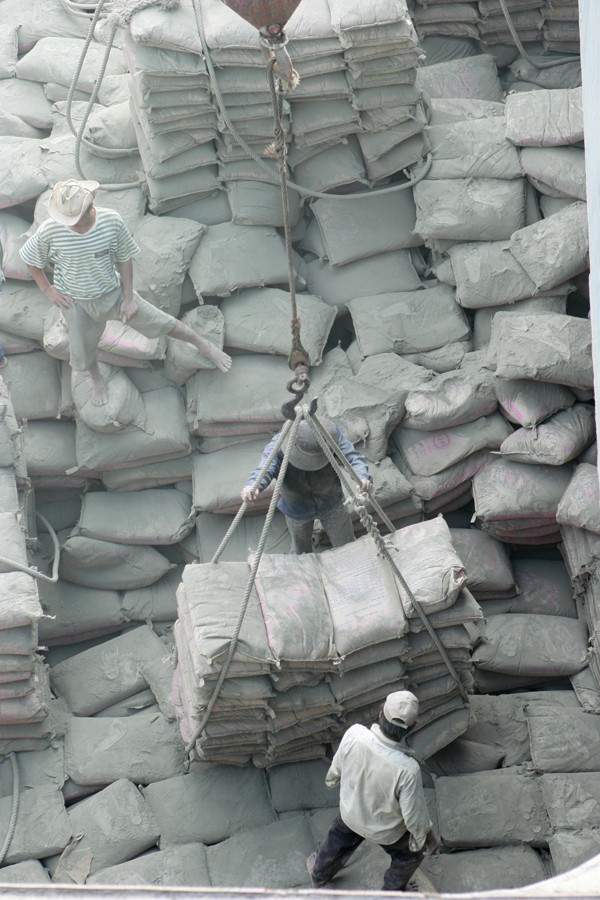
Xi măng trong nước ế ẩm, xuất khẩu giá rẻ. Ảnh: ngọc châu

***

Giá xuất khẩu chỉ hơn nửa giá trong nước:

Nghịch lý ngành xi măng

TP – Giá xi măng xuất khẩu chỉ bằng hơn nửa giá bán trong nước, chỉ giải quyết tình trạng tồn kho; ngân sách không thu được gì, thậm chí mất tài nguyên, gây ô nhiễm.

Tiếp tục đọc “Nghịch lý ngành xi măng (3 bài)”

10 Rivers Contribute Most of the Plastic in the Oceans

ScientificAmerica

The 10 rivers that carry 93 percent of that trash are the Yangtze, Yellow, Hai, Pearl, Amur, Mekong, Indus and Ganges Delta in Asia, and the Niger and Nile in Africa. The Yangtze alone dumps up to an estimated 1.5 million metric tons of plastic waste into the Yellow Sea.


Credit: Amanda Montañez; Source: “Export of Plastic Debris by Rivers into the Sea,” by Christian Schmidt et al., in Environmental Science & Technology, Vol. 51, No. 21; November 7, 2017

Our seas are choking on plastic. A staggering eight million metric tons wind up in oceans every year, and unraveling exactly how it gets there is critical. A recent study estimates that more than a quarter of all that waste could be pouring in from just 10 rivers, eight of them in Asia.

“Rivers carry trash over long distances and connect nearly all land surfaces with the oceans,” making them a major battleground in the fight against sea pollution, explains Christian Schmidt, a hydrogeologist at the Helmholtz Center for Environmental Research in Leipzig, Germany.
Tiếp tục đọc “10 Rivers Contribute Most of the Plastic in the Oceans”

Polluted waste water causes 2,000 rivers to die

07:21 | 22/05/2018

VietNamNet BridgeMore than 2,000 large rivers with 10 kilometers or longer in Vietnam are being threatened by untreated waste water from households, industrial production and craft villages.

vietnam economy, business news, vn news, vietnamnet bridge, english news, Vietnam news, news Vietnam, vietnamnet news, vn news, Vietnam net news, Vietnam latest news, Vietnam breaking news, mass fish deaths, Hai Duong, river pollution
Fish have died in Hai Duong province

The people farming fish in cages on Luc Dau, Kinh Thay and Thai Binh in Hai Duong province have shouted for help as their fish have died en masse because of polluted waste water discharged into rivers. Tiếp tục đọc “Polluted waste water causes 2,000 rivers to die”

Scientists accidentally create mutant enzyme that eats plastic bottles

Theguardian

The breakthrough, spurred by the discovery of plastic-eating bugs at a Japanese dump, could help solve the global plastic pollution crisis

 Scientists explain how plastic-eating enzyme can help fight pollution – video

Tiếp tục đọc “Scientists accidentally create mutant enzyme that eats plastic bottles”

International partners join Việt Nam to combat plastic pollution

Update: June, 04/2018 – 16:30

Trash are seen along the coast in the south of Phước Diêm Commune, Thuận Nam District in central province of Ninh Thuận. — VNA/VNS Photo
Viet Nam News HÀ NỘI — Dozens of embassies and international organisations marked the World Environment Day (June 5) by signing a Code of Conduct on Combating Plastic Pollution.

The signatories include Austria, Belgium, Canada, Denmark, the European Union, Finland, France, Germany, Ireland, Italy, the Netherlands, New Zealand, Norway, Slovakia, Sri Lanka, Sweden, Switzerland, the United Kingdom and the United States of America as well as 16 UN agencies, funds, programmes, offices and World Bank. Tiếp tục đọc “International partners join Việt Nam to combat plastic pollution”

WHO reveals shocking figures on air pollution deaths

UNITED NATIONS — You may want to put on a gas mask after you read the latest report from the World Health Organization (WHO) on urban air pollution. The WHO says nine out of ten people are subjected to high levels of pollutants from the air they breathe. Tiếp tục đọc “WHO reveals shocking figures on air pollution deaths”

Vietnam’s Champion for Renewable Energy: Q&A with Goldman Prize Winner Khanh Nguy Thi

WRI

Khanh Nguy Thi grew up near a coal plant in Bac Am, a village in northern Vietnam. While Nguy Thi’s lifelong dream was to become a diplomat, the memory of pollution in her hometown pulled her toward work in water conservation and community development.

In 2011, Khanh founded the Green Innovation and Development Centre (GreenID) to promote sustainable energy development in Vietnam. She also started the Vietnam Sustainable Energy Alliance, a network of 11 Vietnamese and international environmental organizations that collaborate on regional energy issues. Tiếp tục đọc “Vietnam’s Champion for Renewable Energy: Q&A with Goldman Prize Winner Khanh Nguy Thi”