Báo cáo đề cập các khía cạnh bao quát cần được xem xét trong phát triển gió ngoài khơi Việt Nam. Báo cáo này có nội dung kỹ thuật rất đáng kể và cho thấy nhóm nghiên cứu thực hiện khối lượng công việc nghiên cứu khá chuyên sâu trong một thời gian ngắn.
Tuy nhiên, còn nhiều điểm chúng tôi mong muốn nhấn mạnh nhưng chưa được đề cập trong báo cáo này
1. Báo cáo không đề cập đến việc can thiệp của Trung Quốc trên Biển Đông (Biển Nam Trung Hoa) có thể ảnh hưởng tới các dự án điện gió ngoài khơi của VIệt Nam . Toàn bộ vùng biển, từ miền Bắc Việt Nam đến Khánh Hòa có thể không ổn định cho các nhà đầu tư quốc tế. (Nhưng tất nhiên, đây là một thực tế không thể đưa vào trong báo cáo vì vấn đề này vẫn chưa có giải pháp thực sự hiệu quả).
2. Báo cáo dựa trên giả thiết với nền hệ thống pháp lý, chế độ chính trị và hành chính hiện hành của Việt Nam và hiện trạng sẽ tiếp diễn, và không đề cập đến những thay đổi về mặt cấu trúc cần thiết đối với hệ thống này, đặc biệt trong ngành năng lượng. Điều đó có nghĩa là, tất cả các vấn đề hành chính đang tồn tại sẽ vẫn còn đó, và sẽ tiếp tục cản trở sự phát triển của ngành năng lượng, bao gồm phát triển điện gió ngoài khơi. Tiếp tục đọc “Góp ý về Lộ trình phát triển điện gió ngoài khơi cho Việt Nam – Comments on Offshore wind roadmap for Vietnam “→
Pham Phu Quoc, a deputy of Vietnam’s lawmaking National Assembly for 2016-21, is seen in a file photo.
A serving member of Vietnam’s lawmaking National Assembly (NA) has addressed the controversy around his dual citizenship exposed in an exclusive report by the Al Jazeera.
Dozens of major political figures and their families have bought Cyprus citizenship through the ‘golden passport’ program of the Cypriot government, the Al Jazeera reported on Monday after obtaining what they call ‘The Cyprus Papers.’
Such papers are a batch of leaked documents containing more than 1,400 approved applications for the Cyprus Investment Programme (CIP) run by the Republic of Cyprus.
“The programme allows people to buy a Cypriot passport, and by extension become European Union citizens, by investing at least €2.15 million ($2.5 million) in the country,” the Al Jazeera said in their investigative report.
Named in the papers is Pham Phu Quoc, the incumbent NA representative from Ho Chi Minh City who is serving the 2016-21 tenure.
Tuoi Tre (Youth) newspaper was able to interview Quoc on Tuesday to give further details on his Cyprus citizenship.
Update: August, 26/2020 – 12:15|vietnamnewsChina’s Liaoning aircraft carrier sailing during a drill in the South China Sea in 2018. — AFP/VNA Photo
HÀ NỘI — Việt Nam has condemned China’s latest military drill in Hoàng Sa (Paracel) islands as a move against the country’s territorial integrity and regional peace.
The statement was made by Việt Nam’s Ministry of Foreign Affairs spokesperson Lê Thị Thu Hằng on Wednesday over reported Chinese naval exercises and live-fire drills in a part of the Paracels lying within the hotly contested South China Sea (known in Việt Nam as the East Sea) on August 24-29.
French teacher Peter Vlaming, who had taught since 2012 at West Point High School in West Point, Virginia, was fired in December 2018. (Photo: Alliance Defending Freedom)
A French teacher at West Point High School in West Point, Virginia, was fired for not using pronouns preferred by a transgender student.
Should people be forced to contradict their core beliefs just to keep a job? Can you be compelled to speak a message you don’t believe in?
Caleb Dalton, a counsel with the Christian legal organization Alliance Defending Freedom who represents the teacher, Peter Vlaming, joins “The Daily Signal Podcast” to discuss the issues involved.
Rachel del Guidice: I’m joined today on “The Daily Signal Podcast” by Caleb Dalton, who serves as legal counsel with Alliance Defending Freedom. Caleb, it’s great to have you on “The Daily Signal Podcast.”
Walter Lohman is director of the Asian Studies Center at The Heritage Foundation.
There is a long-held logic in Washington that puts so-called geostrategic interests ahead of values. The idea is that we cannot afford to stand for liberty because our global competitors do not.
If we alienate oppressive governments by criticizing them or pushing for political reform, the logic follows, they will side with our competitors and tilt the game board against us.
This is a much too simple way of looking at the world.
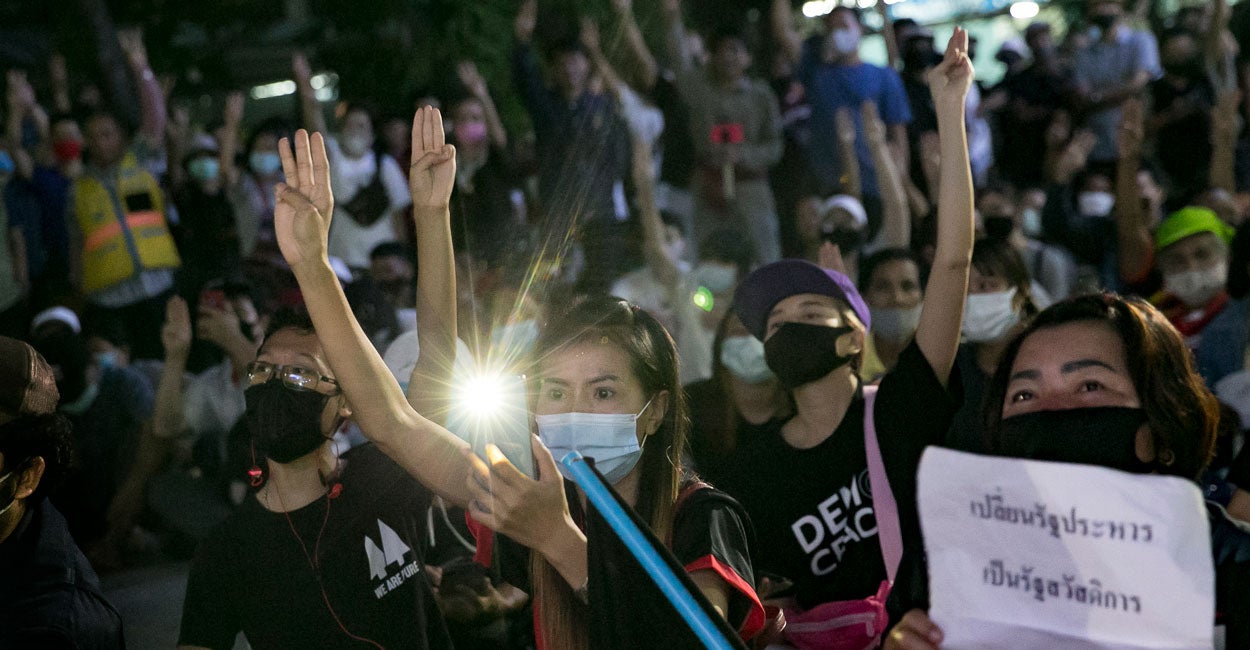
A case in point right now is what is happening in Thailand. For weeks, thousands have been demonstrating in favor of democratic reform, which the Thai government is already attempting to suppress.
If the U.S. turns a blind eye to this suppression—or sides with the Thai authorities—out of fear of pushing the Thai government closer to Beijing, we will be betraying our own democratic values.
The demonstrators are calling for a new constitution and greater freedom of expression. Protesters also are calling for constraints on the power of the Thai monarchy—a very touchy subject in Thailand, as criticism of the monarchy can land one in prison for up to 15 years.
It is hard to blame them. The state of democracy in Thailand today is not good. Elections held last year were best described as “partly free and not fair.” Although they did provide for a transition to civilian government, the military remains very much in control of the Thai political structure.
The strong influence of the military is by design. The country’s 2017 constitution, drafted by the Thai military junta, was written precisely to keep the military in, to keep former Prime Minister Thaksin Shinawatra (and other opposition like the former Future Forward Party) out, and to augment the powers and privileges of the monarchy.
Of course, Thailand is not the worst abuser of liberal freedoms. Freedom House now classifies it as partly free—a status it holds with several other countries in Southeast Asia, including the Philippines, Singapore, Malaysia, and Indonesia, which have regular elections.
The U.S. is right to engage Thailand as the valuable treaty ally it is. The Thai people, however, are also right to demand more of their government.
A relatively low-grade crackdown is already underway, and likely will intensify. The best model may be the current situation in Hong Kong, which Thai authorities may see as the most efficient approach to shutting down dissent.
Like Hong Kong following Beijing’s imposition of its “national security law,” the legal structure is in place in Thailand to target protest leaders and try to decapitate the movement.
There is also the possibility of a much broader, violent shutdown of the protests that anyone familiar with the Thammasat University massacre of 1976 shudders to consider.
In either case, the U.S. must stay true to its values. It cannot condone the arrest of political activists or a broader crackdown on peaceful protests. The Trump administration should speak out and take action against individuals responsible—as it has in Hong Kong.
If things cascade into another military takeover, Washington will be compelled to curtail the extent of its military cooperation with Thailand—as it did after other recent coups in 2006 and 2014.
Is this ceding the field to the People’s Republic of China in what is now a global strategic competition? Not at all.
Certainly, in the short term, Beijing will seek to gain an advantage, as it has at other tense points in U.S.-Thai relations. But Thailand has long had a good security relationship with China, the best in Southeast Asia, in fact. That is not the doing of the U.S.
Thailand is the classic fence-sitter. It wants to engage both the U.S. and China, and barring the former, will still be wary of drawing too close to the latter.
In the longer term, American interests align with the Thai people. They will remember where we were in these days of protests. Any tactical edge we may gain with U.S.-Thai military exercises or new arms sales will be overshadowed by their disappointment in our sense of priorities.
American values are a strategic asset, not a liability. We may soon be called upon to treat them as such.
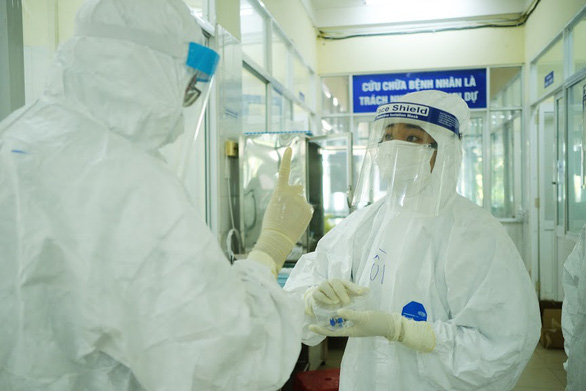
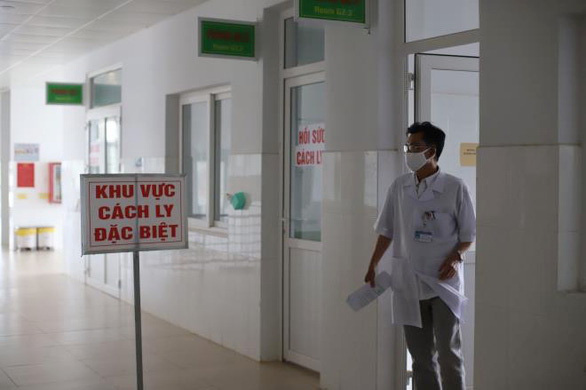
Health workers discuss COVID-19 treatment at a hospital in Da Nang, Vietnam. Photo: Tan Luc / Tuoi Tre
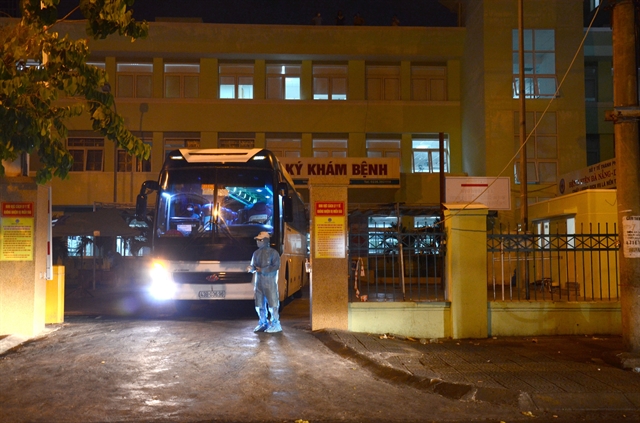
Vietnam reported 14 new coronavirus cases while taking one patient off the national count following negative retests on Thursday, according to the National Steering Committee for COVID-19 Prevention and Control.
The country’s tally has topped 1,000 cases since the virus first hit it in January.
Eleven of the additional cases were registered in Da Nang, one in neighboring Quang Nam Province, and two imported infections.
The patient in Quang Nam is linked to the cluster in Da Nang, a touristy city on the central coast.
The two imported cases include a 33-year-old Filipino expert who entered Vietnam from South Korea and a 27-year-old Vietnamese returnee from Equatorial Guinea. Both were quarantined upon entry, as per regulations.
The Filipino is treated in Khanh Hoa Province, located in south-central Vietnam, while the Vietnamese patient is receiving medical care in Ho Chi Minh City.
On Thursday morning, the Ministry of Health confirmed a 87-year-old man had tested positive for COVID-19 when hospitalized in Hanoi one day earlier.
But the ministry removed the patient from the tally in the evening following his three consecutive negative retests the same day.
Vietnam also announced nine recoveries on Thursday, all in Da Nang.
The Southeast Asian nation has documented 1,007 COVID-19 patients, including 666 local infections as of Thursday night, according to the health ministry.
A total of 542 patients have beaten the pathogen while 25 have died, most having suffered critical concomitant conditions.
A separate patient died on August 12 after having tested negative for the virus four times.
Five hundred and twenty-five domestic cases, most traced back to Da Nang, have been recorded since July 25, when the beach city logged the first locally-transmitted infection after Vietnam had gone 99 days without documenting any community transmission.
Vietnam has closed the border to foreigners since March to quell OVID-19 but the country grants exemption to foreign experts and skilled workers who are to be quarantined upon arrival.
The Vietnamese government has arranged for many flights to take home citizens stranded in other countries over virus-related travel restrictions.
Wednesday, August 19, 2020, 22:04 GMT+7 tuoitrenews
A health worker handles a piece of equipment at a hospital in Vietnam. Photo: Xuan Mai / Tuoi Tre
Vietnam recorded four new coronavirus cases on Wednesday, with its total nearing 1,000, according to the National Steering Committee for COVID-19 Prevention and Control.
The four patients include two in Da Nang, one in neighboring Quang Nam Province, and one in northern Hai Duong Province.
Patient No. 990 is a 25-year-old medical worker at Da Nang Family Hospital.
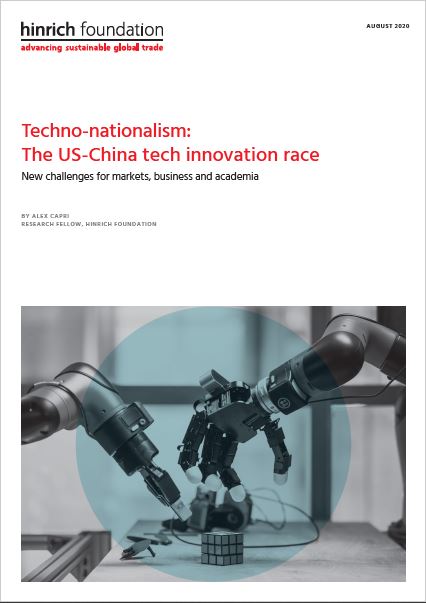
Techno-nationalism: The US-China tech innovation race New challenges for markets, business and academia BY ALEX CAPRI RESEARCH FELLOW, HINRICH FOUNDATION, 20202
The US-China tech innovation race is challenging the laissez-faire economic model. State interventionism, techno-nationalism and US tech funding initiatives are increasing. This paper outlines the implications for markets, academia, research organizations, and governments of the US-China competition to achieve innovation advantage.
A US-China tech innovation race has sparked a paradigm shift in global trade and commerce that is challenging the long-standing primacy of the world’s open trading system.
Current thinking is tilting towards increased state activism and interventionism, not only in the technology landscape but in many of the industries of the future.
Driving this change is techno-nationalism: a mercantilist-like behavior that links tech innovation and enterprise directly to the national security, economic prosperity and social stability of a nation.
In response to decades of Beijing’s innovation-mercantilism, the US has embarked on its own innovation offensive. Washington’s future tech funding initiatives could surpass the scale of the “moonshot” projects last seen during the space race with the former Soviet Union.
Download “Techno-nationalism: The US-China tech innovation race” by Alex Capri
The innovation race involves a broad range of emerging and foundational technologies that will define the industries of the future, including:
Artificial Intelligence (AI) and machine learning
Quantum computing and information systems
Robotics
Energy storage
Semiconductors
Next generation communication (including 5G and 6G)
Hypersonics.
Underlying themes: US techno-nationalism and innovation
As Washington and its allies ramp up techno-nationalist initiatives, core themes will drive the paradigm shift.
Public-private partnerships (PPP) – Technology alliances and government-funded initiatives will play an increasingly important role in advancing long-term innovation in the US, the EU and other traditionally open markets.
Avoiding the China innovation model – The US and EU innovation agendas will not seek to emulate China’s centralized, authoritarian system of techno-nationalism, but, rather, to turbo-charge markets and leverage entrepreneurial ecosystems, as well as academic and defense establishments.
Balancing tensions between MNEs, markets and techno-nationalism – Multinational enterprises (MNEs) will remain the primary drivers of R&D and innovation in free markets and play a vital role in PPP initiatives. They will be pulled into the US-China technology war in a variety of ways which will require a careful balancing of market forces, the interests of MNEs and the needs of state actors.
Multilateral technology alliances – US techno-nationalist policy will increasingly align with the security, economic and ideological objectives of the EU and other historic allies. This will produce more cooperation between the US and its partners.
Section I – The US-China innovation race: The role of the state
This section examines trends for public-spending in R&D and innovation and reviews a series of techno-nationalist funding initiatives from the US government.
It analyzes state activism in free markets and why governments are uniquely qualified to promote innovation and “blue-sky” technologies in ways that the private sector cannot.
Finally, Section I spotlights a historic example of techno-nationalism: SEMATECH and the US semiconductor public-private partnership, which led to a technological leapfrog by the US semiconductor industry, past Japan, in the 1990s.
Section II – MNEs, markets and governments: Navigating new complexities
Section II focuses on non-state actors and their increasingly complex role in public-private partnerships. It explores the tensions between open market forces, multinational companies, and techno-nationalist state activism.
To highlight these tensions, the report analyzes Facebook’s “Libra initiative and Beijing’s efforts to reduce dependency on the US dollar via the digital Yuan, and the challenges those create for MNEs. A US semiconductor sector case study illustrates how state activism can have detrimental effects on markets and backfire on the very parties it is looking to protect.
Section II concludes with an analysis of how open-sourced innovation could be a game-changer in the US-China technology war, particularly regarding future 5G wireless competition.
Section III – Academia and techno-nationalism: Open versus closed systems
Universities, research organizations and academia have become hot zones in the US-China innovation race. Human capital development is key to conducting leading-edge R&D and driving innovation.
Section III looks at how US export controls are affecting R&D activities at universities. It highlights the rules-based frameworks that universities must build to handle increasing government funding into academia.
The section showcases China’s Thousand Talents program and highlights its challenges for public-private partnerships involving academia. It also discusses why the US, in particular, should keep its human capital and innovation pipeline open as it pertains to foreign students, fundamental research programs and, ultimately, why an open system (despite China’s exploitation of it) is better than a closed one.
Finally, section III looks at how some inevitable strategic decoupling between Chinese and US entities will result in the ring-fencing of more “sensitive” R&D activities within the US defense establishment.
Listen to a summary of the report in this podcast featuring Alex Capri and Andrew Staples, Director of Research and Outreach.
Alex Capri is a Research Fellow at the Hinrich Foundation with over 20 years of experience in value chains, logistics and global trade management, both as an academic and a professional consultant.
A worker sprays disinfectant at the gate of Đà Nẵng Hospital, which is now a hot spot of COVID-19 in Việt Nam. — VNA/VNS Photo
HÀ NỘI — Twelve more people have tested positive for COVID-19 in the central city of Đà Nẵng, including a two-year-old baby boy.
The new locally transmitted infections bring the total amount of coronavirus cases nationwide to 558.
Three of the people who have tested positive are patients at Đà Nẵng Hospital. One is a 72-year-old woman being treated at the department of internal medicine, neurology and ophthalmology and the others are men aged 25 and 33.
Eight other cases are either relatives of patients being treated at Đà Nẵng Hospital or came into close contact with the positive cases, including the baby who was in contact with Patient No 509, a medical worker at Cẩm Lệ Health Centre.
Another patient is a 29-year-old man from Hòa Phước, Hòa Vang in Đà Nẵng. It is not clear if he has any connections with the hospital and his previous whereabouts are being investigated.
Yesterday, Việt Nam recorded its first-ever COVID-19-related deaths, a 61-year-old man and a 70-year-old man, both with underlying health conditions. — VNS
TTO – Bộ Y tế sáng 31-7 công bố ghi nhận ca COVID-19 mới, trong đó có 33 ca ở Bệnh viện Đà Nẵng, 2 tại Bệnh viện ung bướu Đà Nẵng. Như vậy tính từ ngày 25-7 đến nay, số ca bệnh liên quan Đà Nẵng đợt này là 93 ca.
This month, the president of the Board of Deputies of British Jews wrote a most courageous letter to the Chinese ambassador in London.
Van der Zyl is just one of many faith leaders to speak out against the atrocities being committed in Xinjiang. But one voice has been strangely absent—that of Pope Francis, ordinarily a powerful advocate for the oppressed. His silence speaks to the dangers of the deal made with China by the Vatican—and demands that others in the church speak out.
by Chris Ross, Executive Professor, Finance, University of Houston and Justin Varghese, MBA Candidate, Bauer College of Business
Liquefied natural gas (LNG) developers and natural gas producers have depended on third parties to create demand for their product. In recent years, LNG market prices have dropped in response to a surge in supplies and roughly two million tons of LNG contracts are set to expire in the next 10 years. Promising new LNG projects cannot be financed and have stalled. Tiếp tục đọc “LNG Projects Have Stalled. A New Business Model Could Help”→
Michael D. Swaine argued in 2019 that:The U.S.-China relationship is confronting its most daunting challenge in the forty years since the two countries established diplomatic ties. Current trends portend steadily worsening relations over the long term, with increasingly adverse consequences for all actors involved. Specifically, Beijing and Washington are transitioning from a sometimes contentious yet mutually beneficial relationship to an increasingly antagonistic, mutually destructive set of interactions. The often positive and optimistic forces, interests, and beliefs that sustained bilateral ties for decades are giving way to undue pessimism, hostility, and a zero-sum mindset in almost every area of engagement.[200]
Bộ Tài nguyên và Môi trường lần đầu giải thích các ý kiến liên quan đến báo cáo đánh giá tác động môi trường dự án Cần Giờ.
Sáng 20/7, tại cuộc họp báo thường kỳ của Bộ Tài nguyên và Môi trường, hầu hết các câu hỏi đều liên quan đến đánh giá tác động môi trường (ĐTM) dự án khu du lịch đô thị lấn biển Cần Giờ (dự án Cần Giờ).
Ông Nguyễn Xuân Hải, Vụ trưởng thẩm định đánh giá tác động môi trường (Tổng cục Môi trường), nêu các nguyên tắc khi phê duyệt báo cáo ĐTM dự án Cần Giờ, như: “Phải giữ được rừng ngập mặn, có biện pháp phù hợp giảm thiểu tác động môi trường nhằm hạn chế tối đa tác động bất lợi đối với dòng chảy, xói lở, thoát lũ, ô nhiễm môi trường”.


 China’s Liaoning aircraft carrier sailing during a drill in the South China Sea in 2018. — AFP/VNA Photo






 CVD
CVD 