Mapped: The Countries with the Most Stateless People
Mapped: The Countries with the Most Stateless People
This was originally posted on our Voronoi app. Download the app for free on iOS or Android and discover incredible data-driven charts from a variety of trusted sources.
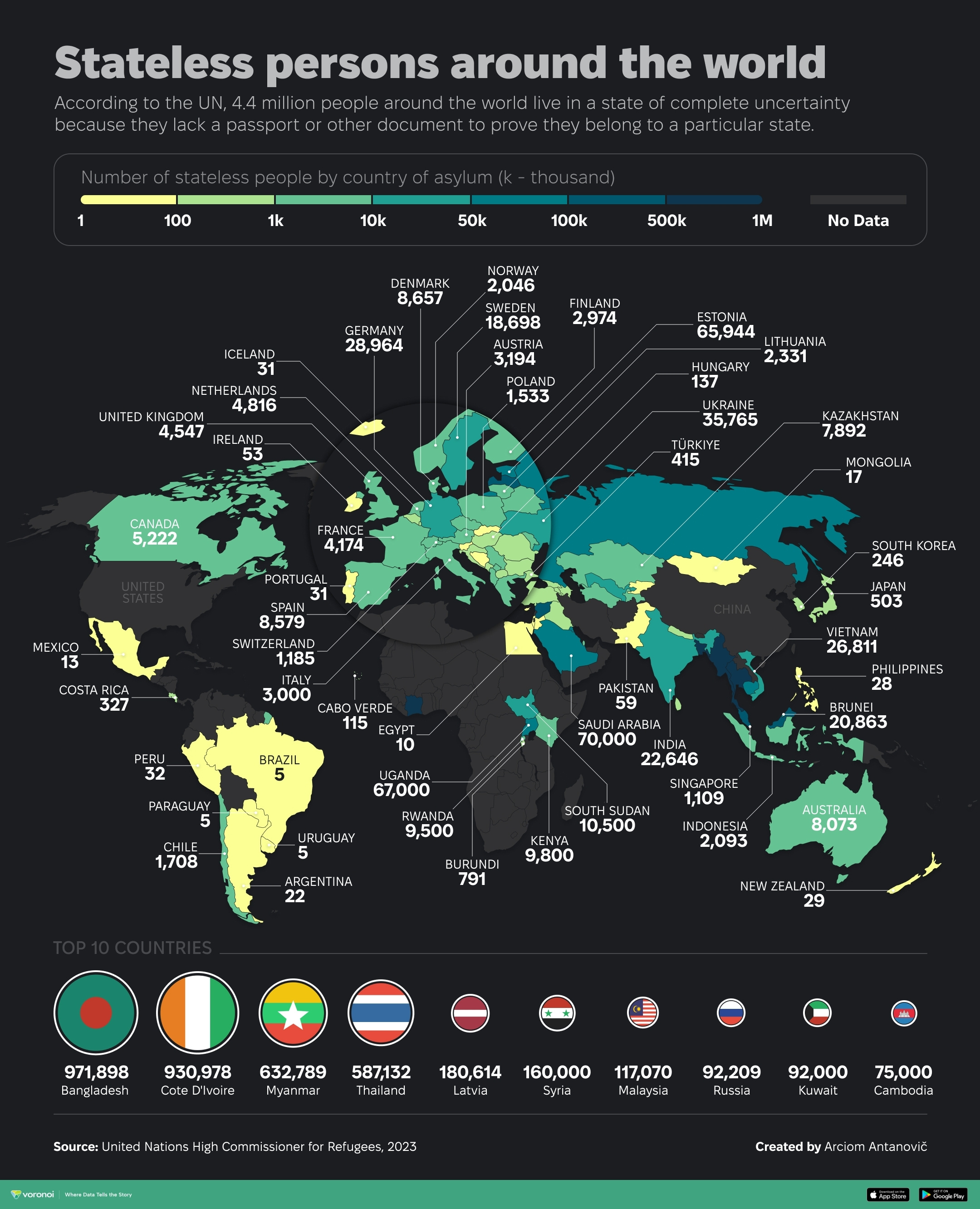
The United Nations High Commissioner for Refugees (UNHCR) officially recognizes over 4.4 million people worldwide as stateless or of undetermined nationality. However, the actual number is likely much higher due to data collection challenges.
Stateless persons—those not recognized as citizens of any country—are deprived of fundamental rights such as education, healthcare, and employment, leaving them highly vulnerable to exploitation and discrimination. But which countries have the most?
This map, created by Arciom Antanovič, uses data from the United Nations High Commissioner for Refugees to show the countries with the most stateless persons in 2023.
Bangladesh Tops the List
Certain countries are home to a disproportionate share of the world’s stateless people, often due to historical, social, and legal complexities.
Bangladesh comes in first with 971,898, followed by Côte d’Ivoire with 930,978, while Myanmar comes in third with 632,789.Search:
Country of Asylum
Stateless Persons
🇦🇱 Albania
2,018
🇦🇷 Argentina
22
🇦🇲 Armenia
520
🇦🇺 Australia
8,073
🇦🇹 Austria
3,194
🇦🇿 Azerbaijan
513
🇧🇩 Bangladesh
971,898
🇧🇾 Belarus
5,567
🇧🇪 Belgium
936
🇧🇦 Bosnia and Herzegovina
21
‹12345…10›
The raw number drops significantly after the fourth-placed Thailand with 587,132, as the fifth-placed Latvia only has 180,614.
The Causes of Statelessness
One of the primary drivers of statelessness is that in some countries, nationality can only be inherited through the father. When fathers are absent, the children may be left without a recognized nationality. This issue is particularly harmful for single mothers and families separated by conflict or migration.
Another significant cause of statelessness is racial and ethnic discrimination. Some governments use citizenship laws to exclude specific minority groups. In Myanmar, the Rohingya are a well-known example of such discrimination.
Geopolitical changes, such as shifting borders and citizenship revocation, also contribute to the issue. Governments sometimes strip individuals of their nationality as a punitive measure.
Generations of Palestinians have called Lebanon home. Many fled here during the 1948 Arab-Israeli War.
It has been a struggle for them to survive. But the current level of poverty is unprecedented – the result of one of the worst economic crises in recent history.
The United Nations agency that is supposed to support them has been crippled by a shortage of funds. Children are hungry, and many people are jobless, while others die at sea trying to reach Europe.
Lebanon’s forgotten Palestinians | The Full Report
HANOI, Dec 9 (Reuters) – A Vietnamese oil service vessel rescued 154 people from a sinking boat in the Andaman Sea and has transferred them to Myanmar’s navy, state media reported, a group that was confirmed by activists as minority Rohingya Muslims.
The vessel, Hai Duong 29, was en route from Singapore to Myanmar when it spotted the boat in distress 285 miles (458.7 km) south of the Myanmar coast on Wednesday, VTCNews said in a report aired late on Thursday.
The Rohingya are a minority that has for years been persecuted in Myanmar and many risk their lives attempting to reach predominantly Muslim Malaysia and Indonesia on rickety boats.
Tucked away within Toronto’s inner city is a small enclave known as “Little Tibet”.
Located in the Parkdale neighbourhood, the restaurants here are famous for delicious Tibetan dumplings known as momos.
Parkdale is also home to one of the largest concentrations of Tibetans outside Asia, stemming from the 1970s when Tibetan refugees flocked to Canada. The community has thrived here, establishing Little Tibet’s reputation as a food mecca and setting up a cultural centre.
But today, rapid gentrification and Toronto’s sky-high rents threaten the area’s unique social fabric. Amid China’s increasing global influence, the Tibetan community is striving to hold on to its past and maintain its traditions in an adopted land.
Explore Little Tibet and meet an immigrant community working to preserve its identity in this episode of A Sense of Community, a four-part series about unique neighbourhoods around the world and the challenges they face.
Concerns are growing among United Nations agencies and humanitarian groups over an agreement between the Bangladesh and Myanmar governments to repatriate several hundred thousand Rohingya refugees within two years.
Trích từ bài phát biểu của Đức Đạt Lai Lạt Ma ở Dharamsala [Ấn Độ] với một nhóm lớn những con dân Tây Tạng của Ngài vào ngày 27 tháng Ba năm 2006. Đức Đạt Lai Lạt Ma đã cảnh báo nguy cơ trầm trọng nhất đối với sự sống còn của bản sắc Tây Tạng đồng thời nhấn mạnh công cuộc giáo dục hiện đại là không thể thiếu để duy trì văn hóa Phật giáo Tây Tạng cũng như duy trì tính dân tộc trong những hoàn cảnh khó khăn nhất của lịch sử Tây Tạng.
Tôi luôn luôn nói rằng, quần chúng nhân dân Tây Tạng ở Tây Tạng mới là chủ nhân thật của vận mệnh Tây Tạng, và khoảng một trăm năm mươi ngàn người Tây Tạng lưu vong ở đây [Dharamsala, Ấn Độ] [1] chỉ đại diện cho nhân dân để hoàn thành sự thật của chính nghĩaTây Tạng, để hành động như những người phát ngôn tự do và như những người đại diện tượng trưng của nhân dân.
Cho đến nay, quần chúng nhân dân ở Tây Tạng vẫn còn ở trong trạng thái đau khổ vì hậu quả bị tước đoạt tự do của họ. Mặc dù vậy, ngay cả khi đối diện với những hiểm nguy đến với cuộc sống của họ, trong mọi phương diện họ vẫn kiên định giữ vững sứ mệnh cao cả về sắc tộc của họ và niềm tin chung vào viễn cảnh tương lai của người Tây Tạng, vẫn giữ vững trong tâm trí các quyền lợi của họ với tư cách là một dân tộc.
Submission argues ICC should investigate possible crimes ‘committed by individuals and corporate actors’
Asylum seekers on Manus Island in 2014. The Global Legal Action Network says Australia’s immigration detention regime could constitute a crime against humanity. Photograph: Eoin Blackwell/AAP
Monday 13 February 2017 03.00 EST Last modified on Monday 13 February 2017 10.43 EST
Australia’s offshore immigration detention regime could constitute a crime against humanity, a petition before the International Criminal Court from a coalition of legal experts has alleged.
On Monday morning, GMT, a 108-page legal submission from the Global Legal Action Network (Glan) and the Stanford International Human Rights Clinic was submitted to the court, detailing what the network describes as the “harrowing practices of the Australian state and corporations towards asylum seekers”. The petition submits the office of the prosecutor of the ICC should open an investigation into possible “crimes against humanity committed by individuals and corporate actors”.
TĐH: Như Tổng thống Obama đã đề cập trong chuyến thăm Việt Nam của ông rằng nhân quyền là một vấn đề quan trọng trong chính sách ngoại giao của Mỹ, tôi đăng ở đây báo cáo năm 2015 về nhân quyền tại Việt Nam do Bộ Ngoại Giao Mỹ công bố. Và để cho công bằng, tôi cũng đăng tải báo cáo năm 2015 về nhân quyền tại Mỹ, do tổ chức Giám sát nhân quyền – Humanrights watch thực hiện (Bộ Ngoại Giao Mỹ không thực hiện báo cáo về nước Mỹ).
Nhân quyền luôn luôn là vấn đề gây tranh cãi giữa các quốc gia. Tuy nhiên,hy vọng là với việc hiểu được một quốc gia nhìn nhận vấn đề của một quốc gia khác như thế nào, đúng hay sai, thì đối thoại Việt – Mỹ và quan hệ hợp tác giữa hai nước trong vấn đề nhân quyền sẽ được thúc đẩy.



 CVD
CVD 