U.N. secretary general: I repeat my call for a humanitarian ceasefire in the Middle East, the unconditional release of all hostages, and the delivery of life-saving supplies at the scale needed. Everyone must assume their responsibilities. This is a moment of truth. History will judge us all.
Chuyên mục: Disaster relief – Cứu hộ khi thảm họa
Commission of Inquiry finds further evidence of war crimes in Ukraine

© Yevhen Nosenko
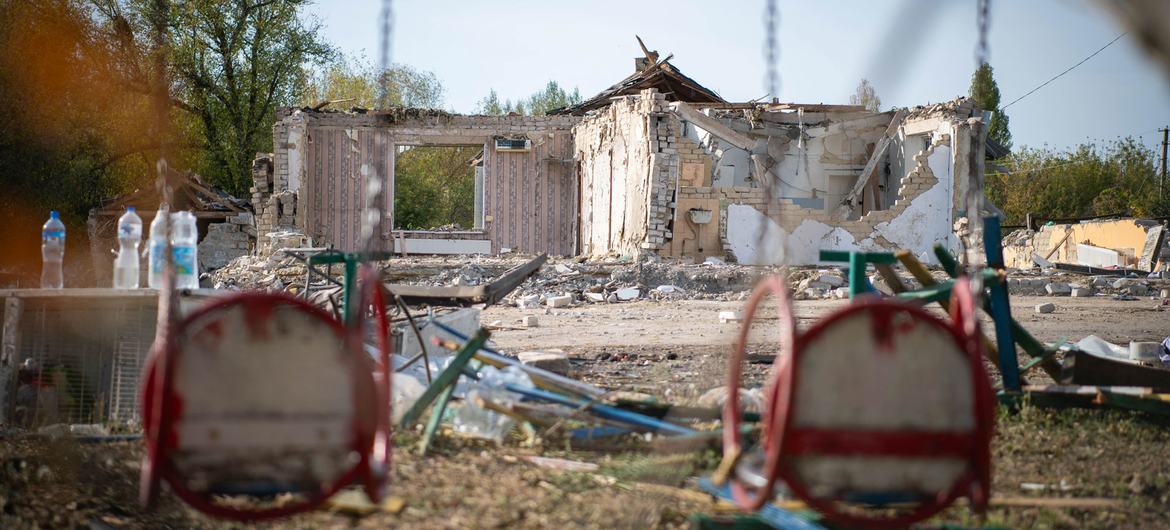
A playground lies in ruins near in the village of Groza in eastern Ukraine.
A new UN report has found continued evidence of war crimes and human rights violations committed by Russian authorities in Ukraine, including torture, rape and the deportation of children.
Tiếp tục đọc “Commission of Inquiry finds further evidence of war crimes in Ukraine”Explainer: What is international humanitarian law?

© UNICEF/Eyad El Baba
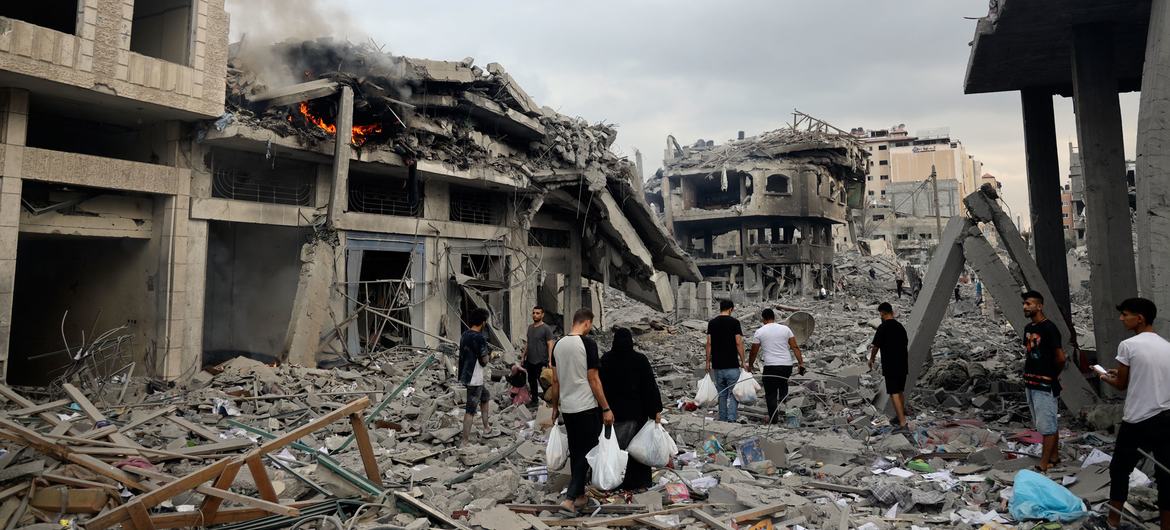
Families flee their shattered homes in Tal al-Hawa neighbourhood in Gaza city.
While aid workers serving conflict-affected civilian populations depend on a set of laws to protect them, some warring parties violate these global agreements, from targeting hospitals and schools to blocking aid workers from reaching civilians with lifesaving goods and services.
But, what exactly are the rules of war and what happens when they are broken?
To find out more about international humanitarian law, known by its acronym IHL, UN News spoke with Eric Mongelard at the UN human rights office, OHCHR.
Here’s what you need to know:
Rules of war
International humanitarian law is as old as war. From passages in the Bible and Quran to medieval European codes of chivalry, this ever-growing set of rules of engagement aims to limit a conflict’s effects on civilians or non-combatants.
The laws represent “the very minimum rules to preserve humanity in some of the worst situations known to mankind,” Mr. Mongelard said, noting that the rules of war apply the moment an armed conflict has begun.

Miền Trung đứng trước nguy cơ “đại hồng thuỷ” sau gần 25 năm
Kinh tế đô thị Trọng Tùng 14:37 15/10/2023
Kinhtedothi – Miền Trung đang ở hình thế kinh điển (điển hình) của mùa mưa, rất giống với hình thái thời tiết từng gây ra trận lũ lụt lịch sử vào tháng 11/1999. Liệu một trận đại hồng thuỷ có lặp lại sau gần 25 năm?
TIN LIÊN QUAN
Gần 1.600 ngôi nhà bị ngập, sơ tán hơn 3.900 người dân tránh mưa lũ
Miền Trung chìm trong mưa lũ
Ký ức khó phai mờ
Đợt lũ lụt xảy ra tại miền Trung vào tháng 11/1999 (hay còn được biết đến với tên gọi là đại hồng thủy 1999) được xem là một trong những trận lũ lụt lớn nhất từng xảy ra. Nguyên nhân của trận lũ lụt lịch sử là do tác động của không khí lạnh mạnh kết hợp với dải áp thấp xích đạo, các nhiễu động trên cao và cuối cùng là áp thấp nhiệt đới.
Các tỉnh miền Trung nước ta đã phải hứng chịu những trận mưa rất lớn từ ngày 1 – 6/11/1999, gây ra lũ lụt nghiêm trọng, nhấn chìm nhiều huyện, thị xã, làm thiệt hại tài sản lên đến gần 3.800 tỷ đồng (giá thời điểm năm 1999, tương đương 21.203 tỷ đồng ở năm 2023).

Miền Trung mưa lớn đến 700mm, kéo dài và rất phức tạp
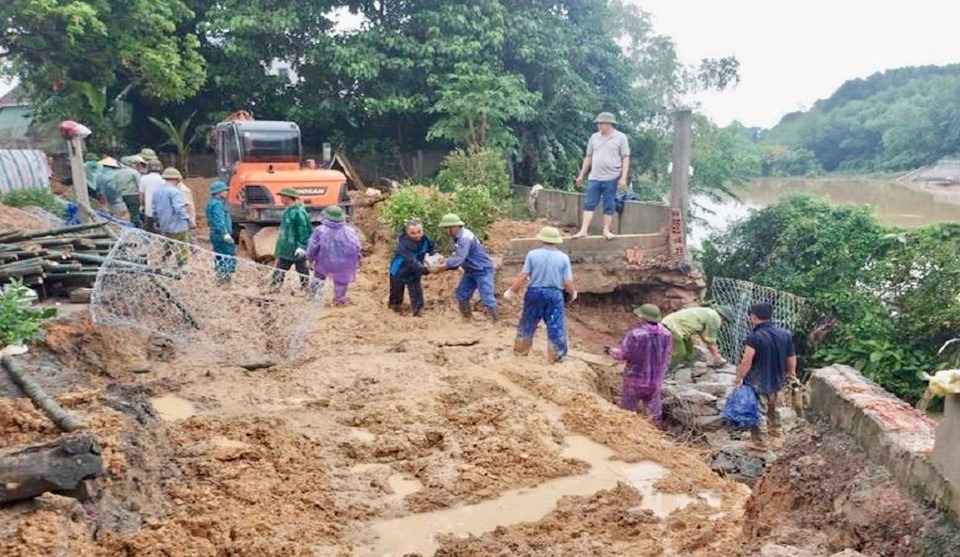
Mưa lớn ở miền Trung liên tục được dự báo cực đoan khi tổng lượng mưa các ngày 13-15/10 có nơi lên đến 700mm. Người dân từ Hà Tĩnh đến Quảng Nam cần chủ động ứng phó với thiên tai phức tạp.
Theo Trung tâm dự báo khí tượng thủy văn quốc gia, đêm qua và sáng sớm nay (13/10), ở khu vực từ Hà Tĩnh đến Quảng Ngãi có mưa vừa, mưa to, cục bộ có mưa rất to. Lượng mưa tính từ 19h tối qua đến 8h sáng nay có nơi trên 170mm như: Hồ Kim Sơn (Hà Tĩnh) 216.6mm, Tân Lâm (Quảng Bình) 201.4mm, Thuận An (Thừa Thiên Huế) 171mm.
Tiếp tục đọc “Miền Trung mưa lớn đến 700mm, kéo dài và rất phức tạp”Heavy rains batter Central Vietnam, cut off roads, shut down schools
SGGP October 13, 2023 at 15:27:32
Heavy rains have continuously drenched the Central region of Vietnam, unleashed floods and landslides, marooned vast areas, cut off roads and shut down schools.
Related News
Central region to continue to suffer from widespread flooding
Mekong Delta facing increasingly serious flooding
This afternoon, the Department of Education and Training of Da Nang City announced that students should not go to school because many roads in the city were flooded due to heavy rains.
After the Steering Committee for Natural Disaster Prevention and Control, Search and Rescue and Civil Defense of Da Nang City announced heavy rain will pummel the city from 9 a.m. to 4 p.m. today, the Department of Education and Training of Da Nang City requested heads of schools to let students stay at home for their safety as some roads are deeply flooded.
Tiếp tục đọc “Heavy rains batter Central Vietnam, cut off roads, shut down schools”
14,000 displaced in Myanmar after record rain sparks floods
Residents of Myanmar’s flood-hit Bago city navigate the city’s submerged streets, salvaging food and belongings from their waterlogged homes, after record rainfall triggered floods that authorities said have displaced 14,000 people. “My house is flooded. This is the first time my house has been flooded in my life,” says Phwar Than Hme, a 101-year-old resident of Bago.
https://www.youtube.com/watch?v=2NC-aNirB5kAt least 15 people are killed when a bomb brought home by children explodes in eastern Congo
A community leader says at least 15 people are dead after a group of children brought home an explosive device they had found while playing
ByJUSTIN KABUMBA Associated Press October 8, 2023, 12:11 AM
GOMA, Congo — At least 15 people were killed in eastern Congo after a group of children brought home an explosive device that they had found while they were playing, a community leader said Saturday.
The tragedy took place Friday evening in the village of Kyangitsi, located in Masisi territory in North Kivu province.
“At around 8 p.m. local time, while some of the residents were trying to find out what it was, the bomb exploded,” said Telesphore Mitondeke, a member of a Masisi grouping of civil society organizations.
For the past two weeks, the region has been the scene of hostilities between local armed groups vying for control of villages.
Tiếp tục đọc “At least 15 people are killed when a bomb brought home by children explodes in eastern Congo”Another major earthquake shakes Afghanistan days after thousands killed
Quake strikes same area where Saturday’s tremors left over 2,400 dead
Independent. co.uk https://cdn.jwplayer.com/previews/UM9dIJ53
Another strong earthquake shook parts of western Afghanistan where a temblor on Saturday killed more than 2,400 people.
A 6.3-magnitude earthquake was recorded early morning on Wednesday near Herat province, according to the US Geological Survey.
The epicentre of the quake was about 28km outside Herat city – the capital of Herat province – at a depth of 10km.
No information was immediately available about damage from Wednesday’s earthquake.
The epicentre of Saturday’s deadly quake was also about 40km northwest of the provincial capital and several aftershocks were recorded.
Taliban officials said more than 2,400 people had died across Herat after the earlier quakes that laid entire villages to waste with many people trapped in rubble.
With little to no international help and resources, Afghans have been struggling to dig through the rubble even after days. The city of Herat just has one hospital, as survivors struggled to get medical care with many left homeless ahead of a harsh winter.
In Naib Rafi, a village that previously had about 2,500 residents, the Associated Press reported that “almost no one was still alive” besides men who were working outside when the quake struck. Survivors worked all day with excavators to dig long trenches for mass burials.
“It is very difficult to find a family member from a destroyed house and a few minutes to later bury him or her in a nearby grave, again under the ground,” Mir Agha, a resident from the city of Herat who had joined hundreds of volunteers to help the locals, told the news agency.
Nearly 2,000 houses in 20 villages were destroyed, the Taliban have said. The area hit by the quake has just one government-run hospital.
According to a WHO report, an estimated 12,110 people (1,730 families) in five districts Zindajan, Injil, Gulran, Injil and Khosan in Herat province have been impacted by the earthquake.
This devastation comes a year after an earthquake killed over 1,000 people in Afghanistan.
Dengue will ‘take off’ in southern Europe, US, Africa this decade, WHO scientist says
By Jennifer Rigby October 6, 2023
LONDON, Oct 6 (Reuters) – Dengue fever will become a major threat in the southern United States, southern Europe and new parts of Africa this decade, the WHO’s chief scientist said, as warmer temperatures create the conditions for the mosquitoes carrying the infection to spread.
The illness has long been a scourge in much of Asia and Latin America, causing an estimated 20,000 deaths each year. Rates of the disease have already risen eight-fold globally since 2000, driven largely by climate change as well as the increased movement of people and urbanization.
Many cases go unrecorded, but in 2022 4.2 million cases were reported worldwide and public health officials have warned that near-record levels of transmission are expected this year. Bangladesh is currently experiencing its worst-ever outbreak, with more than 1,000 deaths.
Tiếp tục đọc “Dengue will ‘take off’ in southern Europe, US, Africa this decade, WHO scientist says”
Cluster Munition Monitor 2023
Antipersonnel landmines are explosive devices designed to injure or kill people. They can lie dormant for years and even decades under, on, or near the ground until a person or animal triggers their detonating mechanism.
They can be activated by direct pressure from above, by pressure put on a wire or filament attached to a pull switch, by a radio signal or other remote firing method, or even simply by the proximity of a person within a predetermined distance. Because no one controls the detonation of landmines, they can be referred to as victim-activated weapons. Since mines are not aimed at a specific target they can indiscriminately kill or injure civilians, including children, soldiers, peacekeepers, and aid workers.Status of 2008 Convention on Cluster Munitions
Cluster Munition Casualties in 2022 and in Historical Record


Negotiations and Vietnam: A Case Study of the 1954 Geneva Conference
We Can Heal War’s Traumas; U.S. and Vietnam Show How
US Institute of Peace 50 years after a peace accord that wasn’t, one-time enemies salve a long war’s wounds.
Wednesday, March 1, 2023 / BY: USIP Staff PUBLICATION TYPE: Analysis and Commentary
This winter marks 50 years since U.S. and Vietnamese diplomats in Paris ceremoniously signed “peace accords” that did not end the Vietnam War, but that achieved America’s withdrawal from it. Thus, the accords permitted, a half-century later, what is now a durable American-Vietnamese reconciliation. In the face of seemingly intractable wars — in Ukraine, Afghanistan, the eastern Congo basin, Yemen or elsewhere — the growing U.S.-Vietnamese relationship shows that even a peace that seems impossible today can indeed be built for our children.

Thượng tướng Nguyễn Chí Vịnh nói về xung đột Ukraine – Nga
Four Asian nations to lose $65bn this decade as heat and flooding shock clothing industry (Bangladesh, Cambodia, Pakistan and Vietnam)
Researchers call on brands to invest in adaptation measures instead of mitigation
https://cdn.jwplayer.com/previews/XzNy1PQ3
Extreme heat and flooding could erase $65bn in apparel export earnings from four Asian countries by 2030 as it jeopardises the health of the workers, new research has revealed.
The slow growth from extreme climate conditions will also result in one million fewer jobs being created, found the study by Cornell University and Schroders.
The research mapped out the climate vulnerability of 32 apparel production hubs of six global brands in Bangladesh, Cambodia, Pakistan and Vietnam. It found flooding and heat pose material risks to entire fashion industry, leading to a 22 per cent decline in export earnings.
These projections are expected to rise significantly by 2050, representing about 69 per cent in foregone export earnings and 8.64 million fewer jobs, warned the researchers.
But brands, investors or regulators are not prioritising in planning for these risks in the countries that collectively represent 18 per cent of global apparel export due to the industry’s focus on mitigation rather than adaptation measures, said the study.