Tensions have flared in recent months between the two countries over the disputed sea
Hanoi: Vietnam has delivered a sharp rebuke to China over military drills in the South China Sea, the second such warning in a week as tensions rise between the countries over the disputed waterway.
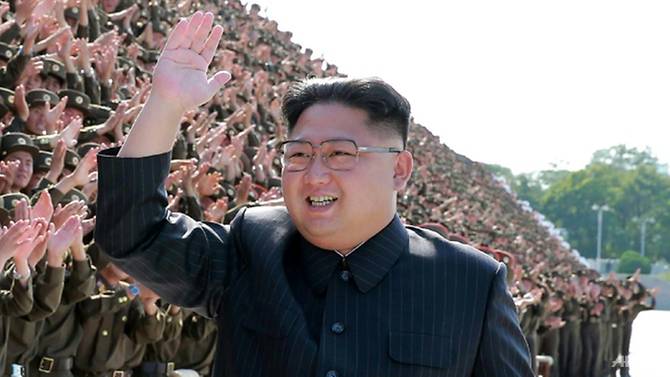
This undated picture released by North Korea’s official Korean Central News Agency on Sep 2 shows North Korean leader Kim Jong-Un attending a photo session in Pyongyang. (Photo: AFP/STR)
ChinaBEIJING: China strongly condemned North Korea’s nuclear test on Sunday, slamming Pyongyang for ignoring international condemnation of its atomic weapons programme.
North Korea “has ignored the international community’s widespread opposition, again carrying out a nuclear test. China’s government expresses resolute opposition and strong condemnation toward this”, the foreign ministry said in a statement on its website. Tiếp tục đọc “China ‘strongly condemns North Korean nuclear test’: Foreign ministry”→
Indonesia’s Deputy Minister for Maritime Affairs Arif Havas Oegroseno points at the location of North Natuna Sea on a new map of Indonesia during talks with reporters in Jakarta, Indonesia, July 14, 2017. REUTERS/Beawiharta
JAKARTA: China has demanded that Indonesia rescind a decision to rename its maritime area in the southwest part of South China Sea to North Natuna Sea.
BEIJING — China’s foreign minister said Wednesday he hopes India can “learn lessons” from a recently resolved border standoff and avoid such occurrences in the future, as the leaders of the two Asian giants prepare to meet next week for a summit in southeastern China.
Wang Yi’s remarks came after the countries agreed Monday to pull back their troops from a disputed Himalayan plateau where China, India and Bhutan meet.
Beijing urges US, South Korea to halt military exercises, as White House considers ‘all options’ after missile launch.
China has urged all parties in the dispute to take steps to de-escalate tensions [File: Reuters]
China has warned that tensions on the Korean peninsula have reached a “tipping point” after North Korea fired a ballistic missile over Japan, a move Japanese Prime Minister Shinzo Abe described as “unprecedented” and a “grave threat” to his country’s security.
Hua Chunying, spokeswoman for the Chinese foreign ministry, urged all sides on Tuesday to avoid provocations, repeating Beijing’s call for Pyongyang to suspend missile tests, while proposing that the United States and South Korea China halt ongoing joint military exercises. Tiếp tục đọc “China: Korean tensions at ‘tipping point’”→
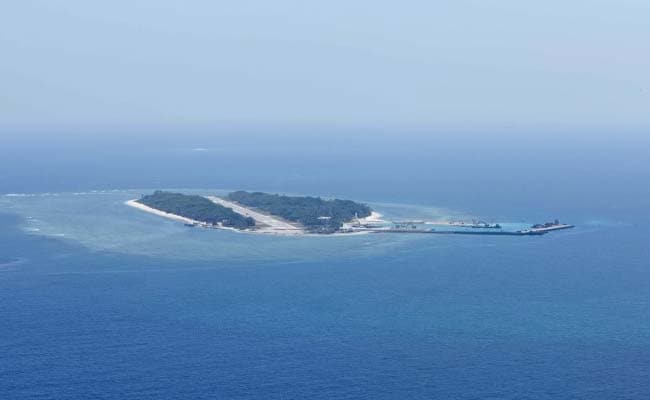
Vox_Since 2014, China has been building islands in the middle of the South China Sea. What were once underwater reefs are now sandy islands complete with airfields, roads, buildings, and missile systems. In less than two years, China has turned seven reefs into seven military bases in the South China Sea, one of the most contentious bodies of water in the world.
href=””>United Nations Law of the Seas, which says a country’s territory extends 200 miles off its shores, an area called the exclusive economic zone, or EEZ. Any trade or resources that fall in a country’s EEZ belong to that country; they’re its sovereign territory. Any area that is not in an EEZ is considered international waters and subject to UN maritime law, meaning it’s shared by everyone. Every country in the region, which includes Malaysia, the Philippines, Brunei, and Vietnam, bases its claim to the South China Sea on the UN’s EEZ laws — except China.
China argues it has a historical claim to the South China Sea, dating back to naval expeditions in the 15th century. After World War II, the Japanese Empire lost control of the South China Sea, and China took advantage of the moment to reclaim it. On maps, it started drawing a dashed line that encompassed most of the South China Sea. This line became its official claim and is known today as the Nine-Dash Line, because it always has nine dashes. In 1973, when the UN law established EEZs, China reaffirmed its Nine-Dash Line, refusing to clarify the line’s boundaries and rejecting other countries’ claims.
Since then, tensions have built around who rightfully owns the South China Sea. The dispute has centered on the Spratly Islands, an archipelago at the heart of the South China Sea. Currently, China, Malaysia, the Philippines, and Vietnam claim some part of the Spratly Island chain. They’ve asserted their claims by putting small buildings, ports, and even some people on what are essentially rocks in the middle of the ocean.
But the Spratlys are very important, because whichever country can successfully claim themcan extend its EEZ to include them, thus gaining miles of precious sovereign territory. This is why China began building up islands in 2014. By turning these rocks into military bases, the Chinese are now able to support hundreds of ships, bolstering their presence in the region. They are using fishing boats, surveillance ships, and navy destroyers to set up blockades around other countries’ islands and defend their own. This is all done very cautiously and in small steps in order to avoid sparking a wider conflict.
Since China began building islands, the disputes have not become violent.But tensions are building in the region. As China deploys more of its military to the Spratlys, other countries are getting nervous and building up their own islands. It’s a complex situation that will continue to gain international attention, for better or for worse.
TTO – Bộ Lịch sử Việt Nam tái bản lần thứ nhất đã đưa ra những quan điểm tiến bộ, trong đó từ bỏ cách gọi chính quyền Việt Nam cộng hòa là ngụy quân, ngụy quyền và chỉ đích danh quân Trung Quốc xâm lược Việt Nam trong chiến tranh biên giới phía Bắc…
Xẻ núi đưa pháo lên điểm tựa trong cuộc chiến bảo vệ biên giới phía Bắc – Ảnh: ĐÀO VĂN SỬ
Cuộc chiến tranh biên giới phía Bắc từ năm 1979 cần phải chỉ đích danh là cuộc chiến tranh xâm lược của Trung Quốc đánh Việt Nam.
Không thể gọi là quân Trung Quốc tiến xuống hay tiến vào Việt Nam, bởi như vậy không nói lên được bản chất vấn đề.
Sách giáo khoa lịch sử phải viết cụ thể về cuộc chiến này, chứ không thể viết dăm ba dòng như vậy thì ai có thể hiểu được?
Bộ trưởng Quốc phòng Phi Luật Tân vừa cho biết, “TQ đã bảo đảm với Phi Luật Tân sẽ không chiếm thêm nơi nào ở Biển Đông” cũng như sẽ không xây thêm gì ở Scarborough Reef (Bãi An Nhơn) của Phi bị TQ chiếm đóng từ năm 2012. Được hỏi về điều này, người phát ngôn của Bộ Ngoại giao TQ chỉ nói vòng vòng mà không trả lời. Vậy là sao?
First posted on UNCLOSforum.wordpress.com on May 29, 2015
FP Situation Report
Friday, May 29, 2015
One of the biggest bits of news has been the first sighting of a massive new Chinese long-range drone that is thought to be able to pick up and track stealthy aircraft at long range. The drone, first reported Thursday by Popular Mechanics’ Jeffrey Lin and P.W. Singer, had its maiden flight in February, and “could change the brewing arms race in the Asia Pacific.”
The double-bodied behemoth, with an estimated 40-meter wingspan, is packed with seven different radar systems and a variety of surveillance equipment to help it detect U.S. stealth aircraft like the F-35 fighter, B-2 bombers, and ships at long distances.
And to no one’s surprise, Beijing has been placing offensive weaponry on the artificial islands it’s been building in the South China Sea. We’ve already seen what look like air strips on some of the clumps of dirt hastily dumped on top of coral reefs, but the mobile artillery pieces that American intelligence have detected is something new.
While hardly a threat to any naval or air assets in the region, the guns are within range of nearby islands claimed by Vietnam, according to the Wall Street Journal’sJulian Barnes and Gordon Lubold, and their sheer symbolism carries some significant weight. With American surveillance planes flying nearby and U.S. Navy ships insisting on the right to transit close to the makeshift bits of land, the artillery pieces represent a small, but real, escalation of the game.
The following is the first public Chinese Military Strategy white paper outlining a new policy of “active defense,” released by the Chinese Ministry of National Defense on May 26, 2015.
________________
China’s Military Strategy
The State Council Information Office of the People’s Republic of China
VietNamNet Bridge – Chinese plan to set up an underwater observation system under the East Sea, according to experts, with the aim of showing that it is becoming an ocean power.
The Global Times reported that China is planning to build a large-scale underwater observation system, compared with an underwater Great Wall, across disputed areas in the East China Sea and East Sea, which serves ‘scientific research’.
According to Hoang Viet, a lecturer at HCMC Law University, a member of the Foundation for East Sea Studies, the plan was first mentioned in February 2017, while the Chinese press has recently reported that the plan was approved by the Chinese administration.
The system, as affirmed by the Chinese side, will serve civil purposes. It will help warn tsunamis and seafloor seismic activity and will serve natural resource exploration and exploitation.
Chinese plan to set up an underwater observation system under the East Sea, according to experts, with the aim of showing that it is becoming an ocean power.
The Global Times also quoted Chinese political circles as saying that it will also be used for security and navigation safety purposes.
As China has not said clearly how it would set up an observatory system, it is still early to comment about it.



 CVD
CVD 