Dans le contexte des défis émergents tels que le changement climatique, l’élévation du niveau de la mer, l’exploitation de ressources marines non durables, la pollution marine…, la CNUDM 1982 et d’autres documents internationaux concernés devraient constituer un cadre juridique important permettant d’intensifier la coopération dans la restauration et l’utilisation de manière durable des ressources maritimes.
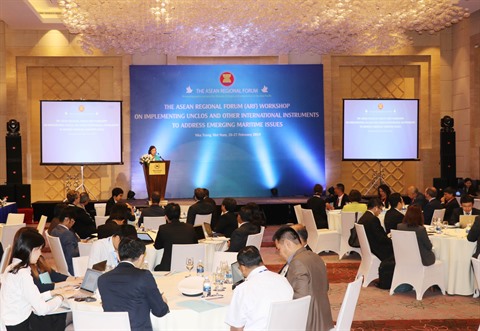
Le séminaire de l’ARF sur l’application de la CNUDM 1982 se tient les 26 et 27 février dans la province de Khanh Hoà (Centre). Photo: Tiên Minh/VNA/CVN
Un séminaire du Forum régional de l’Asean (ARF) sur l’application de la Convention des Nations unies sur le droit de la mer 1982 (CNUDM 1982) et d’autres instruments juridiques internationaux pour faire face aux défis émergents liés à la mer, se tient les mardi 26 et mercredi 27 février dans la ville de Nha Trang, province de Khanh Hoà (Centre) réunissant plus de 80 délégués de 20 pays membre de l’ARF. Tiếp tục đọc “ARF: Application de la CNUDM 1982 pour faire face aux défis émergents”→
Senior Research Fellow in International Regulatory Affairs
The UN Convention on the Law of the Sea requires that coastal nations pay royalties on their seabed resources to landlocked and developing countries.mizoula/Getty Images
KEY TAKEAWAYS
U.S. accession would provide no benefits not already available to the U.S., while creating unnecessary burdens and risks.
The U.S. does not need to join the convention in order to access oil and gas resources on its extended continental shelf, in the Arctic, or in the Gulf of Mexico.
Despite subsequent changes in 1994 that led the Clinton administration to support U.S. accession, the Trump administration should oppose accession to this treaty.
On Monday 14 May 2018 the Chinese Journal of International Law, an Oxford University Press journal, published an extraordinary 500 page “Critical Study” of the Awards on jurisdiction and the merits in the South China Sea Arbitration between the Philippines and China. Readers will recall the case was brought under the UN Convention on the Law of the Sea (UNCLOS) by the Philippines against China and that there was an awards on jurisdiction in 2015 and a final award on the merits in 2016 (discussed in many places including here, here, here, here and here). The Critical Study was produced by the joint efforts of some 70 scholars and is listed as having been authored by the Chinese Society of International Law (CSIL). It examines almost every issue raised in the case – and several that weren’t – and concludes the Tribunal was catastrophically wrong on every single point, right down to how many times the Philippines was allowed to amend its pleadings. Tiếp tục đọc “A new twist in the South China Sea Arbitration: The Chinese Society of International Law’s Critical Study”→
– UN Study on the Naval Arms Race (Report of the General Secretary – Sept. 17, 1985) From UN Site—From CVD
– Military Activities in the Exclusive Economic Zone: Preveting uncertainty and defusing conflict (George V. Galdorisi & Alan G. Kaufman – 2001) From California Western School of Law—From CVD
The United States Naval War College – International Law Studies
Intelligence Gathering in the Exclusive Economic Zone
by: Efthymios Papastavridis
93 INT’L L. STUD. 446 (2017)
Published by the Stockton Center for the Study of International Law
The US Navy regularly carries out such operations to challenge China’s vast claims to the South China Sea, where Beijing has turned reefs into militarised artificial islands. AFP/Ted ALJIBE
BEIJING: China said Wednesday (Oct 11) it has lodged a protest with the United States after an American warship sailed near disputed islands in the South China Sea.
Vox_Since 2014, China has been building islands in the middle of the South China Sea. What were once underwater reefs are now sandy islands complete with airfields, roads, buildings, and missile systems. In less than two years, China has turned seven reefs into seven military bases in the South China Sea, one of the most contentious bodies of water in the world.
href=””>United Nations Law of the Seas, which says a country’s territory extends 200 miles off its shores, an area called the exclusive economic zone, or EEZ. Any trade or resources that fall in a country’s EEZ belong to that country; they’re its sovereign territory. Any area that is not in an EEZ is considered international waters and subject to UN maritime law, meaning it’s shared by everyone. Every country in the region, which includes Malaysia, the Philippines, Brunei, and Vietnam, bases its claim to the South China Sea on the UN’s EEZ laws — except China.
China argues it has a historical claim to the South China Sea, dating back to naval expeditions in the 15th century. After World War II, the Japanese Empire lost control of the South China Sea, and China took advantage of the moment to reclaim it. On maps, it started drawing a dashed line that encompassed most of the South China Sea. This line became its official claim and is known today as the Nine-Dash Line, because it always has nine dashes. In 1973, when the UN law established EEZs, China reaffirmed its Nine-Dash Line, refusing to clarify the line’s boundaries and rejecting other countries’ claims.
Since then, tensions have built around who rightfully owns the South China Sea. The dispute has centered on the Spratly Islands, an archipelago at the heart of the South China Sea. Currently, China, Malaysia, the Philippines, and Vietnam claim some part of the Spratly Island chain. They’ve asserted their claims by putting small buildings, ports, and even some people on what are essentially rocks in the middle of the ocean.
But the Spratlys are very important, because whichever country can successfully claim themcan extend its EEZ to include them, thus gaining miles of precious sovereign territory. This is why China began building up islands in 2014. By turning these rocks into military bases, the Chinese are now able to support hundreds of ships, bolstering their presence in the region. They are using fishing boats, surveillance ships, and navy destroyers to set up blockades around other countries’ islands and defend their own. This is all done very cautiously and in small steps in order to avoid sparking a wider conflict.
Since China began building islands, the disputes have not become violent.But tensions are building in the region. As China deploys more of its military to the Spratlys, other countries are getting nervous and building up their own islands. It’s a complex situation that will continue to gain international attention, for better or for worse.
First posted on UNCLOSforum.wordpress.com on Jan. 31, 2015
Dear friends,
In an effort to have a Vietnamese version of UNCLOS that is very close to the English version, a group of translators are working on the translation from English to Vietnamese, and I am the Editor in Chief of this project.
This copy here is the working draft, not even done with the first draft yet. However, we place it here so that you know the work we are doing, and also to invite your comments.
Please free to comment here or mail to me (Trần Đình Hoành) at tdhoanh@gmail.com
TTCT – Cuộc họp cấp ngoại trưởng ASEAN (AMM) năm nay, và tiếp theo đó là Diễn đàn khu vực ASEAN (ARF), đã diễn ra trong bầu không khí đầy tranh cãi, phản ánh cục diện thế sự ngày nay. Các văn kiện chính, trên bề nổi, phản ánh xu thế đó. Song, trong chiều sâu, lại phản ánh một sự đồng thuận nhất định.
Bộ trưởng Ngoại giao Trung Quốc Vương Nghị. Philstar.com bình luận rằng với Bắc Kinh, COC đi kèm những điều kiện “mơ hồ và không công bằng”.-Ảnh: rappler.com
Nếu so sánh ARF lần thứ nhất hồi năm 1994 tại Bangkok, mà Việt Nam tham dự với tư cách quan sát viên, với ARF năm nay tại Manila, rõ ràng diễn đàn năm nay quá ư là “gay cấn”. Những biến chuyển của chính trường thế giới đã đặt ra những thách thức mới so với cách đây 23 năm. Tiếp tục đọc “HỘI NGHỊ ASEAN: Đằng sau những câu chữ”→
Tại Biển Đông, có lẽ ai cũng thấy hai lực lớn kèn cựa nhau là Mỹ và Trung Quốc. Các nước khác thì có vẻ ấm ấm lạnh lạnh, không quá quan tâm đến vấn đề. Kampuchia thì có vẻ thiên hẳn về TQ. Phi Luật Tân là nước chống TQ mạnh nhất, nay đã đổi chiều. Chỉ VN là còn đứng trong thế cứng cựa với TQ, tiếp tục mời mọc các công ty của các nước đầu tư vào các lô biển để thăm dò và khai thác dầu hoặc khí đốt, tiếp tục lên tiếng chống đối mỗi khi TQ tuyên bố gì hay làm gì ở Biển Đông, trong khi vẫn cố gắng giữ liên hệ ngoại giao tốt với TQ trong những lãnh vực khác, và vẫn giữ ngoại giao thân thiện với Mỹ. Tiếp tục đọc “Biển Đông: Mỹ, Trung quốc, và Việt Nam”→
Bài này là bản cập nhật của bản nguyên thủy năm 2014
Chào các bạn,
Same time next year là cuốn phim Mỹ năm 1978, nói về một câu chuyện bắt đầu năm 1951 giữa một cô 24 tuổi và một cậu 27 tuổi, cả hai đều đã có gia đinh và hạnh phúc với gia đinh, gặp nhau trong một quán ăn, thích nhau và có một one-night affair với nhau. Cả hai vẫn yêu gia đình của mình, nhưng cũng muốn giữ liên hệ với nhau, nên hẹn nhau năm tới cùng ngày này sẽ gặp lại nhau nơi này. Và họ hẹn mỗi năm một lần như thế, thân thiết nhau kinh khủng, cho đến cuối phim… ở năm 1977, tức là 26 năm sau. Các bạn có thể đọc thêm chi tiết ở đây.
TTO – Việt Nam tiếp tục đề nghị các quốc gia có đóng góp xây dựng tích cực, phù hợp với luật pháp quốc tế nhằm duy trì hòa bình, ổn định và thượng tôn pháp luật trên các vùng biển và đại dương.
Người Phát ngôn Bộ Ngoại giao Việt Nam Lê Thị Thu Hằng – Ảnh: Tuổi Trẻ
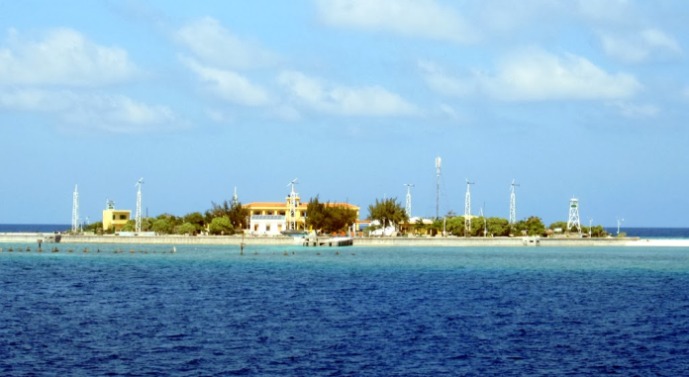
Người Phát ngôn Bộ Ngoại giao Việt Nam Lê Thị Thu Hằng cho biết như vậy khi trả lời câu hỏi của phóng viên tại cuộc họp báo thường kỳ chiều 25-5 xung quanh phản ứng của Việt Nam đối với việc một tàu khu trục Mỹ vào khu vực 12 hải lý quanh đá Vành Khăn thuộc quần đảo Trường Sa của Việt Nam. Tiếp tục đọc “VN nói gì việc tàu Mỹ vào vùng 12 hải lý quanh đá Vành Khăn?”→
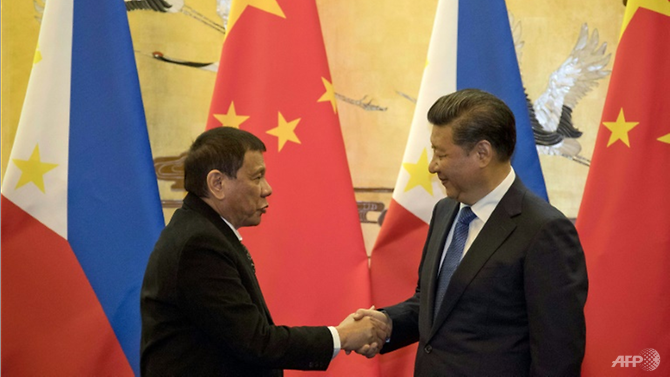
File photo of Philippine President Rodrigo Duterte (L) and his Chinese counterpart Xi Jinping. (Photo: AFP)
19 May 2017 09:26PM (Updated: 19 May 2017 09:30PM)
Share this content
MANILA: Philippine President Rodrigo Duterte said on Friday (May 19) Chinese counterpart Xi Jinping had warned him there would be war if Manila tried to enforce an arbitration ruling and drill for oil in a disputed part of the South China Sea.
In remarks that could infuriate China, Duterte hit back at domestic critics who said he has gone soft on Beijing by refusing to push it to comply with an award last year by the Permanent Court of Arbitration in The Hague, which ruled largely in favor of the Philippines. Tiếp tục đọc “Duterte says China’s Xi threatened war if Philippines drills for oil”→
Foreign Ministry spokesperson Lê Thị Thu Hằng. — VNA/VNS Photo Văn Điệp
HÀ NỘI – Việt Nam adamantly opposes and rejects China’s unilateral ban on fishing in the East Sea from May 1 to August 16, Foreign Ministry spokesperson Lê Thị Thu Hằng told the media at a regular press conference yesterday.
She elaborated that “Việt Nam has sufficient legal foundation and historical evidence testifying to its sovereignty over the Hoàng Sa (Paracel) archipelago as well as the legitimate rights over Việt Nam’s sea areas defined in line with the 1982 UN Convention on the Law of the Sea (UNCLOS).” Tiếp tục đọc “VN objects to China’s East Sea ban”→






 CVD
CVD 
Commentary By
Senior Research Fellow in Anglo-American Relations
Vice President, Kathryn and Shelby Cullom Davis Institute
Senior Research Fellow in International Regulatory Affairs
KEY TAKEAWAYS
U.S. accession would provide no benefits not already available to the U.S., while creating unnecessary burdens and risks.
The U.S. does not need to join the convention in order to access oil and gas resources on its extended continental shelf, in the Arctic, or in the Gulf of Mexico.
Despite subsequent changes in 1994 that led the Clinton administration to support U.S. accession, the Trump administration should oppose accession to this treaty.