TTCT – Vụ một nhóm du khách Trung Quốc nhập cảnh vào Cam Ranh với áo thun in hình “lưỡi bò” trên lưng chỉ là một trong vô vàn âm mưu thôn tính lớn nhỏ.
Máy bay vận tải quân sự Thiểm Tây Y-8 của Trung Quốc trên đá Subi, ảnh công bố ngày 28-4. Ảnh: AMTI
Hôm thứ hai 14-5, Hãng thời trang GAP đã xin lỗi Bắc Kinh vì bán ra những áo thun in bản đồ Trung Quốc mà không thể hiện trên đó Đài Loan, Nam Tây Tạng và biển Nam Hải (cách Trung Quốc gọi Biển Đông). Hãng GAP cam kết trong một thông báo trên Hoàn Cầu Thời Báo rằng họ “tôn trọng chủ quyền và sự vẹn toàn lãnh thổ của Trung Quốc”.
Báo mạng chuyên về kinh tế – tài chính Business Insider của Mỹ, phát hành bằng 8 thứ tiếng Anh, Ba Lan, Đức, Hà Lan, Nhật, Pháp, Hoa, Ý, còn “lập công” khi cho biết “đến tối thứ hai, Business Insider vẫn tìm thấy áo thun gây tranh cãi của Hãng GAP được bán” ngoài thị trường. Vụ việc đó, cùng vụ mặc áo thun in hình “lưỡi bò” ở Việt Nam, thật điển hình cho “cuộc chơi” cùng “luật chơi” ở Biển Đông lúc này. Tiếp tục đọc “Biển Đông: Cuộc chơi và luật chơi của ai?”→
The US network CNBC reports, citing sources close to US intelligence, the Chinese army installed anti-ship and air-to-air defenses on outposts also claimed by Vietnam and the Philippines over the last 30 days
DISPUTED. This 2016 file photo shows a portion of the disputed Mischief Reef in the South China Sea where there are Chinese facilities.
BEIJING, China – Beijing Thursday, May 3, reasserted its right to build “defense” facilities in the disputed South China Sea, but declined to confirm reports it had installed new missiles on artificial islands it has built in the region.
The Chinese army installed anti-ship and air-to-air defenses on outposts also claimed by Vietnam and the Philippines over the last 30 days, US network CNBC reported Wednesday, citing sources close to US intelligence. Tiếp tục đọc “Beijing ‘installs missiles’ on South China Sea islands”→
Vox_Since 2014, China has been building islands in the middle of the South China Sea. What were once underwater reefs are now sandy islands complete with airfields, roads, buildings, and missile systems. In less than two years, China has turned seven reefs into seven military bases in the South China Sea, one of the most contentious bodies of water in the world.
href=””>United Nations Law of the Seas, which says a country’s territory extends 200 miles off its shores, an area called the exclusive economic zone, or EEZ. Any trade or resources that fall in a country’s EEZ belong to that country; they’re its sovereign territory. Any area that is not in an EEZ is considered international waters and subject to UN maritime law, meaning it’s shared by everyone. Every country in the region, which includes Malaysia, the Philippines, Brunei, and Vietnam, bases its claim to the South China Sea on the UN’s EEZ laws — except China.
China argues it has a historical claim to the South China Sea, dating back to naval expeditions in the 15th century. After World War II, the Japanese Empire lost control of the South China Sea, and China took advantage of the moment to reclaim it. On maps, it started drawing a dashed line that encompassed most of the South China Sea. This line became its official claim and is known today as the Nine-Dash Line, because it always has nine dashes. In 1973, when the UN law established EEZs, China reaffirmed its Nine-Dash Line, refusing to clarify the line’s boundaries and rejecting other countries’ claims.
Since then, tensions have built around who rightfully owns the South China Sea. The dispute has centered on the Spratly Islands, an archipelago at the heart of the South China Sea. Currently, China, Malaysia, the Philippines, and Vietnam claim some part of the Spratly Island chain. They’ve asserted their claims by putting small buildings, ports, and even some people on what are essentially rocks in the middle of the ocean.
But the Spratlys are very important, because whichever country can successfully claim themcan extend its EEZ to include them, thus gaining miles of precious sovereign territory. This is why China began building up islands in 2014. By turning these rocks into military bases, the Chinese are now able to support hundreds of ships, bolstering their presence in the region. They are using fishing boats, surveillance ships, and navy destroyers to set up blockades around other countries’ islands and defend their own. This is all done very cautiously and in small steps in order to avoid sparking a wider conflict.
Since China began building islands, the disputes have not become violent.But tensions are building in the region. As China deploys more of its military to the Spratlys, other countries are getting nervous and building up their own islands. It’s a complex situation that will continue to gain international attention, for better or for worse.
ASEAN Foreign Ministers applaud at the opening ceremony of the 50th ASEAN Foreign Ministers Meeting (AMM) at the Philippine International Convention Center Saturday, Aug. 5, 2017 in suburban Pasay city south Manila, Philippines. From left, Malaysia’s Foreign Minister Anifah Aman, Myanmar Minister of State of Foreign Affairs U Kyaw Tin, Thailand Foreign Minister Don Pramudwinai, Vietnam’s Foreign Minister Pham Binh Minh, Philippine Foreign Secretary Alan Peter Cayetano, Singapore’s Foreign Minister Vivian Balakrishnan, Brunei’s Foreign Minister Lim Jock Seng, Cambodia’s Foreign Minister Prak Sokhonn, Indonesia’s Foreign Minister Retno Marsudi, Laos’ Foreign Minister Saleumxay Kommasith and ASEAN Secretary-General Le Luong Minh.(AP Photo/Mohd Rasfan, POOL)
Cuộc họp Việt Trung hủy bỏ vì căng thẳng về Biển Đông
MANILA (Reuters) – Một cuộc họp đã sắp xếp giữa hai bộ trưởng ngoại giao TQ và VN bên lề cuộc họp của cả vùng đã bị hủy bỏ, quan chức sứ quán TQ cho biết, trong căng thẳng ngày càng tăng giữa hai nước về Biển Đông.
Việt Nam đã đòi hỏi lời lẽ nhắc đến quan tâm về bồi đắp đảo nhân tạo và chỉ trích việc quân sự hóa ở Biển Đông trong một thông cáo của các bộ trưởng ngoại giao của ASEAN (Hiệp hội các Quốc gia Đông Nam Á).
Việt Nam đã trỗi lên như là người đối lập lớn tiếng nhất đối với các tuyên bố quyền hành của TQ trên tuyến hàng hải với hơn 3000 tỉ đô đi qua mỗi năm.
Sứ quán TQ không nói gì về lý do hủy bỏ cuộc họp, đã được lên lịch cho ngày thứ hai ở Manila, giữa Wang Yi của TQ và Phạm Bình Minh của VN.
TTCT– Thứ sáu 21-7 vừa rồi, Jared Dummitt và Eliot Kim, hai nghiên cứu sinh của Trường Luật Harvard, đã đăng một bài trên website luật học lawfareblog.com có tựa đề “khác lạ”: “Chiến tranh vì biển: Hãy quen dần với điều đó trên Biển Đông”.
Tàu sân bay tự đóng đầu tiên của Trung Quốc (chưa đặt tên) được hạ thủy ngoài khơi thành phố cảng Đại Liên tháng 4-2017.-Ảnh: The New York Times
Hai tác giả bắt đầu bằng câu chuyện: “Tuần này, hải quân và không quân Trung Quốc đã thực hiện các hoạt động mở rộng – trong số đó có một số vụ là chưa từng có trước đó ở trong và xung quanh lãnh hải của Nhật Bản, Đài Loan và Mỹ. Bắc Kinh đã tỏ rõ giọng điệu thách thức khi dấy lên những dấu hỏi về tính thích đáng của các hoạt động này”. Tiếp tục đọc “Tự do hàng hải của nước lớn”→
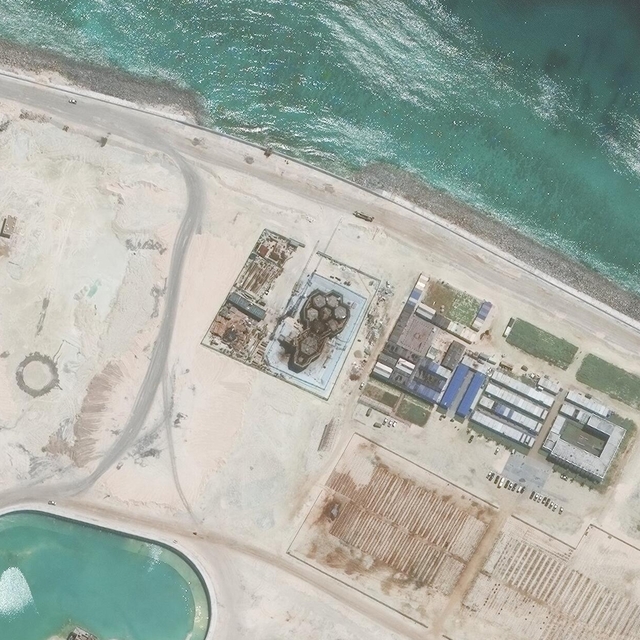
New imagery shows that while China is keeping attention focused on its negotiations with Southeast Asian countries over basic principles to manage the South China Sea disputes, its construction of military and dual-use facilities on the Spratly Islands continues. New missile shelters, radar/communications facilities, and other infrastructure are going in on Fiery Cross, Mischief, and Subi Reefs, suggesting that while the region is engaged in peaceful discussion, China remains committed to developing its power projection capabilities.
Latest military exercise was part of the US Pacific Command’s ‘continuous bomber presence’ programme.
A pair of B-1B Lancer bombers fly in an undated file photo [Staff Sgt Steve Thurow/US Air Force via Reuters]
China said on Friday it was monitoring US military activities in the South China Sea after two US bombers conducted training flights over the disputed waters.
The US Pacific Command said on its website two American Air Force B-1B Lancer bombers flew a 10-hour training mission from Guam over the South China Sea on Thursday, in conjunction with the Navy’s USS Sterett guided-missile destroyer. Tiếp tục đọc “China vigilant as US bombers fly over South China Sea”→
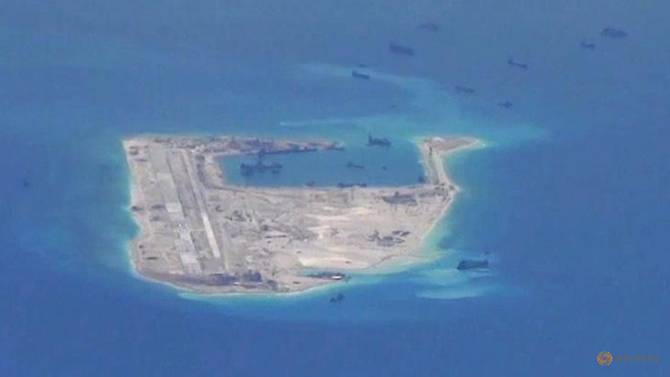
Still image from a United States Navy video purportedly shows Chinese dredging vessels in the waters around Fiery Cross Reef in the disputed Spratly Islands
17 May 2017 01:15PM (Updated: 17 May 2017 05:56PM)
BEIJING: China has installed rocket launchers on a disputed reef in the South China Sea to ward off Vietnamese military combat divers, according to a state-run newspaper, offering new details on China’s ongoing military build-up.




 CVD
CVD 