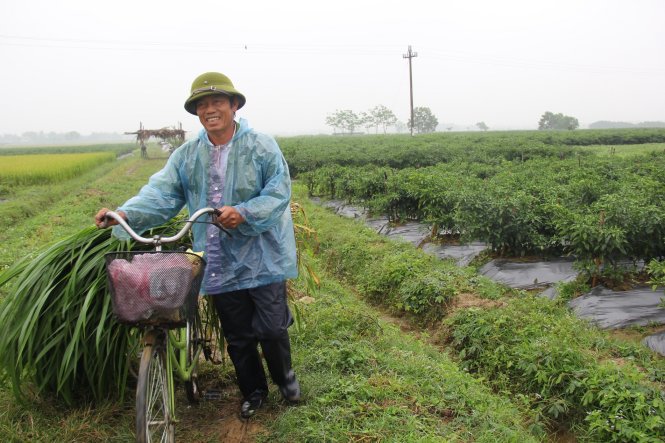
Viet Nam’s farmers suffer as El Niño contributes to widespread drought

Published: 4 April 2016 11:48 CET
A Red Cross staff conducts an assessment with a household in Ben Tre province in Viet Nam. Photo credit: Viet Nam Red Cross Society
IFRC – By Ly Nguyen, IFRC

Since the end of 2015, unusually dry conditions and a shortage of rainfall have seriously affected Viet Nam. These conditions which are associated with El Niño, have led to severe drought  in parts of the central, central highlands and southern regions of the country, including the Mekong Delta. Some water levels are at the lowest recorded in 90 years.

“In 2015, there was lower than average rainfall during the rainy season which ended two months earlier than in previous years. Water shortage has been compounded by saltwater intrusion. Salinity is four times higher than seasonal averages,” said Phan Duy Le, Vice Chairman of Quoi Dien commune in Thanh Phu district, Ben Tre province. “The consequences are very concerning. The drought and salty water have been threatening crops and agricultural production, and most importantly, access to drinking water for local people.”

Tiếp tục đọc “Viet Nam’s farmers suffer as El Niño contributes to widespread drought”

Disease: Poverty and pathogens

  • Michael Eisenstein
  • Nature 531, S61–S63  (17 March 2016) doi:10.1038/531S61a
  • Published online
  • 16 March 2016

The growth of slums in the developing world’s rapidly expanding cities is creating new opportunities for infectious disease to flourish and spread.

BÌNH LUẬN VỀ QUY HOẠCH ĐIỆN 7 HIỆU CHỈNH – LIÊN MINH NĂNG LƯỢNG BỀN VỮNG VIỆT NAM

“Cần tạo nhiều đột phá trong chính sách để đảm bảo tính khả thi và sự đồng bộ giữa định hướng và phương án tăng mạnh năng lượng tái tạo và giảm nhiệt điện than”  

Ngày 18 tháng 3 vừa  qua, Quy hoạch phát triển điện  lực quốc gia giai đoạn 2011 – 2020,  có xét đến năm 2030  HIỆU CHỈNH (QHĐ VII  HC) đã được Thủ  Tướng Chính Phủ phê duyệt.  Những nội dung cơ bản của QHĐ VII HC đã  được chia sẻ và thảo luận tại hội thảo “Phát triển  Năng lượng  – Tăng trưởng  Xanh – Biến  đổi khí  hậu: Nỗ lực  và Khoảng trống”  do Liên  minh Năng lượng  Bền vững Việt  Nam – VSEA – (1)  tổ chức sáng  ngày 24/3/201.

QHĐ VII  HC định hướng  chính sách  phát triển nguồn  điện trong  giai đoạn  tới tập  trung vào  “giảm công  suất và số  lượng các  nhà máy nhiệt điện  than  (NMNĐ than)”,  “giảm bớt  nhu cầu  nhiên liệu  hóa thạch”,  “sử dụng  các công nghệ tiên  tiến trong  nhà máy  nhiệt điện  (tăng hiệu  suất, giảm  tiêu hao nhiên  liệu, giảm  phát thải”, “tăng mạnh tỷ  trọng năng lượng tái tạo (NLTT)  trong cơ cấu nguồn điện”.

Luôn quan  tâm và thúc  đẩy sự  phát triển  năng lượng  bền vững ở  Việt Nam,  VSEA cho  rằng định  hướng điều chỉnh này  của Chính phủ  rất phù  hợp với nguyện  vọng của người dân cũng  như xu  thế  chung của thế giới hướng đến phát triển năng lượng sạch và bền vững.

Tuy nhiên, nhìn vào cơ cấu nguồn điện  trong QHĐ VII HC, nhiệt điện than vẫn dự kiến chiếm tới hơn 50% tổng sản  lượng điện sản xuất trong mười và  mười lăm năm tới. Khối lượng than  nhập khẩu để phát điện dự  kiến vào năm 2030 lên tới hơn 85  triệu tấn, cao gần gấp đôi so  với lượng than cung  ứng nội địa.  Kịch bản  này đặt ra  câu hỏi lớn  với an  ninh năng lượng  của Việt Nam. Liệu an ninh năng lượng  quốc gia có được đảm bảo khi theo  phương án hơn một nửa hệ thống điện phụ  thuộc vào  nhiệt điện than  trong đó  2/3 nguồn nhiên  liệu phụ  thuộc vào bên  ngoài? Tiếp tục đọc “BÌNH LUẬN VỀ QUY HOẠCH ĐIỆN 7 HIỆU CHỈNH – LIÊN MINH NĂNG LƯỢNG BỀN VỮNG VIỆT NAM”

Nonproliferation and Nuclear Energy: The Case of Vietnam

Is Vietnam diverting its civilian know-how to create an indigenous nuclear weapons program? Not yet, says the CSS’ Oliver Thränert, but increased tensions or overt conflict with China could lead Hanoi to develop its own nuclear deterrent.

By Oliver Thränert for Center for Security Studies (CSS)

ISN – For many years, the international nuclear non-proliferation regime has been in deep crisis. This became apparent most recently when the ninth Review Conference of the Parties to the Treaty on the Non-Proliferation of Nuclear Weapons (NPT) in May 2015 ended without a common final document. At the same time, a number of threshold countries are planning to begin using nuclear energy for peaceful purposes. In a time of increasing international tensions, some of them might build on know-how acquired through their civilian programs to safeguard their national security needs through a nuclear weapons program in the near future. Vietnam is an interesting case in point. Irrespective of certain delays in the development of its peaceful nuclear program, the country has progressed quite far. At the same time, it is engaged in an increasingly precarious conflict with its main neighbor, nuclear-armed China. Currently, there are no signs of a Vietnamese nuclear weapons program. In the framework of the nuclear non-proliferation regime, the country is a model of transparency and cooperation. But it is uncertain whether this will always remain the case. On the contrary, Hanoi might change its policy if the conflict with China should come to a head while the NPT continues to be weakened.

Vietnam’s strategic situation

Vietnam might complete its first nuclear reactor within a few years, ahead of ambitious neighbors such as Indonesia or Malaysia. The country’s main motivations are its growing energy requirements and the desire to diversify its energy sources. Considerations of prestige may also be a factor. As a threshold nation, Vietnam aims to achieve the same level as Asia’s developed nations. With a view to China, Hanoi probably also wishes to demonstrate the high level of global confidence that the country enjoys in sensitive matters of security policy. Tiếp tục đọc “Nonproliferation and Nuclear Energy: The Case of Vietnam”

From Omen to Opportunity: How Cheap Oil Is Accelerating Sustainable Energy Investment

An increasingly unprofitable global oil market is driving fuel prices to historic lows and hemorrhaging investment in conventional energy sources. Breaking with tradition, cheap oil no longer foretells disaster for renewable energy companies. On the contrary, disillusioned fossil fuel investors are seeking high-growth opportunities—just in time to ride the renewables wave in the wake of the 2015 Paris climate talks.

worldwatch – Crashing out in February at $27 per barrel, crude oil prices have reached their lowest point in over 13 years, since the 2003 U.S.-led invasion of Iraq. Despite a modest recovery in March driven by expectations for reduced production, investors remain skeptical of underlying oil market fundamentals and are reducing their exposure. These selloffs have dragged down the stock prices of large conventional energy companies listed in the Standard & Poor’s 500 Index by 13 percent and have cost investors more than $703 billion since the record-high oil prices of June 2014.

Responding to these selloffs, oil companies have tightened their belts, decommissioning two-thirds of their rigs and sharply cutting investment in oil field exploration and development, while an estimated 250,000 oil workers have lost their jobs. A Wood Mackenzie report identified 68 major oil and natural gas projects—representing a combined value of $380 billion and output of 2.9 million barrels of oil equivalent (boe) per day—that have been put on hold since late 2014. Besides reducing operating costs, oil companies hope that these measures will have a stabilizing effect on the market by reducing productive capacity in the medium to long term. Tiếp tục đọc “From Omen to Opportunity: How Cheap Oil Is Accelerating Sustainable Energy Investment”

ASEAN PLAN OF ACTION FOR ENERGY COOPERATION (APAEC) 2016-2025

FULL REPORT

EXECUTIVE SUMMARY

Energy is key to the realisation of the ASEAN Economic Community (AEC) which calls for a well-connected ASEAN to drive an integrated, competitive and resilient region. Energy is key to the realisation of the ASEAN Economic Community (AEC) which calls for a well-connected ASEAN to drive an integrated, competitive and resilient region.

ASEAN is now one of the most dynamic and fastest growing economic regions in the world, and through the implementation of the AEC by end of December 2015, this growth is expected to continue. The region is projected to grow by at least 4% per year on average over the next five years, but could be as high as 6% – provided ASEAN moves towards greater integration, where member states continuously implement domestic structural reforms to raise their productivity and competitiveness under the framework of the AEC.

1 To fuel this growth, the demand in primary energy
2 is expected to grow by an average of 4.7% per year from 2013 to reach 1,685 Mtoe in 2035, according to the ASEAN Centre for Energy’s (ACE) 4 th ASEAN Energy Outlook (AEO4).

Addressing this growing demand for energy, which is driven by both economic and demographic growth, has been a challenge for ASEAN ahead of the AEC. Against this backdrop, the 32 nd ASEAN Ministers on Energy Meeting (AMEM) held on 23 rd September 2014 in Vientiane, Lao PDR, endorsed the theme of the new ASEAN Plan of Action for Energy Cooperation (APAEC) 2016-2025 as “Enhancing Energy Connectivity and Market Integration in ASEAN to Achieve Energy Security, Accessibility, Affordability and Sustainability for All” .

The theme also reflects the central elements of connectivity and energy security captured in the Nay Pyi Taw Declaration on the ASEAN Community’s Post 2015 Vision adopted by the ASEAN Leaders at the 25 th ASEAN Summit in Nay Pyi Taw, Myanmar, on 12 th November 2014 The key initiatives under this APAEC include embarking on multilateral electricity trading to accelerate the realisation of the ASEAN Power Grid (APG), enhancing gas connectivity by expanding the focus of the Trans-ASEAN Gas Pipeline (TAGP) to include Liquefied Natural Gas (LNG) regasification terminals as well as promoting clean coal technologies. It also includes strategies to achieve higher aspirational targets to improve energy efficiency and increase the uptake of renewable energy (RE) sources, in addition to building capabilities on nuclear energy.

Plans to broaden and deepen collaboration with ASEAN’s Dialogue Partners (DPs), International Organisations (IOs), academic institutions and the business sector will be stepped up to benefit from their expertise and enhance capacity building in the region. The APAEC 2016-2025 will be implemented in two phases. Phase I will cover the period 2016-2020 for the implementation of short to medium-term measures to enhance energy security cooperation and to take further steps towards connectivity and integration. In 2018, there will be a stocktake of the progress of Phase I, which will guide ASEAN in charting the pathways and directives for Phase II (2021-2025).


The Effects of Fukushima Linger after Five Years, but Not from Radiation

While hundreds died in the evacuation, none perished as a result of exposure to radiation.

technologyreview : The Fukushima Daiichi nuclear accident, which began on March 11, 2011, uprooted thousands of Japanese people, set the worldwide nuclear power industry back a decade, and caused a run on potassium iodide (said to help ward off thyroid cancer). What it didn’t do was kill anyone from radioactive fallout.

A Greenpeace report released this week, Nuclear Scars: The Lasting Legacies of Chernobyl and Fukushima,” takes a harsher view, saying that “the health consequences of the Chernobyl and Fukushima catastrophes are extensive.” But most of the report dwells on Chernobyl, and it notes that the primary effects of Fukushima were “mental health disorders, such as depression, anxiety and Post Traumatic Stress Disorder.” Put another way: fear and panic resulting from the accident (and from the loss of homes and livelihoods) were more dangerous than the radiation.
Tiếp tục đọc “The Effects of Fukushima Linger after Five Years, but Not from Radiation”

Cận cảnh hạn mặn

Đức Tâm – Thứ Hai,  7/3/2016, 14:14 (GMT+7)

Tình trạng hạn mặn đã ảnh hưởng đến cuộc sống của mọi người dân, từ bà bán hàng rong cho đến nhà của Tổng giám đốc Công ty Cấp thoát nước – Ảnh: Đức Tâm

(TBKTSG Online) – Ở Bến Tre hiện nay bạn không cần ra biển để cảm nhận được vị mặn của nước; Chỉ cần nhấp một ngụm trà, bạn đã thấy vị mặn hiện diện ngay tại mỗi gia đình.

Tiếp tục đọc “Cận cảnh hạn mặn”

Cộng đồng người Khmer ứng phó với những thách thức từ thiên tai và biến đổi khí hậu

September 4th, 2015 by Oxfam in Vietnam

OxfamHiện nay có khoảng hơn 1 triệu người dân Khmer sinh sống quanh khu vực đồng bằng sông Cửu Long, mảnh đất đang phải oằn mình chống chọi lại những thiên tai do tác động của biến đổi khí hậu. Các hiện tượng biến đổi khí hậu cực đoan và khó lường ảnh hưởng nghiêm trọng đến cuộc sống người dân trên nhiều phương diện, và những người chịu thiệt hại nhiều nhất chính là nhóm đối tượng đang yếu kém trong xã hội như người nông dân Khmer. Vì vậy, một câu hỏi đã được đặt ra: Liệu cộng đồng Khmer có thể làm gì để ứng phó với những thách thức từ thiên tai và biến đổi khí hậu này?

Tiếp tục đọc “Cộng đồng người Khmer ứng phó với những thách thức từ thiên tai và biến đổi khí hậu”

Crisis Response: When Trees Stop Storms and Deserts in Asia

Mobilising finance for a renewable and sustainable future

eco-business – Global momentum is building towards greater investment in renewables. Renewable energy is no longer seen as an indulgence that needs to be tolerated. Prospects are looking bright for the renewable energy industry as a growing number of countries, including the United States are realizing that the rapidly increasing use of renewable energy has become a beacon for optimism.

In fact, renewable energy sources are becoming affordable thanks to enhanced infrastructure and policies. Over the next decades, huge investments will be flowing into the energy sector. It is critical to seek ways to green those investments. According to UNEP’s 9th “Global Trends in Renewable Energy Investment 2015,” renewables are growing rapidly in both developed and developing countries, with China leading the way. Tiếp tục đọc “Mobilising finance for a renewable and sustainable future”

Science Teachers’ Grasp of Climate Change Is Found Lacking

Despite Stay, America’s Economy and Climate Need the Clean Power Plan

by and

WRI – Yesterday, the U.S. Supreme Court paused implementation of the Clean Power Plan (CPP) to allow an appeals court to consider a legal challenge from a number of states, corporations and industry groups. That case is being expedited, and a decision is expected by the fall.

Importantly, the Supreme Court’s decision to grant a temporary stay was not based on the legal merits of the CPP, which calls for emissions reductions throughout states’ power sectors. Experts agree that the CPP is on solid legal ground and will prevail. Indeed, previously the Supreme Court not only upheld the EPA’s authority to regulate carbon pollution under the Clean Air Act (which the Clean Power Plan builds upon), the Court found the agency had the obligation to do so to protect Americans’ health.

We expect yesterday’s ruling to be only a temporary time out as the CPP heads to full implementation. As the legal case proceeds, the EPA has indicated it will continue to help states put in place the plans and tools they need to comply with the rule, and the Obama administration has committed to continue taking aggressive steps to reduce emissions and lead in the fight against climate change.

Clean Power Plan: Smart, Balanced and Beneficial

The benefits of the plan are clear, far-reaching and worth fighting for. The CPP offers a smart, balanced approach that will cut dangerous pollution as it drives innovation, creates new job opportunities and improves public health. The CPP is one of the most important near-term tools the United States can use to help reach its goal of reducing emissions 26-28 percent below 2005 levels by 2025. In addition, the plan will make our air safer to breathe by reducing Americans’ exposure to particulate matter and ground-level ozone, benefiting our health and the economy by an estimated $25 billion to $65 billion – far more than the $7 billion to $9 billion cost of compliance, according to the EPA.
Tiếp tục đọc “Despite Stay, America’s Economy and Climate Need the Clean Power Plan”

Thổi năng lượng mới cho năng suất nông nghiệp vùng hạ lưu Mekong

English: Reinvigorating agricultural productivity in the Lower Mekong

Aladdin D. Rillo and Mercedita A. Sombilla

asia.nikke

Cuộc cách mạng xanh đã làm nên những kỳ tích ở châu Á. Sản lượng từ những mùa vụ, cụ thể là sản lượng gạo là lương thực chính của khu vực này, đã tăng gấp đôi trong những thập kỷ qua. Vùng hạ lưu đồng bằng sông Mekong, được xem như là vựa gạo của châu Á, kỹ thuật mới và giống cây trồng mới mà cuộc cách mạng xanh mang lại là một thành công lớn.

Sản xuất lúa gạo ở các nước hạ lưu sông Mekong như Campuchia, Lào, Myanmar và Việt Nam tăng vọt 68% từ năm 1980 đên năm 1995. Trong cùng thời gian này, trung bình sản lượng tăng hơn gấp đôi từ mức sản lượng những năm 1960 lên khoảng 3.5 tấn/ha. Tổng diện tích đất canh tác lúa cũng tăng khoảng 25% đạt 16.3 triệu ha từ năm 1996 đến năm 2005.

Cuối năm 2013, tuy nhiên, thành tựu đạt được như bị khựng lại. Giữa năm 2006 và năm 2013, tăng trưởng sản lượng trung bình chậm lại còn 22% trên tất cả các nước hạ lưu sông Mekong trừ Campuchia, trong khi tăng trưởng sản lượng gạo trượt xuống còn 36%.
Tiếp tục đọc “Thổi năng lượng mới cho năng suất nông nghiệp vùng hạ lưu Mekong”

The Problem with Biofuels

The U.S. Navy is touting its “Great Green Fleet,” but why haven’t biofuels made a bigger splash despite a decade of hype and investment?

technologyreview – Last week the U.S. Navy, with its accustomed pomp and fanfare, launched its first carrier strike group powered partly by biofuel—in this case, a blend made primarily from beef fat. The biofueled warships form a central element of the Navy’s Great Green Fleet program to draw half of its power from clean energy sources, rather than petroleum, by 2020.

Attended by secretary of the Navy Ray Mabus and agriculture secretary Tom Vilsack, the ceremony masked what has been nearly a decade of problems for biofuels—an energy source once touted as capable of virtually eliminating the use of petroleum in the transportation sector. Today biofuels production and consumption stand at a fraction of the levels foreseen under the Renewable Fuel Standard, a federal mandate signed by President George W. Bush that requires fuels made from corn, sugarcane, and other biological sources to be mixed into the nation’s gasoline supply. Tiếp tục đọc “The Problem with Biofuels”