Saltwater intrusion to enter deeper in Mekong Delta

Saltwater intrusion in the Mekong Delta during the dry season, is forecast to enter local rivers 30-40km deeper than the annual average.
Saltwater intrusion to enter deeper in Mekong Delta
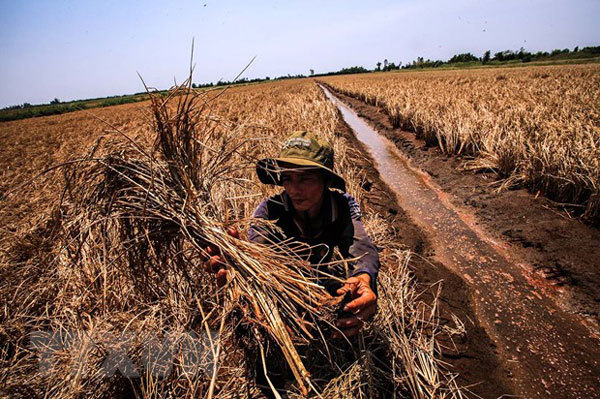
Salinity intrusion destroyed rice fields in the Mekong Delta province of Kien Giang in 2016.—VNA/VNS Photo Trong Dat

That is more severe than 2016, the year of historic salinity which caused VND15 trillion (US$ 646 million) damage to the delta.

The concentration of salinity was about four grammes per litre, said minister of Agriculture and Rural Development Nguyen Xuan Cuong at a meeting held on Friday in the Mekong Delta province of Ben Tre. Tiếp tục đọc “Saltwater intrusion to enter deeper in Mekong Delta”

Sand overexploitation of Mekong River raises worries for Mekong Delta

vietnamnet

The loss of sand has caused erosion and increased salinity as well as subsidence in the Mekong Delta.

The studies of the Mekong River by Prof Stephen Darby from Southampton University found that within several years, the river bed fell by several meters on a section of hundreds of kilometers in length.

Sand overexploitation of Mekong River raises worries for Mekong Delta

Tiếp tục đọc “Sand overexploitation of Mekong River raises worries for Mekong Delta”

Vietnam to buy 1.5 billion kWh of power annually from Laos

By Anh Minh   January 5, 2020 | 02:42 pm GMT+7 VnExpress

Vietnam to buy 1.5 billion kWh of power annually from Laos

A worker repairs electricity cables in Ho Chi Minh City. Photo by VnExpress/Thanh Nguyen.

State power utility EVN will buy around 1.5 billion kWh of electricity a year from Laos for two years starting in 2021.

Under contracts it signed on Saturday, Vietnam Electricity (EVN) will buy over 596 million kWh a year from two hydropower plants belonging to Phongsubthavy Group and 632 million kWh from two plants belonging to Chealun Sekong Group from 2022.

Tiếp tục đọc “Vietnam to buy 1.5 billion kWh of power annually from Laos”

Mekong Delta stays alert for severe drought

By Hoang Nam   January 4, 2020 | 04:45 pm GMT+7

Mekong Delta stays alert for severe drought

A farmer in a paddy field hit by drought in the Mekong Delta’s province of Soc Trang, June 2019. Photo by VnExpress/Thanh Nguyen.

Vietnam’s Mekong Delta is bracing severe drought and salinity in the coming months, and local authorities have been told to take every step possible to mitigate the damage.

For this dry season, which has already started in southern Vietnam and normally lasts until late April, drought conditions are likely to be more severe, resulting in more salinity in the delta, which spreads over 40,577 square kilometers (15,670 square miles).

The nation’s most fertile region for long, the Mekong Delta has been called the Vietnam’s rice granary. It is also the nation’s aquaculture hub.

Tiếp tục đọc “Mekong Delta stays alert for severe drought”

Vietnam and Asia neighbors hungry for cheap coal

asia.nikkei.com

Demand for low-grade coal expands amid economic growth

Vietnam’s steam coal imports in 2019 are estimated to total about 32 million tons, twice the amount for last year and up three times from three years ago.   © Reuters

TOKYO — Demand for low-grade coal with lower combustion efficiency is growing amid economic growth in Vietnam and other emerging Asian countries, placing another hurdle in the global race to reduce greenhouse gas emissions.

While prices of high-grade coal with higher power generation efficiency have fallen by more than 30% over the past year as developed countries have been reducing coal consumption, prices of low-grade coal have fallen more slowly. The price difference between the two categories of coal has shrunk to one-third the level of a year ago. Tiếp tục đọc “Vietnam and Asia neighbors hungry for cheap coal”

More Water Shortages Mean Energy Investors Need New Ways to Manage Drought Risk

WRI.org

On July 5, 2015, the first of six thermal power generation units at the Parli Thermal Power Station in Maharashtra, India shut down. Unable to draw enough water from the nearby Majalgaon dam, which had nearly run dry, the coal-powered unit was unable to run its cooling system and was forced to halt electricity production. This was just the start, as each of the five additional units subsequently shut down as well. Between July 2015 and December 2016, Parli stopped generating electricity entirely for 226 days solely due to water shortages, and during the days it wasn’t entirely shut down, it was largely paralyzed.

Imagine this picture replicated in other parts of India and around the world. Recent research is beginning to link climate change to drought, which suggests that risks to water availability will likely get worse.

That water shortages can prove costly to energy companies is old news. What is less understood is how much water shortages can impact utilities’ bottom lines.

In our new study, Financial Implications of Parched Power, we find that water shortage-induced outages to thermal power generation didn’t just turn off customers’ lights, they also caused occasional and sometimes major financial impacts to thermal power companies. This finding can have important implications for both thermal power companies and their investors. Tiếp tục đọc “More Water Shortages Mean Energy Investors Need New Ways to Manage Drought Risk”

Nghiên cứu của QS cho biết cái nhìn của sinh viên quốc tế về giáo dục đại học Anh Quốc hậu Brexit – sau khi nước Anh rời khỏi Châu Âu

English: QS research reveals international students’ views on UK higher education post-Brexit

Sự thay đổi linh hoạt về nhu cầu của sinh viên quốc tế, các giải pháp duy trì và quan hệ quốc tế là thách thức mà các trường đại học phải vượt qua (dựa theo báo cáo mới của QS – một công ty giáo dục đại học hàng đầu toàn cầu cung cấp bảng xếp hạng và tuyển sinh đại học).

Một khảo sát lớn với hơn 75.000 sinh viên từ 191 quốc gia cho biết: 23.557 trong số này quan tâm đến việc học tập tại Vương quốc Anh. Bản báo cáo khảo sát khuyến nghị hiện tại là thời điểm Chính phủ Anh hợp tác với ngành giáo dục đại học để đảm bảo rằng hệ thống nhập cư sau Brexit được chuẩn bị tốt nhất cho phát triển giáo dục toàn cầu.
Tiếp tục đọc “Nghiên cứu của QS cho biết cái nhìn của sinh viên quốc tế về giáo dục đại học Anh Quốc hậu Brexit – sau khi nước Anh rời khỏi Châu Âu”

Mekong Delta’s main flower, ornamental plant growing district affected by saltwater in rivers

vietnamnews – Update: December, 14/2019 – 09:00
Farmers prepare to sell flowers during the 2019 Tết in Bến Tre Province’s Chợ Lách District. – VNA/VNS Photo Huỳnh Phúc Hậu
BẾN TRE – The unusually early saltwater intrusion this year is threatening the farming of flowers and ornamental plants in Bến Tre Province’s Chợ Lách District, the Cửu Long (Mekong) Delta’s largest producer of flowers and ornamental plants.

Chợ Lách is growing more than 11 million pots of flowers and ornamental plants for Tết (Lunar New Year), which falls on January 25 next year, according to the district Bureau of Agriculture and Rural Development. Tiếp tục đọc “Mekong Delta’s main flower, ornamental plant growing district affected by saltwater in rivers”

Gravest threat to Mekong delta today is sediment starvation not rising seas

wwf.panda.org

Posted on 10 December 2019

New research shows that the increasing vulnerability of the Mekong delta to floods, salt intrusion and erosion is caused by insufficient sediment in the river not climate-induced rise in sea levels.

Published in the journal Nature Scientific Reports, the findings of the Rise and Fall Project at Utrecht University are clear: the growing threat to the Mekong Delta – and the communities, cities, rice fields and biodiversity that depend on it – posed by higher tides and salt intrusion is almost entirely due to the loss of river sediment because of upstream dams and sand mining in the delta.

Rising tides in the delta have major ramifications for flooding in subsiding and increasingly vulnerable cities, and river bank erosion. While sea level rise and climate change have received most attention in relation to the sinking and shrinking of the Mekong delta, the research shows that in the last 20 years, they have driven less than 5% of these trends.
Tiếp tục đọc “Gravest threat to Mekong delta today is sediment starvation not rising seas”

Vietnam among six nations worst hit by climate change in 20 years

By Minh Nga   December 10, 2019 | 07:48 am GMT+7 VNExpress

Vietnam among six nations worst hit by climate change in 20 years

Nguyen Thi Tu, a resident of Ho Chi Minh City’s District 7, walks on a flooded street as the city was hit by the record tide of more than 1.7 meters on September 30, 2019. Photo by VnExpress/Huu Khoa.

Vietnam is one of six countries most affected by climate change between 1999 and 2018, according to survey results released this week.

The Global Climate Risk Index, published by the German environmental think tank Germanwatch, ranked Vietnam sixth among countries hit hardest by extreme weather events in that period, with its Climate Risk Index (CRI) at 29.83.

Puerto Rico, Myanmar, Haiti, the Philippines and Pakistan are adjudged the worst affected nations with the lowest CRI scores.

Tiếp tục đọc “Vietnam among six nations worst hit by climate change in 20 years”

Analysis: Floating solar power along the dammed-up Mekong River

news.mongabay.com 

Analysis by  on 3 December 2019

  • This year, the first floating solar power generating system in Southeast Asia was deployed on a reservoir in Vietnam.
  • Floating solar power systems are being written into the energy master plans of Singapore, Thailand, Indonesia and the Philippines as well as Vietnam, and into the calculations of investment banks.
  • The technology presents an alternative to additional hydroelectric power projects.

For two decades or more, alarms have been sounding for the Mekong Delta. It’s being hammered by climate change, by a proliferation of upstream dams, by unsustainable and inappropriate farming practices, by greed and political expediency. The punishment the delta’s taking has been well reported, first in scholarly papers, then in specialized publications and appeals by NGOs.

Now there’s a consensus: an environmental disaster is inexorably unfolding over 75,000 square kilometers (29,000 square miles) of famously fertile lowlands in Vietnam and Cambodia, home to some 35 million farmers and fishermen. Major media are publishing melancholy obituaries for the Mekong that once was.
Tiếp tục đọc “Analysis: Floating solar power along the dammed-up Mekong River”

Mekong ký sự

Ấn chuột vào chữ "Youtube" ở cuối màn ảnh, bên phải, để xem trực tiếp trên Youtube và thấy được danh sách của tất cả các clips trong chuỗi bài. Tổng cộng 4800 km chiều dài sông, khoảng 37 tiếng đồng hồ video clips.

Đi dọc dòng Mekong từ thượng nguồn đến hạ nguồn, do Đài Truyền Hình TP Hồ Chí Minh thực hiện.

Phát triển Đồng Bằng Sông Cửu Long

Chào các bạn,

Mình viết bài này về phát triển Đồng Bằng Sông Cửu Long vì (1) mình yêu người dân miền Tây rất hiền lành chân thật, (2) mình phục dân miền Tây với tinh thần chiến đấu và sáng tạo đã được minh chứng hơn 300 năm, (3) ĐBCCL là một trong những vùng bị ảnh hưởng nhất thế giới bởi biến đổi khí hậu, (4) phát triển ĐBSCL cũng là một phần lớn của phát triển đất nước, và (5) quan trọng nhất là chính sách của VN cho đến lúc này là không công bình với người dân ở ĐBSCL.

Cho phép mình nói về điểm quan trọng nhất, điểm số 5 bên trên: Chính sách của VN cho đến lúc này là không công bình với người dân ở ĐBSCL. Tiếp tục đọc “Phát triển Đồng Bằng Sông Cửu Long”