Southeast Asia from Scott Circle – August 4, 2016

A Quick but Concerning Start to the Duterte Presidency

By Conor Cronin (@ConorCroninDC), Research Associate, Southeast Asia Program (@SoutheastAsiaDC), CSIS

August 4, 2016

Rodrigo Duterte, the newly minted president of the Philippines, was quick out of the gates after taking office in late June. In an executive order on July 24, Duterte established new freedom of information regulations for the executive branch by circumventing Congress, where freedom of information bills have languished for decades. The president made infrastructure a top priority for his administration, pushing road construction projects around the country along with solutions to many of Manila’s chronic woes such as flooding and the overcrowding of its international airport. Tiếp tục đọc “Southeast Asia from Scott Circle – August 4, 2016”

The pattern of capital flows into Asia in the last decade

The pattern of capital flows into Asia in the last decade

asiapathways-abdi: Looking at the varying patterns of the capital flows into Asia in the last decade, the period after the taper tantrum on 21 May 2013 until 31 October 2015 is of particular interest from both global and local perspectives. Globally, the wave of capital flows became more volatile due to various international factors: (i) the pace of monetary policy normalization in the United States (US), (ii) the slowdown in the People’s Republic of China, (iii) the slide in oil prices, and (iv) higher political uncertainty and elevated geopolitical tensions. Locally, the growth momentum in Asia slowed down due to weaker balance of payments, worsening external debt conditions, and reduction in real economic activity. Monetary policy in Asia therefore became more accommodative to support growth. This, in turn, lowered expected relative interest returns and caused capital to flow out of Asia. Moreover, the exchange rate return on investing in Asian assets, which previously had been a byproduct of investment, declined. This is because there was greater risk aversion on Asian assets and there was downward pressure on all emerging Asian currencies due to weaker economic fundamentals. Tiếp tục đọc “The pattern of capital flows into Asia in the last decade”

CSIS Southeast Asia Sit-Rep – July 28:

CSIS Southeast Asia SIT-REP

This issue includes an analysis on U.S. relations with its strategic partner Singapore as the two countries celebrate 50 years of diplomatic relations, a critical look at Vietnam’s efforts to promote startups in its economy, a podcast exploring China’s intelligence services, and much more. Links will take you to the full publications, multimedia, or to registration for upcoming programs when available. To jump to a section, select one of the following:

Tiếp tục đọc “CSIS Southeast Asia Sit-Rep – July 28:”

CSIS Southeast Asia from Scott Circle – July 21, 2016

Singapore-U.S. Relations to Set Pace for Twenty-first Century U.S. Engagement in Southeast Asia

By Phuong Nguyen (@PNguyen_DC), Associate Fellow, Southeast Asia Program (@SoutheastAsiaDC), CSIS

July 21, 2016

Singapore prime minister Lee Hsien Loong will pay an official visit to Washington, complete with a state dinner in his honor hosted by President Barack Obama, on August 1-2. The visit comes as the two countries celebrate the 50th anniversary of their diplomatic relations. Lee will be the first leader from Southeast Asia hosted for a state dinner at the Obama White House, a privilege enjoyed by only four other Asian leaders—from China, Japan, India, and South Korea—during Obama’s two terms. Tiếp tục đọc “CSIS Southeast Asia from Scott Circle – July 21, 2016”

Women and politics in East Asia

19 June 2016
Author: Katharine H.S. Moon, Wellesley CollegeEastasiaforum – This is supposed to be the Asian century, with East Asian countries leading the way. The world admires many East Asian countries for their miraculous economic growth, democracy-building and cultural innovation. But can East Asia also provide a model for developing women’s rights and political power? East Asia has no coherent pattern to boast or export.https://i0.wp.com/www.eastasiaforum.org/wp-content/uploads/2016/06/Moon-400x280.jpgEast Asians are known for creating wealth nationally and personally but this does not necessarily produce women’s political empowerment or participation. One of the poorest countries in the world, Rwanda, sits atop the very wealthy Nordic states, the United States and newly rich Asia with the highest female representation in national politics worldwide.

In East Asia, the Philippines boasts the highest representation of women in political institutions. Nearly 30 per cent of the Philippines’ lower house is occupied by women, and women form a quarter of the upper house. In local politics, women also fare well, with 17 out of 80 provinces having voted for female governors in 2013. Since 2010, women have also made up 40–45 per cent of the highest civil service positions. Tiếp tục đọc “Women and politics in East Asia”

Study: climate change warming Asian waters, altering monsoon

FILE - A farmer works in a rice paddy field at Reba Maheswar village, 56 kilometres (35 miles) east of Guwahati, India, on July 3, 2015. Photo: AP

NEW DELHI: Each year as temperatures rise across India, farmers look to the sky and pray for rain.

The all-important monsoon forecast becomes a national priority, with more than 70 percent of India’s 1.25 billion citizens engaged in agriculture and relying on weather predictions to decide when they will sow their seeds and harvest their crops.


But getting the forecast right remains a challenge, thanks to the complex — and still poorly understood — ways in which South Asia’s monsoon rains are influenced by everything from atmospheric and ocean temperatures to air quality and global climate trends. Even the amount of ice in Antarctica is suspected to have an impact. Tiếp tục đọc “Study: climate change warming Asian waters, altering monsoon”

CSIS Southeast Asia Sit-Rep – July 14, 2016

CSIS Southeast Asia SIT-REP

This issue includes an analysis on the threats posed by the Islamic State in Southeast Asia, an explainer on the Permanent Court of Arbitration’s ruling on the Philippines’ case against China, a critical look at the implementation of Indonesia’ Global Maritime Fulcrum vision, and much more. Links will take you to the full publications, multimedia, or to registration for upcoming programs when available. To jump to a section, select one of the following:

  • Commentaries on ISIS in Southeast Asia
  • CogitAsia articles covering South China Sea, the Philippines, Vietnam, Indonesia, and Cambodia

Tiếp tục đọc “CSIS Southeast Asia Sit-Rep – July 14, 2016”

Brexit được xem là dấu hiệu mở đường cho “Thế kỷ châu Á”

LÊ MINH (TTXVN/VIETNAM+) LÚC : 13/07/16 20:55

(Nguồn: tribune.com.pk)

Các nhà phân tích cho rằng việc cử tri Anh bỏ phiếu rời khỏi Liên minh châu Âu (EU), và sự bất mãn ở các nước phương Tây khác đang được xem là dấu hiệu sẽ mở đường cho một “Thế kỷ châu Á,” với sự đi đầu của Trung Quốc và Ấn Độ. Tiếp tục đọc “Brexit được xem là dấu hiệu mở đường cho “Thế kỷ châu Á””

ASEAN Đang Học Cách Chèo Lái Kỷ Nguyên Mới trong Chính Trị Của Cường Quốc

ENGLISH: ASEAN Learning to Navigate a New Age in Great Power Politics

Tác giả: Phuong Nguyen (@PNguyen_DC), Chương trình Đông Nam Á (@SoutheastAsiaDC), CSIS

Kết thúc hội nghị ASEAN-Trung Quốc mới đây tại Côn Minh, Trung Quốc hôm 13 tháng 6, Bắc Kinh gây sức ép lên một vài thành viên của ASEAN thân Trung Quốc nhằm khiến các nước này rút lại sự ủng hộ của họ đối với thông cáo báo chí chung của ASEAN về việc thể hiện “những quan ngại sâu sắc” đối với những diễn biến gần đây trên biển Nam Trung Quốc (South China Sea). Sự việc này làm dấy lên những câu hỏi cốt lõi về khả năng đồng thuận của tổ chức này trước những thử thách đặt ra bởi những diễn biến chiến lược mới của khu vực.
Tiếp tục đọc “ASEAN Đang Học Cách Chèo Lái Kỷ Nguyên Mới trong Chính Trị Của Cường Quốc”

CSIS – Southeast Asia from Scott Circle – July 7, 2016

Recalibrating the Islamic State Threat in Southeast Asia

By Phuong Nguyen (@PNguyen_DC), Associate Fellow, and Conor Cronin (@ConorCroninDC), Research Associate, Southeast Asia Program (@SoutheastAsiaDC), CSIS

July 7, 2016

For many Southeast Asian governments, terrorism threats rank among their top security concerns. Indonesia, Malaysia, and Singapore—no strangers to dealing with violent Islamist threats—have been on heightened alert for the past two years over concern that attacks linked to the Islamic State in Iraq and Syria (ISIS) militant group could take place in their territories. Tiếp tục đọc “CSIS – Southeast Asia from Scott Circle – July 7, 2016”

CSIS Southeast Asia Sit-Rep – June 30, 2016

CSIS Southeast Asia SIT-REP

This issue includes a critical look at ASEAN’s leadership void and its implications for the grouping, profiles of key members of new Philippine president Duterte Rodrigo’s cabinet, and much more. Links will take you to the full publications, multimedia, or to registration for upcoming programs when available. To jump to a section, select one of the following:

Can Better Technology Lure Asia’s Youth Back to Farming?

Can Better Technology Lure Asia’s Youth Back to Farming?

Reprint |   | Print | |En español

ADB president Takehiko Nakao speak at the Food Security Forum in Manila. Credit: Diana G. Mendoza/IPS

ADB president Takehiko Nakao speaks at the Food Security Forum in Manila. Credit: Diana G. Mendoza/IPS

ipsnews – MANILA, Jun 25 2016 (IPS) – Farming and agriculture may not seem cool to young people, but if they can learn the thrill of nurturing plants to produce food, and are provided with their favorite apps and communications software on agriculture, food insecurity will not be an issue, food and agriculture experts said during the Asian Development Bank (ADB)’s Food Security Forum from June 22 to 24 at the ADB headquarters here. Tiếp tục đọc “Can Better Technology Lure Asia’s Youth Back to Farming?”

CSIS – Southeast Asia from Scott Circle – June 23, 2016

ASEAN Learning to Navigate a New Age in Great Power Politics

By Phuong Nguyen (@PNguyen_DC), Associate Fellow, Southeast Asia Program (@SoutheastAsiaDC), CSIS

June 23, 2016

At the end of a recent ASEAN-China summit in Kunming, China, on June 13, Beijing pressured several ASEAN members close to it to withdraw their support for an ASEAN joint press statement expressing “serious concerns” about recent developments in the South China Sea. These events raised fundamental questions about the ability of the grouping to pull together amid challenges posed by the region’s new strategic realities. Tiếp tục đọc “CSIS – Southeast Asia from Scott Circle – June 23, 2016”

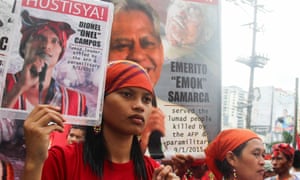
Environmental activist murders set record as 2015 became deadliest year

theguardian – Global Witness says at least 185 activists were killed and anti-mining activities were the most deadly – with 42 deaths related to protests

Michelle Campos says her father and grandfather were publicly executed in September 2015 for opposing mining in Mindanao, Philippines.

Michelle Campos says her father and grandfather were publicly executed in September 2015 for opposing mining in Mindanao, Philippines. Photograph: Tulda productions

At least 185 environmental activists were killed last year, the highest annual death toll on record and close to a 60% increase on the previous year, according to a UK-based watchdog. Tiếp tục đọc “Environmental activist murders set record as 2015 became deadliest year”

CSIS Southeast Asia Sit-Rep – June 16, 2016

CSIS Southeast Asia SIT-REP

This issue includes a look at Aung San Suu Kyi’s efforts to tackle communal problems in western Myanmar’s Rakhine State, an analysis of Philippine president-elect Rodrigo Duterte’s economic agenda, and much more. Links will take you to the full publications, multimedia, or to registration for upcoming programs when available. To jump to a section, select one of the following:

Tiếp tục đọc “CSIS Southeast Asia Sit-Rep – June 16, 2016”