Global warming to bring record hot year by 2028 – probably our first above 1.5°C limit

Academic rigour, journalistic flair, The Conversation

Lindsey Wasson/AP/AAP

Published: May 17, 2023 11.01am BST

Author

  1. Andrew KingSenior Lecturer in Climate Science, The University of Melbourne

Disclosure statement

Andrew King receives funding from the National Environmental Science Program.

Partners

University of Melbourne provides funding as a founding partner of The Conversation AU.

View all partners

CC BY NDWe believe in the free flow of information

One year in the next five will almost certainly be the hottest on record and there’s a two-in-three chance a single year will cross the crucial 1.5℃ global warming threshold, an alarming new report by the World Meteorological Organization predicts.

The report, known as the Global Annual to Decadal Climate Update, warns if humanity fails to reduce greenhouse gas emissions to net zero, increasingly worse heat records will tumble beyond this decade.

So what is driving the bleak outlook for the next five years? An expected El Niño, on top of the overall global warming trend, will likely push the global temperature to record levels.

Has the Paris Agreement already failed if the global average temperature exceeds the 1.5℃ threshold in one of the next five years? No, but it will be a stark warning of what’s in store if we don’t quickly reduce emissions to net zero.

boy plays in fountain during heatwave
One year in the next five will almost certainly be the hottest on record, bringing more heatwaves like this boy experienced in Britain around the time the last record was set. Andy Rain/EPA

Read more: Two trillion tonnes of greenhouse gases, 25 billion nukes of heat: are we pushing Earth out of the Goldilocks zone?


Warming makes record heat inevitable

The World Meteorological Organization update says there is a 98% chance at least one of the next five years will be the hottest on record. And there’s a 66% chance of at least one year over the 1.5℃ threshold.

Tiếp tục đọc “Global warming to bring record hot year by 2028 – probably our first above 1.5°C limit”

G-7 Hiroshima summit: Who’s attending, what will be discussed?

By MARI YAMAGUCHI today AP

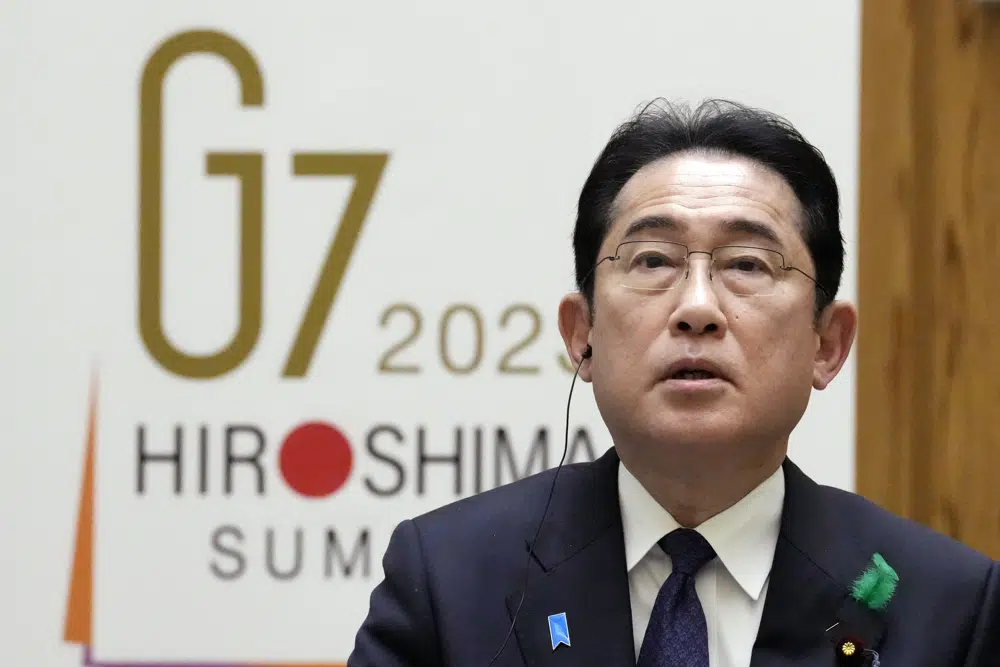
FILE - Japan's Prime Minister Fumio Kishida speaks during an interview with foreign media members at the Prime Minister's official residence Thursday, April 20, 2023, in Tokyo. Leaders of seven of the world’s most powerful democracies will gather this weekend for the Group of Seven summit in Hiroshima, the location of the world’s first atomic attack at the end of World War II. The leaders are expected to strongly condemn Russia’s war on Ukraine while pledging their continuing support for Ukraine. (AP Photo/Eugene Hoshiko, File)

FILE – Japan’s Prime Minister Fumio Kishida speaks during an interview with foreign media members at the Prime Minister’s official residence Thursday, April 20, 2023, in Tokyo. Leaders of seven of the world’s most powerful democracies will gather this weekend for the Group of Seven summit in Hiroshima, the location of the world’s first atomic attack at the end of World War II. The leaders are expected to strongly condemn Russia’s war on Ukraine while pledging their continuing support for Ukraine. (AP Photo/Eugene Hoshiko, File)

TOKYO (AP) — Leaders of seven of the world’s most powerful democracies will gather this weekend for the Group of Seven summit in Hiroshima, the location of the world’s first atomic attack at the end of World War II.

From the emergence of crucial developing countries to security worries, including growing aggression from China, North Korea and Russia, here’s a look at the G-7, who will attend and some of the key issues:

Tiếp tục đọc “G-7 Hiroshima summit: Who’s attending, what will be discussed?”

North Korea has stolen $721m worth of cryptocurrency from Japan in the past five years

Vietnam was the next largest victim, having lost $540m, the US following with $497m and finally Hong Kong, which suffered losses to the Diplomatic Republic of North Korea (DPRK) of $281m.

Hackers linked to the government in Pyongyang regularly target foreign adversaries looking to steal funds.

By Claudia Glover, techmonitor

North Korean hackers have stolen cryptocurrencies worth $721m from Japan in the past five years, a report revealed this week. The long history of animosity between the countries, and the close association between Japan and the US, is likely to be behind the trend, researchers say.

Japan has been the main target of North Korean hackers since 2017. (Photo by Astrelok/Shutterstock)

This figure is equal to 30% of the total of such losses worldwide, states the report. The research was carried out by UK cryptocurrency research company Elliptic on behalf of Asia Nikkei.

North Korea has stolen $721m from Japan since 2017

According to Elliptic’s findings, Japan is the worst hit by North Korea’s worldwide cryptocurrency raids, suffering $721m in thefts out of a global $2.3bn between 2017 and the end of 2022. 

Vietnam was the next largest victim, having lost $540m, the US following with $497m and finally Hong Kong, which suffered losses to the Diplomatic Republic of North Korea (DPRK) of $281m.

Tiếp tục đọc “North Korea has stolen $721m worth of cryptocurrency from Japan in the past five years”

Universal Declaration of Human Rights

Universal Declartion of Human Rights (1948) >>

The Core International Human Rights Instruments and their monitoring bodies

There are 9 core international human rights instruments. Each of these instruments has established a committee of experts to monitor implementation of the treaty provisions by its States parties. Some of the treaties are supplemented by optional protocols dealing with specific concerns whereas the Optional Protocol to the Convention against Torture establishes a committee of experts.

DateMonitoring Body
ICERDInternational Convention on the Elimination of All Forms of Racial Discrimination21 Dec 1965CERD
ICCPRInternational Covenant on Civil and Political Rights16 Dec 1966CCPR
ICESCRInternational Covenant on Economic, Social and Cultural Rights16 Dec 1966CESCR
CEDAWConvention on the Elimination of All Forms of Discrimination against Women18 Dec 1979CEDAW
CATConvention against Torture and Other Cruel, Inhuman or Degrading Treatment or Punishment10 Dec 1984CAT
CRCConvention on the Rights of the Child20 Nov 1989CRC
ICMWInternational Convention on the Protection of the Rights of All Migrant Workers and Members of Their Families18 Dec 1990CMW
CPEDInternational Convention for the Protection of All Persons from Enforced Disappearance20 Dec 2006CED
CRPDConvention on the Rights of Persons with Disabilities13 Dec 2006CRPD
ICESCR – OPOptional Protocol to the Covenant on Economic, Social and Cultural Rights10 Dec 2008CESCR
ICCPR-OP1Optional Protocol to the International Covenant on Civil and Political Rights16 Dec 1966CCPR
ICCPR-OP2Second Optional Protocol to the International Covenant on Civil and Political Rights, aiming at the abolition of the death penalty15 Dec 1989CCPR
OP-CEDAWOptional Protocol to the Convention on the Elimination of Discrimination against Women10 Dec 1999CEDAW
OP-CRC-ACOptional protocol to the Convention on the Rights of the Child on the involvement of children in armed conflict25 May 2000CRC
OP-CRC-SCOptional protocol to the Convention on the Rights of the Child on the sale of children, child prostitution and child pornography25 May 2000CRC
OP-CRC-ICOptional Protocol to the Convention on the Rights of the Child on a communications procedure19 Dec 2011CRC
OP-CATOptional Protocol to the Convention against Torture and Other Cruel, Inhuman or Degrading Treatment or Punishment18 Dec 2002SPT
OP-CRPDOptional Protocol to the Convention on the Rights of Persons with Disabilities12 Dec 2006CRPD
International Covenant on Civil and Political Rights (1966) >>

International Covenent on Economic, Social and Cultural Rights (1967) >>

A law that cancels cancel culture? This country is considering it

By Heather Chen, CNN

Published 9:57 PM EDT, Fri May 12, 2023

‘Cancel culture’ or corporate cowardice?

07:49 – Source: CNN — 

Cancel culture, the online trend of calling out people, celebrities, brands and organizations – rightly or wrongly – for perceived social indiscretions or offensive behaviors, has become a polarizing topic of debate.

To some, it’s an important means of social justice and holding powerful figures to account. But to others, it’s often “misused and misdirected” and has become a form of mob rule.

But one country wants to put an end to the deeply contested online phenomena by introducing what legal experts and observers say would be the world’s first law against cancel culture – raising alarm among rights activists who fear that such legal powers could be used to stifle free speech.

Over the past year, Singapore’s government has been “looking at ways to deal with cancel culture,” a spokesperson told CNN – amid what some say is a brewing culture war between gay rights supporters and the religious right following the recent decriminalization of homosexuality in the largely conservative city-state.

Tiếp tục đọc “A law that cancels cancel culture? This country is considering it”

Eight things the world must do to avoid the worst of climate change

Latest IPCC report highlights key measures countries must take to avoid climate catastrophe

Fiona Harvey, Environment editor, The Guardian Tue 21 Mar 2023 19.10 GMT

The Intergovernmental Panel on Climate Change published the “synthesis report” of its sixth assessment report (AR6) on Monday. Eight years in preparation, this mammoth report encompasses the entire range of human knowledge of the climate system, compiled by hundreds of scientists from thousands of academic papers, and published in four parts, in August 2021, February and April 2022, and March 2023.

The report drew together the most important findings – but also highlighted some key measures that governments and countries must take immediately if we are to avoid climate catastrophe:

Reduce methane

A flare to burn methane from oil production in North Dakota, US.
A flare to burn methane from oil production in North Dakota, US. Photograph: Matthew Brown/AP

Sharp cuts to short-lived climate pollutants, methane chief among them, could cut more than half a degree from global heating. Produced from oil and gas operations and coalmines, and from animal husbandry and natural sources – such as decaying vegetation – methane is a greenhouse gas about 80 times more powerful than carbon dioxide. But it lasts only for about 20 years before degrading into CO2.

Tiếp tục đọc “Eight things the world must do to avoid the worst of climate change”

Long popular in Asia, floating solar catches on in US

Search

The sun rises over floating solar panels on May 3, 2023, in Selangor, Malaysia. Floating solar panel farms are beginning to boom in the United States after rapid growth in Asia. They're attractive not just for their clean power and lack of a land footprint, but because they also conserve water by preventing evaporation. (AP Photo/Vincent Thian)

By ISABELLA O’MALLEY

May 10, 2023 AP

When Joe Seaman-Graves, the city planner for the working class town of Cohoes, New York, Googled the term “floating solar,” he didn’t even know it was a thing.

What he did know is that his tiny town needed an affordable way to get electricity and had no extra land. But looking at a map, one feature stood out.

“We have this 14-acre water reservoir,” he said.

Seaman-Graves soon found the reservoir could hold enough solar panels to power all the municipal buildings and streetlights, saving the city more than $500,000 each year. He had stumbled upon a form of clean energy that is steeply ramping up.

Tiếp tục đọc “Long popular in Asia, floating solar catches on in US”

Aggression in West PH Sea: China’s maritime ‘Great Wall’ plan

By: Kurt Dela Peña May 04, 2023 globalnation.inquirer.net

COMPOSITE IMAGE: JEROME CRISTOBAL FROM INQ/STOCK/PAMALAKAYA FILE PHOTOS

(First of two parts)

MANILA, Philippines—China is building a maritime ‘Great Wall’ in the South China Sea, including the West Philippine Sea, according to analysts who have been keeping tabs on Chinese aggression in the disputed waters.

But unlike the engineering marvel Great Wall built mainly for defense, the one that China is building on seas far from its coast is also for dominance, the analysts said.

In the 1990s, China started building structures over coral reefs and islets inside the Philippines’ exclusive economic zone (EEZ) in the West Philippine Sea. This was met by so far the strongest protest from the Philippine government—an arbitration case over the Scarborough Shoal standoff in 2012.

But China, instead, “flexed more of its military muscle.” The intrusion continued with impunity.

Tiếp tục đọc “Aggression in West PH Sea: China’s maritime ‘Great Wall’ plan”

How Bidenomics Has Finally Defeated Reaganomics


TRICKLE DOWN IS DONE

Two years into his presidency, Joe Biden has revolutionized America’s economic policy—both home and abroad.

David Rothkopf, thedailybeast

Published May. 03, 2023 4:11AM ET 


The last thing many of us expected when Joe Biden became president was that he would be a revolutionary. But just over two years into Biden’s presidency, there is no doubt that he has done more to dramatically transform U.S. policy and thinking in more areas than any of his predecessors since Franklin Roosevelt. Tiếp tục đọc “How Bidenomics Has Finally Defeated Reaganomics”

What the Bush-Obama China Memos Reveal

Newly declassified documents contain important lessons for U.S. China policy.

APRIL 29, 2023, 6:00 AM Foregn Policy

By Michael J. Green, the CEO of the United States Studies Centre at the University of Sydney, and Paul Haenle, the director of Carnegie China.

As U.S.-China relations transition from an era of engagement to one of strategic competition, some in the Biden and former Trump administrations have claimed to be abandoning four decades of naive American assumptions about Beijing. Past U.S. policy, they say, was based on a futile view that engagement would lead to a democratic and cooperative China. This, however, is not only a misreading of past U.S. policies but also dangerous analytical ground upon which to build a new national security strategy.

The fact is that no administration since that of Richard Nixon has made U.S. security dependent on Chinese democratization. Every administration has combined engagement with strategies to counterbalance China through alliances, trade agreements, and U.S. military power. Throwing out all previous U.S. approaches to China would mean throwing out some of the most important tools the current administration relies on to compete with China. And the Biden administration will not get its China strategy right until it is clear about what has worked in the past.

Hand-Off: The Foreign Policy George W. Bush Passed to Barack Obama; Stephen J. Hadley, Peter D. Feaver, William C. Inboden, and Meghan L. O’Sullivan (eds.); Brookings Institution Press, 774 pp., $39, February 2023

Tiếp tục đọc “What the Bush-Obama China Memos Reveal”

U.S. Support for the Philippines in the South China Sea

PRESS STATEMENT

OFFICE OF THE SPOKESPERSON

US STATE DEPARTMENT

APRIL 29, 2023

The United States stands with The Philippines in the face of the People’s Republic of China (PRC) Coast Guard’s continued infringement upon freedom of navigation in the South China Sea. Imagery and video recently published in the media is a stark reminder of PRC harassment and intimidation of Philippine vessels as they undertake routine patrols within their exclusive economic zone.  We call upon Beijing to desist from its provocative and unsafe conduct. The United States continues to track and monitor these interactions closely.

Tiếp tục đọc “U.S. Support for the Philippines in the South China Sea”