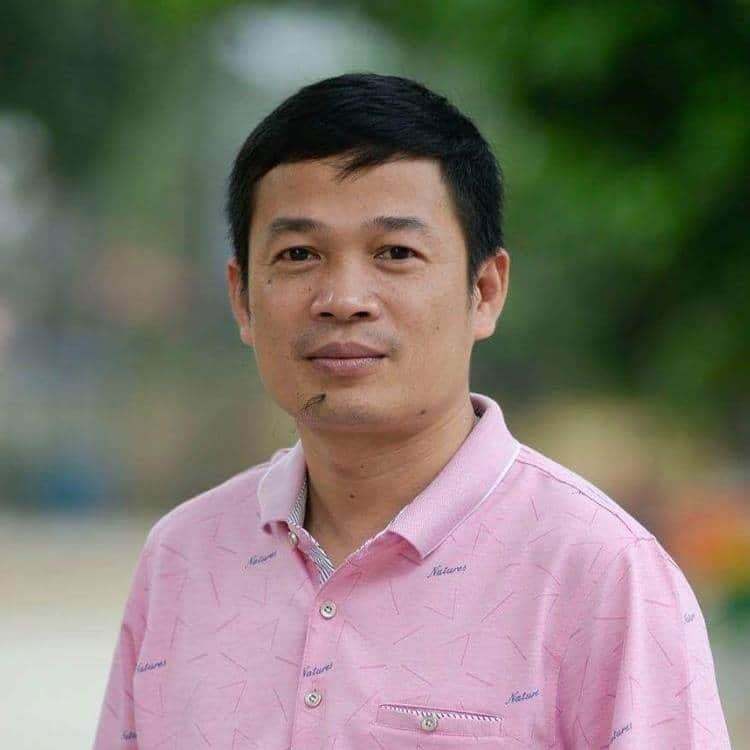
I am an attorney in the Washington DC area, with a Doctor of Law in the US, attended the master program at the National School of Administration of Việt Nam, and graduated from Sài Gòn University Law School. I aso studied philosophy at the School of Letters in Sài Gòn.
.
I have worked as an anti-trust attorney for Federal Trade Commission and a litigator for a fortune-100 telecom company in Washington DC.
I have taught law courses for legal professionals in Việt Nam and still counsel VN government agencies on legal matters.
I have founded and managed businesses for me and my family, both law and non-law.
I have published many articles on national newspapers and radio stations in Việt Nam.
In 1989 I was one of the founding members of US-VN Trade Council, working to re-establish US-VN relationship.
Since the early 90's, I have established and managed VNFORUM and VNBIZ forum on VN-related matters; these forums are the subject of a PhD thesis by Dr. Caroline Valverde at UC-Berkeley and her book Transnationalizing Viet Nam.
I translate poetry and my translation of "A Request at Đồng Lộc Cemetery" is now engraved on a stone memorial at Đồng Lộc National Shrine in VN.
I study and teach the Bible and Buddhism. In 2009 I founded and still manage dotchuoinon.com on positive thinking and two other blogs on Buddhism.
In 2015 a group of friends and I founded website CVD - Conversations on Vietnam Development (cvdvn.net).
I study the art of leadership with many friends who are religious, business and government leaders from many countries.
I have written these books, published by Phu Nu Publishing House in Hanoi:
"Positive Thinking to Change Your Life", in Vietnamese (TƯ DUY TÍCH CỰC Thay Đổi Cuộc Sống) (Oct. 2011)
"10 Core Values for Success" (10 Giá trị cốt lõi của thành công) (Dec. 2013)
"Live a Life Worth Living" (Sống Một Cuộc Đời Đáng Sống) (Oct. 2023)
I practice Jiu Jitsu and Tai Chi for health, and play guitar as a hobby, usually accompanying my wife Trần Lê Túy Phượng, aka singer Linh Phượng.
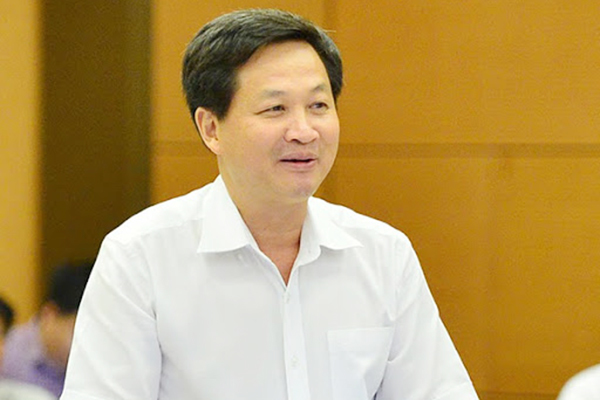
On September 14, Government Inspector General Le Minh Khai represented the Government in reporting to the National Assembly Standing Committee on anti-corruption tasks in 2020.
Government Inspector General Le Minh Khai
According to the Government Inspectorate’s report, some high-ranking officials were suspended from work after investigating their involvement in legal cases, including former Hanoi Mayor Nguyen Duc Chung and former Vice Chairman of HCM City Tran Vinh Tuyen.
12 high-ranking officials faced criminal sanctions for being irresponsible, causing corruption cases.
The authorities also disciplined 56 officials, handled 64 officials for criminal violation of norms and standards and recovered nearly VND23 billion related to the violations.
Vietnam has never had the strength and position as good as it has now to rise up. We need to have a mindset of going ahead. Only when we carry that mindset will we be able to seize the opportunity.
VietNamNet introduces the last part of the presentation by Minister of Planning and Investment Nguyen Chi Dung.
Focus on transport infrastructure, energy
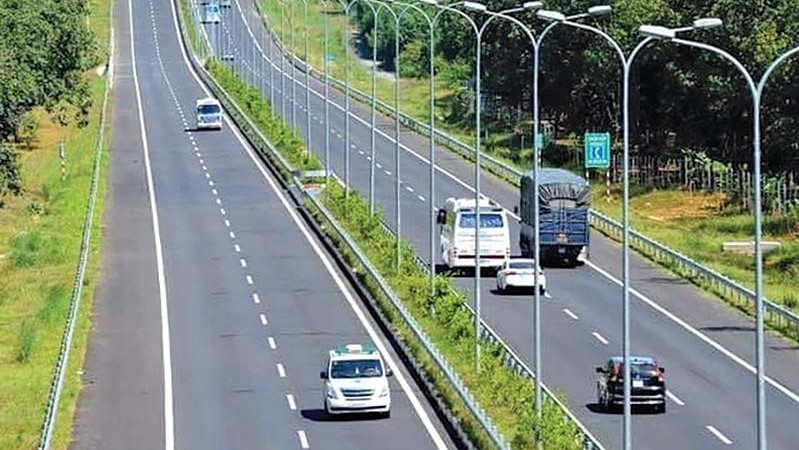
Three North – South expressway projects will start this September.
In terms of investment, Vietnam needs to focus on major transport infrastructure and energy projects to improve the competitiveness of the economy, and build the North-South expressway soon. No country can develop without expressways. Tiếp tục đọc “Vietnam must ‘go ahead, not follow’”→
French lensman Pierre Dieulefils captured images of daily life in Vietnam in the 1880s.
At the end of the 19th century southern women preferred “ao ngu than” (five-piece ao dai) and beaded jewelry. According to designer Sy Hoang, rich women used to wear this type of ao dai, with four layers representing the parents of the wife and husband and the fifth, the wearer. The tunic also had five buttons, symbolic of the five qualities everyone should have – nhan (kindness), le (decorum), nghia (uprightness), tri (wisdom) and tin (faithfulness). Tiếp tục đọc “Vietnam in the late 19th century through French photographer’s lens”→
Donald Trump is making rivalry with China a key platform in his re-election campaign as relations between the two countries continue to deteriorate. Photo composite: AFP
Luật này quy định về hoạt động đầu tư theo phương thức đối tác công tư; quản lý nhà nước, quyền, nghĩa vụ và trách nhiệm của cơ quan, tổ chức, cá nhân có liên quan đến hoạt động đầu tư theo phương thức đối tác công tư.
Luật này áp dụng đối với các bên trong hợp đồng đầu tư theo phương thức đối tác công tư, cơ quan quản lý nhà nước và cơ quan, tổ chức, cá nhân có liên quan đến hoạt động đầu tư theo phương thức đối tác công tư.
When asked if reporters were threatening their businesses in order to receive advertising in their newspapers, a number of businesspeople said there “have been numerous such cases”.
T, the media executive of a large private corporation, showed VietNamNet reporters a message on his mobile phone, which had been sent that day.
Nguyen Tri Thuc from Tap Chi Cong San
The sender introduced himself as a reporter and asked for a meeting with the spokesperson of the corporation to get ‘some related documents’.
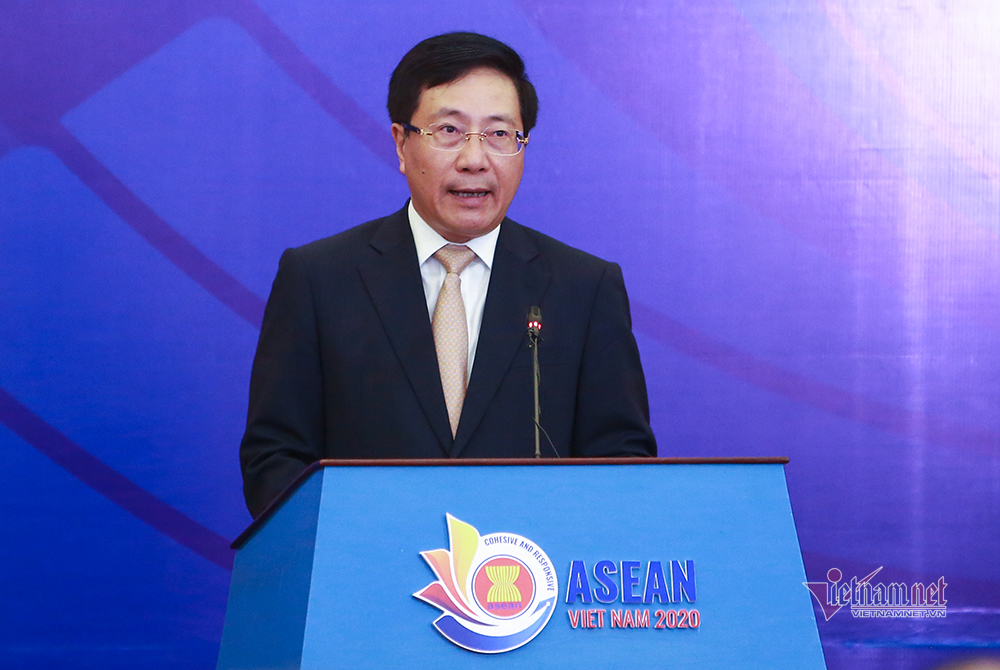
ASEAN is steadfast in its stance of restraint and peaceful settlement of disputes on the basis of international law in the face of threats to stability, security and safety, and freedom of navigation and aviation in the East Sea.
Speaking at the opening of the 53rd ASEAN Foreign Ministers Meeting (AMM 53) and related conferences on September 9, Deputy Prime Minister and Foreign Minister Pham Binh Minh said this was the first time the meeting has been held online. “Dynamism in action, flexibility in response, and creativity in cooperation are characteristic of ASEAN over the past five decades,” he said.
Deputy Prime Minister and Foreign Minister Pham Binh Minh
Entering its 6th decade, ASEAN is now in a period of accelerating community building, while promoting its role and position in the region and actively contributing to efforts for peace, stability and development of the international community.
China is introducing countermeasures ‘to urge the US to repeal its wrong decisions’.
The unspecified countermeasures will apply to all US embassy and consulate staff and the consulate-general in Hong Kong, a ministry statement said [Carlos Garcia Rawlins/Reuters]
Beijing will impose “reciprocal restrictions” on all American diplomats in China in response to earlier curbs on the activities of its embassy staff in the United States, China’s Ministry of Foreign Affairs has said.
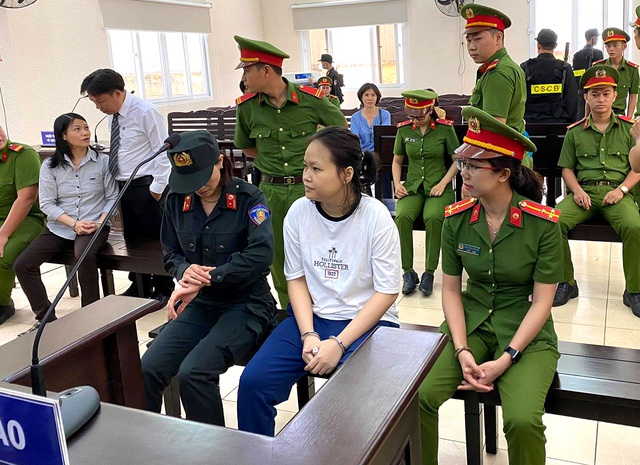
Update: July, 03/2020 – 16:19|vietnamnewsPhạm Thị Thiên Hà (centre) in court on Friday morning. — Photo dantri.com.vn
BÌNH DƯƠNG — A woman who murdered two men and encased their bodies in concrete has been sentenced to death.
Phạm Thị Thiên Hà followed a controversial religious cult but took its practices to extreme measures, insisting members fasted for up to two weeks at a time and cut all ties with their families.
Minister of Planning and Investment Nguyen Chi Dung has urged localities in the south-east and Mekong Delta regions to develop transport infrastructure by diversifying the sources of and effectively using capital over the next five years.
Vam Cong Bridge across Hau River in the Mekong Delta. VNA/VNS Photo
Speaking at a conference on socio-economic development in the two regions, he called on them to lay out their objectives and priorities for public investment in 2021-25 to ensure “focused and effective investment.”
By Huyen Le September 10, 2020 | 08:50 pm GMT+7 vnexpressA vessel by the Vietnam Fisheries Resources Surveillance performs its duty at sea. Photo by VnExpress/Nguyen Dong.
Vietnam and China have agreed to promote negotiations for the delimitation of sea areas beyond the mouth of the Gulf of Tonkin.
The two sides will also negotiate cooperation on the East Sea, which is known internationally as the South China Sea.
The two countries held online the 13th round of negotiations regarding the seas beyond the mouth of the Gulf of Tonkin and the 10th round of consultation on cooperation for mutual benefit at sea on Wednesday, according to a Thursday press release from the Ministry of Foreign Affairs.
Clean Cities, Blue Ocean (CCBO) is USAID’s flagship program for combatting ocean plastic pollution. The program works globally to target ocean plastics directly at their source, focusing on rapidly urbanizing areas that contribute significantly to the estimated eight million metric tons of plastic that flow into the ocean each year.
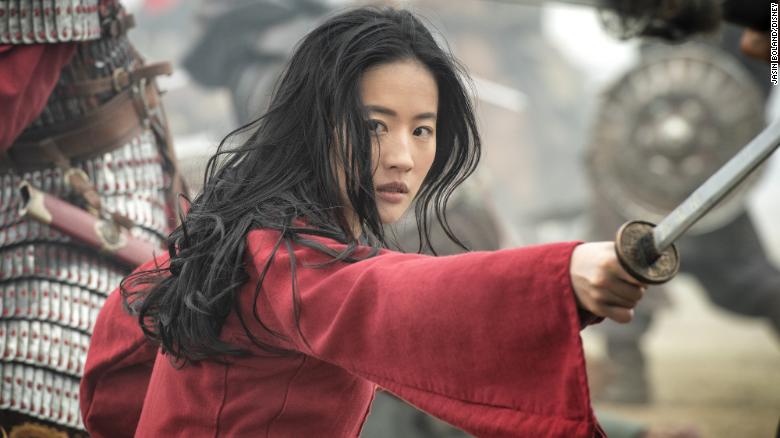
Hong Kong (CNN Business)Disney has publicly thanked a Chinese government agency accused of human rights abuses in Xinjiang for its help in making “Mulan” — a revelation that has provoked a storm of criticism online.Disney (DIS) acknowledges several Chinese government bodies in the credits for the live-action remake of the 1998 animated picture of the same name, but a few in particular have raised red flags: The Xinjiang government’s publicity department and the Public Security and Tourism bureaus for Turpan, a city of about 633,400 people just outside Xinjiang’s capital Urumqi.Disney did not respond to a request for comment from CNN Business to its media inquiry line, and to US press officers about the film and the credits. It’s not clear how much of “Mulan” may have been shot in Xinjiang, though people who worked on the movie have said on social media and in interviews that they scouted and filmed locations there.The US State Department estimates that since 2015 as many as two million of the Muslim-majority Uyghurs and other Turkic minorities have been imprisoned in enormous re-education camps in Xinjiang.The Turpan Public Security Bureau has been listed by the US government as an organization involved in “human rights violations and abuses” in the region.Beijing has long defended the crackdown in Xinjiang as necessary to tackle extremism and terrorism, and said it is in line with Chinese law and international practice, calling accusations of mass detentions a “groundless lie” and “sensational rumor.” A spokesperson for the country’s foreign ministry on Tuesday reiterated its defense of what it calls its Xinjiang “vocational skills education and training centers.” CNN Business has reached out to the Xinjiang government and Turpan’s tourism bureau, but Turpan’s Public Security bureau could not be reached for comment.
By David Lawder Reuters Posted September 9, 2020 12:55 am Updated September 9, 2020 12:56 am
U.S. impose sanctions on senior Chinese official over alleged Uighur rights abuse
U.S. Customs and Border Protection officials have prepared orders to block imports of cotton and tomato products from western China’sXinjiang region over allegations they are produced with forced labor, although a formal announcement has been delayed.
The Trump administration announcement of the actions, initially expected on Tuesday, has been put off until later this week because of “scheduling issues,” a CBP spokesman said.
The cotton and tomato bans along with five other import bans over alleged Xinjiang forced-labor abuses would be an unprecedented move by CBP and likely stoke tensions between the world’s two largest economies.
The “Withhold Release Orders” allow the CBP to detain shipments based on suspicion of forced-labor involvement under long-standing U.S. laws aimed at combating human trafficking, child labor and other human rights abuses.STORY CONTINUES BELOW ADVERTISEMENT
President Donald Trump’s administration is ratcheting up pressure on China over its treatment of Xinjiang’s Uighur Muslims. The United Nations has said it has credible reports that 1 million Muslims have been detained in camps in the region, where they are put to work.1:46China warns U.S. over Uighur bill, raising doubts over early trade dealChina warns U.S. over Uighur bill, raising doubts over early trade deal
China denies mistreatment of the Uighurs and says the camps are vocational training centers needed to fight extremism.
CBP Executive Assistant Commissioner Brenda Smith told Reuters that the effective import bans would apply to the entire supply chains involving cotton, including cotton yarn, textiles and apparel, as well as tomatoes, tomato paste and other products exported from the region.
“We have reasonable but not conclusive evidence that there is a risk of forced labor in supply chains related to cotton textiles and tomatoes coming out of Xinjiang,” Smith said in an interview. “We will continue to work our investigations to fill in those gaps.”STORY CONTINUES BELOW ADVERTISEMENT
U.S. law requires the agency to detain shipments when there is an allegation of forced labor, such as from non-governmental organizations, she said.
The bans could have far-reaching effects for U.S. retailers and apparel producers, as well as food manufacturers. China produces about 20% of the world’s cotton and most of it comes from Xinjiang. China also is the world’s largest importer of cotton, including from the United States.
The China Cotton Association, a trade body, declined to comment on Wednesday.
A Beijing-based cotton trader said the impact may be limited as China brings in about 2 million tonnes of cotton and 2 million tonnes of cotton yarn from abroad each year, which may be sufficient to produce textiles for the United States. Xinjiang’s output is about 5 million tonnes.
“If Xinjiang cotton goes to the domestic industry and non-Western markets, the impact may be limited, it can probably still be digested,” he said.
In the short-term, it could also boost cotton imports into China, he added.STORY CONTINUES BELOW ADVERTISEMENThttps://df7719edd330f16da50a98d8c70a9d62.safeframe.googlesyndication.com/safeframe/1-0-37/html/container.html0:40Teen’s TikTok tutorial turns into a plea for Uighurs in ChinaTeen’s TikTok tutorial turns into a plea for Uighurs in China
‘Abusive working and living conditions’
In March, U.S. lawmakers proposed legislation that would effectively assume that all goods produced in Xinjiang are made with forced labor and would require certification that they are not.
In July, Washington issued an advisory saying companies doing business in Xinjiang or with entities using Xinjiang labor could be exposed to “reputational, economic, and legal risks.”
The State Department also said it sent a letter to top American companies including Walmart Inc, Apple Inc and Amazon.com Inc warning them over risks faced from maintaining supply chains associated with human rights abuses in Xinjiang region.
In a draft announcement seen by Reuters, the CBP said it identified forced-labor indicators involving the cotton, textile and tomato supply chains “including debt bondage, unfree movement, isolation, intimidation and threats, withholding of wages, and abusive working and living conditions.”STORY CONTINUES BELOW ADVERTISEMENT
The agency’s orders would block cotton produced by the Xinjiang Production and Construction Corps, and apparel produced by Yili Zhuowan Garment Manufacturing Co Ltd and Baoding LYSZD Trade and Business Co Ltd. It says those entities use prison labor from Chinese government administered “re-education” internment camps.2:18Leaked documents reveal China’s surveillance of minority UighursLeaked documents reveal China’s surveillance of minority Uighurs
In addition, the proposed CBP orders would block imports of products made at the Lop County Industrial Park as well as the Lop County No. 4 Vocational Skills Education and Training Center. The moves follow the detention on July 1 of hair extensions and other goods from the Lop County Meixin Hair Product Co..
The CBP orders would also block imports of computer parts made by the Hefei Bitland Information Technology Co Ltd, based in Anhui, China.



![The unspecified countermeasures will apply to all US embassy and consulate staff and the consulate-general in Hong Kong, a ministry statement said [Carlos Garcia Rawlins/Reuters]](https://www.aljazeera.com/mritems/imagecache/mbdxxlarge/mritems/Images/2020/9/11/e060e7920ca14e3cbcbe65d3513e6964_18.jpg "Beijing to impose restrictions on all US diplomats in China")
 Phạm Thị Thiên Hà (centre) in court on Friday morning. — Photo dantri.com.vn
 A vessel by the Vietnam Fisheries Resources Surveillance performs its duty at sea. Photo by VnExpress/Nguyen Dong.

 1:46China warns U.S. over Uighur bill, raising doubts over early trade dealChina warns U.S. over Uighur bill, raising doubts over early trade deal
 0:40Teen’s TikTok tutorial turns into a plea for Uighurs in ChinaTeen’s TikTok tutorial turns into a plea for Uighurs in China
 2:18Leaked documents reveal China’s surveillance of minority UighursLeaked documents reveal China’s surveillance of minority Uighurs
