Political declaration on establishing the Just Energy Transition Partnership with Viet Nam

GOV.UK

Published 14 December 2022

  1. The Governments of the Socialist Republic of Viet Nam, together with the International Partners Group, consisting of the European Union, the United Kingdom of Great Britain and Northern Ireland, the United States of America, Japan, the Federal Republic of Germany, the Republic of France, the Italian Republic, Canada, the Kingdom of Denmark and the Kingdom of Norway;
  2. Recognising the need to accelerate action towards the objectives and long-term goals of the United Nations Framework Convention on Climate Change (UNFCCC) and the Paris Agreement, including through the implementation of the Glasgow Climate Pact, to minimise the worst adverse impacts of climate change for countries, people and the environment;
  3. Noting that limiting global warming to 1.5°C to mitigate the worst adverse impacts of climate change requires rapid, deep and sustained reductions in global greenhouse gas emissions, including reducing global carbon dioxide emissions by 45% by 2030 relative to the 2010 level and to net zero around mid-century as well as deep reductions in other greenhouse gas emissions, emphasising climate change adaptation and achieving net zero emissions as an opportunity for sustainable development;
  4. Recognising that for Viet Nam, as an independent, sovereign and fast developing lower middle income country heavily affected by the impacts of climate change, it will be key to embrace the opportunities brought about by the fast decreasing cost of renewable energies as an opportunity for sustainable development and to tackle related challenges such as poverty, inequality and unemployment, which are exacerbated by the impact of the COVID-19 pandemic and climate change, and that vulnerable groups and some important economic sectors may be impacted by the energy transition, including thermal electricity generation, coal mining, heavy industry and transport;
  5. Recognising the need for new, predictable, long-term and sustainable support from partner countries, multilateral organisations and investors in finance, technology and capacity building for Viet Nam to exploit fully the opportunities of the transition in accordance with the national framework of public debt and external debt management to contribute significantly to the implementation of the NDC of Viet Nam, its commitment to reach to net zero greenhouse gas emissions by 2050 and its development orientation to become a high-income developed country by 2045;
  6. Tiếp tục đọc “Political declaration on establishing the Just Energy Transition Partnership with Viet Nam”

In Hindsight: The Long and Winding Road to UN Security Council Reform 

securitycouncilreport.org

The current war in Ukraine, which has shown the impotence of the UN Security Council when one of its permanent members goes to war in violation of the UN Charter, has brought renewed energy to the debate over reforming the Council. Security Council reform has been an ongoing topic of discussion in the UN General Assembly since the early post-Cold War period, with reform pressures tending to intensify in response to an international crisis that exposes the structural weaknesses of the Security Council.   

The new momentum for changing the status quo took off on 27 February, when the Security Council referred the situation in Ukraine to the General Assembly following its own failure to adopt a draft resolution deploring Russia’s aggression against Ukraine. This was the Security Council’s first use of a “Uniting for Peace” resolution in 40 years. Two months later, through an initiative led by Liechtenstein, the General Assembly decided by consensus (A/RES/76/262, adopted on 26 April) that it would meet whenever a veto is cast in the Security Council. It has now convened twice in accordance with this new procedure: following vetoes by China and Russia on the Democratic People’s Republic of Korea in May, and after a Russian veto on Syria in July.   

Security Council Reform: What Does It Mean, What Would It Require? 

Tiếp tục đọc “In Hindsight: The Long and Winding Road to UN Security Council Reform “

The Mekong Delta is drowning in ‘sand debt’ – it urgently needs a sand budget

thethirdpole.net

With data on the flow of sand from the upstream Mekong and the amount being extracted, scientists can now calculate how much sand can be mined without further harm to Vietnam’s Mekong Delta

<img src="https://www.thethirdpole.net/content/uploads/2022/12/Dredged-sand-transported-in-Mekong-Delta_Alamy_HFPKCG-scaled.jpg&quot; alt="

Dredged sand is transported in the Mekong Delta, Vietnam. The Mekong Delta is sinking due to unsustainable sand mining and the impacts of upstream dams. (Image: Josef Kubes / Alamy)

“>

Dredged sand is transported in the Mekong Delta, Vietnam. The Mekong Delta is sinking due to unsustainable sand mining and the impacts of upstream dams. (Image: Josef Kubes / Alamy)

Marc Goichot

December 7, 2022

Many people will be familiar with the dread when your income no longer covers your expenses; when you’ve exhausted your savings and are sinking ever deeper into debt. In the Mekong Delta, a similar downward spiral is happening. But it’s not the delta’s finances that are draining away – it’s the sand that sustains it. Not its economic stability that is being undermined, but its very foundations.

The Mekong is literally drowning in ‘sand debt’: far more sand is being removed than is being replenished. Without a budget setting out how much sand can be extracted sustainably, this debt will turn into disaster.

If you only look at the headline figures, all seems well with Vietnam’s Mekong Delta and the connected Dong Nai Delta – home to a combined 40 million people, growing cities, thriving economies, and a major regional rice bowl and seafood source. But a closer look reveals some real cause for alarm. The Mekong Delta is sinking. Saltwater is intruding ever further inland. The water table is dropping. All these come with significant costs to communities and nature, as infrastructure, livelihoods and the survival of species are negatively affected.

house collapse due to Mekong delta erosion

RECOMMENDEDAs the Mekong delta washes away, homes and highways are being lost

Tiếp tục đọc “The Mekong Delta is drowning in ‘sand debt’ – it urgently needs a sand budget”

As climate changes, Mekong farmers try floating rice

mekongeye.com

Mekong Delta farmers turn to indigenous rice strain to counter unpredictable floods as upstream dams affect water flow

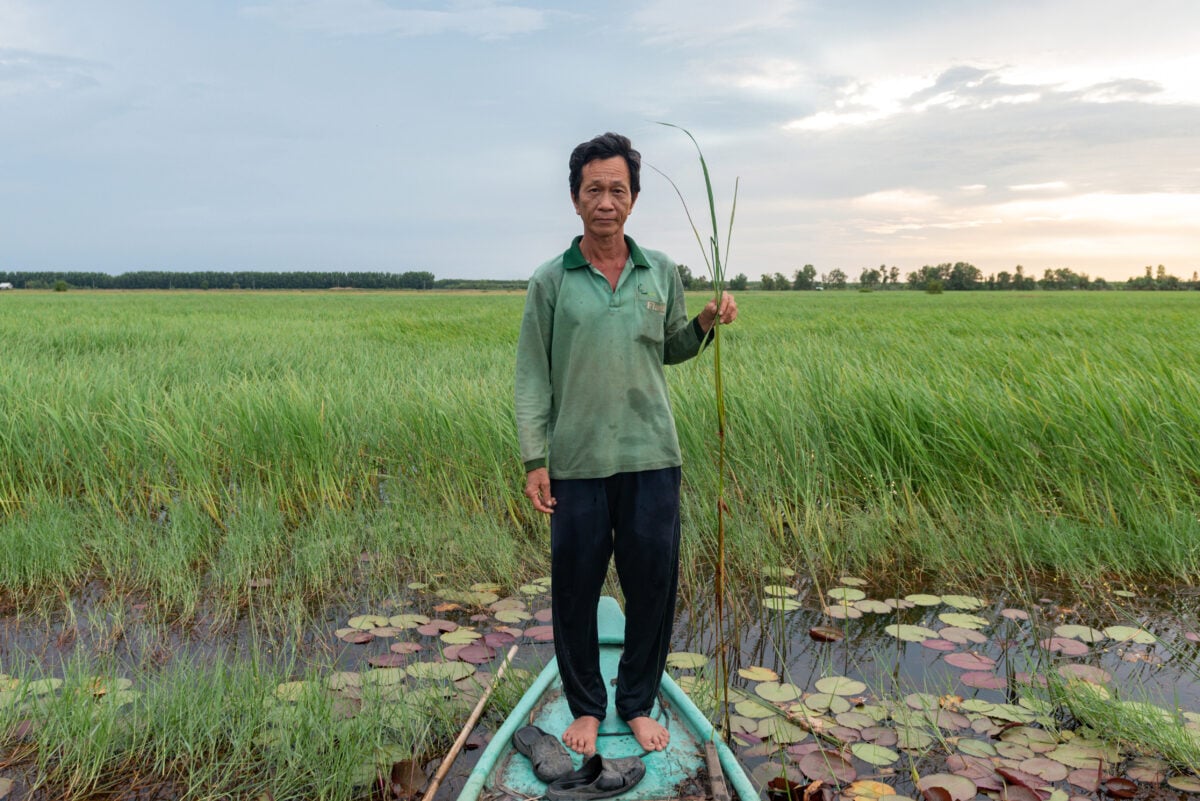
Farmer Bui Bich Tien, 52, holds a floating rice plant that grows taller than himself in his fields during the floating season in Vinh An hamlet, An Giang province, Vietnam. PHOTO: Thanh Hue

AN GIANG, VIETNAM – Before the first August rain of the flood season in Vietnam’s Mekong Delta, Bui Bich Tien started planting rice seedlings. Over the next six months, as the annual floods from upstream inundated his farmland in Vinh An hamlet, Tri Ton district in An Giang province, the rice grew with and above the rising water level.

This is no ordinary rice variety. Known as floating or deep-water rice, as the water level rises, the rice plants outgrow it, reaching up to three meters tall. It was once a staple, feeding farmers across five Mekong countries.

Tien, 52, is one of the few farmers to continue this tradition. He has been growing this species since he inherited 1.5 hectares of land in 1999.

Tiếp tục đọc “As climate changes, Mekong farmers try floating rice”

Charting a path for Vietnam to achieve its net-zero goals

Mckinsey.com

By harnessing opportunities across sectors—particularly in power—Vietnam could potentially accelerate decarbonization to achieve net-zero emissions by 2050.

Vietnam is more exposed to climate risk than nearly any other country in the world. By some estimates, it is one of the top five countries likely to be most affected by climate change.1 Barring adaptation and mitigation measures, the country could face severe social and economic consequences.

Stakeholders across the country understand this reality and have begun making pledges and announcing policies aimed at reducing greenhouse-gas (GHG) emissions. At the UN Climate Change Conference in Glasgow (COP26) in 2021, Prime Minister Pham Minh Chinh announced the country’s commitment to phase out coal power generation by the 2040s and achieve net-zero carbon emissions by 2050. Most recently, in its National Strategy on Climate Change, Vietnam announced a 43.5 percent emissions-reduction target by 2030, sector-specific emissions targets for 2030 and 2050, and qualitative suggestions for achieving these goals.2

While these are praiseworthy goals, they are unlikely to propel Vietnam to net-zero emissions by 2050 on their own. Carrying out that mission will require more detailed and specific actions. To sketch out one possible scenario for Vietnam to achieve its climate ambitions, we conducted a bottom-up analysis of the country’s key economic sectors and the required emissions trajectory. Carefully focused and aggressive actions to reduce emissions across sectors of the economy, especially in power, could put Vietnam on a path to potentially achieve net-zero emissions by 2050.

This transition won’t be easy. Vietnam faces structural challenges, and the transition will require considerable investment—as well as significant mindset and operational changes. Nonetheless, by building on existing efforts and engaging across sectors, Vietnam could realize its commitments and help keep global warming below key thresholds.

Such actions would also improve health outcomes, provide access to new sustainable value pools, and grow GDP.

The net-zero imperative and progress to date

Tiếp tục đọc “Charting a path for Vietnam to achieve its net-zero goals”

WHO: COVID disruption resulted in 63,000 more malaria deaths

APnews.com

FILE - Surgeon and doctor-turned-refugee, Dr. Tewodros Tefera, prepares a malaria test for 23-year-old Tigrayan refugee Hareg from Mekele, Ethiopia, at the Sudanese Red Crescent clinic in Hamdayet, eastern Sudan, near the border with Ethiopia, on March 17, 2021. The coronavirus pandemic interrupted efforts to control malaria, resulting in 63,000 more deaths and 13 million more infections. That's according to a World Health Organization report released Thursday Dec. 8, 2022. (AP Photo/Nariman El-Mofty, File)

FILE – Surgeon and doctor-turned-refugee, Dr. Tewodros Tefera, prepares a malaria test for 23-year-old Tigrayan refugee Hareg from Mekele, Ethiopia, at the Sudanese Red Crescent clinic in Hamdayet, eastern Sudan, near the border with Ethiopia, on March 17, 2021. The coronavirus pandemic interrupted efforts to control malaria, resulting in 63,000 more deaths and 13 million more infections. That’s according to a World Health Organization report released Thursday Dec. 8, 2022. (AP Photo/Nariman El-Mofty, File)

The coronavirus pandemic interrupted efforts to control malaria, resulting in 63,000 additional deaths and 13 million more infections globally over two years, according to a report from the World Health Organization published Thursday.

Cases of the parasitic disease went up in 2020 and continued to climb in 2021, though at a slower pace, the U.N. health agency said Thursday. About 95% of the world’s 247 million malaria infections and 619,000 deaths last year were in Africa.

“We were off track before the pandemic and the pandemic has now made things worse,” said Abdisalan Noor, a senior official in WHO’s malaria department.

Alister Craig, dean of biological sciences at the Liverpool School of Tropical Medicine, noted that progress in reducing malaria deaths had stalled even before COVID-19.

“It is almost as if we have reached a limit of effectiveness for the tools we have now,” said Lister, who was not linked to the WHO report.

ADVERTISEMENT

Noor said he expected the wider rollout of the world’s first authorized malaria vaccine next year to have a “considerable impact” on reducing the number of severe illnesses and deaths if enough children get immunized, adding that more than 20 countries have applied to vaccines alliance Gavi for help in securing the shot. Still, the vaccine is only about 30% effective and requires four doses.

Bed nets can protect people from being bitten by the mosquitoes that spread malaria. The WHO report found that about three-quarters of nets provided by donors have been distributed, but there are major gaps in some of the worst-hit countries. Authorities in Nigeria, for example, gave out just over half their nets, while Congo distributed about 42% of theirs.

Officials also raised concerns about a new invasive mosquito species that thrives in cities, is resistant to many pesticides and which could undo years of progress against malaria. The invasive species has not yet significantly contributed to the continent’s overall malaria burden, but the insects are likely responsible for a recent spike in parts of the horn of Africa, Noor said.

David Schellenberg, a professor at the London School of Hygiene and Tropical Medicine, said there were promising new tools and strategies to tackle malaria, but that “the elephant in the room is the level of funding.” WHO estimated the total investment into malaria — about $3.5 billion — was less than half of what was needed to dramatically reduce its impact.

___

The Associated Press Health and Science Department receives support from the Howard Hughes Medical Institute’s Science and Educational Media Group. The AP is solely responsible for all content.

Indonesian families sue government over deaths from syrup medicines

theguardian.com

Since August, 199 people have died of acute kidney injury, prompting an inquiry and ban on some medicines

A pharmacy in Jakarta, Indonesia displays a sign that says the sale of medicinal syrup has been temporarily halted.
A pharmacy in Jakarta, Indonesia, displays a sign saying the sale of medicinal syrup has been temporarily halted. Photograph: Tatan Syuflana/AP

Rebecca Ratcliffe and agenciesFri 2 Dec 2022 06.20 EST

A dozen families, whose relatives died or fell ill after consuming cough syrup medicines, have sued the Indonesian government and companies accused of supplying the products.

At least 199 people, many of them young children, have died as a result of acute kidney injury since August, prompting the government to ban some syrup medicines and launch an investigation.

Agence France-Presse, which reported news of the lawsuit, said the class action been launched against the ministry of health, the country’s food and drug agency and seven companies implicated in selling dangerous syrups.

Families are seeking compensation of about 2 bn rupiah (£103,000) for every person killed and about 1 bn rupiah for every person injured, according to Awan Puryadi, a legal representative of the victims’ relatives.

https://25a58290001841e3759427c40c91e7bb.safeframe.googlesyndication.com/safeframe/1-0-40/html/container.html

He told AFP that the authorities had failed to prevent the sale of harmful medicines. “No one has claimed responsibility. They are very disappointed with the current situation,” Puryadi said.

Indonesia’s food and drug agency has suspended the licences of at least three manufacturers that were producing syrup medicines while police investigate.

According to a World Health Organization product alert issued in November, eight products in Indonesia were found by the national regulatory authority to contain dangerous levels of ethylene glycol and/or diethylene glycol – colourless liquids that are typically used in antifreeze.

According to the WHO, the consumption of such compounds, especially by children, may result in serious injury or death. Toxic effects can include “abdominal pain, vomiting, diarrhoea, inability to pass urine, headache, altered mental state, and acute kidney injury which may lead to death”, the WHO has warned.

In October, the World Health Organization issued an alert over four Indian-made cough and cold syrups that it said could be linked to acute kidney injuries and the deaths of 70 children in the Gambia.

Indonesia passes new criminal code, outlaws sex outside marriage

aljazeera.com

Controversial changes fuelled protests when they were first proposed in 2019 and could still be challenged in court.

Bambang Wuryanto, head of the parliamentary commission overseeing the amendments to the criminal code, passes the newly passed law to the deputy speaker of parliament.
Parliament passed the controversial law on Tuesday [Willy Kurniawan/Reuters]

Published On 6 Dec 20226 Dec 2022

Indonesia has passed a controversial new Criminal Code that includes outlawing sex outside marriage and cohabitation, in changes that critics contend could undermine freedoms in the Southeast Asian nation.

The new laws apply to Indonesians and foreigners and also restore a ban on insulting the president, state institutions or Indonesia’s national ideology known as Pancasila.

Tiếp tục đọc “Indonesia passes new criminal code, outlaws sex outside marriage”

The Reality of Vietnam’s Energy Transition

The country has emerged as a regional leader in renewables, but some thorny challenges lie ahead.

thediplomat.com

By Kathryn Neville November 25, 2022

The Reality of Vietnam’s Energy Transition
The Vinh Tan thermal power plant in Binh Thuan province, Vietnam.Credit: Depositphotos

ADVERTISEMENT

Earlier this fall, U.S. climate envoy John Kerry shone a spotlight on Vietnam, urging the Southeast Asian nation to “do what is sensible” and refocus its energy sector by investing in renewables and retiring fossil fuels. His remarks coincided with a deal between the European Union and the United Kingdom that made headway last week, which will see the two powers invest at least $11 billion in Vietnam’s green transition. The Just Energy Transition Partnership (JETP) seeks to cancel projects for new coal plants and build out 60GW of renewable energy capacity by 2030. Expected to be finalized at an Association of Southeast Asian Nations (ASEAN) meeting next month, the ambitious package will include public and private financing, technology transfers, and technical assistance.

JETP is not the first deal of its kind. The last decade has seen investors show a growing interest in expanding renewable technology in Southeast Asia. But for Vietnam’s government, the green energy transition is less about a passion for saving the planet and more about driving economic growth by any means possible. Vietnam cares about decarbonization – and renewables do have the potential to become the lowest-cost available energy option. But many political, regulatory, and financing challenges still stand in the way of this goal. Vietnam will ultimately act in its own best interest when deciding its energy future, but it must be wary of not getting overly ambitious with its commitments to the green transition by taking on debt and accepting capital for projects that are premature, imprudent, or ill-advised. An “energy transition” can be dangerous to any developing country that does not have the same risk tolerance as wealthier nations, and Vietnam is susceptible to falling into this trap.

THE LAW AFFECTING CIVIL SOCIETY IN ASIA: Developments and Challenges for Nonprofit and Civil Society Organizations

The International Center for Not-for-Profit Law

DOWNLOAD full report here

The Paradox of Asia and the Scope of this Report
Asia presents a paradox. Many of the more than forty countries in this vast region aren home to vibrant civil society sectors, engaged in everything from social services to advocacy to mutual benefit activities and other pursuits that fall within the definitions of non-profit or charitable activity. Yet in many countries of Asia, government regulatory controls on civil society are restrictive or highly restrictive. Indeed, based on reports from countries as diverse as India, China, Thailand and Vietnam, among many others, the legal operating environment is becoming more restrictive, particularly for advocacy and other groups engaged in independent civil society activity.

This report is an overview of the regulatory environment affecting civil society and civil society organizations (CSOs)2 across Asia, focusing on a number of countries and key themes. These themes include: general constitutional and legal frameworks; types of organizational forms of CSOs; establishment requirements; registration and incorporation requirements; termination and dissolution procedures; state supervisory requirements; legal treatment of foreign organizations; and rules related to funding sources, including cross-border philanthropy and economic activities. While this report may make reference to any country in Asia, it focuses predominantly on Afghanistan, Kazakhstan, Kyrgyzstan, Tajikistan, Turkmenistan and Uzbekistan (Central Asia); Bangladesh, Bhutan, India, Nepal, Pakistan and Sri Lanka (South Asia); Cambodia, Indonesia, Laos, Malaysia, Myanmar, Philippines, Singapore, Thailand and Vietnam
(Southeast Asia); China, Hong Kong, Japan, Mongolia and South Korea (East Asia); and Fiji (Pacific).

This report is intended to identify key trends in the regulation of civil society and CSOs across Asia. As readers will note, it is not a detailed study of each country, and not all issues are covered for each country. For more detail, we invite readers to consult other

A Brief History of Nonprofit Organizations (And What We Can Learn)

nonprofithub.org

Though the idea of helping and giving back to others has existed since Biblical times, nonprofit organizations in the United States have a much shorter history. Every couple of decades, a new era ushers in a new set of ideas, principles and practices that affect how the nonprofit sector functions. Let’s take a look at what we can learn from the history of nonprofit organizations.

Without being too retrospective, we can learn a thing or two from the past when it comes to fundraising for nonprofits. When problems emerge, you have to think of new and creative ways to deal with them. But why spend hours trying to blaze your own trail when others have done it before you? Below, you’ll find some key turning points in the history of the nonprofit sector and what we can learn from them.

1900s

Tiếp tục đọc “A Brief History of Nonprofit Organizations (And What We Can Learn)”

Analysis: Can Indonesia ditch coal and improve lives with new green deal?

reuters.com

By Michael Taylor

  • Summary
  • Indonesia secures $20 billion worth of pledges
  • Improving lives just as important as closing coal power plants
  • Training workforce for green energy is key to ‘just transition’

KUALA LUMPUR, Nov 18 (Thomson Reuters Foundation) – After clinching one of the largest-ever climate finance deals to shutter its coal-fired power plants early, Indonesia needs to work out how to make sure communities that will be impacted by the shift to renewable energy do not lose out, analysts said.

A coalition of rich nations pledged $20 billion of public and private finance to help Indonesia retire its coal power plants sooner than planned, the United States, Japan and other partners said this week

The Indonesia Just Energy Transition Partnership (JETP), which involves providing grants and concessional loans over a three- to five-year period linked to cuts in emissions from the power sector, is based on a similar deal made with South Africa last year.

Tommy Pratama, executive director of Indonesian policy think-tank Traction Energy Asia, said a “just transition” that benefits local communities is vital for the green deal’s success.

“The key decisions about how the funding is spent must be open and transparent with the full involvement of acknowledged experts, affected local communities and civil society groups,” said Pratama in an interview.

Tiếp tục đọc “Analysis: Can Indonesia ditch coal and improve lives with new green deal?”

Nên thừa nhận chế định kết hợp dân sự giữa hai người cùng giới tính

lapphap.vn

Bài viết đăng tải trên ấn phẩm Nghiên cứu lập pháp số 7(263), tháng 4/2014) – TS. CAO VŨ MINH – Đại học Luật TP. Hồ Chí Minh.

1. Đi tìm lời giải cho quy định “cấm kết hôn giữa những người cùng giới tính”

Trong rất nhiều nội dung cần sửa đổi của Luật Hôn nhân và gia đình (Luật HNVGĐ) thì vấn đề hôn nhân giữa những người cùng giới tính (NCGT) đang nhận được quan tâm sâu sắc của toàn xã hội. Vấn đề nên hay không nên thừa nhận hôn nhân đồng giới (HNĐG) đang phát sinh những quan điểm trái chiều nhau. Hiện nay có hai quan điểm chủ đạo: i) không nên công nhận HNĐG vì điều này trái với quy luật tự nhiên của cuộc sống; ii) nên công nhận HNĐG vì mọi người sinh ra là bình đẳng bất kể người đó có xu hướng tính dục và bản dạng giới như thế nào.

Liên quan đến vấn đề giới tính trong kết hôn, Luật HNVGĐ hiện hành của nước ta quy định cấm kết hôn giữa những NCGT[1]. Như vậy, nếu đặt câu hỏi: “theo pháp luật Việt Nam, người đồng tính (NĐT) có quyền kết hôn hay không?” thì lời đáp sẽ rất đơn giản và rõ ràng: “có”. Tuy nhiên, nếu hỏi rằng: “NĐT có được kết hôn một cách tự nguyện, theo ý muốn thực sự, theo nhu cầu mang tính bản năng của họ không?” thì câu trả lời sẽ là ngược lại. Thực ra, quy định cấm kết hôn “giữa những NCGT” không nhằm riêng vào NĐT[2]. Tuy vậy, việc cấm kết hôn giữa những NCGT đã hạn chế hầu như tất cả những khả năng kết hôn mà NĐT có nhu cầu.

NĐT bị hấp dẫn về mặt giới tính bởi NCGT với họ và thường có nhu cầu quan hệ tình dục với người cùng giới. Với thiên hướng tình dục này, có bốn khả năng kết hôn có thể đặt ra với NĐT.

Trường hợp thứ nhất: kết hôn giữa NĐT nam với NĐT nữ (kết hôn khác giới tính giữa hai NĐT). Trường hợp này không có nhiều khả năng xảy ra trên thực tế vì xu hướng tình dục của hai người này không hướng vào nhau.

Tiếp tục đọc “Nên thừa nhận chế định kết hợp dân sự giữa hai người cùng giới tính”

World toilet day: In Praise of Toilets

ipsnews.net

A Dalit woman stands outside a dry toilet located in an upper caste villager’s home in Mainpuri, in the northern Indian state of Uttar Pradesh. Credit: Shai Venkatraman/IPS - World Day raises awareness of all these 3.6 billion people living without access to safely managed sanitation, posing dangerous health problems - Close to 4 billion people –or about half of the world’s total population of 8 billion– still live without access to a safe toilet and other sanitation facilities - 2022 World Toilet Day focuses on another invisible fact: the grave impacts of such a sanitation crisis on groundwater, which is the source of up to 99% of the world’s fresh water

A Dalit woman stands outside a dry toilet located in an upper caste villager’s home in Mainpuri, in the northern Indian state of Uttar Pradesh. Credit: Shai Venkatraman/IPS

MADRID, Nov 14 2022 (IPS) – For those who have it, a toilet is that ‘thing’ in the bathroom, next to the bidet, the hand-washing sink with hot and cold water faucets, and the bathtub.

Given their ‘unprestigious’ function, some billionaires, in particular in the Gulf oil-producer kingdoms, fancy to pose their buttocks on a solid-gold toilet. Once they are there, why not also solid-gold faucets?

Many others prefer a more comfortable use of their toilets, thus endowing them with both automatic heating and flushing. And anyway, being given-for-granted, nobody would give a thought to the high importance of all these ‘things’.

The other side of the coin shows an entirely different picture. A shocking one by the way.

Billions of humans without one

And it is a fact that close to 4 billion people –or about half of the world’s total population of 8 billion– still live without access to a safe toilet and other sanitation facilities.

Nearly a full decade ago, the international community, represented in the United Nations General Assembly, decided to declare 19 November every single year, as a world day to address such a staggering problem.

Tiếp tục đọc “World toilet day: In Praise of Toilets”

Áp lực Giáo viên: Ngày nằm viện hay nhà có tang, nghỉ dạy vẫn bị trừ điểm thi đua

“…lên tiết để trao đổi kinh nghiệm cho giáo viên thực tập chỉ được cộng 1 điểm thi đua nhưng hiến máu lại được cộng đến 3 điểm. Do đó, giáo viên lại rủ nhau hiến máu cho thật nhiều. Hiến máu là công việc cao cả nhưng giáo viên cứ đi hiến máu về lại mệt nghỉ cả ngày, cả lớp phải nghỉ theo. Rất đau lòng”

tuoitre.vn

TTO – Cử tri là giáo viên tại TP.HCM cho biết bản thân rất chán nản, không phải vì lương thấp mà áp lực công việc quá cao. Nhiều tiêu chí xét thi đua khiến giáo viên như đội trên đầu một chiếc vòng kim cô, siết ngày càng chặt.

Giáo viên bật khóc vì công việc áp lực như đội vòng kim cô - Ảnh 1.

Đoàn đại biểu Quốc hội TP.HCM, đơn vị số 1 tiếp xúc cử tri TP Thủ Đức – Ảnh: THẢO LÊ

Sáng 16-11, Đoàn đại biểu Quốc hội TP.HCM đơn vị 1 gồm ông Vũ Hải Quân – giám đốc Đại học Quốc gia TP.HCM và ông Nguyễn Thanh Sang – phó viện trưởng Viện Kiểm sát nhân dân TP.HCM – đã tiếp xúc cử tri TP Thủ Đức. Đại biểu Nguyễn Anh Tuấn đã nhận công tác bí thư Tỉnh ủy Bắc Ninh nên không dự buổi tiếp xúc cử tri. 

Giáo viên nản vì lương thấp mà áp lực công việc quá cao 

Tiếp tục đọc “Áp lực Giáo viên: Ngày nằm viện hay nhà có tang, nghỉ dạy vẫn bị trừ điểm thi đua”