I'm from Hanoi, Viet Nam.
I'm an author of Dot Chuoi Non (dotchuoinon.com/author/hangbelu/), a blog on Positive thinking, founded by Dr. Tran Dinh Hoanh, an attorney in Washington DC.
I'm a co-founder of Conversations on Vietnam Development - cvdvn.net, a virtual think tank. I am a co-founder of two companies in Viet Nam working on children education services. I advise companies on STEAM education, English language education for children and students in Vietnam.
I'm studying the Buddha's teaching and the teaching of Jesus. I practice mindful living including meditation.
I hold a PhD on Sustainable Energy Systems from University of Lisbon and Aalto University.
I graduated from Hanoi University of Technology on Environmental Engineering. I obtained a Master degree of the same major from Stanford University and Nanyang Technological University.
My English-language blog at: hangbelu.wordpress/.
I play table tennis as a hobby.
Dân số Việt Nam hiện ở mức hơn 99 triệu, lãnh đạo Tổng cục Dân số Bộ Y tế cho biết theo dự báo, nước ta sẽ đón chào công dân thứ 100 triệu vào năm 2023.
Thông tin do TS Phạm Vũ Hoàng, Phó Tổng cục trưởng Tổng cục Dân số, cho biết tại lễ ký kết biên bản ghi nhớ hợp tác lĩnh vực kế hoạch hóa gia đình (KHHGĐ) tại Việt Nam diễn ra ngày 28/11. Với quy mô hơn 99 triệu người, Việt Nam có tổng số dân đứng thứ 15 thế giới, thứ 8 châu Á và thứ 3 cộng đồng ASEAN. “Quy mô dân số lớn mang đến nhiều lợi thế nhưng cũng nhiều thách thức cho sự phát triển kinh tế xã hội”, ông nhận định.
Công dân thứ 90 triệu của Việt Nam chào đời ngày 1/11/2013. Từ đó đến nay, mỗi năm dân số nước ta tăng lên trung bình một triệu người.
Trong hơn một thập kỷ qua, nước ta đã duy trì mức sinh thay thế, trung bình mỗi bà mẹ có khoảng 2 con. Hiện số phụ nữ trong độ tuổi sinh đẻ 15-49 của nước ta là gần 25 triệu, tiếp tục tăng lên 26 triệu người vào năm 2030.
People from the collective ‘Kyivska Kolyada’ ride in the train after singing Christmas carols and collect money for the Ukrainian army at a metro station in Kyiv, Ukraine, 25 December 2022. 2022 is the first year Orthodox churches were allowed to hold a Christmas prayer service on 24 December. Traditionally, the Orthodox church celebrates Christmas on 6 January. [EPA-EFE/OLEG PETRASYUK]
Russian forces bombarded scores of towns in Ukraine on Christmas Day as Russian President Vladimir Putin said he was open to negotiations, a stance Washington has dismissed as posturing because of continued Russian attacks.
Russia on Sunday launched more than 10 rocket attacks on the Kupiansk district in the Kharkiv region, shelled more than 25 towns along the Kupiansk-Lyman frontline, and in Zaporizhzhia hit nearly 20 towns, said Ukraine’s top military command.
Russia’s defence ministry said on Sunday that it had killed about 60 Ukrainian servicemen the previous day along the Kupiansk-Lyman line of contact and destroyed numerous pieces of Ukrainian military equipment.
Reuters was not able to independently verify the reports.
Putin’s 24 February invasion of Ukraine – which Moscow calls a “special military operation” – has triggered the biggest European conflict since World War Two and confrontation between Moscow and the West since the 1962 Cuban Missile Crisis.
Despite Putin’s latest offer to negotiate, there is no end in sight to the 10-month conflict.
“We are ready to negotiate with everyone involved about acceptable solutions, but that is up to them – we are not the ones refusing to negotiate, they are,” Putin told Rossiya 1 state television in an interview broadcast on Sunday.
An adviser to Ukrainian President Volodymyr Zelenskyy said Putin needed to return to reality and acknowledge it was Russia that did not want talks.
“Russia single-handedly attacked Ukraine and is killing citizens,” the adviser, Mykhailo Podolyak, tweeted. “Russia doesn’t want negotiations, but tries to avoid responsibility.”
Russian attacks on power stations have left millions without electricity, and Zelenskyy said Moscow would aim to make the last few days of 2022 dark and difficult.
“Russia has lost everything it could this year. … I know darkness will not prevent us from leading the occupiers to new defeats. But we have to be ready for any scenario,” he said in an evening video address on Christmas Day.
Ukraine has traditionally not celebrated Christmas on 25 December, but 7 January, the same as Russia. However, this year some Orthodox Ukrainians decided to celebrate the holiday on 25 December and Ukrainian officials, starting with Zelenskyy and Ukraine’s prime minister, issued Christmas wishes on Sunday.
The Kremlin says it will fight until all its territorial aims are achieved, while Kyiv says it will not rest until every Russian soldier is ejected from the country.
Asked if the geopolitical conflict with the West was approaching a dangerous level, Putin on Sunday said: “I don’t think it’s so dangerous.”
Kyiv and the West say Putin has no justification for what they cast as an imperial-style war of occupation.
Blasts at Engels airbase
Blasts were heard at Russia’s Engels air base, hundreds of kilometres (miles) from the Ukraine frontlines, Ukrainian and Russian media reported on Monday.
Russia’s governor of Saratov region, home to the Engels air-base, said law enforcement agencies were checking information about “an incident at a military facility”.
“There were no emergencies in residential areas of the (Engels) city,” Roman Busargin, the governor of the region, said on the Telegram messaging app. “Civil infrastructure facilities were not damaged.”
The air base, near the city of Saratov, about 730 km (450 miles) southeast of Moscow, was hit on 5 December in what Russia said were Ukrainian drone attacks on two Russian air bases that day. The strikes dealt Moscow a major reputational blow and raised questions about why its defences failed, analysts said.
Ukraine has never publicly claimed responsibility for attacks inside Russia, but has said, however, that such incidents are “karma” for Russia’s invasion.
Sharia guides the personal religious practices of Muslims worldwide, but whether it should influence modern legal systems remains a subject of intense debate.
Friday prayers at the Wazir Khan mosque in Lahore, Pakistan. Damir Sagolj/Reuters
WRITTEN BY Kali Robinson Last updated December 17, 2021 2:00 pm (EST)
Summary
Sharia is the ideal form of divine guidance that Muslims follow to live a righteous life. Human interpretations of sharia, or fiqh, are the basis of Islamic law today.
About half the world’s Muslim-majority countries have sharia-based laws, and most Muslims worldwide follow aspects of sharia in their private religious practices.
Debate continues to flare over sharia’s place in the modern world, particularly with regard to its teachings relating to criminal justice, democracy, and social equality.
Most of the world’s nearly fifty Muslim-majority countries have laws that reference sharia, the guidance Muslims believe God provided them on a range of spiritual and worldly matters. Some of these nations have laws that call for what critics say are cruel criminal punishments, or place undue restrictions on the lives of women and minority groups. However, there is great diversity in how governments interpret and apply sharia, and people often misunderstand the role it plays in legal systems and the lives of individuals.
What is sharia?
Sharia means “the correct path” in Arabic. In Islam, it refers to the divine counsel that Muslims follow to live moral lives and grow close to God. Sharia is derived from two main sources: the Quran, which is considered the direct word of God, and hadith—thousands of sayings and practices attributed to the Prophet Mohammed that collectively form the Sunna. Some of the traditions and narratives included in these sources evolved from those in Judaism and Christianity, the other major Abrahamic religions. Shiite Muslims include the words and deeds of some of the prophet’s family in the Sunna. However, sharia largely comprises the interpretive tradition of Muslim scholars.
In the Declaration of the High-level Meeting on the Rule of Law, Member States noted that “the rule of law and development are strongly interrelated and mutually reinforcing, that the advancement of the rule of law at the national and international levels is essential for sustained and inclusive economic growth, sustainable development, the eradication of poverty and hunger and the full realization of all human rights and fundamental freedoms, including the right to development, all of which in turn reinforce the rule of law”. They therefore called for consideration of that interrelationship in the post-2015 international development agenda. At the international level, the body of international instruments, including those concerning international trade and finance, climate change and protection of the environment and the right to development, establishes internationally agreed standards which support sustainable development.
At the national level, the rule of law is necessary to create an environment for providing sustainable livelihoods and eradicating poverty. Poverty often stems from disempowerment, exclusion and discrimination. The rule of law fosters development through strengthening the voices of individuals and communities, by providing access to justice , ensuring due process and establishing remedies for the violation of rights . Security of livelihoods, shelter, tenure and contracts can enable and empower the poor to defend themselves against violations of their rights. Legal empowerment goes beyond the provision of legal remedies and supports better economic opportunities.
epa10363106 Pro-government supporters, including families of killed Iranian soldiers, protest against the UN and western countries in front of the United Nation office in Tehran, Iran, 13 December 2022. EPA-EFE/ABEDIN TAHERKENAREH
2022 has been a year where high-profile international cases of violence against women, such as in Iran, Ukraine, and Afghanistan, have made headlines, but this is just part of a trend that permeates every aspect of society, according to United Nations (UN) officials interviewed by EURACTIV.
UN Women Brussels Director Dagmar Schumacher and the UN’s Director in Brussels Camilla Bruckner sat down with EURACTIV to discuss progress in Europe and the situation for women outside of the Union following the 16 Days of Activism against Gender-Based Violence.
U.N. council adopts first Myanmar resolution in decades
UNITED NATIONS, Dec 21 (Reuters) – The U.N. Security Council adopted its first resolution on Myanmar in 74 years on Wednesday to demand an end to violence and urge the military junta to release all political prisoners, including ousted leader Aung San Suu Kyi.
Myanmar has been in crisis since the army took power from Suu Kyi’s elected government on Feb. 1, 2021, detaining her and other officials and responding to pro-democracy protests and dissent with lethal force.
It has long been split on how to deal with the Myanmar crisis, with China and Russia arguing against strong action. They both abstained from the vote on Wednesday, along with India. The remaining 12 members voted in favor.
“China still has concerns,” China’s U.N. Ambassador Zhang Jun told the council after the vote. “There is no quick fix to the issue … Whether or not it can be properly resolved in the end, depends fundamentally, and only, on Myanmar itself.”
He said China had wanted the Security Council to adopt a formal statement on Myanmar, not a resolution.
Russia’s U.N. Ambassador Vassily Nebenzia said Moscow did not view the situation in Myanmar as a threat to international peace and security and therefore believed it should not be dealt with by the U.N. Security Council.
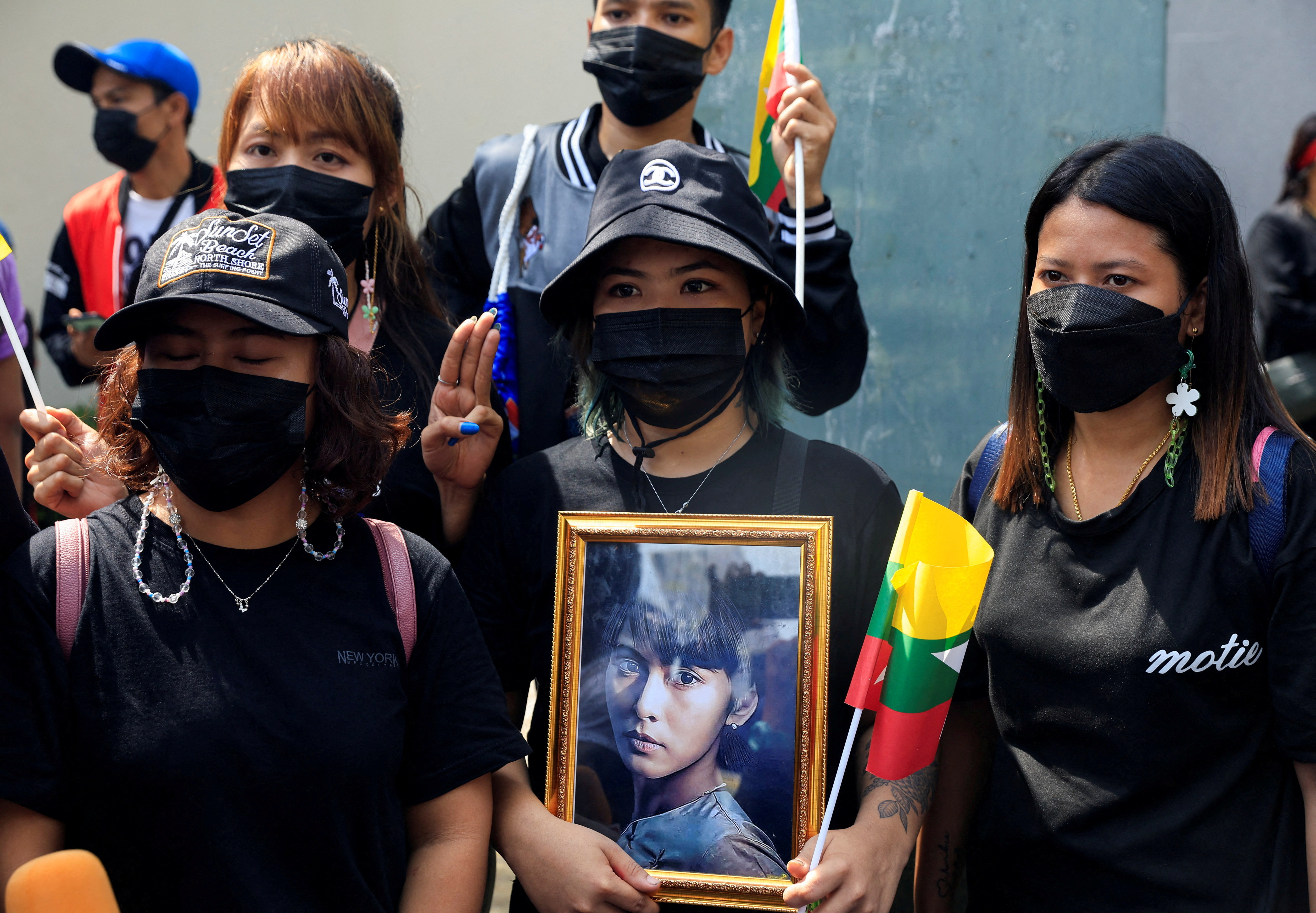
Myanmar citizens who live in Thailand, hold a portrait of former Myanmar state counsellor Aung San Suu Kyi as they protest against the execution of pro-democracy activists, at Myanmar embassy in Bangkok, Thailand July 26, 2022. REUTERS/Soe Zeya Tun
U.S. Secretary of State Antony Blinken welcomed the resolution’s adoption. “This is an important step by the Security Council to address the crisis and end the Burma military regime’s escalating repression and violence against civilians,” he said in a statement.
‘FIRST STEP’
Until now the council had only agreed formal statements on Myanmar, where the army also led a 2017 crackdown on Rohingya Muslims that was described by the United States as genocide. Myanmar denies genocide and said it was waging a legitimate campaign against insurgents who attacked police posts.
Derek Grossman is a senior defense analyst at the think tank RAND Corp. in Santa Monica, California and adjunct professor in the practice of political science and international relations at the University of Southern California. He formerly served as an intelligence adviser at the Pentagon.
During her meeting with Xi Jinping on the sidelines of the Asia-Pacific Economic Cooperation leaders’ summit last month in Bangkok, New Zealand Prime Minister Jacinda Ardern expressed interest in continued cooperation, but also pressed the Chinese president on controversial issues, including Xinjiang, Hong Kong, the South China Sea and the Taiwan Strait.
The meeting was the clearest sign yet that Wellington has adopted a harder line on Beijing. This will be good news for allies who have questioned whether New Zealand has been the weak link in collective approaches to countering China. But Wellington’s increasingly hard-line stance could antagonize Beijing, risking what has heretofore been a productive partnership.
For years, Wellington has assiduously tried to keep its political and economic interactions with Beijing separate.
The planet has already warmed by 1.1 degrees C (2 degrees F) due to human-induced climate change. Millions of people today are facing the real-life consequences of higher temperatures, rising seas, fiercer storms and unpredictable rainfall. Rapidly reducing emissions is essential to limit temperature rise and secure a safer future for us all, as is making major investments to protect communities from severe impacts that will continue to worsen.
Yet collective efforts to curb greenhouse gas emissions and adapt are currently not enough to tackle the speed and scale of climate impacts, meaning that some losses and damages from climate change are inevitable. How countries handle these losses and damages has been a key issue at UN climate negotiations and beyond.
Here, we provide an explainer on the concept of loss and damage and what’s needed to address it:
1) What Is Loss and Damage?
“Loss and damage” is a general term used in UN climate negotiations to refer to the consequences of climate change that go beyond what people can adapt to, or when options exist but a community doesn’t have the resources to access or utilize them. This could include the loss of coastal heritage sites due to rising sea levels, or the loss of homes and lives during extreme floods.
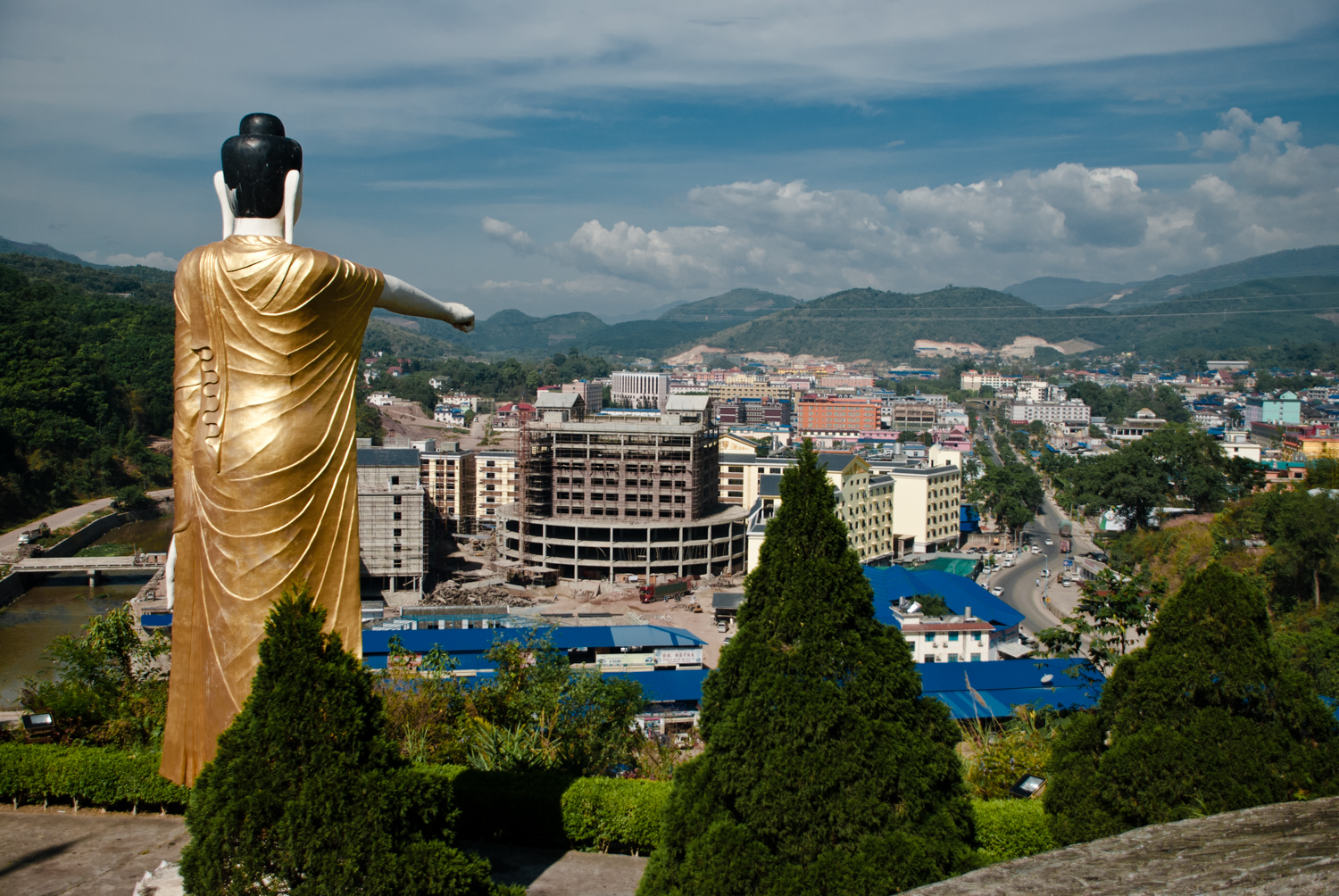
*Mong La, a town on the border between China and Myanmar, is notorious for a gambling town dubbed a ‘City of Sin’ in the heart of the Golden Triangle with Laos and Thailand”
A view of Mong La, a gambling enclave on the border between China and a rebel-administered sliver of Myanmar’s Shan State. (Sebastian Strangio)
Around six months ago, Ekapop Lueangprasert, a local government official and business owner in the Sai Mai suburb of Bangkok, was checking messages sent to his Sai Mai Must Survive Facebook page – a volunteer initiative he’d set up to try and help local people struggling financially during the pandemic – when he received a disturbing video from an 18-year-old girl.
“Today is January 28th at 1 am, 2022. I’m in a building opposite the Karaoke Bar,” says the Thai teenager into the camera, her eyes swollen from crying. She seems exhausted, close to breaking point, but determined to get as much information across as she can while she has the chance. The woman explains that she traveled from Bangkok to Sa Kaeo on the Thailand-Cambodia border to meet a Thai broker who had promised her a job in Poipet, a seedy casino town just over the border in Cambodia. She was then told that the role would actually involve scamming strangers online – and that if she wanted to leave, her father would have to pay 40,000 baht ($1,080) to secure her release. “I know everything and I’m afraid that [the boss] will kill me,” she sobs. “I don’t know what he will do to the others after this and I don’t know if I can contact you again. I’ve heard that at least 20 or 30 people have died.”
The request had come out of the blue and Ekapop was initially apprehensive. “I asked her, how can you use your phone?” he says. But as the teenager hastily sent and deleted location pins, photos from the compound, and other evidence of her treatment, it became clear she was telling the truth – and in the coming months, messages, videos, and photos flooded in from other Thai trafficking victims trapped in borderland casino towns in Cambodia, Laos, and Myanmar. All told near-identical stories about being duped by offers of well-paid, legitimate work, only to find themselves imprisoned in horrifying conditions by Chinese gangsters. Under constant threat of violence, they were forced to engage in illegal activities – mostly tricking people into making fake investments online – with the knowledge or even collusion of local authorities.
Intellectual property (IP) law reform and enforcement in Vietnam has been at the center of a broad range of trade agreements the country has signed onto. But change has been slow, and enforcement has been lacking. Here’s how a spat between a cartoon wolf and a cartoon pig could change that.
The owners of the UK’s Peppa Pig, EOne, are suing Vietnam’s Sconnect, the owners of popular YouTube cartoon Wolfoo, alleging trademark and copyright infringement. More specifically, EOne is alleging Sconnect created Wolfoo to look and feel like Peppa Pig to imply the two cartoons were connected.
In its complaint, EOne claims that parts of Wolfoo’s audio have been taken directly from episodes of Peppa Pig and that images of Peppa Pig herself appear on items like clocks and watering cans in the background of Wolfoo videos.
This is currently before the courts in the UK.
But the courts have not been EOne’s only means of recourse.
YouTube, for example, took down 2,000 Wolfoo videos from August to October this year for copyright infringement at the request of EOne. This cost Sconnect US$2 million in lost revenue up to October, according to their own estimates.
In response, Sconnect has made overtures to the Vietnamese government looking for support. It has also countersued in Vietnam and has launched a lawsuit in Russia where, earlier in the year, a copyright infringement case brought by EOne was dismissed in response to sanctions imposed over the war in the Ukraine.
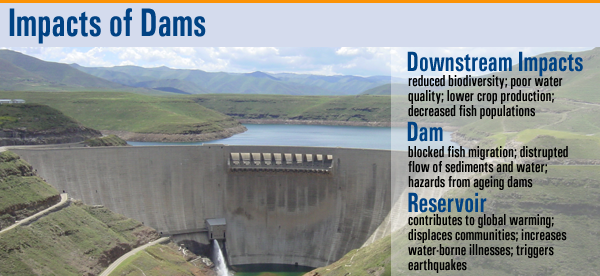
Earthquakes can be induced by dams. Globally, there are over 100 identified cases of earthquakes that scientists believe were triggered by reservoirs (see Gupta 2002). The most serious case may be the 7.9-magnitude Sichuan earthquake in May 2008, which killed an estimated 80,000 people and has been linked to the construction of the Zipingpu Dam.
How Do Dams Trigger Earthquakes?
In a paper prepared for the World Commission on Dams, Dr. V. P Jauhari wrote the following about this phenomenon, known as Reservoir-Induced Seismicity (RIS): “The most widely accepted explanation of how dams cause earthquakes is related to the extra water pressure created in the micro-cracks and fissures in the ground under and near a reservoir. When the pressure of the water in the rocks increases, it acts to lubricate faults which are already under tectonic strain, but are prevented from slipping by the friction of the rock surfaces.”
Given that every dam site has unique geological characteristics, it is not possible to accurately predict when and where earthquakes will occur. However, the International Commission on Large Dams recommends that RIS should be considered for reservoirs deeper than 100 meters.
Depth of the reservoir is the most important factor, but the volume of water also plays a significant role in triggering earthquakes.
RIS can be immediately noticed during filling periods of reservoirs.
RIS can happen immediately after the filling of a reservoir or after a certain time lag.
Many dams are being built in seismically active regions, including the Himalayas, Southwest China, Iran, Turkey, and Chile (see map). International Rivers calls for a moratorium on the construction of high dams in earthquake-prone areas.
By 2015, the dam industry had choked more than half of the Earth’s major rivers with some 57,000 large dams. The consequences of this massive engineering program have been devastating. The world’s large dams have wiped out species; flooded huge areas of wetlands, forests and farmlands; and displaced tens of millions of people.
Courtesy of James Syvitski at Colorado University, who produced the video with Bob Stallard of the USGS and Albert Kettner at CSDMS. Data from Alex de Sherbinin (CIESIN, University of Colorado), and Bernhard Lehner (Department of Geography, McGill University).
The “one-size-fits-all” approach to meeting the world’s water and energy needs is also outdated: better solutions exist. While not every dam causes huge problems, cumulatively the world’s large dams have replumbed rivers in a massive experiment that has left the planet’s freshwaters in far worse shape than any other major ecosystem type, including tropical rainforests. In response, dam-affected communities in many parts of the world are working to resolve the legacies of poorly planned dams. Elsewhere (and especially in North America), communities are starting to take down dams that have outlived their usefulness, as part of a broader river restoration movement.
The Governments of the Socialist Republic of Viet Nam, together with the International Partners Group, consisting of the European Union, the United Kingdom of Great Britain and Northern Ireland, the United States of America, Japan, the Federal Republic of Germany, the Republic of France, the Italian Republic, Canada, the Kingdom of Denmark and the Kingdom of Norway;
Recognising the need to accelerate action towards the objectives and long-term goals of the United Nations Framework Convention on Climate Change (UNFCCC) and the Paris Agreement, including through the implementation of the Glasgow Climate Pact, to minimise the worst adverse impacts of climate change for countries, people and the environment;
Noting that limiting global warming to 1.5°C to mitigate the worst adverse impacts of climate change requires rapid, deep and sustained reductions in global greenhouse gas emissions, including reducing global carbon dioxide emissions by 45% by 2030 relative to the 2010 level and to net zero around mid-century as well as deep reductions in other greenhouse gas emissions, emphasising climate change adaptation and achieving net zero emissions as an opportunity for sustainable development;
Recognising that for Viet Nam, as an independent, sovereign and fast developing lower middle income country heavily affected by the impacts of climate change, it will be key to embrace the opportunities brought about by the fast decreasing cost of renewable energies as an opportunity for sustainable development and to tackle related challenges such as poverty, inequality and unemployment, which are exacerbated by the impact of the COVID-19 pandemic and climate change, and that vulnerable groups and some important economic sectors may be impacted by the energy transition, including thermal electricity generation, coal mining, heavy industry and transport;
Recognising the need for new, predictable, long-term and sustainable support from partner countries, multilateral organisations and investors in finance, technology and capacity building for Viet Nam to exploit fully the opportunities of the transition in accordance with the national framework of public debt and external debt management to contribute significantly to the implementation of the NDC of Viet Nam, its commitment to reach to net zero greenhouse gas emissions by 2050 and its development orientation to become a high-income developed country by 2045;
The current war in Ukraine, which has shown the impotence of the UN Security Council when one of its permanent members goes to war in violation of the UN Charter, has brought renewed energy to the debate over reforming the Council. Security Council reform has been an ongoing topic of discussion in the UN General Assembly since the early post-Cold War period, with reform pressures tending to intensify in response to an international crisis that exposes the structural weaknesses of the Security Council.
The new momentum for changing the status quo took off on 27 February, when the Security Council referred the situation in Ukraine to the General Assembly following its own failure to adopt a draft resolution deploring Russia’s aggression against Ukraine. This was the Security Council’s first use of a “Uniting for Peace” resolution in 40 years. Two months later, through an initiative led by Liechtenstein, the General Assembly decided by consensus (A/RES/76/262, adopted on 26 April) that it would meet whenever a veto is cast in the Security Council. It has now convened twice in accordance with this new procedure: following vetoes by China and Russia on the Democratic People’s Republic of Korea in May, and after a Russian veto on Syria in July.
Security Council Reform: What Does It Mean, What Would It Require?
With data on the flow of sand from the upstream Mekong and the amount being extracted, scientists can now calculate how much sand can be mined without further harm to Vietnam’s Mekong Delta
Dredged sand is transported in the Mekong Delta, Vietnam. The Mekong Delta is sinking due to unsustainable sand mining and the impacts of upstream dams. (Image: Josef Kubes / Alamy)
“>
Dredged sand is transported in the Mekong Delta, Vietnam. The Mekong Delta is sinking due to unsustainable sand mining and the impacts of upstream dams. (Image: Josef Kubes / Alamy)
Many people will be familiar with the dread when your income no longer covers your expenses; when you’ve exhausted your savings and are sinking ever deeper into debt. In the Mekong Delta, a similar downward spiral is happening. But it’s not the delta’s finances that are draining away – it’s the sand that sustains it. Not its economic stability that is being undermined, but its very foundations.
The Mekong is literally drowning in ‘sand debt’: far more sand is being removed than is being replenished. Without a budget setting out how much sand can be extracted sustainably, this debt will turn into disaster.
If you only look at the headline figures, all seems well with Vietnam’s Mekong Delta and the connected Dong Nai Delta – home to a combined 40 million people, growing cities, thriving economies, and a major regional rice bowl and seafood source. But a closer look reveals some real cause for alarm. The Mekong Delta is sinking. Saltwater is intruding ever further inland. The water table is dropping. All these come with significant costs to communities and nature, as infrastructure, livelihoods and the survival of species are negatively affected.






 CVD
CVD 
