Gánh nặng bệnh tật do nhiệt điện đốt than ở Đông Nam Á – Burden of Disease from Rising Coal-Fired Power Plant Emissions in Southeast Asia

 Department of Earth and Planetary Sciences, Harvard University, Cambridge, Massachusetts 02138 United States
 John A. Paulson School of Engineering and Applied Sciences, Harvard University, Cambridge, Massachusetts 02138 United States
§ Greenpeace International, 1066 AZ Amsterdam, The Netherlands
 Department of Geography, University of Colorado, Boulder, Colorado 80309 United States
Environ. Sci. Technol.201751 (3), pp 1467–1476
DOI: 10.1021/acs.est.6b03731
Publication Date (Web): January 12, 2017
Copyright © 2017 American Chemical Society
*Phone: 617 496 9428; e-mail: skoplitz@fas.harvard.edu.

ACS AuthorChoice – This is an open access article published under an ACS AuthorChoice License, which permits copying and redistribution of the article or any adaptations for non-commercial purposes.

Abstract

Abstract Image

Southeast Asia has a very high population density and is on a fast track to economic development, with most of the growth in electricity demand currently projected to be met by coal. From a detailed analysis of coal-fired power plants presently planned or under construction in Southeast Asia, we project in a business-as-usual scenario that emissions from coal in the region will triple to 2.6 Tg a–1 SO2 and 2.6 Tg a–1 NOx by 2030, with the largest increases occurring in Indonesia and Vietnam. Simulations with the GEOS-Chem chemical transport model show large resulting increases in surface air pollution, up to 11 μg m–3 for annual mean fine particulate matter (PM2.5) in northern Vietnam and up to 15 ppb for seasonal maximum 1 h ozone in Indonesia. We estimate 19 880 (11 400–28 400) excess deaths per year from Southeast Asian coal emissions at present, increasing to 69 660 (40 080–126 710) by 2030. 9000 of these excess deaths in 2030 are in China. As Chinese emissions from coal decline in coming decades, transboundary pollution influence from rising coal emissions in Southeast Asia may become an increasing issue.

Tiếp tục đọc “Gánh nặng bệnh tật do nhiệt điện đốt than ở Đông Nam Á – Burden of Disease from Rising Coal-Fired Power Plant Emissions in Southeast Asia”

German villages go 100% renewable

Thermal solar plant at Neuerkirch, Germany, part of the country’s transition towards clean energy. [AEE/Adelphi/Tobias Vollmer]

Local communities are at the forefront of the clean energy transition in Germany, with some villages relying 100% on renewables. EURACTIV Slovakia spoke to mayors there.

Neuerkirch and Külz are two small villages in Western Germany – of 300 and 500 souls respectively. And yet, they feel a part of something bigger that goes even beyond the country’s energy transition, the ‘Energiewende’. Tiếp tục đọc “German villages go 100% renewable”

EU mandatory register for lobbyists, a baby step towards full transparency

Lobbyisten sehen sich bei Querschnittspolitikbereichen zunehmend nach strategischen Verbündeten um.

This article is part of our special report Lawmaking in the dark.

Over time, the business of influence has been honed into a fine art in Western democracies. But that art is becoming increasingly regulated, even if the average citizen perceives lobbyists as cigar-smoking men in suits wining and dining lawmakers to gain an unfair advantage.

What they may not think of is the long-haired environmentalist who is pushing for renewable energy support, or the farmer who is trying to explain to his MP why a new pesticide regulation could put him out of business. Tiếp tục đọc “EU mandatory register for lobbyists, a baby step towards full transparency”

Ocean plastic pollution – what role can social science play?

29 November 2017

IDS is partnering with the EU, UN, Chatham House and other organisations to host a high level side event on circular economy solutions to tackling ocean plastic pollution, during this year’s United Nations Environment Assembly in Nairobi (4-6 December). The event will showcase specific examples of collaborative action and policies that aim to reduce plastic waste, address unsustainable consumption and production patterns and redirect investment for a clean, efficient and circular economy. Ahead of the event, I want to highlight the importance of a universal development approach and transformative social science research, as solutions to the ocean plastics problem.

A large sculpture of a shark made out of plastic waste found in the ocean.

Ocean plastics pollution – not just an environmental issue

Plastics pollution of oceans has emerged as a major global environmental crisis. Between 4.8 and 12.7 million tonnes of plastics enter the ocean each year. It is devastating for marine ecosystems and the accumulation of microplastics in food chains pose a risk to human health. And the issue is becoming more serious.  By 2050, plastics production is expected to increase to over 2000 tonnes per year, up from 311 million tonnes in 2014.

Plastics end up in the ocean as the result of chains of human activities in different parts of the world. We are all contributing to it. China, Indonesia and the Philippines have been identified as the top three sources of ocean plastics pollution by the Ocean Conservancy. While litter found on the sea floor around the UK has risen 150% in the last year and UK plastic waste drifts to the artic where is has a very damaging impact on one of the most vulnerable ecosystems in the world.

Tiếp tục đọc “Ocean plastic pollution – what role can social science play?”

Conserving Forests Could Cut Carbon Emissions As Much As Getting Rid of Every Car on Earth

Globalforestwatch.org

By Susan MinnemeyerNancy Harris and Octavia Payne

Cantonal Hojancha was once a major cattle ranching region. Most of this area was cleared for pasture only 30 years ago. Now, many of the residents have moved into the service industry, and the pasture land has slowly converted back to forest. Photo by Aaron Minnick (World Resources Institute)

New analysis from The Nature Conservancy, WRI and others estimates that stopping deforestation, restoring forests and improving forestry practices could cost-effectively remove 7 billion metric tons of carbon dioxide annually, or as much as eliminating 1.5 billion cars—more than all of the cars in the world today!

In fact, forests are key to at least six of the study’s 20 “natural climate solutions,” which could collectively reduce 11.3 billion metric tons of greenhouse gas emissions per year. That’s as much as halting global oil consumption, and would get us one-third of the way toward limiting global warming to 2 degrees C (3.6 degrees F) above pre-industrial levels — the threshold for avoiding catastrophic effects of climate change — by 2030.

Stopping Deforestation Offers the Biggest Benefit

Tiếp tục đọc “Conserving Forests Could Cut Carbon Emissions As Much As Getting Rid of Every Car on Earth”

Những vấn đề pháp lý thực tế của Trí tuệ nhân tạo – Artificial Intelligent

English: Artificial Intelligence: The Real Legal Issues

Nếu bạn đang đọc bài này, rất có thể bạn sẽ bắt gặp khái niệm Trí tuệ Nhân tạo – AI/Artificial Intelligent trong các nghiên cứu của mình. Giống như hầu hết các vấn đề thời thượng, có rất nhiều bài viết về chủ đề này chia thành hai loại – tài liệu hoặc giả định một mức độ kiến ​​thức dựa trên khoa học máy tính hoặc thông thường hơn là phần mềm bán hàng được cải trang dạng mỏng mà không truyền tải được nhiều.

Bài báo này dựa trên bài thuyết trình mà tôi trình bày tại Hội nghị thường niên của SCL Viện Kỹ thuật London vào tháng 6 và hy vọng sẽ cung cấp cho những người không có kiến thức và kinh nghiệm (và người có một ít kiến thức) một nền tảng vững chắc để có thể dựa vào đó để có những hiểu biết và đánh giá thực tiễn về những rủi ro pháp lý khi sử dụng trí tuệ nhân tạo. Vì vậy, bài viết sẽ hy vọng sẽ được tiếp cận được với những người có tư duy pháp lý khi quan tâm đến công nghệ này.

 Những rủi ro pháp lý mà tôi đã phân loại thành “Thách thức nguyên nhân – hệ quả” và “Thách thức về Dữ liệu lớn” Tiếp tục đọc “Những vấn đề pháp lý thực tế của Trí tuệ nhân tạo – Artificial Intelligent”

Artificial Intelligence: The Real Legal Issues

John Buyers
United Kingdom October 23 2017

lexology_If you’re reading this, the chances are that you will have come across the concept of Artificial Intelligence in your prior researches. Like most issues “du jour“, a lot has been written on the topic which falls into two categories – material either presupposes a level of prior computer- science based knowledge or; more commonly is thinly disguised salesware which doesn’t convey a lot.
Tiếp tục đọc “Artificial Intelligence: The Real Legal Issues”

New Index Shows Increase in Entrepreneurship Could Add $7 Trillion to Global Economy


New report ranks 137 countries at Global Entrepreneurship Summit in India

Washington, D.C. – As the demand for data-driven research on how to strengthen entrepreneurship support programs increase, the 2018 Global Entrepreneurship Index, which evaluates the health of entrepreneurship in 137 countries, was unveiled at the Global Entrepreneurship Summit in Hyderabad, India, as part of a policy panel discussion. Tiếp tục đọc “New Index Shows Increase in Entrepreneurship Could Add $7 Trillion to Global Economy”

Progress in AI isn’t as Impressive as You Might Think

A new report gauges how far we’ve come, dampening ideas that machines are approaching human-type intelligence.

technologyreview_With so much excitement about progress in artificial intelligence, you may wonder why intelligent machines aren’t already running our lives.

Key advances have the capacity to dazzle the public, policymakers, and investors into believing that human-level machine intelligence may be just around the corner. But a new report (PDF), which tries to gauge actual progress being made, attests that this is far from true. The findings may help inform the discussion over how AI will affect the economy and jobs in the coming years.

“There’s no question there have been a number of breakthroughs in recent years,” says Erik Brynjolfsson, a professor at the MIT Sloan School of Management and one of the authors of the report. “But it’s also clear we are a long way from artificial general intelligence.”

Brynjolfsson points to remarkable advances in image classification and voice recognition. But computers trained to perform these tasks cannot do much else, and they cannot adapt if the nature of the task changes slightly or if they see something completely unfamiliar.

The report is part of an ongoing effort, called the AI Index, to quantify progress in artificial intelligence and identify areas where more is still needed. The other authors are Yoav Shoham, a professor at Stanford; Raymond Perrault, a researcher at SRI; Jack Clark, director of policy at OpenAI; and Calvin LeGassick, project manager for the AI Index.
Tiếp tục đọc “Progress in AI isn’t as Impressive as You Might Think”

Mở sòng bạc casino, thêm việc làm Nhưng cũng tạo ra tội phạm, gây phá sản và thậm chí tự tử – Nghiên cứu đã chỉ ra

English: Studies: Casinos bring jobs, but also crime, bankruptcy, and even suicide

Năm 2012, tại Mỹ trong khi cuộc đua tổng thống đang chiếm phần lớn sự chú ý, tại nhiều bang cũng có những đề xuất ​​quan trọng cần được xem xét bỏ phiếu.

Bang Maryland đang xem xét đề xuất cho phép các trò chơi tại 5 sòng bạc của tiểu bang, và phê duyệt đề nghị xây sòng bạc thứ sáu tại hạt Prince George, gần DC. Đề xuất được chào mời như là một cách để tài trợ cho giáo dục – quỹ mà nó tạo ra sẽ được phân bổ – và trớ trêu thay, sự phản đối nó chủ yếu được tài trợ bởi các chủ của sòng bạc đối thủ. Nhưng các nghiên cứu kinh tế về sòng bạc cho thấy rằng cộng đồng cần phải thận trọng với các sòng bạc. Tiếp tục đọc “Mở sòng bạc casino, thêm việc làm Nhưng cũng tạo ra tội phạm, gây phá sản và thậm chí tự tử – Nghiên cứu đã chỉ ra”

Communist Hanoi gets its first McDonald’s

AFP / HOANG DINH NAMThe global fast food chain received a warm welcome in Hanoi as hungry diners crammed into the two-storey eatery for a first taste of the Golden Arches

AFP_Global burger behemoth McDonald’s opened its first branch on Saturday in the historic heart of communist Hanoi, a conservative city renowned for its traditional — and cheap — Vietnamese staples beloved by food-obsessed locals.

Hungry customers lined up for Big Macs and Chicken McNuggets at the Vietnamese capital’s first location overlooking the tree-lined Hoan Kiem lake, which draws millions of tourists annually to see French-era colonial buildings and sample street-food favourites like pho noodle soup and banh mi sandwiches.

The restaurant is the first outside of the southern commercial hub Ho Chi Minh City, where 16 branches have opened since McDonald’s first came to Vietnam in 2014 to much fanfare, especially among the rapidly-growing middle class and American-obsessed youth. Tiếp tục đọc “Communist Hanoi gets its first McDonald’s”

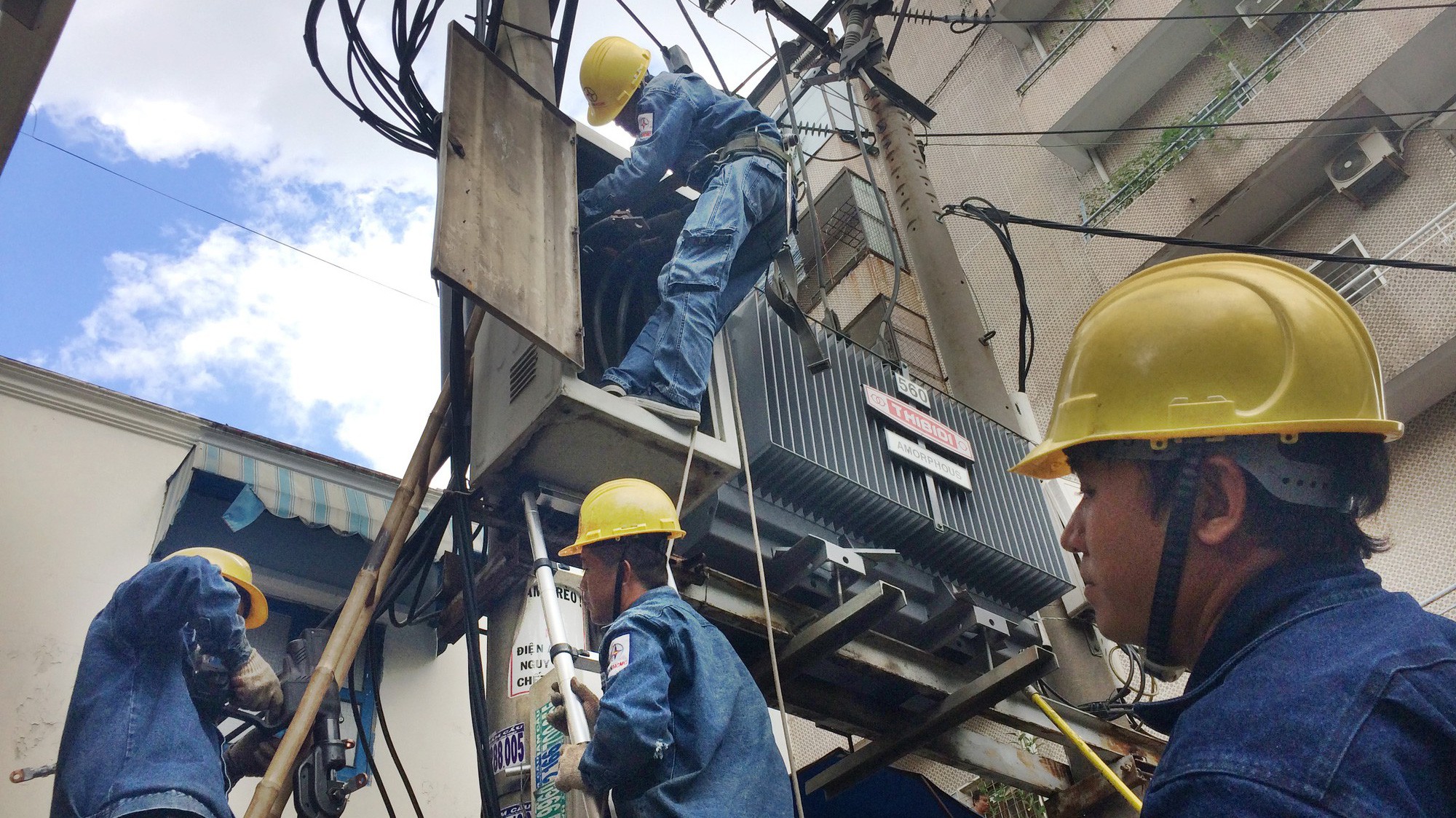
Sao lại tăng giá điện vào cuối năm?

02/12/2017 09:27 GMT+7

Thi công lắp đặt điện trên đường Vũ Huy Tấn (Q.Bình Thạnh, TP.HCM) – Ảnh: Châu Anh

TTO – Nhiều chuyên gia đề nghị phải giải trình minh bạch, thuyết phục lý do tăng giá điện cũng như có lộ trình để doanh nghiệp (DN), người dân có sự chuẩn bị.

tuoitre.vn_Việc tăng 6,08% giá điện được đánh giá là phù hợp trong bối cảnh nhu cầu đầu tư ngành điện tăng cao.

Buổi họp báo về tăng giá điện do Bộ Công thương tổ chức chiều 1-12 trở nên nóng hơn khi hàng loạt câu hỏi của báo chí đặt ra về tính hợp lý, cơ sở của việc tăng giá điện 6,08% cũng như đề nghị làm rõ các khoản lỗ, chênh lệch tỉ giá…

Tăng giá để xử lý lỗ tỉ giá

Tại buổi họp báo, ông Võ Quang Lâm, phó tổng giám đốc Tập đoàn Điện lực Việt Nam (EVN), chỉ cho biết khoản lỗ tỉ giá sẽ được phân bổ dần dần nhằm giảm bớt áp lực tăng giá điện, nhưng không giải trình cụ thể khoản lỗ gần 600 tỉ đồng xuất phát do đâu.

Cũng theo ông Lâm, việc tăng giá điện sẽ tác động đến chỉ số giá tiêu dùng là 0,1% và tăng trưởng GDP là 0,166% trong năm 2018.

Đại diện của Kiểm toán Deloitte giải thích thêm về khoản chênh lệch tỉ giá lên tới 9.500 tỉ đồng là do EVN phải vay vốn nước ngoài để đầu tư nhà máy nên phát sinh chênh lệch tỉ giá, dù điều hành tỉ giá của Ngân hàng Nhà nước đã khá ổn định.

Theo vị này, nếu khoản lỗ chênh lệch tỉ giá được phân bổ ngay vào giá thành, chắc chắn tình hình sản xuất kinh doanh chung sẽ bị lỗ, nhưng quan điểm điều hành của Chính phủ là chưa phân bổ tỉ giá vào giá thành để giảm áp lực tăng giá.

Ông Nguyễn Anh Tuấn, cục trưởng Cục Điều tiết điện lực, cũng cho rằng theo chỉ đạo của Chính phủ, khoản lỗ tỉ giá sẽ chỉ được hạch toán một phần hoặc giãn ra đưa vào giá thành để tránh tạo áp lực đến việc tăng giá bán lẻ điện.

Do đó, đợt điều chỉnh giá điện lần này chỉ đưa một phần vào khâu truyền tải điện, khâu phát điện… Cũng theo ông Tuấn, EVN đã tiết kiệm 1.266 tỉ đồng chi phí thường xuyên, giảm giá thành trong khâu truyền tải điện, chi phí sửa chữa lớn tiết kiệm 5%, tốc độ tăng lương thấp hơn năng suất lao động…

Tiếp tục đọc “Sao lại tăng giá điện vào cuối năm?”

Samsung dismisses labor abuse claims in Vietnam

November 26, 2017 | 11:31 am GMT+7

Samsung said a sample size of 45 female workers is insufficient to conclude its workers suffer from health problems like fatigue, dizziness and miscarriages.

vnexpress.net_A new report has revealed a series of health and workplace violations at Samsung plants in Vietnam, but the South Korean tech giant has categorically rejected the claims.

The study, which was released early this month, reported “serious” labor code violations at an industrial giant that is one of the leading investors and employers in the country.

45 female workers reported extreme fatigue, fainting and dizziness at work, and said that miscarriages were extremely common, according to the study by the Hanoi-based Research Center for Gender, Family and Environment in Development (CGFED) and IPEN, a global network of environment and health NGOs.

They also said that workers, including pregnant women, were required to stand for the entire 8-12 hour shifts or face a pay cut. They had limited breaks and had to ask to use the restroom.

Many are rostered on alternating day and night shift shifts, regardless of weekends, they said.

Workers said they had experienced problems with their eyesight, nose bleeds and stomach aches, as well as joint and leg pains.

No workers have received copies of their contracts, which is mandatory under Vietnamese labor laws, according to the report.

Samsung Electronics operates two cellphone plants in Bac Ninh and Thai Nguyen in northern Vietnam, which produce around half of all the cellphones that Samsung supplies to the global market.

The plants, which had 149,000 staff as of the end of April, made $36 billion last year, accounting for 68 percent of all revenue from the countrys electronics industry, which is the highest grossing sector in Vietnam.

Joe DiGangi, IPENs Senior Science and Technical Advisor, said that the study is important because the lives and rights of workers in the electronics industry in Vietnam have been “neglected”.

“Companies make a lot of money in Vietnam, but their profit rests on the tired shoulders of the female-majority workforce,” he said.

Tiếp tục đọc “Samsung dismisses labor abuse claims in Vietnam”

Australia in plans to export colossal amounts of wind and solar energy to Southeast Asia

Climateactionprogramme.org

An international consortium of energy companies has presented its plans to develop a 6 gigawatt (GW) solar and wind hybrid project in Western Australia, designed to export clean energy to Indonesia through subsea cables.

Western Australia is set to take advantage of its significant solar and wind resources to export renewable energy to Indonesia, contributing significantly to the country’s clean energy future and energy security through reducing reliance on imported fossil fuels.

The proposed project is called Asian Renewable Energy Hub (AREH) and is another mega energy project which underlines the significant opportunities that domestic renewable resources can provide for countries to become the ‘new’ energy exporters.

The hybrid power plant would be spread over 14,000 square km in flat desert land on the north-west coast of Australia.

It would comprise approximately 1,200 wind turbines supplied by Vestas, and 10 million solar panels with an aggregated capacity of 6GW – enough electricity to power more than 7 million households. Tiếp tục đọc “Australia in plans to export colossal amounts of wind and solar energy to Southeast Asia”