
visualcapitalist.com November 25, 2025
Key Takeaways
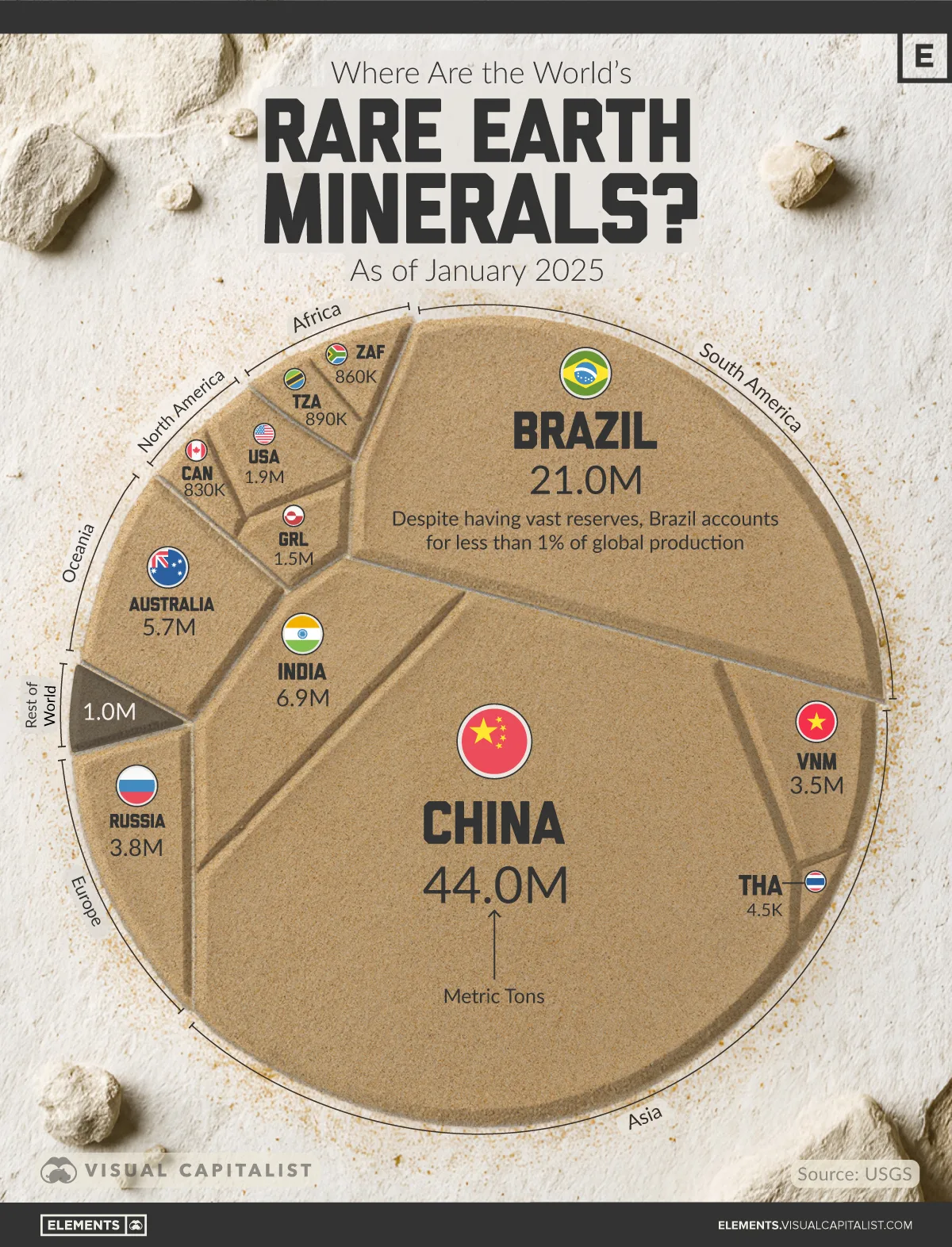
- China accounts for nearly half of global rare earth reserves (44M of 92M metric tons).
- Brazil ranks second (21M tons), while the U.S. holds 1.9M tons—about 2% of the total.
Rare earth elements (REEs) are the backbone of modern technology, from EV motors and wind turbines to smartphones and precision-guided systems.
This map breaks down where the world’s known rare earth reserves are located in 2025, highlighting how concentrated they are across a handful of countries.
The distribution is highly uneven. China alone holds nearly half of the global total, followed by Brazil’s sizable deposits. By contrast, many advanced economies have limited reserves.
The data for this visualization comes from the U.S. Geological Survey (USGS).
A Heavily Concentrated Reserve Base
China leads with 44.0 million metric tons, about 48% of the world total of 91.9 million metric tons. Brazil is a clear second at 21.0 million tons (23%), reflecting large ionic clay and hard-rock deposits that are still early in development.
| Rank | Country | Reserves (Metric Tons) |
|---|---|---|
| 1 | 🇨🇳 China | 44,000,000 |
| 2 | 🇧🇷 Brazil | 21,000,000 |
| 3 | 🇮🇳 India | 6,900,000 |
| 4 | 🇦🇺 Australia | 5,700,000 |
| 5 | 🇷🇺 Russia | 3,800,000 |
| 6 | 🇻🇳 Vietnam | 3,500,000 |
| 7 | 🇺🇸 U.S. | 1,900,000 |
| 8 | 🇬🇱 Greenland | 1,500,000 |
| 9 | 🇹🇿 Tanzania | 890,000 |
| 10 | 🇿🇦 South Africa | 860,000 |
| 11 | 🇨🇦 Canada | 830,000 |
| 12 | 🇹🇭 Thailand | 4,500 |
| — | 🌍 Rest of World | 1,015,500 |
| — | 🌐 World Total | 91,900,000 |
India (6.9 million tons) and Australia (5.7 million tons) round out the top tier, while Russia (3.8 million tons) and Vietnam (3.5 million tons) are also ahead of the United States. Together, the top six countries account for roughly four-fifths of known reserves.
Advanced Economies: Small Shares, Big Demand
The United States holds just 1.9 million metric tons of rare earths (2%), underscoring its reliance on trade and midstream processing to secure supply. In recent months, the Trump administration has sought to reduce U.S. dependence on Chinese materials by funding domestic mining projects, streamlining permits, and partnering with allies to diversify supply chains.
In October, President Trump and President Xi Jinping agreed to reduce tariffs in exchange for China maintaining the flow of rare earth exports.
Emerging Players
Canada (0.83 million tons) and the EU-adjacent Greenland (1.5 million tons) have meaningful but smaller bases.
Africa and the Arctic feature emerging sources: Tanzania (0.89 million tons) and South Africa (0.86 million tons) join Greenland as potential growth nodes if infrastructure and processing scale.

 CVD
CVD 