In late 2025, images of deformed fish caught in Thailand’s rivers made headlines around the world. The strange lesions on the fish have been linked to rare earth mines upstream.
Driven by soaring global demand for rare earths, mining operations in Myanmar are sending toxic metals into tributaries of the Mekong River, contaminating waterways that millions depend on. War-torn Myanmar, where regulatory oversight is weak, has created the conditions for such mines to proliferate — unchecked and unregulated.
China dominates global rare earth mining, but undeveloped reserves elsewhere could reshape future supply chains.
Greenland holds an estimated 1.5 million metric tons of rare earth reserves despite having no commercial production.
U.S. President Donald Trump has once again put Greenland at the center of global attention.
His renewed threat to assert U.S. control over the Arctic territory has drawn sharp reactions from European leaders and Denmark, which governs Greenland as an autonomous territory.
While the island’s strategic location is often cited, another underlying motivation is increasingly tied to its vast mineral potential. In particular, Greenland’s rare earth reserves have become a focal point in a world racing to secure critical resources.
This visualization compares rare earth mine production and reserves across countries, placing Greenland’s untapped resources in a global context.
China remains the backbone of the global rare earth market. In 2024, it produced roughly 270,000 metric tons, accounting for well over half of global output.
China also controls the largest reserves, estimated at 44 million metric tons. This combination of scale and integration gives Beijing significant leverage over industries ranging from electric vehicles to defense systems.
Country
Reserves (Metric Tons)
Rare Earth Production 2024 (Metric Tons)
🇨🇳 China
44.0M
270,000
🇧🇷 Brazil
21.0M
20
🇮🇳 India
6.9M
2,900
🇦🇺 Australia
5.7M
13,000
🇷🇺 Russia
3.8M
2,500
🇻🇳 Vietnam
3.5M
300
🇺🇸 United States
1.9M
45,000
🇬🇱 Greenland
1.5M
0
🇹🇿 Tanzania
890K
0
🇿🇦 South Africa
860K
0
🇨🇦 Canada
830K
0
🇹🇭 Thailand
4.5K
13,000
🇲🇲 Myanmar
0
31,000
🇲🇬 Madagascar
0
2,000
🇲🇾 Malaysia
0
130
🇳🇬 Nigeria
0
13,000
🌍 Other
0
1,100
🌐 World total (rounded)
>90,000,000
390,000
Large Reserves, Limited Production Elsewhere
Outside China, many countries with sizable reserves play only a minor role in production.
Brazil holds an estimated 21 million metric tons of rare earth reserves yet produces almost nothing today. India, Russia, and Vietnam show similar patterns.
Why Greenland Matters
Greenland’s estimated 1.5 million metric tons of rare earth reserves exceed those of countries like Canada and South Africa. Yet the island has never had commercial rare earth production.
Environmental protections, infrastructure constraints, and local political opposition have slowed development. Still, as supply chain security becomes a priority for major economies, Greenland’s position is becoming harder to ignore.
Trump’s interest in Greenland is driven by more than symbolism. Rare earths are essential for advanced manufacturing, clean energy technologies, and military hardware. With China firmly entrenched as the dominant supplier, policymakers in Washington are increasingly focused on alternative sources.
CNA Few countries are better prepared against China threatening their rare earth supplies than Japan, says David Fickling for Bloomberg Opinion.
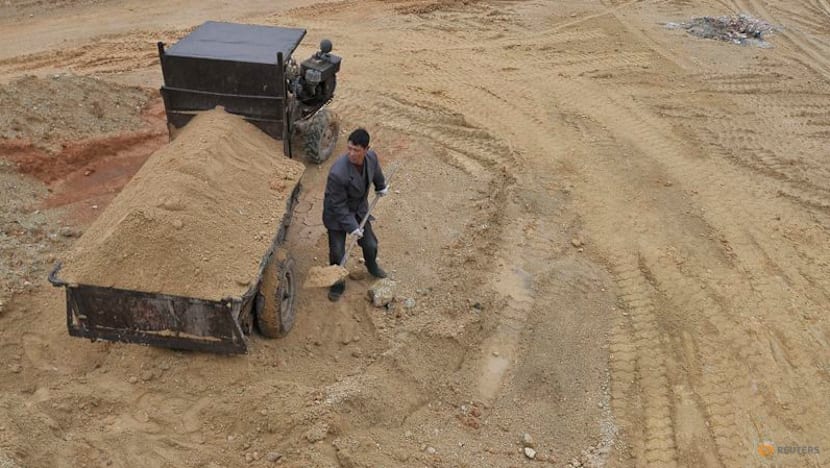
A labourer works at a site of a rare earth metals mine at Nancheng county, Jiangxi province, China, on Mar 14, 2012. (File photo: Reuters)
David Fickling 09 Jan 2026 05:59AM(Updated: 09 Jan 2026 09:30AM)
SYDNEY: To a hammer, every problem is a nail. If your most potent means of geopolitical leverage is threatening supplies of high-strength magnets, rare earth elements will always be the solution.
The most obvious victim of this threat will be rare earth magnets made with the elements neodymium and praseodymium, and increasingly spiced up with rarer samarium, dysprosium and terbium. They’re used everywhere from charging cables to the switchgear in wind turbines to motors powering electric vehicles, missile guidance systems and aircraft flaps.
Luật sửa đổi, bổ sung một số điều của Luật Địa chất và khoáng sản khẳng định đất hiếm là khoáng sản chiến lược đặc biệt. Việc thăm dò, khai thác, chế biến phải được kiểm soát chặt chẽ, không xuất khẩu thô khoáng sản đất hiếm. Chỉ các doanh nghiệp, tổ chức được Nhà nước chỉ định hoặc cho phép mới được quyền thăm dò, khai thác, chế biến và sử dụng đất hiếm. Hoạt động chế biến sâu đất hiếm phải gắn với xây dựng hệ sinh thái công nghiệp hiện đại để nâng cao chuỗi giá trị trong nước…
Chỉ các doanh nghiệp, tổ chức được Nhà nước chỉ định hoặc cho phép mới được quyền thăm dò, khai thác, chế biến và sử dụng đất hiếm. Ảnh minh họa
Tiếp tục chương trình Kỳ họp thứ 10, ngày 11/12, Quốc hội biểu quyết thông qua Luật sửa đổi, bổ sung một số điều của Luật Địa chất và khoáng sản với đa số đại biểu có mặt tán thành.
Trước khi Quốc hội thông qua, Bộ trưởng Bộ Nông nghiệp và Môi trường Trần Đức Thắng, thừa ủy quyền của Thủ tướng Chính phủ báo cáo giải trình, tiếp thu, chỉnh lý dự thảo Luật sửa đổi, bổ sung một số điều của Luật Địa chất và khoáng sản. Theo đó, Chính phủ đã tiếp thu và phối hợp với các cơ quan có liên quan rà soát, chỉnh lý, hoàn thiện dự thảo về các vấn đề bảo đảm tính thống nhất, đồng bộ của hệ thống pháp luật, quy định đầy đủ các trường hợp chuyển tiếp và một số vấn đề cụ thể khác.
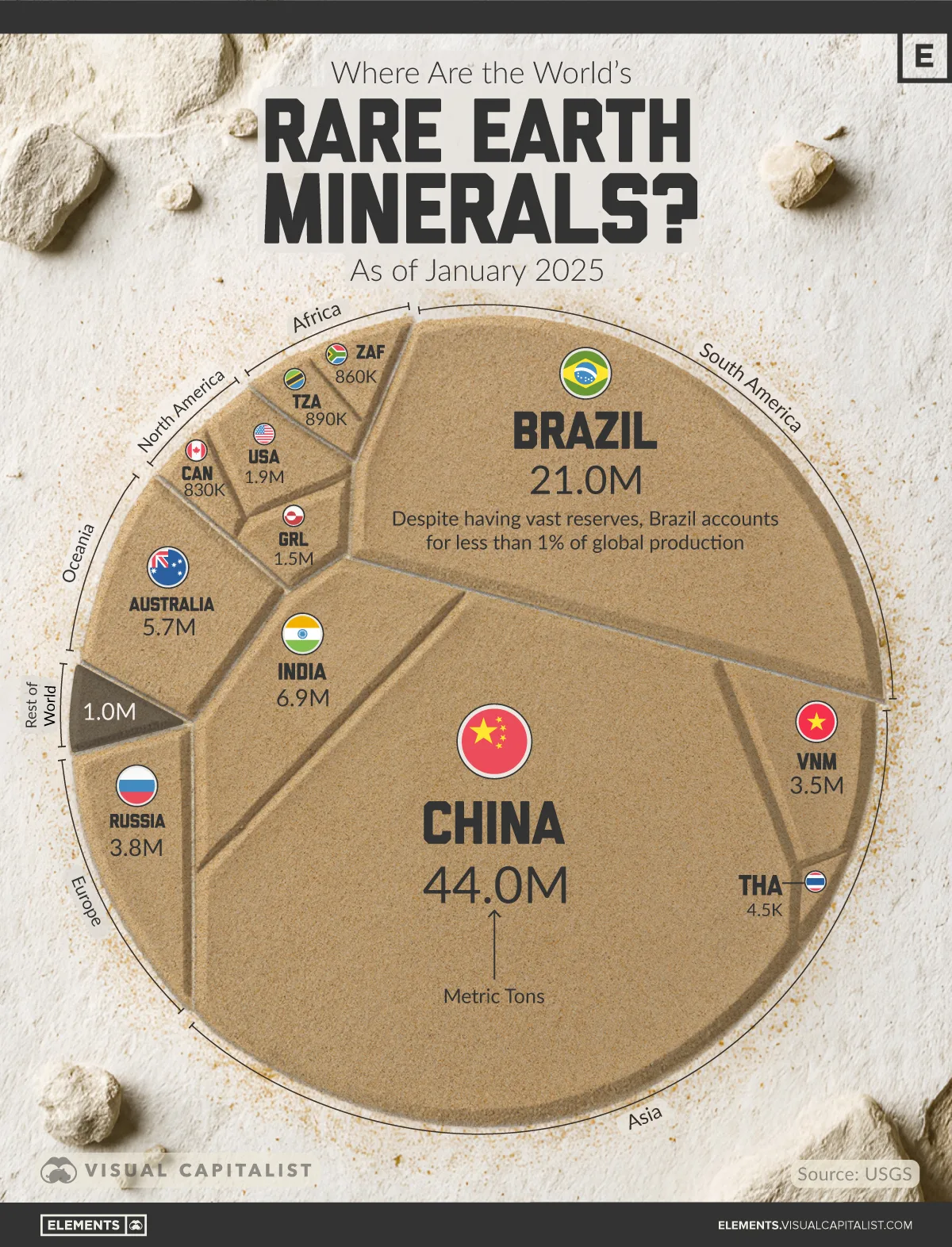
China accounts for nearly half of global rare earth reserves (44M of 92M metric tons).
Brazil ranks second (21M tons), while the U.S. holds 1.9M tons—about 2% of the total.
Rare earth elements (REEs) are the backbone of modern technology, from EV motors and wind turbines to smartphones and precision-guided systems.
This map breaks down where the world’s known rare earth reserves are located in 2025, highlighting how concentrated they are across a handful of countries.
The distribution is highly uneven. China alone holds nearly half of the global total, followed by Brazil’s sizable deposits. By contrast, many advanced economies have limited reserves.
China leads with 44.0 million metric tons, about 48% of the world total of 91.9 million metric tons. Brazil is a clear second at 21.0 million tons (23%), reflecting large ionic clay and hard-rock deposits that are still early in development.
Item 1 of 4 United Wa State Army (UWSA) soldiers march during a media display in Pansang, Wa territory in northeast Myanmar, October 4, 2016. Picture taken on October 4, 2016. REUTERS/Soe Zeya Tun/File Photo
[1/4]United Wa State Army (UWSA) soldiers march during a media display in Pansang, Wa territory in northeast Myanmar, October 4, 2016. Picture taken on October 4, 2016. REUTERS/Soe Zeya Tun/File Photo Purchase Licensing Rights, opens new tab
Summary
Beijing-backed UWSA protecting new rare earth mines in Shan state, sources say
Mines being run by Chinese-speaking operators
China relies on Myanmar for rare earth imports but had recently faced some supply challenges
Rare earths offer Beijing leverage in trade war with Washington
BANGKOK, June 12 (Reuters) – A Chinese-backed militia is protecting new rare earth mines in eastern Myanmar, according to four people familiar with the matter, as Beijing moves to secure control of the minerals it is wielding as a bargaining chip in its trade war with Washington.
China has a near-monopoly over the processing of heavy rare earths into magnets that power critical goods like wind turbines, medical devices and electric vehicles. But Beijing is heavily reliant on Myanmar for the rare earth metals and oxides needed to produce them: the war-torn country was the source of nearly half those imports in the first four months of this year, Chinese customs data show.
Toxic runoff from unregulated mines in Myanmar has sparked health and environmental concerns, across the border in Thailand.
Thai authorities have detected levels of arsenic nearly five times above acceptable limits. Meanwhile, local fishermen and residents are complaining of falling incomes and expressing food safety concerns.
Al Jazeera’s Tony Cheng reports from Bangkok, Thailand.
Rare earth rush in Myanmar blamed for toxic river spillover into Thailand
Water tests from the Kok and Sai rivers near Thailand’s border with Myanmar have revealed elevated arsenic levels, leading Thai officials to warn citizens to avoid contact with river water.
The pollution is widely believed to be linked to unregulated mining in Myanmar’s Shan state.
Extraction of gold in Shan State has surged in the years since the 2021 military coup in Myanmar; more recently, mounting evidence suggests rare earth mining is also expanding across the state.
Elevated arsenic levels have also been found at testing points in the Mekong, which is fed by both the Kok and Sai rivers.
We want the newest gadgets, the most advanced electric vehicles, and a fully electrified future, but behind all of that is a class of critical metals: rare earths. These are the only metals in the world, to date, that can be used to create powerful and portable magnets, essential to everything from EVs to wind turbines. So why the worry? For decades, China has maintained an iron grip on the entire supply chain for rare earths. Today, demand is skyrocketing for rare earths, because the world is racing to electrify just about every part of our lives. Kartik Kuna is the first outsider to gain filming access to a particular magnet factory in Dongguan, China – one of many Chinese factories that are producing a huge majority of the world’s rare earth magnets. Just why is it so hard to outcompete China in this space? Kartik also witnesses for himself a startling statistic – China is building up offshore wind power capacity at breakneck pace… all of which requires rare earths. Tiếp tục đọc “Power scramble – 3 parts”→
Myanmar’s Kachin State, supplying 38% of China’s rare earth imports, halted mining, causing an immediate spike in global prices.
The long-term effects of this suspension might lead to scarcity, illicit mining, and environmental issues in the region.
China’s economic slowdown combined with geopolitical risks highlights the need for diversified sourcing in the rare earth market.
The Rare Earths MMI (Monthly Metals Index) witnessed yet another steep increase month-over-month. Indeed, supply disruptions remain a massive concern in the rare earths industry, so rare earth magnets and other materials witnessed renewed bullish strength across the board over recent months.
The digging of raw nickel ore near Sorowako, Indonesia’s Sulawesi island, on January 8, 2014. REUTERS/Yusuf Ahmad
The latest episode of The President’s Inbox is live, and we’ve revived the practice of posting a weekly episode recap on The Water’s Edge. This week, Jim sat down with Morgan Bazilian, the Director of the Payne Institute and a professor of public policy at the Colorado School of Mines. They discussed the role of critical minerals in geopolitical competition with China.
Here are four takeaways from the conversation:
1. Critical minerals are essential for the green energy transition. Lithium, cobalt, nickel, copper, and other minerals are critical to building the batteries, electrical grids, and solar facilities needed to move away from fossil fuels. Demand for lithium alone is predicted to increase thirteen-fold by 2040 and could become a sticking point in the green energy transition. Nor is demand for critical minerals limited to the energy sector; they’re widely used to manufacture everything from smartphones to advanced weaponry.
2. China dominates the critical mineral supply chain. A few countries sit atop vast mineral reserves. Seventy-five percent of the world’s known lithium reserves are found in Argentina, Bolivia, and Chile. The Democratic Republic of the Congo possess more than half the world’s cobalt reserves. Indonesia has more than 20 percent of the world’s nickel reserves. Regardless of where mines might be located, China owns or finances many of them. As recently as 2020, China owned and financed fifteen of the nineteen cobalt mines in the DROC. China also dominates the refining process. It controls 65 percent of cobalt refining, nearly 60 percent of the lithium refining, and as much as 95 percent of manganese refining. This dominance gives China leverage over customers, something it has used in the past. In 2010, China stopped exporting rare earth elements (a subset of critical minerals essential to electronics manufacturing) to Japan amid heightened tensions between the two countries.
3. The United States can lessen its dependence but doing so will take time. The United States is working with its allies and partners to lessen potential vulnerabilities to disruptions in critical mineral supply. The recently signed Mineral Security Partnership with Australia, Canada, the United Kingdom, France, Germany, Japan, South Korea, and others would allow investments in mining infrastructure abroad by the United States through the Export-Import Bank. The United States is currently negotiating a deal with the EU that would harmonize rules governing critical minerals used in electric batteries. The United States struck a similar deal with Japan last month. President Biden could also invoke the Defense Production Act to rapidly increase domestic investment in critical minerals. But all of these steps will take time to produce results. It can take more than sixteen years to make a new mine operational. There’s been pushback to investments in mining and processing due to their harmful environmental impacts, and both Democratic and Republican lawmakers have voiced concern about a need for congressional oversight in the trade agreements.
4. Technological advancements could lessen supply chain vulnerabilities. Technology has a long history of solving scarcity problems. Critical minerals could provide yet another example. For example, progress is being made on developing sodium batteries. They don’t require either cobalt or nickel as lithium batteries do. Even better for the United States, Wyoming sits on top of more than 90 percent of the world’s main industrial source of sodium. But it would take time to scale up sodium battery production and ease doubts about their durability, let alone ramp up construction of sodium battery factories to compete with China and get the rest of the world onboard.
Shortly after Jim and Morgan talked, Chile nationalized its lithium reserves, citing economic and environmental concerns. Chile isn’t the first country to make this move. Mexico did the same last year.
If you’re looking to read more of Morgan’s work, check out the piece he co-wrote earlier this year for Foreign Affairs arguing that the United States needs to rework its supply chains at home and abroad to “win the energy battle of the twenty-first century.” In another article for Foreign Policy, he and his co-authors warned America’s dependency on the critical minerals that China dominates poses a national security risk. He also co-wrote a piece for the Wilson Center’s New Security Beat blog that argued the United States needs to diversify its supply chains globally and domestically so that its climate mitigation strategies and military readiness are not in competition with one another.Read Original Post
TTCT – Hồi năm 2019, khi tổng thống Mỹ lúc đó là Donald Trump hỏi mua hòn đảo khổng lồ ở Bắc Cực Greenland từ Đan Mạch, ông đã bị chê là vô duyên và lố bịch. Nhưng giờ, khi cuộc bầu cử sớm sắp diễn ra ở đấy – chính quyền Greenland sụp đổ vì tranh cãi liên quan tới tài nguyên đất hiếm – xem chừng ông Trump đã nhìn xa trông rộng.
Cuộc bầu cử ở Greenland, với tổng dân số chỉ hơn 56.000 người, dự kiến diễn ra vào ngày 6-4, và chỉ hơn một tháng sau sẽ là cột mốc trọng đại khác – 300 năm ngày vùng đất này trở thành lãnh thổ của Đan Mạch. Đầu cua tai nheo cũng là từ đó: ở đây có một phe đang đòi độc lập.
Dân Greenland biểu tình phản đối một dự án khai khoáng. Ảnh: ejatlas.org
Kachin State’s Chipwi Township in northernmost Myanmar is known for its pristine forests and crystal-clear water.
But 10 years ago, local residents started noticing the patches of land that had been cleared on the lush mountains surrounding their town, which borders China’s Yunnan province. It started with one patch of land, where all the trees were cut down. Then others followed.
Soon locals saw heavy machinery being moved through their town, heading to those barren plots of land. Then workers started flooding in. They excavated the ground and left open pits, many filled with chemically-laced water, in areas once rich in woodland. The water near those sites was no longer clean.
It became obvious at that stage that the newcomers were looking for something underneath the ground – rare earth, which contains elements widely used in high-tech products like smartphones, computer components, electric vehicles and solar cells.
pv-magazine.com
The Chinese government will extend duties on U.S. and South Korean polysilicon for another five years from today despite committing to buy $200 billion more American goods and services in the trade deal signed on Wednesday. Poly manufacturer REC Silicon says it expects polysilicon to form part of that trade agreement.
China’s latest trade tariff announcement appears to be at odds with the deal just signed with the U.S.
Image: Nathan Hughes Hamilton/Flickr
China’s Ministry of Commerce (MOFCOM) has announced the anti-dumping duties applied to U.S. and South Korean-made polysilicon will remain in place for another five years from today.
Norwegian poly producer REC Silicon, which manufactures almost all of its current output of the solar module raw material in the U.S., said this morning the extension of duties announced yesterday was expected as part of a pre-planned tariff review independent of the trade deal thrashed out by President Trump and China on Wednesday. Tiếp tục đọc “China holds firm on strategy to build self-sufficient domestic polysilicon industry”→