In late 2025, images of deformed fish caught in Thailand’s rivers made headlines around the world. The strange lesions on the fish have been linked to rare earth mines upstream.
Driven by soaring global demand for rare earths, mining operations in Myanmar are sending toxic metals into tributaries of the Mekong River, contaminating waterways that millions depend on. War-torn Myanmar, where regulatory oversight is weak, has created the conditions for such mines to proliferate — unchecked and unregulated.
China dominates global rare earth mining, but undeveloped reserves elsewhere could reshape future supply chains.
Greenland holds an estimated 1.5 million metric tons of rare earth reserves despite having no commercial production.
U.S. President Donald Trump has once again put Greenland at the center of global attention.
His renewed threat to assert U.S. control over the Arctic territory has drawn sharp reactions from European leaders and Denmark, which governs Greenland as an autonomous territory.
While the island’s strategic location is often cited, another underlying motivation is increasingly tied to its vast mineral potential. In particular, Greenland’s rare earth reserves have become a focal point in a world racing to secure critical resources.
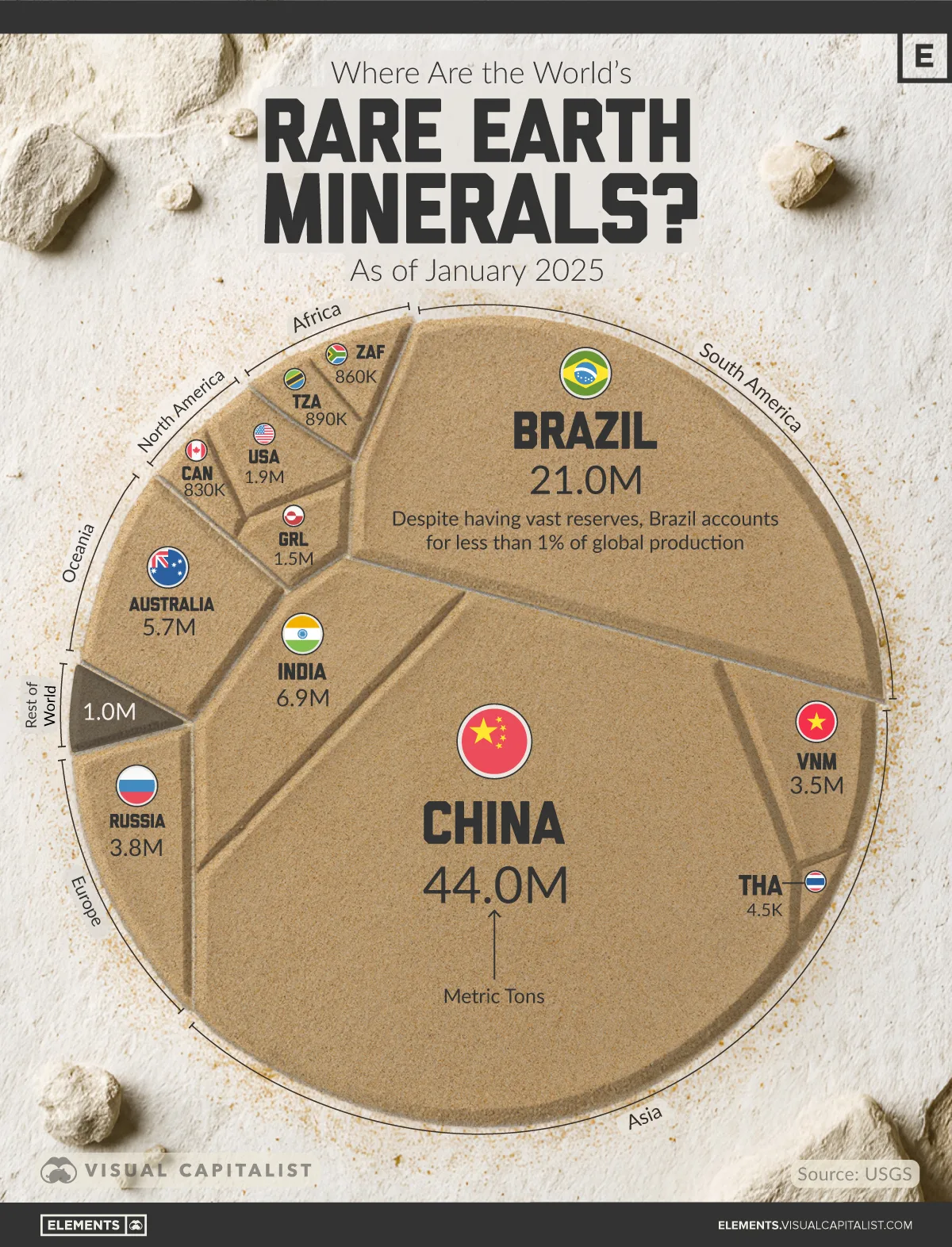
This visualization compares rare earth mine production and reserves across countries, placing Greenland’s untapped resources in a global context.
China remains the backbone of the global rare earth market. In 2024, it produced roughly 270,000 metric tons, accounting for well over half of global output.
China also controls the largest reserves, estimated at 44 million metric tons. This combination of scale and integration gives Beijing significant leverage over industries ranging from electric vehicles to defense systems.
Country
Reserves (Metric Tons)
Rare Earth Production 2024 (Metric Tons)
🇨🇳 China
44.0M
270,000
🇧🇷 Brazil
21.0M
20
🇮🇳 India
6.9M
2,900
🇦🇺 Australia
5.7M
13,000
🇷🇺 Russia
3.8M
2,500
🇻🇳 Vietnam
3.5M
300
🇺🇸 United States
1.9M
45,000
🇬🇱 Greenland
1.5M
0
🇹🇿 Tanzania
890K
0
🇿🇦 South Africa
860K
0
🇨🇦 Canada
830K
0
🇹🇭 Thailand
4.5K
13,000
🇲🇲 Myanmar
0
31,000
🇲🇬 Madagascar
0
2,000
🇲🇾 Malaysia
0
130
🇳🇬 Nigeria
0
13,000
🌍 Other
0
1,100
🌐 World total (rounded)
>90,000,000
390,000
Large Reserves, Limited Production Elsewhere
Outside China, many countries with sizable reserves play only a minor role in production.
Brazil holds an estimated 21 million metric tons of rare earth reserves yet produces almost nothing today. India, Russia, and Vietnam show similar patterns.
Why Greenland Matters
Greenland’s estimated 1.5 million metric tons of rare earth reserves exceed those of countries like Canada and South Africa. Yet the island has never had commercial rare earth production.
Environmental protections, infrastructure constraints, and local political opposition have slowed development. Still, as supply chain security becomes a priority for major economies, Greenland’s position is becoming harder to ignore.
Trump’s interest in Greenland is driven by more than symbolism. Rare earths are essential for advanced manufacturing, clean energy technologies, and military hardware. With China firmly entrenched as the dominant supplier, policymakers in Washington are increasingly focused on alternative sources.
CNA Few countries are better prepared against China threatening their rare earth supplies than Japan, says David Fickling for Bloomberg Opinion.
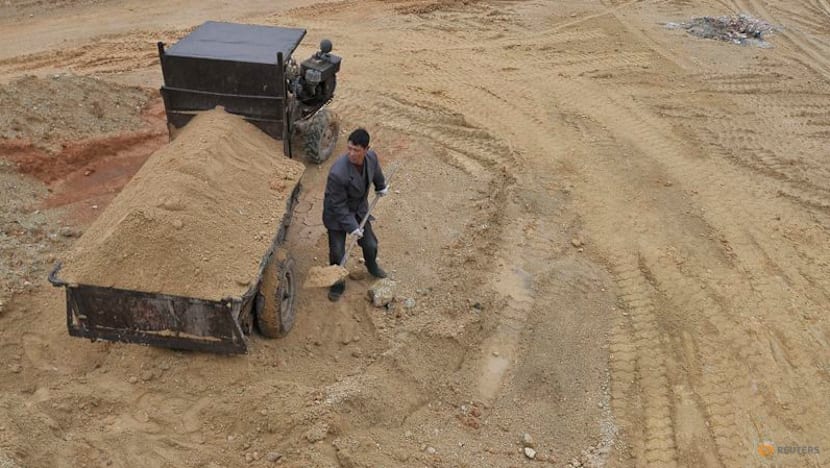
A labourer works at a site of a rare earth metals mine at Nancheng county, Jiangxi province, China, on Mar 14, 2012. (File photo: Reuters)
David Fickling 09 Jan 2026 05:59AM(Updated: 09 Jan 2026 09:30AM)
SYDNEY: To a hammer, every problem is a nail. If your most potent means of geopolitical leverage is threatening supplies of high-strength magnets, rare earth elements will always be the solution.
The most obvious victim of this threat will be rare earth magnets made with the elements neodymium and praseodymium, and increasingly spiced up with rarer samarium, dysprosium and terbium. They’re used everywhere from charging cables to the switchgear in wind turbines to motors powering electric vehicles, missile guidance systems and aircraft flaps.
Luật sửa đổi, bổ sung một số điều của Luật Địa chất và khoáng sản khẳng định đất hiếm là khoáng sản chiến lược đặc biệt. Việc thăm dò, khai thác, chế biến phải được kiểm soát chặt chẽ, không xuất khẩu thô khoáng sản đất hiếm. Chỉ các doanh nghiệp, tổ chức được Nhà nước chỉ định hoặc cho phép mới được quyền thăm dò, khai thác, chế biến và sử dụng đất hiếm. Hoạt động chế biến sâu đất hiếm phải gắn với xây dựng hệ sinh thái công nghiệp hiện đại để nâng cao chuỗi giá trị trong nước…
Chỉ các doanh nghiệp, tổ chức được Nhà nước chỉ định hoặc cho phép mới được quyền thăm dò, khai thác, chế biến và sử dụng đất hiếm. Ảnh minh họa
Tiếp tục chương trình Kỳ họp thứ 10, ngày 11/12, Quốc hội biểu quyết thông qua Luật sửa đổi, bổ sung một số điều của Luật Địa chất và khoáng sản với đa số đại biểu có mặt tán thành.
Trước khi Quốc hội thông qua, Bộ trưởng Bộ Nông nghiệp và Môi trường Trần Đức Thắng, thừa ủy quyền của Thủ tướng Chính phủ báo cáo giải trình, tiếp thu, chỉnh lý dự thảo Luật sửa đổi, bổ sung một số điều của Luật Địa chất và khoáng sản. Theo đó, Chính phủ đã tiếp thu và phối hợp với các cơ quan có liên quan rà soát, chỉnh lý, hoàn thiện dự thảo về các vấn đề bảo đảm tính thống nhất, đồng bộ của hệ thống pháp luật, quy định đầy đủ các trường hợp chuyển tiếp và một số vấn đề cụ thể khác.
China accounts for nearly half of global rare earth reserves (44M of 92M metric tons).
Brazil ranks second (21M tons), while the U.S. holds 1.9M tons—about 2% of the total.
Rare earth elements (REEs) are the backbone of modern technology, from EV motors and wind turbines to smartphones and precision-guided systems.
This map breaks down where the world’s known rare earth reserves are located in 2025, highlighting how concentrated they are across a handful of countries.
The distribution is highly uneven. China alone holds nearly half of the global total, followed by Brazil’s sizable deposits. By contrast, many advanced economies have limited reserves.
China leads with 44.0 million metric tons, about 48% of the world total of 91.9 million metric tons. Brazil is a clear second at 21.0 million tons (23%), reflecting large ionic clay and hard-rock deposits that are still early in development.
Item 1 of 4 United Wa State Army (UWSA) soldiers march during a media display in Pansang, Wa territory in northeast Myanmar, October 4, 2016. Picture taken on October 4, 2016. REUTERS/Soe Zeya Tun/File Photo
[1/4]United Wa State Army (UWSA) soldiers march during a media display in Pansang, Wa territory in northeast Myanmar, October 4, 2016. Picture taken on October 4, 2016. REUTERS/Soe Zeya Tun/File Photo Purchase Licensing Rights, opens new tab
Summary
Beijing-backed UWSA protecting new rare earth mines in Shan state, sources say
Mines being run by Chinese-speaking operators
China relies on Myanmar for rare earth imports but had recently faced some supply challenges
Rare earths offer Beijing leverage in trade war with Washington
BANGKOK, June 12 (Reuters) – A Chinese-backed militia is protecting new rare earth mines in eastern Myanmar, according to four people familiar with the matter, as Beijing moves to secure control of the minerals it is wielding as a bargaining chip in its trade war with Washington.
China has a near-monopoly over the processing of heavy rare earths into magnets that power critical goods like wind turbines, medical devices and electric vehicles. But Beijing is heavily reliant on Myanmar for the rare earth metals and oxides needed to produce them: the war-torn country was the source of nearly half those imports in the first four months of this year, Chinese customs data show.
Toxic runoff from unregulated mines in Myanmar has sparked health and environmental concerns, across the border in Thailand.
Thai authorities have detected levels of arsenic nearly five times above acceptable limits. Meanwhile, local fishermen and residents are complaining of falling incomes and expressing food safety concerns.
Al Jazeera’s Tony Cheng reports from Bangkok, Thailand.
Rare earth rush in Myanmar blamed for toxic river spillover into Thailand
Water tests from the Kok and Sai rivers near Thailand’s border with Myanmar have revealed elevated arsenic levels, leading Thai officials to warn citizens to avoid contact with river water.
The pollution is widely believed to be linked to unregulated mining in Myanmar’s Shan state.
Extraction of gold in Shan State has surged in the years since the 2021 military coup in Myanmar; more recently, mounting evidence suggests rare earth mining is also expanding across the state.
Elevated arsenic levels have also been found at testing points in the Mekong, which is fed by both the Kok and Sai rivers.
NEW UNICRI Report: Crimes Associated with Critical Minerals in Southeast Asia
As Southeast Asia’s role in global critical mineral supply chains grows, so does its exposure to criminal threats like environmental crimes, corruption, and illicit financial flows.
UNICRI’s latest publication analyzes how various actors exploit legal and enforcement gaps across the mineral value chain. It includes case studies on unlawful extraction, smuggling, and corruption-linked offenses.
Key criminal patterns identified:
Illegal mining operations
Corruption in licensing and environmental compliance
Smuggling and laundering of proceeds
Lack of supply chain transparency
Recommendations to strengthen regional responses:
Enhance financial investigation and AML cooperation
Develop traceability tools and leverage complementary technologies such as satellite monitoring
Build enforcement capacity on mining-related crime
Promote inter-agency coordination
Empower Indigenous and local communities through strengthened FPIC implementation
Advance research on criminal methodologies in mineral supply chains
UNICRI supports collaboration among Member States and relevant stakeholders to promote secure, transparent, and sustainable mineral supply chains.
As global demand for critical minerals grows, it will be important to anticipate and address the potential harms the mining and metals sector can have on societies, communities and the environment. Overlooking these risks can ultimately disrupt supply for clean energy technologies.
Traceability systems can, when used as part of a wider risk-based due diligence process, help meet emerging policy goals by providing ways to integrate data on origin, evolution, and ownership of minerals. Some traceability approaches can also provide a platform for embedding data on environmental, social and governance issues. To work effectively, however, traceability systems must be carefully designed – balancing standardisation and context, maintaining data quality, and adapting to varying supply chain complexities. They also require strong collaboration among companies, governments and civil society, backed by cost-sharing, reliable verification and secure data-sharing protocols. Above all, traceability should serve clear objectives rather than become an end in itself: policy makers and practitioners should adopt a measured approach, progressively deploying mechanisms where necessary while allowing for inclusive participation and access to markets and investment.
This report includes a practical eight-step roadmap, from setting policy objectives to building trust mechanisms, which can help ensure traceability systems are fit for purpose and aligned with the realities of global supply chains.
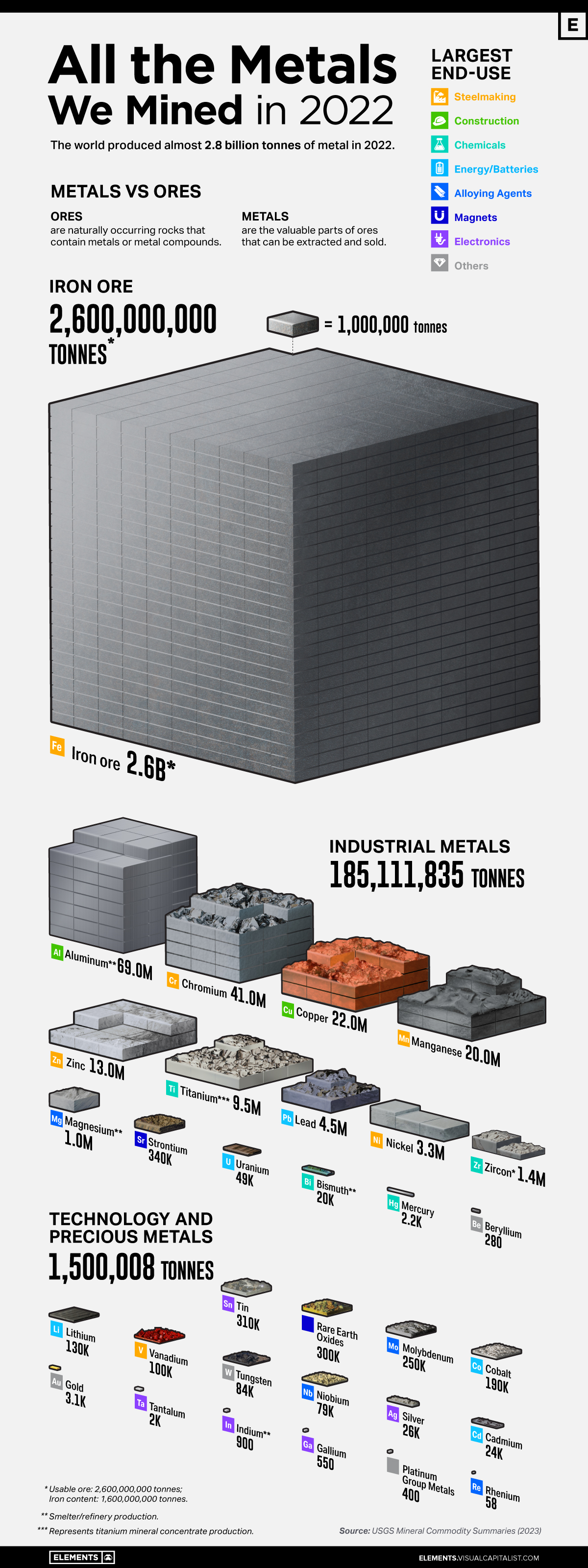
Metals are a big part of our daily lives, found in every building we enter and all devices we use.
Today, major industries that directly consume processed mineral materials contribute 14% of the United States economy.
The above infographic visualizes all 2.8 billion tonnes of metals mined in 2022 and highlights each metal’s largest end-use using data from the United States Geological Survey (USGS).
Iron Ore Dominance
Iron ore dominates the metals mining landscape, comprising 93% of the total mined. In 2022, 2.6 billion tonnes of iron ore were mined, containing about 1.6 billion tonnes of iron.
Metal/Ore
Quantity Mined in 2022 (tonnes)
% of Total
Iron ore
2,600,000,000
93.3%
Industrial metals
185,111,835
6.6%
Technology and Precious Metals
1,500,008
0.05%
Total
2,786,611,843
100%
Percentages may not add up to 100 due to rounding.
Iron ores are found in various geologic environments, such as igneous, metamorphic, or sedimentary rocks, and can contain over 70% iron, with many falling in the 50-60% range.
Combined with other materials like coke and limestone, iron ore is primarily used in steel production. Today, almost all (98%) iron ore is dedicated to steelmaking.
The ore is typically mined in about 50 countries, but Australia, Brazil, China, and India are responsible for 75% of the production.
Because of its essential role in infrastructure development, iron ore is one of the most crucial materials underpinning urbanization and economic growth.
Industrial Metals
Industrial metals occupy the second position on our list, constituting 6.6% of all metals mined in 2022. These metals, including copper, aluminum, lead, and zinc, are employed in construction and industrial applications.
We want the newest gadgets, the most advanced electric vehicles, and a fully electrified future, but behind all of that is a class of critical metals: rare earths. These are the only metals in the world, to date, that can be used to create powerful and portable magnets, essential to everything from EVs to wind turbines. So why the worry? For decades, China has maintained an iron grip on the entire supply chain for rare earths. Today, demand is skyrocketing for rare earths, because the world is racing to electrify just about every part of our lives. Kartik Kuna is the first outsider to gain filming access to a particular magnet factory in Dongguan, China – one of many Chinese factories that are producing a huge majority of the world’s rare earth magnets. Just why is it so hard to outcompete China in this space? Kartik also witnesses for himself a startling statistic – China is building up offshore wind power capacity at breakneck pace… all of which requires rare earths. Tiếp tục đọc “Power scramble – 3 parts”→
Myanmar’s Kachin State, supplying 38% of China’s rare earth imports, halted mining, causing an immediate spike in global prices.
The long-term effects of this suspension might lead to scarcity, illicit mining, and environmental issues in the region.
China’s economic slowdown combined with geopolitical risks highlights the need for diversified sourcing in the rare earth market.
The Rare Earths MMI (Monthly Metals Index) witnessed yet another steep increase month-over-month. Indeed, supply disruptions remain a massive concern in the rare earths industry, so rare earth magnets and other materials witnessed renewed bullish strength across the board over recent months.
Critical minerals, essential for a range of clean energy technologies, have risen up the policy and business agenda in recent years. Rapid growth in demand is providing new opportunities for the industry, but a combination of volatile price movements, supply chain bottlenecks and geopolitical concerns has created a potent mix of risks for secure and rapid energy transitions. This has triggered an array of new policy actions in different jurisdictions to enhance the diversity and reliability of critical mineral supplies.
Since the International Energy Agency’s (IEA) landmark analysis on the Role of Critical Minerals in Clean Energy Transitions and the new ministerial mandates in March 2022, the Agency has expanded its work on critical minerals to help policymakers address these emerging challenges and ensure reliable and sustainable supplies of critical minerals. These efforts include a commitment to regular market monitoring, which aims to provide a clear understanding of today’s demand and supply dynamics and what they mean for the future. In this inaugural piece of analysis, we review the latest price, investment and production trends in the critical minerals sector. The first chapter provides a snapshot of industry developments in 2022 and early 2023. The second chapter reviews key trends in the battery sector given its importance in driving demand growth for critical minerals. The third chapter presents a concise review of key trends for each individual commodity. In the final chapter, we present implications for policy and industry stakeholders.



 Key criminal patterns identified:
 Recommendations to strengthen regional responses:
 Read the report: