Like The Atlantic? Subscribe to The Atlantic Daily, our free weekday email newsletter.
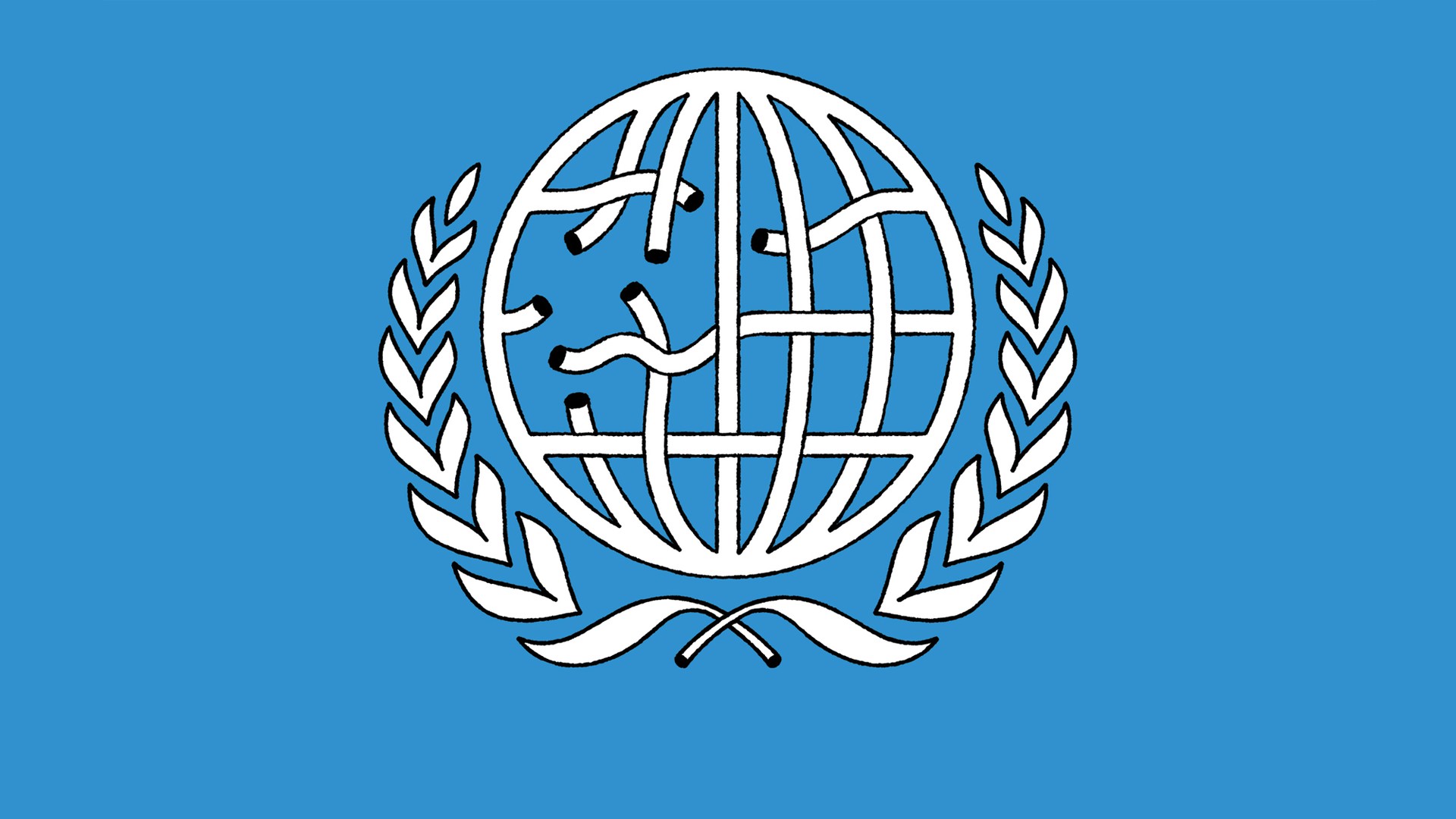
Back in may, when President Donald Trump called for America to stop funding the World Health Organization, he presented a list of the WHO’s recent failures: the organization’s initial failure to flag the spread of the novel coronavirus; its initial failure to follow up when Taiwan—a country excluded from the WHO because of Chinese objections—inquired about evidence that seemed to indicate that the virus could be transmitted from one human to another; its initial failure to press China to accept an international investigation into the source of the virus. At the beginning of the pandemic, the WHO, which operates as a specialized agency of the United Nations, seemed to be one beat behind. It also seemed overly reliant upon biased information provided by the government of China.
The United States has released guidance on its immigration laws that will make it almost impossible for members of a Communist party or similar to be granted permanent residence or citizenship of America.
U.S. Secretary of State Mike Pompeo meets Vatican Secretary of State Cardinal Pietro Parolin, at the Vatican, Thursday, Oct. 1, 2020. Pompeo is meeting Thursday with top Vatican officials, a day after tensions over U.S. opposition to the Vatican’s China policy spilled out in public. (Vatican Media via AP)
ROME (AP) — The U.S. and the Vatican butted heads over China on Thursday as the Holy See chafed at U.S. Secretary of State Mike Pompeo’s public call to take a harsher stance against Chinese restrictions on religious freedom.
Beijing is going all in to back a breakthrough in Chinese semiconductor manufacturing as the nation faces US sanctions on hi-tech goodsBut many newcomers to the industry have little experience and some experts say the ‘whatever it takes’ approach shows tolerance for inefficiency
The US Department of Commerce has written to American suppliers of China’s biggest chip manufacturer, warning them of “unprecedented risks” that their products could be used by the Chinese military.
Beijing hit back with tariffs ranging from 5% to 25% on US goods.
What’s next?
Under the so-called “phase one” deal signed in January, China pledged to boost US imports by $200bn above 2017 levels and strengthen intellectual property rules.
The US agreed to halve some of the new tariffs it had imposed on China.
The White House said it will tackle additional issues in a second, “phase two” deal but analysts said they didn’t expect anything concrete anytime soon
What a difference two months can make. In May, Taiwan Semiconductor Manufacturing Co. (TSMC), the world’s largest chipmaker, lost the business of Huawei Technologies—its biggest Chinese customer and the source of 13% of its revenue—as a casualty of geopolitical jockeying between superpowers. But TSMC shareholders took the loss in stride. And by late July, after a stumble by rivalIntel, TSMC’s stock had risen almost 50% since May, making it one of the world’s 10 most valuable companies.
May’s low and July’s high have something in common: They both reflect TSMC’s distinctive role in the global tech economy. Although far from a household name, TSMC controls roughly half of the world’s contract chip manufacturing. Brand-name companies that design their own chips—most notably Apple—rely on TSMC’s world-class production so they don’t have to spend tens of billions to build their own factories. Crack open your iPhone and you’ll find a chip from TSMC. If you could crack open an American guided missile, you’d likely find one there too. Its prowess has elevated TSMC to No. 362 on the Global 500, with $35 billion in revenue. Today it gets 60% of sales from the U.S. and about 20% from mainland China.
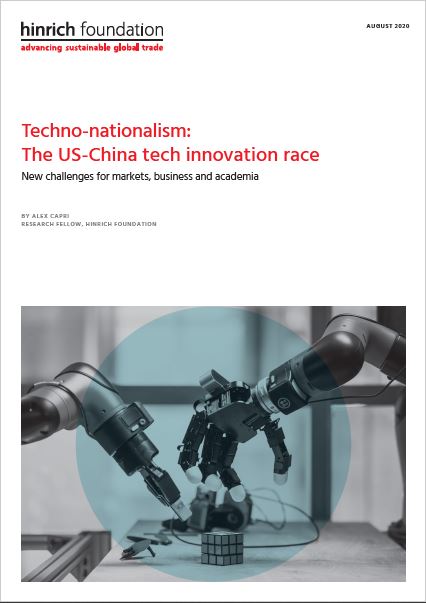
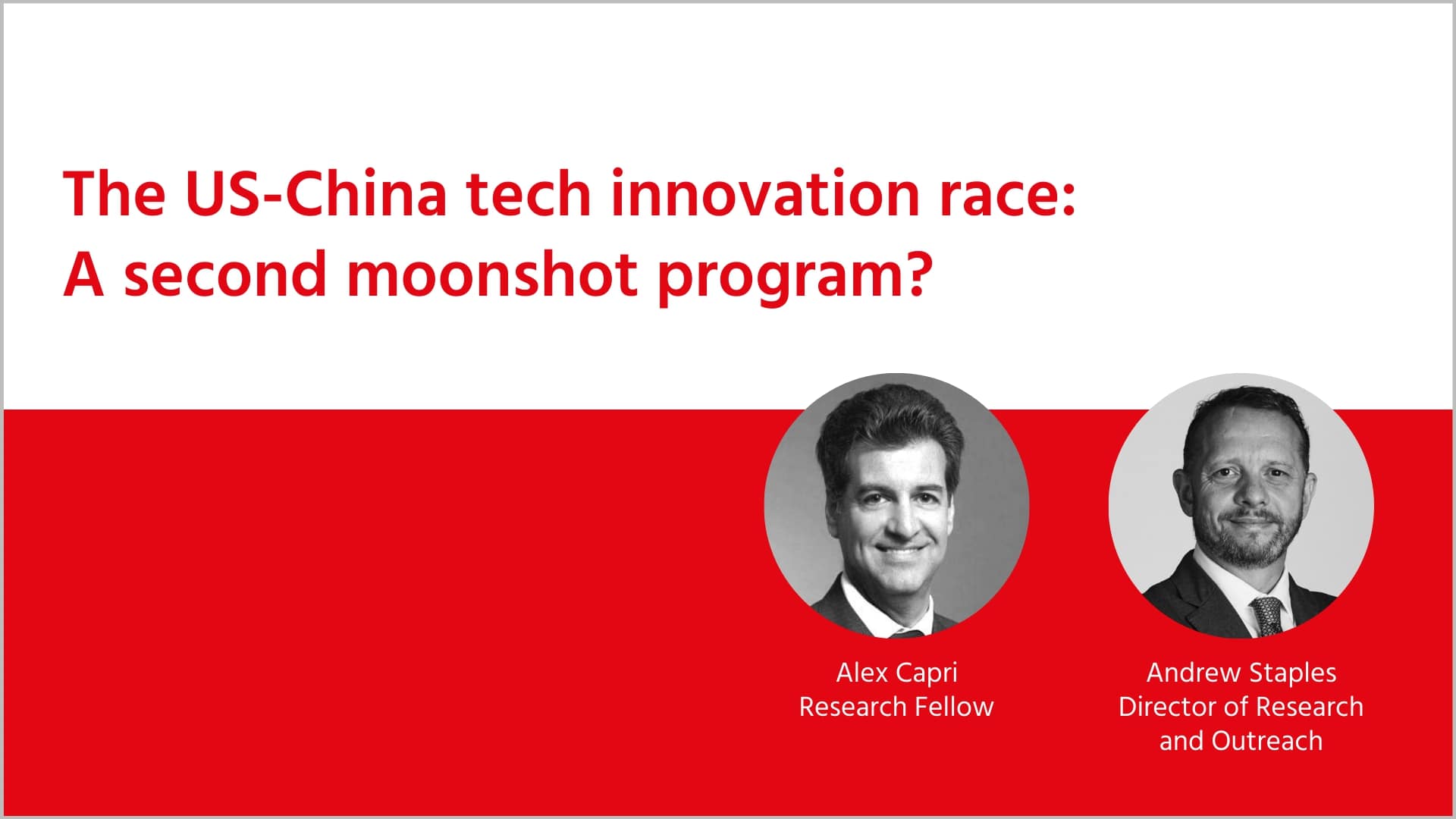
Techno-nationalism: The US-China tech innovation race New challenges for markets, business and academia BY ALEX CAPRI RESEARCH FELLOW, HINRICH FOUNDATION, 20202
The US-China tech innovation race is challenging the laissez-faire economic model. State interventionism, techno-nationalism and US tech funding initiatives are increasing. This paper outlines the implications for markets, academia, research organizations, and governments of the US-China competition to achieve innovation advantage.
A US-China tech innovation race has sparked a paradigm shift in global trade and commerce that is challenging the long-standing primacy of the world’s open trading system.
Current thinking is tilting towards increased state activism and interventionism, not only in the technology landscape but in many of the industries of the future.
Driving this change is techno-nationalism: a mercantilist-like behavior that links tech innovation and enterprise directly to the national security, economic prosperity and social stability of a nation.
In response to decades of Beijing’s innovation-mercantilism, the US has embarked on its own innovation offensive. Washington’s future tech funding initiatives could surpass the scale of the “moonshot” projects last seen during the space race with the former Soviet Union.
Download “Techno-nationalism: The US-China tech innovation race” by Alex Capri
The innovation race involves a broad range of emerging and foundational technologies that will define the industries of the future, including:
Artificial Intelligence (AI) and machine learning
Quantum computing and information systems
Robotics
Energy storage
Semiconductors
Next generation communication (including 5G and 6G)
Hypersonics.
Underlying themes: US techno-nationalism and innovation
As Washington and its allies ramp up techno-nationalist initiatives, core themes will drive the paradigm shift.
Public-private partnerships (PPP) – Technology alliances and government-funded initiatives will play an increasingly important role in advancing long-term innovation in the US, the EU and other traditionally open markets.
Avoiding the China innovation model – The US and EU innovation agendas will not seek to emulate China’s centralized, authoritarian system of techno-nationalism, but, rather, to turbo-charge markets and leverage entrepreneurial ecosystems, as well as academic and defense establishments.
Balancing tensions between MNEs, markets and techno-nationalism – Multinational enterprises (MNEs) will remain the primary drivers of R&D and innovation in free markets and play a vital role in PPP initiatives. They will be pulled into the US-China technology war in a variety of ways which will require a careful balancing of market forces, the interests of MNEs and the needs of state actors.
Multilateral technology alliances – US techno-nationalist policy will increasingly align with the security, economic and ideological objectives of the EU and other historic allies. This will produce more cooperation between the US and its partners.
Section I – The US-China innovation race: The role of the state
This section examines trends for public-spending in R&D and innovation and reviews a series of techno-nationalist funding initiatives from the US government.
It analyzes state activism in free markets and why governments are uniquely qualified to promote innovation and “blue-sky” technologies in ways that the private sector cannot.
Finally, Section I spotlights a historic example of techno-nationalism: SEMATECH and the US semiconductor public-private partnership, which led to a technological leapfrog by the US semiconductor industry, past Japan, in the 1990s.
Section II – MNEs, markets and governments: Navigating new complexities
Section II focuses on non-state actors and their increasingly complex role in public-private partnerships. It explores the tensions between open market forces, multinational companies, and techno-nationalist state activism.
To highlight these tensions, the report analyzes Facebook’s “Libra initiative and Beijing’s efforts to reduce dependency on the US dollar via the digital Yuan, and the challenges those create for MNEs. A US semiconductor sector case study illustrates how state activism can have detrimental effects on markets and backfire on the very parties it is looking to protect.
Section II concludes with an analysis of how open-sourced innovation could be a game-changer in the US-China technology war, particularly regarding future 5G wireless competition.
Section III – Academia and techno-nationalism: Open versus closed systems
Universities, research organizations and academia have become hot zones in the US-China innovation race. Human capital development is key to conducting leading-edge R&D and driving innovation.
Section III looks at how US export controls are affecting R&D activities at universities. It highlights the rules-based frameworks that universities must build to handle increasing government funding into academia.
The section showcases China’s Thousand Talents program and highlights its challenges for public-private partnerships involving academia. It also discusses why the US, in particular, should keep its human capital and innovation pipeline open as it pertains to foreign students, fundamental research programs and, ultimately, why an open system (despite China’s exploitation of it) is better than a closed one.
Finally, section III looks at how some inevitable strategic decoupling between Chinese and US entities will result in the ring-fencing of more “sensitive” R&D activities within the US defense establishment.
Listen to a summary of the report in this podcast featuring Alex Capri and Andrew Staples, Director of Research and Outreach.
Alex Capri is a Research Fellow at the Hinrich Foundation with over 20 years of experience in value chains, logistics and global trade management, both as an academic and a professional consultant.
CHANGSHA, China — The United States has ordered China to close its consulate general in Houston “in order to protect American intellectual property and American’s private information,” State Department spokeswoman Morgan Ortagus said Wednesday.
Năm 2016, chính phủ Việt Nam đã công bố chiến lược phát triển lực lượng lao động lành nghề để đáp ứng nhu cầu trong nước và quốc tế và đưa đất nước ngang tầm với phần còn lại của khu vực ASEAN, mặc dù có rất ít chi tiết được công bố kể từ đó.
(Reuters) – Một mặt trận mới mở ra trong cuộc chiến thương mại Mỹ-Trung khi các công ty chuyển sản xuất sang Việt Nam tham gia vào một cuộc chiến khốc liệt thu hút lao động lành nghề, làm trầm trọng thêm tình trạng thiếu hụt lao động lành nghề và thúc đẩy cải cách giáo dục để giải quyết vấn đề này.
Sinh viên thực tập tại phòng thí nghiệm của một trường cao đẳng dạy nghề công nghiệp tại Hà Nội, Việt Nam ngày 9 tháng 10 năm 2019. Ảnh chụp ngày 9 tháng 10 năm 2019 bởi REUTERS / Kham
Việt Nam trở thành một trong những nước hưởng lợi lớn nhất từ cuộc chiến thương mại giữa Washington và Bắc Kinh.
pv-magazine.com
The Chinese government will extend duties on U.S. and South Korean polysilicon for another five years from today despite committing to buy $200 billion more American goods and services in the trade deal signed on Wednesday. Poly manufacturer REC Silicon says it expects polysilicon to form part of that trade agreement.
China’s latest trade tariff announcement appears to be at odds with the deal just signed with the U.S.
Image: Nathan Hughes Hamilton/Flickr
China’s Ministry of Commerce (MOFCOM) has announced the anti-dumping duties applied to U.S. and South Korean-made polysilicon will remain in place for another five years from today.
Norwegian poly producer REC Silicon, which manufactures almost all of its current output of the solar module raw material in the U.S., said this morning the extension of duties announced yesterday was expected as part of a pre-planned tariff review independent of the trade deal thrashed out by President Trump and China on Wednesday. Tiếp tục đọc “China holds firm on strategy to build self-sufficient domestic polysilicon industry”→
Vietnam is struggling to curb fraud in exports destined for America as manufacturers seek to dodge punishing tariffs due to the US-China trade spat by illegally using ‘Made in Vietnam’ labels. Photo: AFP
Vietnam is struggling to curb fraud in exports destined for America, custom officials said Thursday, as manufacturers seek to dodge punishing tariffs due to the US-China trade spat by illegally using “Made in Vietnam” labels.
Cách của ông Trump là loại bỏ hoặc hạn chế môi trường có lợi để Trung Quốc không thể soán ngôi của Mỹ. Còn Trung Quốc dường như đang áp dụng chủ trương ‘kiên nhẫn chiến lược’.
The move comes as labor costs are rising in China along with added pressure from spiraling tariffs due to the ongoing Sino-U.S. trade tensions.
A member of the media tries a Google Inc. Pixel 3 smartphone after its sales launch event at a SoftBank Corp. store on Nov. 5, 2018 in Tokyo, Japan.Tomohiro Ohsumi / Getty Images file
/ Source: Reuters
By Reuters
Alphabet’s Google is shifting its Pixel smartphone production to Vietnam from China starting this year as it builds a cheap supply chain in Southeast Asia, the Nikkei business daily reported on Wednesday.
The move comes as labor costs are rising in China along with added pressure from spiraling tariffs due to the ongoing Sino-U.S. trade tensions.











 CVD
CVD 