When Vietnam hosted this month its first-ever International Defense Expo at a military airstrip in Hanoi, the event signaled a quiet but evolving shift in the communist nation’s defense policy.
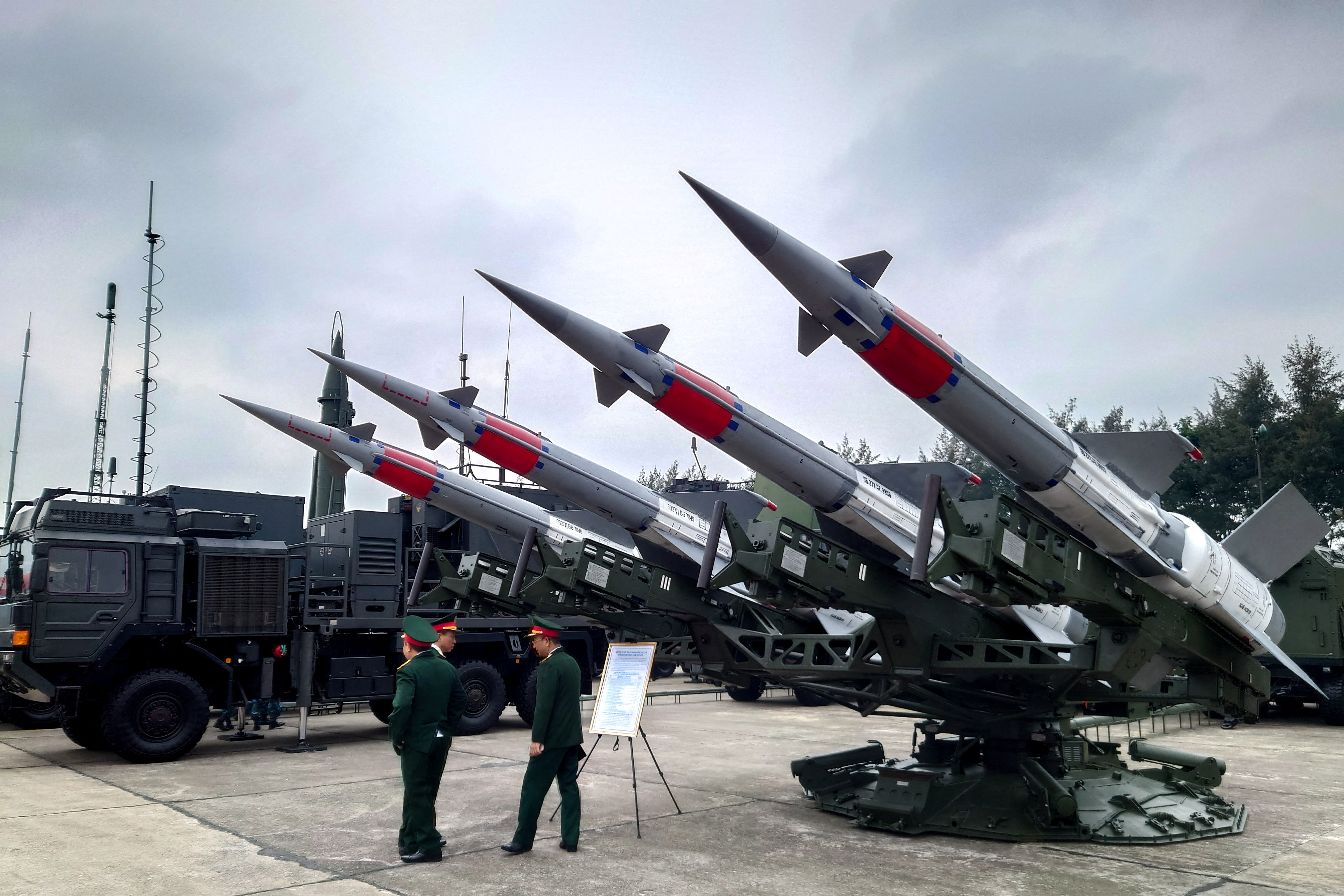
Military arms are displayed at the Vietnam International Defence Expo 2022, in Hanoi, Vietnam, December 8, 2022. REUTERS/Khanh Vu
HANOI, Dec 8 (Reuters) – U.S. and Russian defence firms on Thursday displayed weapons and promoted models of aircraft at Vietnam’s first large-scale arms fair, as the two powers vie for influence and arms sales in the strategic Southeast Asian country that borders China.
The event at a Hanoi airbase attracted 174 exhibitors from 30 countries, including all large arms-making nations except China.
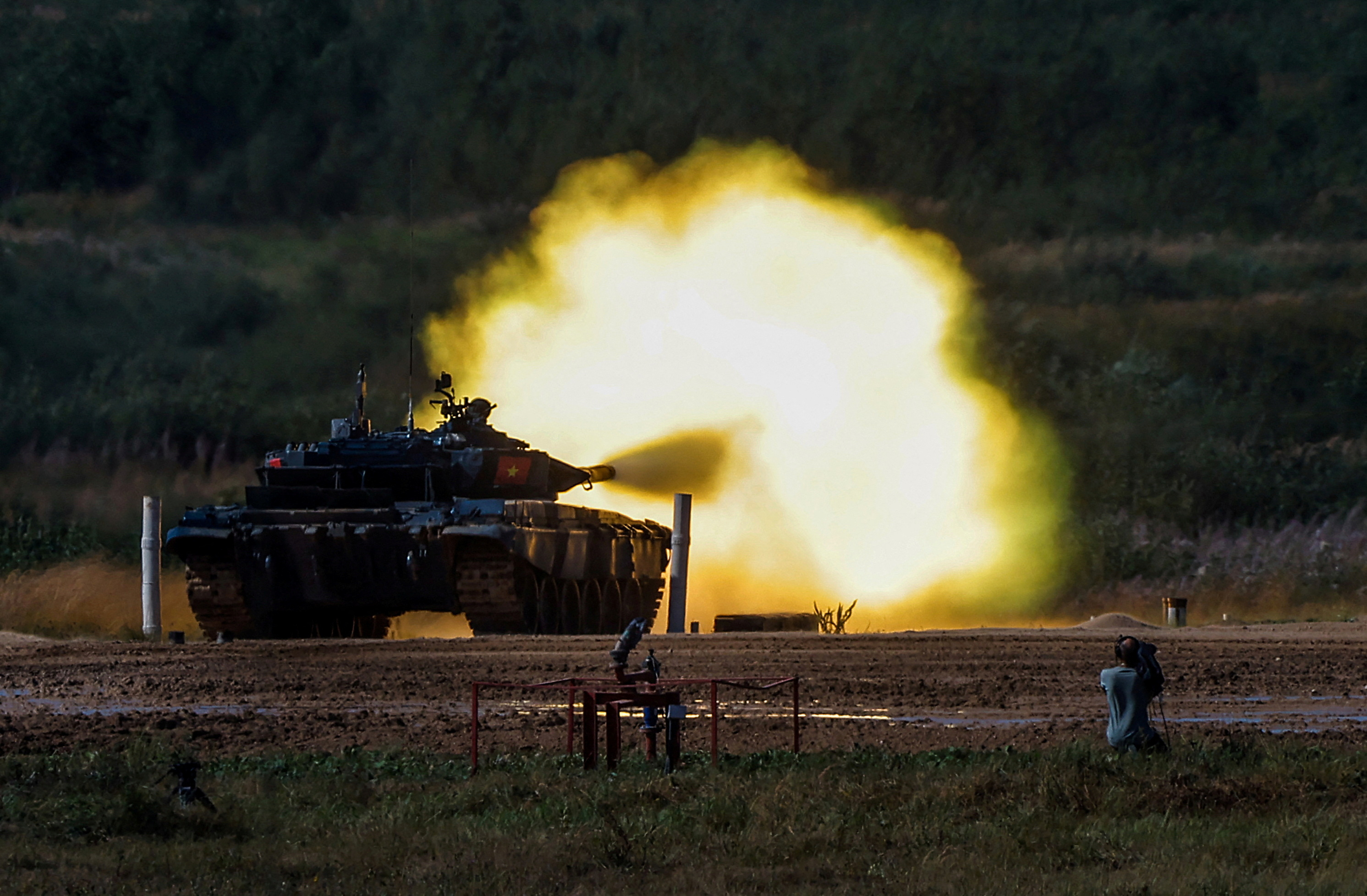
T-72 B3 tank operated by a crew from Vietnam fires during the Tank Biathlon competition at the International Army Games 2022 in Alabino, outside Moscow, Russia August 16, 2022. REUTERS/Maxim Shemetov
HANOI, Dec 7 (Reuters) – Vietnam is eyeing a major defence shift as it seeks to reduce its reliance on Russian arms and launch a push to export locally made weapons, officials and analysts said, with possible buyers in Africa, Asia – and potentially even Moscow.
The Southeast Asian nation is one of the world’s 20 biggest buyers of weapons amid on-and-off tensions with China, with an annual budget for arms imports estimated at about $1 billion and set to grow, according to GlobalData, a provider of military procurement intelligence.
Most of that money has historically gone to Russia, which was for decades Vietnam’s main supplier of weapons and defence systems. That made Vietnam one of the top buyers of Russian arms, according to data from the Stockholm International Peace Research Institute (SIPRI), which tracks global military expenditures.
Aljazeera – Vladimir Putin’s absence from the G20 Summit in Bali also undermines talk of a Russian pivot to the Asia-Pacific region.
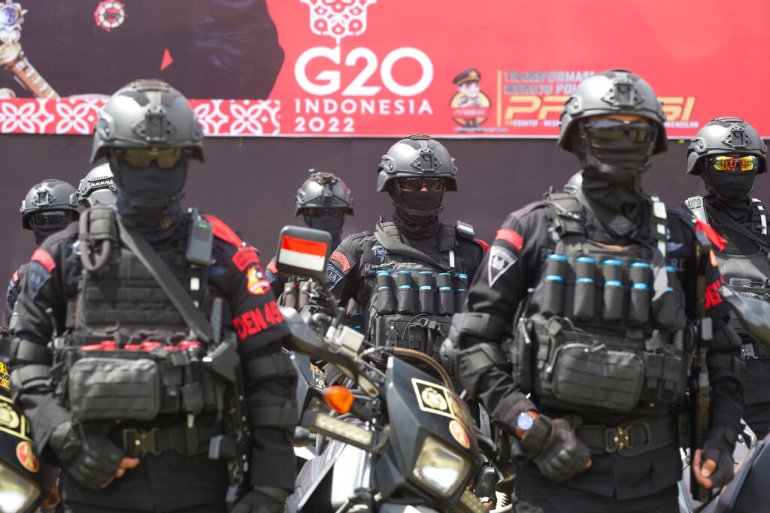
Indonesian police line up during a security parade on November 7, 2022, in preparation for the G20 meeting in Bali, Indonesia [File: Firdia Lisnawati/AP] (AP Photo)
By Al Jazeera Staff
Published On 15 Nov 202215 Nov 2022
Russian President Vladimir Putin has oozed a casual resentment when describing the “irreversible and even tectonic changes” that he says have led the West to become a spent force in the world.
“Western countries are striving to maintain a former world order that is beneficial only to them,” he told attendees at the Eastern Economic Forum in the Russian city of Vladivostok in September.
Aljazeera – Soviet-era nostalgia and anti-Western sentiment fuel online support for Russia’s Vladimir Putin and his war on Ukraine.
Russian President Vladimir Putin looks through a scope as he shoots a Chukavin sniper rifle (SVCh-380) during a visit to the military Patriot Park in Kubinka, outside Moscow, in September 2018 [File: Alexey Nilkolsky/Sputnik/ AFP]
By Al Jazeera Staff
Published On 18 Nov 202218 Nov 2022
While the West has united in condemnation of Russia’s invasion of Ukraine, opinions differ markedly in parts of the developing world where Russia is not reviled but revered for what some see as its stance against the West and its hypocrisies.
In Southeast Asia, a region dominated for decades by “strongman” political leaders and where nostalgia for the Soviet Union persists in some quarters, Russian President Vladimir Putin has a strong following among social media users who are sympathetic to his invasion of Ukraine and find his macho self-image appealing.
nikkei – Murky origins plague furniture sector coming down from COVID-fueled buying spree
A company displays lumber in Vietnam, whose wood products industry is grappling with risks ranging from the Ukraine war to fake forest certificates and U.S. trade probes. (Photo by Lien Hoang)
HO CHI MINH CITY — Reputational risks are piling up for a Vietnamese lumber industry already beset by a falloff in demand from the heights of the pandemic.
One of the world’s biggest wood and furniture exporters, Vietnam enjoyed a surge in orders when overseas buyers spent COVID lockdowns renovating their home offices and kitchens.
But the Southeast Asian country faces accusations of importing Chinese goods for re-export with “Made in Vietnam” labels since the onset of the China-U.S. tariff war in 2018. Now an actual war in Ukraine is stoking concern that sanctioned products from Russia may be routed through Vietnam, which maintains a neutral stance on the conflict between Kyiv and Moscow, as it does with Beijing and Washington. A third concern, about logging of fuel wood, has added to the pressure.
Plywood allegedly made from Russian birch is being loaded on a ship in Haiphong, Vietnam, for export to the United States in May 2022. (Obtained by Environmental Investigation Agency)
October 1, 2022 at 2:00 a.m. EDT
HO CHI MINH CITY, Vietnam — Russian birch wood has continued to flow to American consumers, disguised as Asian products, despite U.S. economic sanctions imposed on Russia over its invasion of Ukraine, a new report says.
The Environmental Investigation Agency (EIA), a nonprofit watchdog group based in Britain, has found that most birch products currently being exported from Vietnam to the United States originate in Russia. According to Vietnam customs data, roughly 40,000 cubic meters of birch wood is transported every month from Russia andChina into Vietnam, where it’s assembled into furniture and plywood.
YOHEI MURAMATSU and TOMOYA ONISHI, Nikkei staff writers
September 6, 2022 04:22 JST
BANGKOK/HANOI — From wooing more Russian tourists to boosting trade, Southeast Asian nations are bolstering economic ties with Russia in hopes of curbing inflation and spurring their recovery from the COVID-19 pandemic.
The U.S. and European countries have imposed sweeping sanctions on Russia in response to its invasion of Ukraine. But these efforts could be hindered by emerging nations as they prioritize addressing their own economic headwinds.
(LLCT) – Chính sách đối ngoại của Đảng giai đoạn 1976-1986 đã để lại những kinh nghiệm quý báu, đó là: cần phải đánh giá đúng sự vận động, biến đổi của bối cảnh quốc tế, khu vực; bám sát thực tiễn đất nước, kịp thời điều chỉnh chủ trương, chính sách đối ngoại, thường xuyên phòng, tránh nguy cơ mất độc lập, tự chủ về tư duy và đường lối đối ngoại; coi trọng công tác dự báo, tổng kết thực tiễn; chủ động khắc phục đường lối đối ngoại “nhất biên đảo”; tích cực thiết lập các mối quan hệ với các nước lớn và các nước láng giềng… Những kinh nghiệm này đã góp phần định hướng đường lối đối ngoại của Đảng trong thời kỳ đổi mới và hội nhập quốc tế; cần được vận dụng, phát huy có hiệu quả trong sự nghiệp xây dựng và bảo vệ Tổ quốc hiện nay.
As the Russia-Ukraine conflict unfolds and completes a month, Vietnam Briefing looks at the impact of the conflict on Vietnam as well as businesses in the country. While it’s still early to determine long-term effects, we examine the short-term effects that will play a key role in how the economy moves forward.
The Russia-Ukraine conflict which began on February 24, sent shockwaves to global markets and led to an unprecedented response from countries around the world in the form of economic sanctions and other restrictive measures. In doing so, western countries and allies are sending a clear signal that they want to cut off Russia from the global financial system and isolate Putin politically.
While analysts state the impact of the Russia-Ukraine conflict is likely to have limited direct consequences on Vietnam, the fallout of the conflict is likely to have significant consequences on trade and businesses in Vietnam. From disrupting trade and global supply chains to causing tensions geopolitically, we discuss the impact that is likely to be felt by businesses operating in Vietnam.
(VOVWORLD) – A nuclear science and technology research center with a 10-MWt nuclear reactor will be built in Vietnam, according to the Vietnam Atomic Energy Institute.
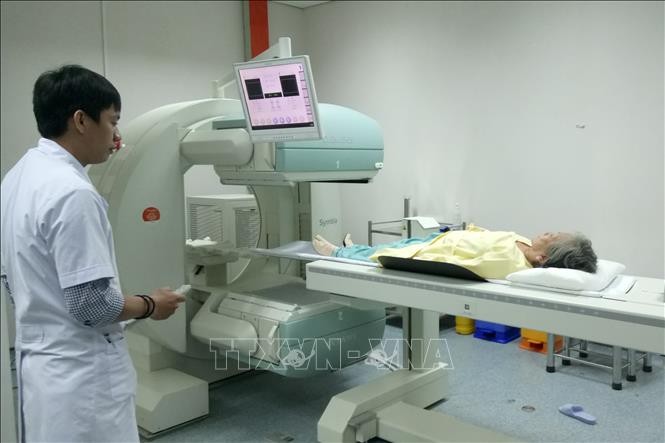
The Dong Nai General Hospital uses nuclear technology in early diagnosis of cancer. (Photo: VNA)
Dr. Tran Chi Thanh, Director of the Vietnam Atomic Energy Institute, said procedures to build the research center started in 2019.
The project is part of an agreement between Vietnam and Russia signed in November, 2011. The new research center will replace a nuclear reactor in Da Lat in Central Vietnam to boost nuclear applications for socio-economic development.
TTCT – Gần như ngay khi Thủ tướng Việt Nam Phạm Minh Chính rời Nhật Bản, kết thúc tốt đẹp chuyến thăm chính thức nước này, chuyên cơ chở Chủ tịch nước Nguyễn Xuân Phúc đã hạ cánh xuống Geneva, Thụy Sĩ vào sáng 26-11, mở đầu một vòng ngoại giao quan trọng khác.
Giống như nhiều lĩnh vực khác, công tác ngoại giao cũng gặp nhiều trở ngại trong năm 2021 vừa qua vì đại dịch COVID-19, nhưng càng về cuối năm, hoạt động đối ngoại của VN lại càng tấp nập.
Chủ tịch nước Nguyễn Xuân Phúc trong chuyến thăm Thụy Sĩ. Ảnh: VNA
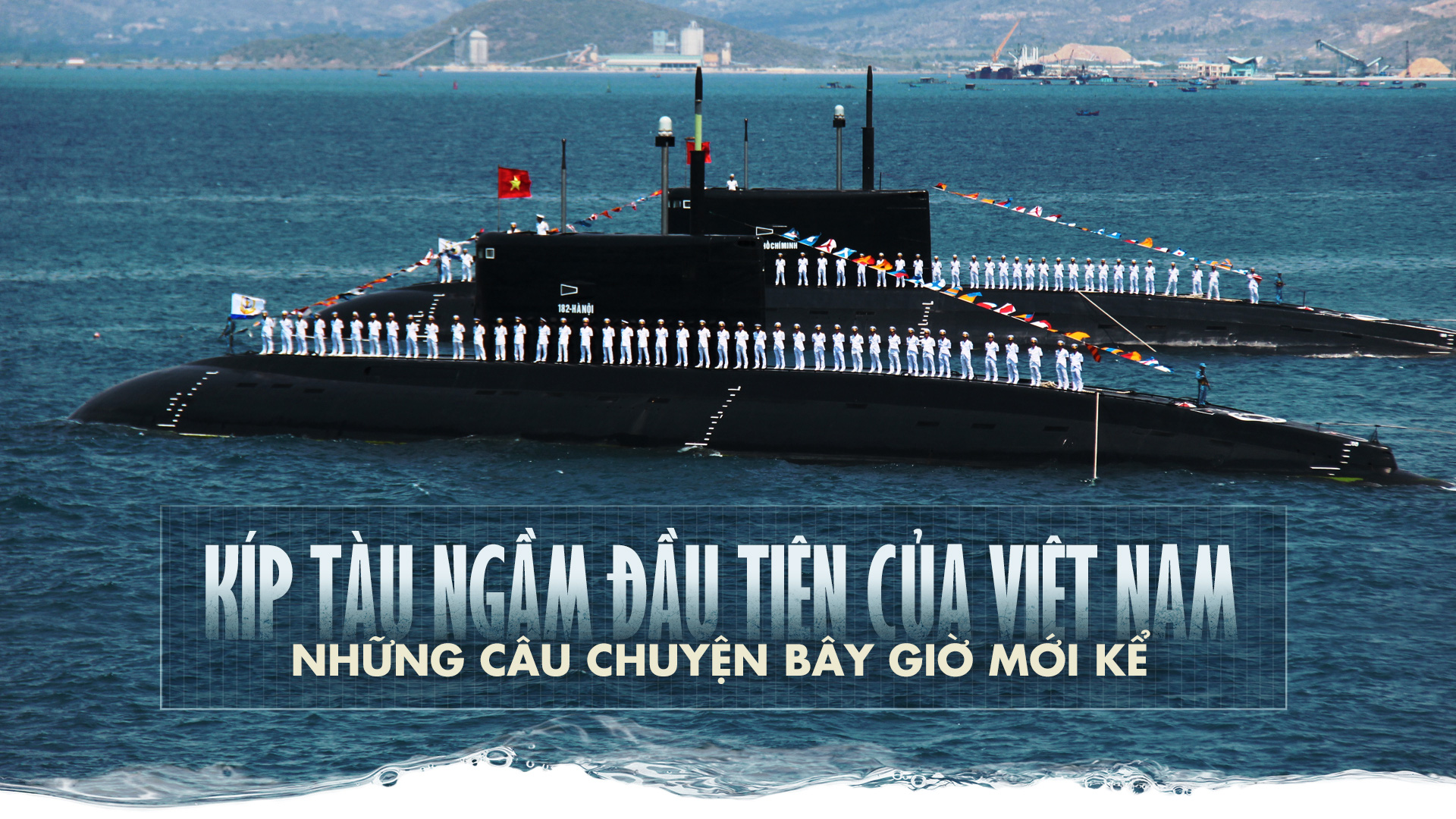
TTO – Đúng 9h ngày 2-6-2017, lần đầu tiên trong lịch sử Hải quân nhân dân Việt Nam và cả Tổ quốc, quả tên lửa phóng đi từ tàu ngầm bắn trúng trực tiếp mục tiêu, ghi dấu mốc đầy tự hào với kíp tàu ngầm lớp kilo 636 số hiệu 182-Hà Nội.
Đây cũng chính là kíp tàu ngầm đầu tiên được đi Nga học.
Nhớ lại những dấu mốc không thể nào quên với tàu ngầm kilo số hiệu 182, thiếu tá Nguyễn Trọng Khôi, thuyền trưởng tàu ngầm mang tên thủ đô Hà Nội, nói: “Khi bước chân sang Nga học, chúng tôi đã quyết tâm học, không chỉ vì danh dự của mỗi cá nhân mà còn học vì Tổ quốc”. Tiếp tục đọc “Kíp tàu ngầm đầu tiên của Việt Nam – những câu chuyện bây giờ mới kể”→


![Russian President Vladimir Putin looks through the scope as he shoots a Chukavin sniper rifle (SVC-380) during a visit to the military Patriot Park in Kubinka, outside Moscow, in September 2018 [File: Alexey Nilkolsky/Sputnik/ AFP]](https://www.aljazeera.com/wp-content/uploads/2022/11/000_1995N2.jpg?resize=770%2C513)




 CVD
CVD 