Xây dựng lăng mộ cho tổ tiên và người thân là nhu cầu chính đáng của nhiều gia đình Việt. Tuy nhiên, tại nhiều khu vực nông thôn, việc làm này thường diễn ra tự phát gây ảnh hưởng tiêu cực tới môi trường, đời sống sinh hoạt và sản xuất nông nghiệp của người dân.
Vấn đề này đòi hỏi cơ quan chức năng và chính quyền địa phương cần sớm quy hoạch khu vực nghĩa trang tập trung, có phương án di dời ngôi mộ ở khu dân cư và xử phạt hành vi cố ý xây dựng mộ trái phép. Đồng thời, cần khuyến khích người dân làm tang lễ văn minh và sử dụng hình thức hỏa táng nhằm bảo vệ môi trường và sử dụng quỹ đất hợp lý.
Rác thải công nghệ tại Việt Nam đang tăng rất nhanh, đặc biệt là rác điện tử (điện thoại, laptop, thiết bị gia dụng) và rác thải mới như tấm pin năng lượng mặt trời. Các loại rác này chứa nhiều kim loại nặng và hóa chất độc hại, gây nguy cơ lớn cho môi trường và sức khỏe cộng đồng.
Mặc dù Việt Nam đã có quy định như Luật Bảo vệ môi trường 2020 và cơ chế trách nhiệm mở rộng của nhà sản xuất (EPR), việc thực hiện vẫn còn nhiều hạn chế do hạ tầng thu gom – tái chế chưa đồng bộ, công nghệ xử lý còn lạc hậu và doanh nghiệp chưa thực hiện nghiêm túc. Trong tương lai, lượng rác thải công nghệ và tấm pin mặt trời sẽ tăng mạnh (dự báo hàng trăm nghìn tấn), vì vậy cần hoàn thiện chính sách, tăng đầu tư công nghệ tái chế hiện đại, xây dựng hệ thống thu gom hiệu quả và nâng cao ý thức người dân, doanh nghiệp.
mekongeye.com Produced in partnership with the Putlizer Center
Long-term intensive chemical use in Laos’ banana farms has degraded the country’s once-fertile soil, and it may take nearly half a century to restore it.
Laos’ fertile soil and its proximity to China have created ideal conditions for banana cultivation to meet the surging demand from Chinese consumers.
This fruit frenzy has attracted Chinese companies to seek farmland in Laos, a landlocked country that has embraced a “green agriculture” approach to combat poverty.
With government approval, the sector has expanded, offering jobs, infrastructure development, and revenue from land once considered undervalued.
However, an investigation by Mekong Eye and the Rainforest Investigations Network (RIN) reveals that the fruit plantation boom has left a legacy of soil degradation and uncertain livelihoods for many local farmers.
OUDOMXAY & BOKEO, LAOS – Northern Laos is experiencing soil degradation after years of monocropping and widespread chemical use on banana farms operated by Chinese entrepreneurs.
Thiep doesn’t remember the name of the Chinese fruit company that leased his family’s land, only that it was one of the first to arrive in his northern Lao village in 2007.
After a decade of monocropping bananas, the company left and then returned the land to his family. But in the interim, the earth had changed in ways Thiep and his household couldn’t have anticipated.
“The soil is unusually hard and dry, not like it used to be. We had to replace the plow with a stronger one just to break the ground,” Thiep recalled.
His family members invested extra effort into its first rice crop after reclaiming the plotland. That year, they enjoyed a bumper harvest that was more than they had before the arrival of the Chinese company. But it was the last time they saw such abundance.
“The yield kept decreasing after that,” Thiep said, planting seedlings in the flooded paddy. “Before we leased it out, this plot produced 60 bags of rice. Now it’s down to 30, not enough for the family to eat.”
Nearly two decades ago, Chinese entrepreneurs, attracted by geographic proximity, blanketed northern Laos with banana plantations.
Exporting bananas to China quickly became an economic mainstay, replacing the long reliance on subsistence rice farming. The plantations not only created local jobs but also increased income for households leasing their land to companies.
But investment capital is bittersweet: it may have provided the region with a ladder out of the depths of poverty, but it has ushered in new perils.
Some local workers have reportedly fallen ill or died after pesticide spraying on farms.
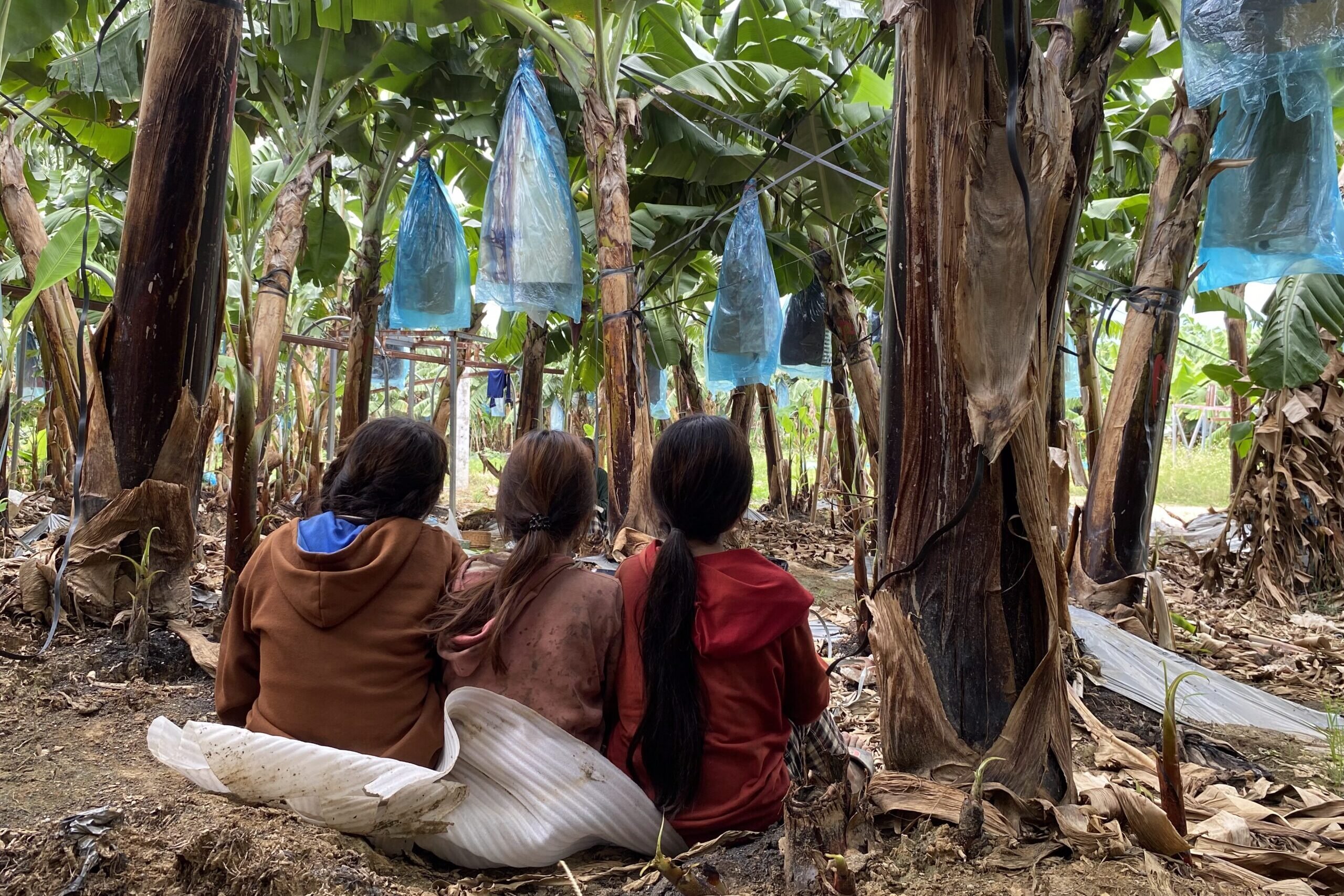
Young Hmong workers rest after long hours of labor on a banana plantation in Oudomxay province, northern Laos. Many, including children under 15, face direct exposure to hazardous agricultural chemicals used in the plantations.
A 2017 study, conducted with the Lao government’s involvement, found that agricultural chemicals – used intensively and without consistent management on banana plantations – had poisoned rivers and soil, and harmed the health of residents and plantation workers.
Among the chemicals identified were paraquat – a highly toxic herbicide banned in several countries, including Laos and China – and chlorothalonil, a hazardous substance banned in the EU in 2020 due to its potential to pollute groundwater and cause cancer.
Facing the issue, an official from the Ministry of Industry and Commerce verbally stated in early 2017 that the Prime Minister’s Office had ordered a ban on all commercial banana cultivation, according to the Laos News Agency. However, our reporter was unable to find any official orders on public platforms dating back to 2016.
Fruits of spoil: Laos’ forests disappearing as fruit farms flourish
Mekong eyes – 16 December 2024 at 9:27 (Updated on 16 December 2024 at 15:40)
The country’s improved railway connectivity facilitates fruit exports to China but has also sparked a boom in foreign-owned banana and durian farms, leading to forest clearance
A Chinese-owned banana plantation on land that was once forested, located in Attapeu province, southern Laos, in August 2024.
ATTAPEU, LAOS — The new high-speed railway has enabled faster fruit exports from Laos to China, attracting more investment in large-scale plantations. However, this growth has come at the cost of deforestation.
Bananas and the “king of tropical fruit” – durians – are very popular in China, but they typically ripen within a few days of harvesting.
However, that problem was resolved with the launch of the Laos-China Railway in 2021, which has enabled landlocked Laos to deliver its fruit quickly to China’s 1.4 billion consumers.
TT – Những khu công nghiệp mọc vội, những đập thủy điện ồ ạt dựng lên, chất thải giết chết các dòng sông, gây ô nhiễm bầu trời, bệnh tật xuất hiện, nguồn sống thu hẹp dần… đó là những “sự cố” mà đất nước láng giềng Thái Lan đang gánh chịu.
Tuổi Trẻ tường trình những câu chuyện từ những làng quê trên đất Thái.
Tháng 5-2007, hội nghị hằng năm lần 40 của Ngân hàng Phát triển châu Á (ADB) tại Nhật Bản xuất hiện một phụ nữ Thái Lan. “Món quà” mà chị Maliwan Najwirot mang đến trình hội nghị là hơn 300 giấy xác nhận tử vong của người dân Mae Moh nằm trong vùng bị ảnh hưởng bởi ô nhiễm từ nhà máy điện than ở Mae Moh. Chị hỏi chủ tịch ADB một câu hỏi khó: “Ông cảm thấy thế nào khi tiền đóng thuế của mình và người dân Nhật Bản đem cho vay đã giết chết 300 người dân Mae Moh?”. ADB sau đó đã ngưng hoàn toàn các khoản cho vay với dự án Mae Moh.
Chị Maliwan với hơn 300 giấy chứng tử của người dân Mae Moh trong kỳ họp lần 40 của ADB tại Nhật – Ảnh: Greenpeace
VNE – Thứ gọi là “làng ung thư” có thật sự tồn tại?
Khái niệm này phổ biến trong truyền thông hơn một thập kỷ qua. Nó mô tả những địa phương nơi người dân tin rằng có tỷ lệ mắc ung thư cao hơn mặt bằng chung – và việc này diễn ra mang tính quy luật, lâu dài, bởi một nguyên nhân bí ẩn nào đó.
“Làng ung thư” tồn tại nôm na như một ý niệm dân gian cho đến tháng Một năm 2015. Trung tâm Quy hoạch và Điều tra tài nguyên nước Quốc gia, thuộc Bộ Tài nguyên và Môi trường công bố một danh sách “làng ung thư” với 37 địa danh. Lần đầu tiên, “làng ung thư” được chính thức hóa bởi một cơ quan nhà nước. Tiếp tục đọc “Nỗi ám ảnh trong những ‘làng ung thư’”→
NN – 27/07/2018, 08:42 (GMT+7) Hiện có khoảng 200 doanh nghiệp tham gia sản xuất kinh doanh thuốc BVTV, khoảng 100 nhà máy sản xuất thuốc BVTV và hơn 30 ngàn đại lý buôn bán thuốc BVTV. Đáng chú ý là thực sự chỉ khoảng 15-20 doanh nghiệp chi phối...
Lợi ích nhóm
Theo ông Trương Quốc Tùng – nguyên Phó Chủ tịch Thường trực Hội Khoa học Kỹ thuật Bảo vệ Thực vật (BVTV) Việt Nam, lịch sử dùng thuốc BVTV ở nước ta được bắt đầu ở miền Bắc vào năm 1955. Nó tỏ ra là phương tiện quyết định, nhanh chóng dập tắt các dịch sâu bệnh trên diện rộng. Nếu không có thuốc BVTV nhiều dịch hại cây trồng có thể làm giảm 40-60% năng suất trên diện rộng, cục bộ có thể mất trắng.
Vỏ bao thuốc BVTV vứt bừa bãi ở một vùng trồng rau sạch
TheLEADERGiấc mơ “hữu cơ” nào cũng đáng quý, mặc dù không có giấc mơ nào giống nhau, chỉ có điều chúng ta phải trung thực với những gì có thể làm hay nói cách khác là minh bạch thông tin vườn trồng cũng như sản phẩm để cộng đồng lựa chọn.







 CVD
CVD 