Tính đến ngày 1.1.2021 cả nước đã có 101.029 công trình điện mặt trời mái nhà. Ảnh: TL.Biến tướng trong đầu tư điện mặt trời kết hợp sản xuất nông nghiệp.
Trong 3 tháng cuối năm 2020, khu vực Tây Nguyên đặc biệt là các tỉnh Đắk Lắk, Gia Lai, Đắk Nông, Bình Phước xuất hiện nhiều nhóm nhà đầu tư thuê đất của dân để làm dự án điện mặt trời áp mái và hứa hẹn người dân chỉ cần ký giấy tờ do bên họ chuẩn bị sẵn thì sẽ nhận được tiền thuê đất hằng tháng khoảng 30 triệu đồng/ha.
Nhóm đầu tư này mua gom đất nông nghiệp của các hộ dân, rồi làm thủ tục xin đấu nối với Điện lực Đắk Lắk (PC Đắk Lắk). Điều kiện để được đấu nối là phải có dự án nông nghiệp (chăn nuôi, trồng trọt), tận dụng tầng mái công trình lắp pin năng lượng. Theo quy định của Tập đoàn Điện lực Việt Nam (EVN), các công trình điện mặt trời trên 1 MWp (điện đấu lưới) phải được Bộ Công Thương phê duyệt. Vì vậy, nhóm nhà đầu tư này thành lập thêm nhiều công ty con, chia nhỏ dự án (dưới 1 MWp) nhằm lách luật. Tiếp tục đọc “Băm đất nông nghiệp làm điện mặt trời”→
LNG importers will bear climate-related risks of exporting countries, threatening energy security and electricity costs
The Texas energy crisis has become world news.
During last week’s extreme winter weather, surging electricity demand collided with falling generation, forcing the state’s grid operator to implement rolling blackouts. In many cases, blackouts lasted for over 24 hours, causing fuel and electricity supply shortages and disruptions throughout the gas supply chain. At least 4.5 million Texans were at one point without electricity and more than 30 deaths have been attributed to power losses, though the final toll could be much larger.
News of the Texas power crisis has spread throughout Asia, where energy growth markets such as Vietnam, the Philippines, and Bangladesh are considering U.S. liquified natural gas (LNG) imports as an alternative to coal-fired electricity generation. But the events in Texas have highlighted the risks inherent in LNG imports for both the energy transition and climate change adaptation.
Below are five lessons from the crisis for emerging markets in Asia.
Lesson 1. Gas/LNG volatility is here to stay.
It has been a tumultuous year in global LNG markets. The COVID-19 outbreak sent global LNG demand plummeting and Asian prices hit an all-time low of $1.85/MMBtu last May. U.S. LNG export facilities remained idle for much of the summer, oil and gas drilling fell by 40% internationally, and bankruptcies in the North American oil and gas sector soared to their highest level since 2016. Starting in the fall, a combination of production shut-ins, shipping delays, and cold weather caused Asian LNG prices to spike to a record high of $32.50/MMBtu.
The Texas energy crisis is another sign that volatility in global gas markets is likely to continue. High electricity demand combined with supply chain disruptions sent wholesale natural gas prices skyrocketing. At Texas’s Waha Hub, for example, prices jumped from $2.77 to $219, while spot prices in Oklahoma’s Oneok hub jumped to over $1,000/MMBtu. For gas producers able to keep wells operating, the Texas freeze was “like hitting the jackpot,” but for LNG exporters, power outages disrupted liquefaction trains and feedgas pipelines. Several LNG export terminals scaled back production, while Corpus Christi LNG and Cameron LNG went offline completely. Overall, 10 cargoes amounting to 1 billion cubic meters of gas were likely delayed from the already-volatile global LNG market.
Volatility in global gas markets is likely to continue
Lesson 2. Volatile prices can cause LNG-fired power plants in Asia and associated infrastructure to go under-utilised.
Volatile LNG prices create an increasingly challenging environment for price-sensitive emerging markets. High prices and difficulties sourcing gas can cause gas-fired power plants in importing countries to go underutilized. In turn, all the associated infrastructure – ports, regasification facilities, pipelines – are also at risk of being stranded. IEEFA recently estimated that volatile LNG prices put over $50 billion of natural gas projects at risk of cancellation in Vietnam, Bangladesh, and Pakistan.
Since the value of associated infrastructure is dominated by fixed costs, per unit natural gas prices depend largely on total gas demand. This means that to realize any economic benefits from imported gas, costs must be spread over a wider consumer base than currently exists in many south and southeast Asian countries. The decision to import LNG is therefore not an incremental one. Rather, it will lead to new sources of financial vulnerability resulting from long-term, large-scale fossil gas lock-in. Without major storage capacity, volatile LNG prices will be a constant threat to the affordability of gas and gas-powered electricity in import markets.
Lesson 3. LNG imports come at the cost of domestic energy security.
By importing greater volumes of LNG, Asian countries become more vulnerable to supply disruptions in global gas markets and geopolitical dynamics beyond their control. With increasingly severe and frequent weather events caused by climate change, Asian importers are not just assuming the risks of climate-related disruptions in their own country, they are also assuming risks of climate-related weather events in exporting countries. In Texas, generators were not required to invest in cold weather safeguards, leaving them vulnerable to unpredictable weather events.
LNG import infrastructure in Asia is highly vulnerable to extreme weather
LNG import infrastructure in Asia is also highly vulnerable to extreme weather. While numerous countries rely on floating storage and regasification units (FSRUs) as cheaper alternatives to land-based import terminals, FSRUs are difficult to operate in poor weather conditions. In 2018, Bangladesh announced it would cancel plans to build additional FSRUs because they were unreliable during the monsoon season. In Malta, the inoperability of FSRUs during storms has caused the complete shut-down of the country’s gas-fired power plants.
Lesson 4. Grid expansion and modernization must take centre stage.
Some commentators have suggested the solution to climate-related blackouts is to build more generation capacity, but all power sources are susceptible to outages when weather events occur. In Texas, 30,000MW of thermal capacity was forced offline – including 40% of natural gas capacity and a nuclear reactor – as well as 17,000MW of wind capacity. As a result, wholesale electricity prices skyrocketed to the state’s $9,000 per MWh cap, up from their average of $30.
Along with generation capacity, grid reliability depends largely on transmission infrastructure and interconnections to other areas. The Texas grid is highly isolated from surrounding power systems, limiting power imports from nearby markets. In small portions of the state connected to other grids, cities experienced brief blackouts compared to the rest of the state.
A greater emphasis on system-level planning in emerging Asian markets, rather than a myopic focus on generation, could improve the efficiency of existing generators, enable the installation of greater capacities of domestic renewable energy, and lower wholesale electricity prices during times of short supply.
Lesson 5. The energy transition is a humanitarian issue.
The COVID-19 pandemic and the Texas energy crisis have exacerbated the risks inherent in LNG imports and revealed the flaws of centralized generation capacity buildouts. In Texas, blackouts disproportionately affected low-income communities, while electricity bills for some households that maintained power spiked into the tens of thousands of dollars. The total cost of electricity sold in Texas from February 15-19 was $50.6 billion, up from $4.2 billion in the prior week. For Asian countries already grappling with high electricity prices, the risks of LNG imports and associated infrastructure lock-in are simply too high. Instead, reliability and resilience are key to keeping costs down and the lights on.
The winter storms that swept across the U.S., particularly Texas, upending the energy market and knocking out power for millions of people, have delivered a windfall for Macquarie Group, with the Australian bank lifting its profit outlook for 2021 by as much as 10 percent, just two weeks after warning that earnings would be “slightly down”.
“Extreme winter weather conditions in North America have significantly increased short-term client demand for Macquarie’s capabilities in maintaining critical physical supply across the commodity complex,” according to the company, which is the second-largest supplier of gas in North America after oil major BP, as quoted by Reuters.
TheLEADERCác dự án nhiệt điện khí LNG sẽ gặp nhiều khó khăn khi triển khai hơn so với các dự án nhiệt điện than – vốn đã phải đối mặt với tình trạng chậm tiến độ triền miên, theo Viện Kinh tế Năng lượng và phân tích tài chính (IEEFA).
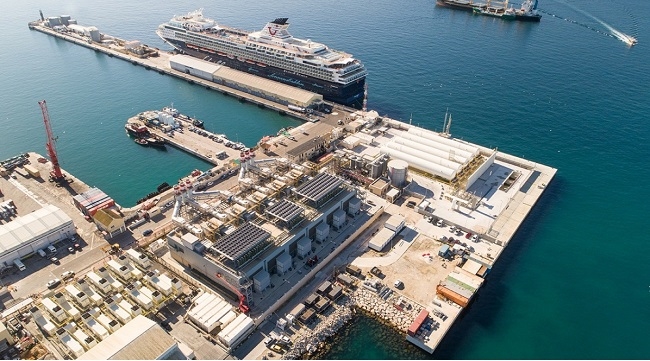
Toàn cảnh một nhà máy Nhiệt điện sử dụng khí LNG.
Trong thời gian vừa qua, Việt Nam đã nhanh chóng nổi lên là một trong những thị trường nhập khẩu khí thiên nhiên hóa lỏng (LNG) cho phát điện tiềm năng nhất ở châu Á.
Bui Van Kien, deputy director general of the National Power Transmission Corporation (EVNNPT) under Vietnam Electricity (EVN), talks about the risks of falling behind schedule on the North-South 500kV power line in the central region.
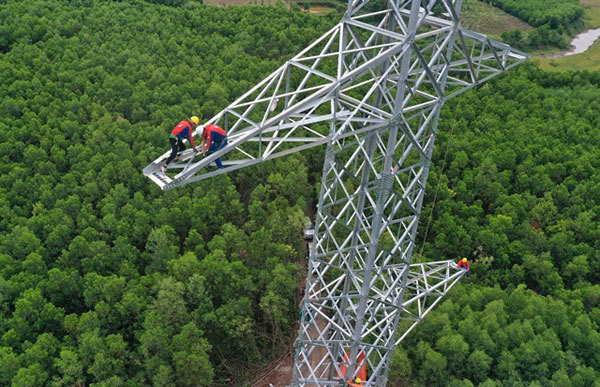
Installation of a power tower in Hoa Vang District, Da Nang, part of Circuit 3 of the North-South 500kV power transmission line.
Circuit 3 (Vung Ang-Quang Trach-Doc Soi-Pleiku 2) of the 500kV power line is meant to ensure energy security in the southern region. Construction is entering a critical phase but is facing adverse factors due to factors outside of human control. Can you tell us about these problems?Tiếp tục đọc “Major power line suffers multiple setbacks”→
Her husband is a worker at a garment factory and earns around VND4 million ($170) a month, and the grocery shop brings in around the same amount. They have two children in school.
By Dat Nguyen October 13, 2020 | 12:13 pm GMT+7 VNExpressAn aerial view of the 500kV substation of the Trung Nam Thuan Nam Solar Power Plant in the central province of Ninh Thuan. Photo courtesy of Trungnam Group.
The largest solar farm in Southeast Asia has been commissioned in Vietnam’s central province of Ninh Thuan.
The 450 megawatt Trung Nam Thuan Nam Solar Power Plant, which spreads over an area of nearly 560 hectares in Thuan Nam District, went on stream on Monday evening, 102 days after construction began in mid-May.
Dozens of solar companies are claiming renewable energy certificates issued for “wood-burning” biomass technology are unconstitutional as most such facilities are fueled by wood pellets co-fired with coal in older power plants. A constitutional court decision is expected within two years.SEPTEMBER 30, 2020 EMILIANO BELLINI
Solar companies pointed to the coal-fired power station shutdowns triggered in the nation by air pollution last year.
Image: Hanwha Q Cells
Some 63 South Korean entities have filed a lawsuit at the country’s constitutional court alleging subsidies for biomass projects are unconstitutional.
– Sau sự thành công của lưới điện 500kV mạch 1, có thể thấy trong quy hoạch phát triển lưới truyền tải, xu thế chung là tiếp tục phát triển mạnh lưới truyền tải 500 kV Bắc – Nam giữa các vùng miền và các trung tâm điện lực. Lưới 500 kV đang được đánh giá là cứu cánh để giải tỏa công suất nguồn điện, truyền tải điện tới các trung tâm phụ tải điện ở xa như trong định hướng Quy hoạch phát triển điện lực quốc gia Việt Nam giai đoạn 2021 – 2030, tầm nhìn 2045 (Quy hoạch điện 8) hiện nay. Bài viết này xin nêu vấn đề ở khía cạnh khác để phản biện lại việc phát triển hệ thống truyền tải 500 kV tại Quy hoạch điện VIII.
Bộ Công thương dự kiến trong giai đoạn từ 2022 – 2024, khách hàng sử dụng điện được mua điện trên thị trường điện giao ngay và từ sau năm 2024 sẽ được lựa chọn đơn vị bán lẻ điện.
Trung tâm điện lực Duyên Hải – 1 trong những trung tâm điện lực lớn nhất nướcẢNH CHÍ HIẾUTheo đề án đề xuất mô hình thị trường bán lẻ điện cạnh tranh mà Bộ Công thương vừa phê duyệt, dự kiến trong giai đoạn từ 2022 – 2024, khách hàng sử dụng điện được mua điện trên thị trường điện giao ngay và sau năm 2024 sẽ được lựa chọn đơn vị bán lẻ điện.Đó là một trong những nội dung đáng chú ý tại báo cáo của Bộ Công thương chuẩn bị cho phiên giải trình trước Uỷ ban Thường vụ Quốc hội diễn ra sáng nay (7.9).
Đề xuất phương pháp xây dựng biểu giá bán lẻ điện sinh hoạt của Việt Nam [Kỳ 1]
05:13 |04/09/2020
– Giá bán lẻ điện ở nước ta là vấn đề nổi cộm từ nhiều năm nay, đặc biệt nó lại rộ lên khi chuẩn bị ban hành biểu giá bán lẻ điện mới. Nguyên nhân chính là do đến nay chưa có một phương pháp xây dựng biểu giá bán lẻ điện nói chung và giá bán lẻ điện sinh hoạt nói riêng, trong đó làm rõ một cách căn cơ và giải đáp một cách thỏa mãn các nguyên tắc, căn cứ, phương pháp xác định biểu giá bán lẻ điện và việc áp dụng các nguyên tắc, căn cứ đó vào việc xác định giá bán lẻ điện trong từng thời kỳ. Trong chuyên đề này, chuyên gia Tạp chí Năng lượng Việt Nam đề xuất phương pháp xây dựng biểu giá bán lẻ điện sinh hoạt của Việt Nam với mục đích góp phần giải quyết một trong những vấn đề nổi cộm của ngành điện nước ta từ nhiều năm nay.
Giai đoạn 2010-2019, Việt Nam không xảy ra thiếu điện. Tuy nhiên giai đoạn 2021 – 2025, Việt Nam phải đối mặt với nguy cơ thiếu hụt điện năng. Từ bây giờ, nhiều giải pháp đã được tính đến để không gặp cảnh “cắt điện luân phiên”.
Báo cáo mới nhất về thực trạng, giải pháp phát triển điện lực đến năm 2030 của Bộ Công Thương đánh giá: Ngành điện, mà nòng cốt là EVN, cùng với các Tổng công ty phát điện của các tập đoàn: Dầu khí Việt Nam, Công nghiệp Than – Khoáng sản Việt Nam trong thời gian qua đã cơ bản đáp ứng đủ nhu cầu điện.
Tốc độ tăng trưởng điện sản xuất giai đoạn 2011-2019 là 10,1%/năm, điện thương phẩm giai đoạn 2011-2019 tăng trưởng bình quân 10,5 %/năm, công suất phụ tải lớn nhất toàn hệ thống (Pmax) năm 2019 đạt 38.249 MW.
Cung ứng điện năng trong 10 năm qua được đảm bảo. Ảnh: Lương Bằng
What will the liquefied natural gas (LNG) market of tomorrow look like? Today, a number of newer business models have emerged due to rapidly changing dynamics that have impacted the market, including increasing resource availability, new technologies and new sources of demand.
By: Sverre Alvik, Energy Transition Program Director, DNV GL
The coronavirus pandemic will have a dramatic impact on energy supply and demand in the short term and will have lasting impacts once the pandemic dissipates. However, that will in itself do little to advance the world’s progress towards the Paris climate ambitions.
Energy use is strongly linked to economic activity, which has, and will continue to be, significantly impacted by the novel coronavirus pandemic: Our energy forecast is predicated on IMF’s longer outbreak scenario, where World GDP will shrink 6 per cent in 2020. The lingering effects of the pandemic will take the wind out of the sails of the world economy for many years – reducing World GDP in 2050 by 9 per cent, relative to pre-pandemic forecasts. Even with slower growth, however, by mid-century the world economy will still be twice its size today. In contrast, energy demand will not grow. In 2050, it will be about the same as it is today, in spite of a larger population and world economy. This is largely due to significant improvements in energy intensity, but also due to the effects of COVID-19.
Thủ tướng giao BCT nghiên cứu phản biện của Tạp chí Năng lượng Việt Nam
09:47 |23/07/2018
Văn phòng Chính phủ có Văn bản số: 6885/VPCP-CN, do Bộ trưởng, Chủ nhiệm Văn phòng Chính phủ Mai Tiến Dũng ký, truyền đạt ý kiến của Thủ tướng Nguyễn Xuân Phúc đề nghị Bộ Công Thương chủ trì, phối hợp với các cơ quan liên quan nghiên cứu các kiến nghị của Tạp chí Năng lượng Việt Nam về “phản biện khoa học, kiến nghị giải pháp nâng cao hiệu quả hoạt động ngành Dầu khí Việt Nam trong giai đoạn tới”. (Trong quá trình thực hiện chức năng nhiệm vụ được giao, đề xuất, báo cáo Thủ tướng Chính phủ những vấn đề vượt thẩm quyền).

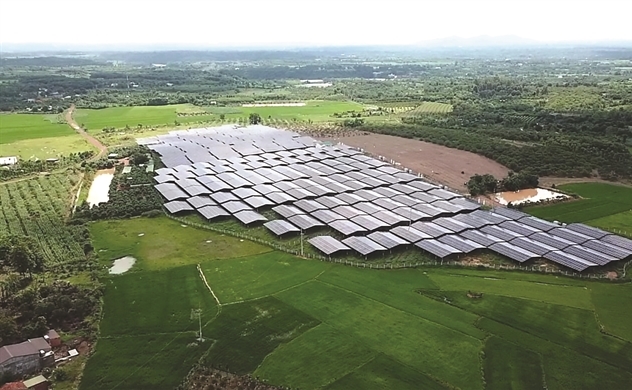



 An aerial view of the 500kV substation of the Trung Nam Thuan Nam Solar Power Plant in the central province of Ninh Thuan. Photo courtesy of Trungnam Group.


 CVD
CVD 