The world is facing a global sand crisis

September 7, 2017 9.22pm BST

theconversation_When people picture sand spread across idyllic beaches and endless deserts, they understandably think of it as an infinite resource. But as we discuss in a just-published perspective in the journal Science, over-exploitation of global supplies of sand is damaging the environment, endangering communities, causing shortages and promoting violent conflict.

Skyrocketing demand, combined with unfettered mining to meet it, is creating the perfect recipe for shortages. Plentiful evidence strongly suggests that sand is becoming increasingly scarce in many regions. For example, in Vietnam domestic demand for sand exceeds the country’s total reserves. If this mismatch continues, the country may run out of construction sand by 2020, according to recent statements from the country’s Ministry of Construction. Tiếp tục đọc “The world is facing a global sand crisis”

China’s Mekong Plans Threaten Disaster for Countries Downstream

Foreignpolicy

Beijing is building hydroelectric dams and dredging to allow bigger boats as worries of environmental devastation grow.
  • CATEGORIES: DISPATCH

BANGKOK — Thirty million people depend for a living on the Mekong, the great Asian river that runs through Southeast Asia from its origins in the snowfields of Tibet to its end in the delta region of Vietnam, where it fertilizes one of the world’s richest agricultural areas. It’s the greatest freshwater fishery on the planet, second only to the Amazon in its riparian biodiversity. If you control its waters, then you control much of the economy of Southeast Asia. Tiếp tục đọc “China’s Mekong Plans Threaten Disaster for Countries Downstream”

Vietnam uses water cannon to disperse protest at global fashion brands supplier


FILE PHOTO: Picture shows a protesting camp set by villagers to block entrance of Hong Kong’s Pacific Crystal textiles factory after villagers accused the company of polluting local water in Hai Duong province, outside Hanoi, Vietnam July 13, 2017. REUTERS/Staff

HANOI (Reuters) – Vietnamese authorities on Monday used water cannon and electric rods to end a five-month long protest by villagers blockading a textile plant that serves global fashion brands, an official and a villager said.

The blockade represents another challenge to the communist nation’s government over industrial pollution woes, at a time when Vietnam seeks more foreign investors to keep up one of the highest rates of growth in Southeast Asia.

Hundreds of people from the northern province of Hai Duong have maintained watch in shifts day and night since April to stop work at the Pacific Crystal Textiles mill, operated by Hong Kong-based Pacific Textiles.

Tiếp tục đọc “Vietnam uses water cannon to disperse protest at global fashion brands supplier”

House Construction with Plastic Bottles by Samarpan Foundation

http://www.samarpanfoundation.org — May 2011
Do you remember the last time you bought a drink in a plastic bottle? Chances are that you threw away the bottle, without a second thought, when you were done. That’s what most of us do. Plastic is one of the most disposable materials in the modern world. It makes up much of the street side litter in urban and rural areas. It is rapidly filling up landfills as well as choking water bodies. Plastic bottles make up approximately 11% of the content of landfills, causing serious environmental consequences. Tiếp tục đọc “House Construction with Plastic Bottles by Samarpan Foundation”

Locals protest against titanium mining in Binh Dinh

Vietnamnet_Residents in two communes of the southern province of Binh Dinh have raised a heated protest against titanium mining activities, citing pollution concerns.

Binh Dinh, protest, titanium mining, Vietnam economy, Vietnamnet bridge, English news about Vietnam, Vietnam news, news about Vietnam, English news, Vietnamnet news, latest news on Vietnam, Vietnam
Residents in My An and My Tho communes of Phu My District took to the streets to protest the polluting titanium mining company in Binh Dinh Province. — Photo tuoitre.vn

For many days now, people living in My An and My Tho communes of Phu My District have been preventing Hoang Dat Co from exploiting the titanium in the region fearing water pollution.

Dang Ngoc Thai, head of Xuan Phuong village of My An Commune, said previously, a vast casuarina forest covered the region.

“However, since 2006, when the company was allowed to exploit titanium in the region, they have chopped down hectares of the forest. The trucks carrying titanium ores are a constant source of pollution,” he said.

Thai also added that the wells in the village had run dry, forcing residents to spend a hefty sum of money to dig new wells.

In the neighbouring village of Xuan Binh (My An Communme), the foul smell and muddy water are also suspected to be caused by the company’s mining activities.

“Now, if the authorities once again let them resume their mining, then we will suffer further; the environment is heavily polluted already. We demanded a halt on all the titanium mining activities here,” a resident said, expressing his anger. Tiếp tục đọc “Locals protest against titanium mining in Binh Dinh”

Climate change is disrupting the birds and the bees

BBC_Our changing climate seems set to disrupt just about everything. From rising sea levels to ocean acidification, the list of negative consequences from climate change is endless. But one area that often goes unmentioned in the climate change discussion is sex.

Over the last two decades, scientists have found that warmer temperatures are quietly spoiling the mood, making it harder for plants and animals to reproduce.

Here are five ways that climate change is ruining sex lives.

It’s a numbers game

While humans and many other animals determine sex genetically, many reptiles and some fish use the incubation temperature of the eggs to set the gender of their offspring. This means that changing global temperatures could alter the ratio of sexes produced, making it harder for these animals to find mates. Tiếp tục đọc “Climate change is disrupting the birds and the bees”

Asian consumer firms need to buck up on sustainability: New report

eco-business_A new report by WWF has found that most major Asian consumer goods firms are lagging behind their western counterparts on making their operations and supply chains more sustainable, and their investors are also not paying enough attention to environmental risks.

Non-profit group World Wide Fund for Nature (WWF) has published a report shining an uncomfortable spotlight on Asian consumer firms, which finds them severely lagging behind international standards on sustainability.The international group said the lack of sustainability among Asian manufacturers of food, household, and personal care products is in part due to a lack of scrutiny from financiers. Tiếp tục đọc “Asian consumer firms need to buck up on sustainability: New report”

AIIB supports Paris and is not funding coal – Ngân hàng AIIB ủng hộ hiệp định Paris và không tài trợ cho than đá

Opening Address
Meeting of the AIIB Board of Governors
President Jin Liqun
June 16, 2017
As Prepared for Delivery

AIIB_Your Excellencies, the President of the Republic of Korea; the Deputy Prime Minister and Minister for Strategy and Finance; Distinguished Governors and Members of the Board of Directors; Honored Guests; Ladies and Gentlemen.

It is a great privilege and an honor for me to welcome you to the second Annual Meeting of the Board of Governors of the Asian Infrastructure Investment Bank. Tiếp tục đọc “AIIB supports Paris and is not funding coal – Ngân hàng AIIB ủng hộ hiệp định Paris và không tài trợ cho than đá”

Letters from the Mekong: A Call for Strategic Basin-Wide Energy Planning in Laos

This issue brief—the third in Stimson’s “Letters from the Mekong” series — continues to challenge the prevailing narrative that the current rapid pace of dam construction on the Mekong River in mainland Southeast Asia will continue until the entire river is turned into a series of reservoirs. Certainly, the construction of even a few large dams will severely impact food security in the world’s most productive freshwater fishery and sharply reduce the delivery of nutrient-rich sediment needed to sustain agriculture, especially in Cambodia and Vietnam’s Mekong Delta. However, our team’s extensive research over a number of years, including site visits and meetings with regional policymakers, provides compelling evidence that not all of the planned dams will be built due to rising political and financial risks, including questions about the validity of current supply and demand projections in the greater Mekong region. As a consequence, we have concluded that it is not yet too late for the adoption of a new approach that optimizes the inescapable “nexus” tradeoffs among energy, export revenues, food security, and fresh water and protects the core ecology of the river system for the benefit of future generations.

In particular, through a continued examination of rising risks and local and regional responses to those risks, we believe that Laos and Cambodia will fall far short of current plans for more than 100 dams on the Mekong mainstream and tributaries. This reality will have particular implications for Laos, which seeks to become the “Battery of Southeast Asia” by setting the export of hydropower to regional markets as its top economic development priority.

In the case of Laos in particular, the reluctant recognition that its dream of damming the Mekong are in jeopardy may cause a reconsideration of its development policy options. Fewer Lao dams will mean that national revenue targets will not be met. Already the government has begun to make overtures for US and other donor assistance in managing the optimization of its hydropower resources. This is not surprising since Lao decision makers depend almost entirely on outside developers to build out its planned portfolio of dams under commercial build-own-operate-transfer (BOOT) concessions for export to neighboring countries. All of these dams are being constructed in a one-off, project-byproject manner with no prior input from the intergovernmental Mekong River Commission (MRC) or neighboring countries, and hence there is little practical opportunity for synergistic planning that could optimize the benefits of water usage on a basin-wide scale.

Because planners cannot see past the next project, it is impossible to determine to what extent the targets for the final power output of either Laos or the basin as a whole are achievable. Further, critical red lines of risk tolerance, particularly toward the environmental and social risks that impede dam construction, are unidentifiable because the government has little stake invested in the projects and derives few resources from the BOOT process to mitigate risk.

By 2020 roughly 30% of the Mekong basin’s power potential in Laos will be tapped by existing dams and those currently under construction. Beyond 2020 the prospect for completing the remaining 70 plus dams planned or under study by the Lao Ministry of Energy and Mines is unknowable. As Lao officials begin to realize they will not necessarily meet their development goals, there will still be time to transition to a basin-wide, strategic energy plan that meets projected revenue goals while minimizing impacts on key environmental flows through a combination of fewer dams and other non-hydropower sources of clean energy generation.

Hy vọng cho Hà Nội? Hệ thống xe buýt mới có thể giảm ô nhiễm…nếu có đủ người sử dụng

English: Hope for Hanoi? New bus system could cut pollution … if enough people use it

Từ toà nhà cao ốc văn phòng tại Hà Nội, anh Trần Dũng hầu như không thể nhìn thấy đường chân trời của thành phố đằng sau lớp khói bụi dày đặc. Trước khi rời công sở, anh chuyên viên trợ lý này kiểm tra phần ứng dụng AirVisual để đọc mức ô nhiễm không khí, ứng dụng cung cấp số đo chỉ số PM2.5 tại thời gian thực – PM2.5 là các hạt bụi nhỏ li ti có trong khói bụi mà có thể huỷ hoại cổ họng và phổi của con người.

Traffic jam in Hanoi

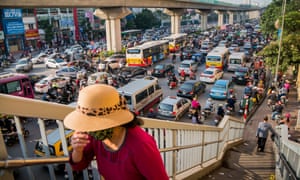
Những hàng dài xe máy và ô tô là nguyên nhân chính gây ô nhiễm không khí ở Hà Nội

Chỉ số PM2.5 thường dao động từ 100 đến 200 microgram mỗi mét khối – mức độ này thường được xếp vào loại “không tốt cho sức khoẻ” mà được toàn cầu đã công nghận. Nhưng vào ngày 19/12 năm rồi, nó đạt đến “mức độ  nguy hiểm” ở mức 343 microgram/m3, cao hơn cả ở Bắc Kinh.

Bị sốc khi đọc được con số này, anh Dũng đã chia sẻ ảnh chụp màn hình với bạn bè trên Facebook, anh viết: “Tôi không thể tin vào mắt mình. Các bạn bảo trọng!” Tiếp tục đọc “Hy vọng cho Hà Nội? Hệ thống xe buýt mới có thể giảm ô nhiễm…nếu có đủ người sử dụng”

‘Irrational’ Coal Plants May Hamper China’s Climate Change Efforts

The China Kingho Energy Group’s coal-to-gas plant in Chuluqay, Xinjiang, China, in 2014. Credit Benjamin Haas/Bloomberg

YINING, China — When scientists and environmental scholars scan the grim industrial landscape of China, a certain coal plant near the rugged Kazakhstan border stands out.

On the outside, it looks like any other modern energy plant — shiny metal towers loom over the grassy grounds, and workers in hard hats stroll the campus. But in those towers, a rare and contentious process is underway, spewing an alarming amount of carbon dioxide, the main greenhouse gas accelerating climate change.

The plant and others like it undermine China’s aim of being a global leader on efforts to limit climate change.

The plant, in the country’s far west, converts coal to synthetic natural gas. The process, called coal-to-gas or coal gasification, has been criticized by Chinese and foreign scholars and policy makers. For one thing, it is relatively expensive. It also requires enormous amounts of water, which exacerbates the chronic water crisis in northern China. And worst of all, critics say, it emits more carbon dioxide than traditional methods of energy production, even other coal-based ways.

Continue reading on New York Times

Bacteria to improve sanitation on Southeast Asia’s largest lake

KAMPONG CHHNANG, Cambodia: Piles of rotten garbage and a choking odour engulfed the bank of Tonle Sap near a small harbour in Chhnok Tru, Kampong Chhnang. Most of the rubbish, from plastic bags to human waste and animal carcasses, came from a fresh market a few steps away.

For visitors, the experience may be shocking. But for the inhabitants of Tonle Sap – Southeast Asia’s largest freshwater lake stretching 13,000 sqkm across five Cambodian provinces – that is the only environment they know, and it is getting worse. Tiếp tục đọc “Bacteria to improve sanitation on Southeast Asia’s largest lake”

Hackers Scrambling to Save Climate Data from Trump Administration

David Z. Morris

Jan 23, 2017

Fortune_Wired has provided a glimpse into an initiative to download and securely store reams of climate and environmental data from the Environmental Protection Agency and National Oceanic and Atmospheric Administration as the Trump administration takes power. The organizers of the work, including some based at the University of Toronto, were initially motivated by widespread environmental data destruction under Canadian Prime Minister Stephen Harper.

Tiếp tục đọc “Hackers Scrambling to Save Climate Data from Trump Administration”

Vietnam punishes 4 officials over Formosa environmental disaster

HANOI: Vietnam said on Thursday (Jan 26) it would punish four officials over one of its worst environmental disasters, caused by a unit of Taiwan conglomerate Formosa Plastics, in the first action against government officials ten months after the accident.

Formosa Ha Tinh Steel, which runs an US$11 billion steel plant, polluted more than 200km (125 miles) of coastline in April, killing more than 100 tonnes of fish and devastating the environment, jobs and economies of four provinces. Tiếp tục đọc “Vietnam punishes 4 officials over Formosa environmental disaster”

6 Environment and Development Stories to Watch in 2017

http://www.wri.org/blog/2017/01/6-environment-and-development-stories-watch-2017?utm_campaign=wridigest&utm_source=wridigest-2017-01-11&utm_medium=email&utm_content=learnmore

Last year brought major political shocks to the world: the election of Donald Trump; the rise of “fake news;” and the emergence of populist, anti-globalization movements in Britain, the Philippines and elsewhere. Many of these were fueled by the growing feeling among certain groups that they are being left out of economic opportunities.

The big question for 2017 is: Are these disruptions merely a speed bump for progress toward a more sustainable, equitable world, or will they signal a much larger retreat? Tiếp tục đọc “6 Environment and Development Stories to Watch in 2017”