Bà Trương Mỹ Lan bị đề nghị mức án tử hình

VNE – Thứ ba, 19/3/2024, 14:26 (GMT+7)

TP HCMBị VKS đề nghị mức án tử hình về 3 tội danh, bà Trương Mỹ Lan ngã quỵ, được cảnh sát dìu, cho phép ngồi để đảm bảo sức khỏe.

Bà Trương Mỹ Lan tại tòa, chiều 19/3. Ảnh: Thanh Tùng

Chiều 19/3, VKS hoàn tất luận tội đối với bà Trương Mỹ Lan (68 tuổi, Chủ tịch Tập đoàn Vạn Thịnh Phát) và 85 người liên quan đến các sai phạm tại Ngân hàng Thương mại cổ phần Sài Gòn (SCB).

Tiếp tục đọc “Bà Trương Mỹ Lan bị đề nghị mức án tử hình”

Rửa tiền, án phạt và rủi ro màu xám

HỒ QUỐC TUẤN – 04/12/2023 06:58 GMT+7

TTCT Binance bị phạt 4 tỉ đô la và chuyện quy định mới Ngân hàng Nhà nước Việt Nam phải giám sát giao dịch từ 400 triệu đồng trở lên có liên quan gì với nhau?

Ảnh: Axios

Tháng 11 vừa rồi, Binance, sàn giao dịch tiền mã hóa lớn nhất thế giới với quy mô giao dịch mỗi ngày gần 80 tỉ đô la Mỹ (theo Coinmarketcap), đã thừa nhận tội hình sự liên quan đến rửa tiền và vi phạm các lệnh trừng phạt tài chính quốc tế, đồng thời đồng ý trả hơn 4,3 tỉ USD tiền phạt.

Tiếp tục đọc “Rửa tiền, án phạt và rủi ro màu xám”

The Unexpected Twist in Vietnam’s Renewable Energy Saga

fulcrumm.sg PUBLISHED 4 JAN 2024 LE HONG HIEP

Punishment awaits the senior officials who allowed Vietnam’s renewable energy quest to go off the rails, despite its apparent initial success. This policy crisis has the potential to affect other economic sectors if no clear end is in sight.

In late 2023, the Inspection Commission of the Central Committee of the Communist Party of Vietnam (CPV) found that Tran Tuan Anh, head of CPV’s Central Economic Commission, and Trinh Dinh Dung, former deputy prime minister, were among the senior government officials responsible for “shortcomings in the advisory and policy-making processes for the development of solar and wind power projects, as well as in the implementation of the amended Power Development Plan VII” (PDP7). The Commission therefore recommended disciplinary actions be taken against Anh, Dung and some other senior officials involved.

Anh served as the minister of industry and trade while Dung was deputy prime minister overseeing economic affairs, including the energy sector, from 2016 to 2021. During their tenure, Vietnam experienced a remarkable surge in renewable energy, with numerous solar and wind power projects completed in just three years. According to Vietnam Electricity (EVN), the state-owned utility company, this led to a significant increase in Vietnam’s renewable energy output, rising from a mere 997 GWh in 2018 to an impressive 37,865 GWh in 2022. Vietnam therefore emerged as Southeast Asia’s renewable energy leader, accounting for 69 per cent of the region’s solar and wind power generation by 2022.

Such successes, however, did not come without problems. Last April, an inspection by the Government Inspectorate revealed numerous violations in the licensing and certification of renewable energy projects. For example, the amended PDP7 outlined a goal of installing 850MW of solar power by 2020, increasing to 4,000MW by 2025. Similarly, the plan projected 800MW of wind power by 2020, with a target of 2,000MW by 2025. However, as of May 2023, the total installed capacity of wind, solar, and rooftop solar projects in Vietnam had already reached a staggering 21,839MW, greatly surpassing targets set in PDP7.

This sudden surge in renewable energy has caused a strain on the national power grid, particularly in the central region where most renewable energy projects are located. Moreover, during the same period, there was a lack of new traditional power plants constructed, which are necessary to provide a stable baseload for renewable energy sources that are more weather-dependent and thus less reliable. This has created significant safety concerns for the national power system. Consequently, EVN had to curtail the amount of power it purchased from renewable sources, resulting in substantial financial losses for project owners.

A main driver behind Vietnam’s rapid growth in renewable energy has been the implementation of high feed-in tariffs (FITs) for certified projects that began commercial operation before specific deadlines. For instance, solar farms that became operational by 30 June 2019 were eligible for a FIT of 9.35 US cents/kWh, while onshore and offshore wind farms that began commercial operation by 1 November 2021 received FITs of 8.5 US cents/kWh and 9.8 US cents/kWh, respectively. Meanwhile, the FIT for rooftop solar projects operated before 31 December 2020 is 8.38 US cents/kWh. These FITs are locked in for 20 years.

This sudden surge in renewable energy has caused a strain on the national power grid, particularly in the central region where most renewable energy projects are located.

These attractive FITs sparked fierce competition among local investors to build solar and wind projects but most of them had no track record in the energy sector. They mainly leveraged connections, often involving under-the-table payments, to secure project licenses, then relied heavily on bank financing or corporate bonds to fund project development. Due to the pandemic and cut-throat competition for equipment and contractors, 62 wind projects failed to start operation before the FIT deadlines. Unable to sell their output to EVN, these projects faced severe financial difficulties. Even projects that qualified for the FITs faced mounting issues. Aside from the curtailment imposed by EVN, the Government Inspectorate found violations in the certification of many projects, putting them at risk of disqualification from the FITs. Foreign investors acquiring projects from local investors may face potential losses if similar violations are found.

The situation also negatively impacts the state and the broader economy. Most FIT rates are higher than average electricity retail prices, meaning that the state and end-users are essentially subsidising renewable energy projects. These high FITs have contributed to EVN’s mounting accumulative losses over the past two years, reaching VND55 trillion (US$2.3 billion) by September 2023. The government therefore has had no choice but to allow EVN to raise electricity retail prices, putting upward pressure on inflation and undermining Vietnam’s competitiveness.

In light of these grave consequences, the government has been trying to contain the damage. For example, EVN stopped buying power from rooftop solar projects completed after 31 December 2020, leaving thousands of investors in limbo. Authorities have also conducted thorough inspections into most renewable energy projects. Projects found to have committed serious violations, such as lacking construction permits or failing to secure proper land usage purpose conversion and commercial operation certification, may have their power purchase agreements with EVN terminated.

Last month, EVN even proposed lowering the FITs for 38 projects but quickly withdrew the proposal after just one day. This sudden reversal may reflect the government’s struggle in finding a satisfactory solution. Being lenient will perpetuate losses for the state budget but a heavy-handed approach could cause extensive financial losses for investors, potentially affecting the banking system, given investors’ heavy reliance on bank financing. This could also negatively impact investors’ confidence in Vietnam’s investment climate and raise doubts about the country’s commitment to energy transition.

At present, there seems to be no straightforward solution. It is not clear yet how Vietnam will effectively address and learn from this situation for future policy decisions. However, it is inevitable that those responsible for this predicament will soon face serious consequences for what could potentially become one of the most significant policy mishaps in Vietnam’s recent history.

2024/2

Le Hong Hiep is a Senior Fellow and Coordinator of the Vietnam Studies Programme at ISEAS – Yusof Ishak Institute.

Việt Nam cần làm gì để thoát khỏi ‘Danh sách Xám’?

20/11/2023 13:43

(ĐTTCO) – Thoát khỏi Danh sách Xám trước năm 2025 là một trong những mục tiêu trọng tâm của Việt Nam, trong đó cần nhận diện tài sản ảo và các nhà cung cấp tài sản ảo; tăng cường quy định, cơ chế phòng, chống tội phạm rửa tiền thông qua giao dịch tiền ảo.

Phải thoát khỏi Danh sách Xám trước 2025

Theo ước tính của Quỹ tiền tệ quốc tế (IMF), một quốc gia khi bị đưa vào Danh sách Xám của Cơ quan Đặc nhiệm Tài chính về chống rửa tiền (FATF), thì phần lớn các quốc gia đó có nguy cơ giảm trung bình 7,6% GDP, dòng vốn đầu tư trực tiếp từ nước ngoài (FDI) giảm trung bình 3% GDP, dòng vốn đầu tư gián tiếp giảm trung bình 2,9% GDP, và dòng vốn đầu tư thông qua các kênh khác giảm trung bình 2,4% GDP. Tiếp tục đọc “Việt Nam cần làm gì để thoát khỏi ‘Danh sách Xám’?”

Chính trường Singapore: Khi tiêu chuẩn chống tham nhũng quá cao

THANH TUẤN 20/08/2023 07:19 GMT+7

TTCTKể từ khi nắm quyền ở Singapore từ năm 1959, Đảng Hành động nhân dân (PAP) luôn đảm bảo vị thế bằng điều hành ổn định và mô hình quản trị gần như không tham nhũng.

Ảnh: CNBC
Ảnh: CNBC

Các bộ trưởng và quan chức nước này được trả lương cao tương đương lãnh đạo các tập đoàn quốc tế, và những hành vi sai phạm bị xử lý gần như ngay tức khắc. 

Nhưng mấy tuần gần đây, uy tín của PAP rung chuyển bởi một loạt bê bối. Giữa tháng 7, Bộ trưởng Giao thông S. Iswaran bất ngờ bị bắt cùng tỉ phú Ong Beng Seng (người có công đưa đua xe F1 tới nước này). Cơ quan Điều tra tham nhũng Singapore (CPIB) thông báo đang điều tra mối liên hệ giữa hai người, dù chi tiết vụ việc chưa được tiết lộ thêm.

Cùng tháng 7, Chủ tịch Quốc hội Tan Chuan-Jin (Trần Xuyên Nhân), từng là ngôi sao của PAP, đệ đơn từ chức vì những lời lẽ “thô tục và phi nghị viện”. Ông đồng thời thừa nhận có những “khía cạnh còn khiếm khuyết” khiến gia đình bị tổn thương.

Tiếp tục đọc “Chính trường Singapore: Khi tiêu chuẩn chống tham nhũng quá cao”

‘The most corrupt forces are ganging up’: Malaysia’s PM Anwar Ibrahim speaks with 101 East

Al Jazeera English – 15-6-2023

After a divisive election led to Malaysia’s first hung parliament, Anwar Ibrahim has secured the nation’s top job. But at what cost?

With uneasy alliances, racial and religious tensions and political rivals waiting in the wings, Malaysia’s new prime minister faces challenges on multiple fronts as he promises to crack down on corruption and unite the nation.

He’s overcome obstacles before on a tumultuous political journey, in which he’s twice been imprisoned on controversial sodomy charges.

Well-known for his reform agenda, can he deliver the change he says Malaysia needs? Anwar Ibrahim speaks to 101 East.

Chapters:
0:00 | The turbulent journey
2:36 | An uneasy coalition
5:43 | 1MDB corruption scandal
8:40 | On government stability
11:26 | On race matters
13:15 | On religion
16:52 | Anwar’s legacy

One year on, Pandora Papers continues to be anti-corruption ‘tour de force’

icij.org

From pivotal legislative pushes in the U.S. and elsewhere, to ongoing probes into deposed leaders and tax dodgers, the impact of the largest ever offshore investigation is still being felt around the world.

n Oct. 3, 2021 — one year ago today — the International Consortium of Investigative Journalists and 150 media partners around the globe began rolling out the Pandora Papers, a world-rocking exposé that’s been called “a money bomb with political ripples,” “a financial earthquake” and “one of the essential stories of our time.”

The project took readers deeper than ever inside an offshore financial system that perpetuates corruption and authoritarianism and widens gaps between rich and poor. A U.S. senator called the investigation a “wake-up call to all who care about the future of democracy.”

More than 600 journalists at 151 news organizations in 117 countries worked together to make the Pandora Papers a reality — the largest collaboration in journalism history.

The Pandora Papers’ revelations about the financial secrets of prime ministers, oligarchs, mobsters and other powerful figures spawned action by governments and international groups, triggering investigations, legislation and rule changes in dozens of countries.

Impacts keep coming.

Tiếp tục đọc “One year on, Pandora Papers continues to be anti-corruption ‘tour de force’”

Seven years after the Panama Papers, the country sees a dramatic decrease in corporate registrations

A new study shows registrations going down and dissolutions going up in Panama

ICIJ by Carmen Molina Acosta May 23, 2023

The Panamanian flag flies over Panama City.

Registrations of anonymous corporations in Panama have dropped by more than half in the last decade, according to a new investigation by Bloomberg Línea.

These corporations, known as sociedades anónimas, pay minimal to no tax and have served as the backbone of Panama’s offshore industry for decades.

A Bloomberg analysis based on data extracted from the Panamanian public registry shows a 63% decrease in registrations from 2012 to 2022, ICIJ member Mary Triny Zea reported. Similarly, the number of dissolutions of companies and private-interest funds per year has also increased; in 2013, there were seven. In 2022, that number had jumped to 5,575.

Bloomberg’s analysis also included data on Delaware and the British Virgin Islands – two other secrecy jurisdictions long considered competitors to Panama. While the British Virgin Islands also saw a decrease in company registrations over the last decade, registrations in Delaware have steadily risen over the past decade, with 62,510 new ones in 2021. The U.S. currently tops the Financial Secrecy Index, the Tax Justice Network’s ranking of jurisdictions most complicit in helping people hide their finances.

Panama Bar Association president Juan Carlos Araúz attributes this change in the country  to its poor reputation after the ICIJ’s Panama Papers investigation. That investigation, based on 11.5 million leaked records from the now defunct Panamanian law firm Mossack Fonseca, blew open a system of offshore banking that enabled tax avoidance, money laundering and corruption.

ICIJ accepts information about wrongdoing by corporate, government or public services around the world. We do our utmost to guarantee the confidentiality of our sources.

“Despite the efforts Panama has made to set a standard of control at a higher level than any other jurisdiction in the world, it’s still impacted by the country’s reputation,” Araúz told Bloomberg.

The same year ICIJ published the Panama Papers, 2016, Panama saw its highest number of anonymous corporation dissolutions in the last decade: 14,172. More recently, the Panamanian government has cracked down on the industry, suspending – and then dissolving – hundreds of thousands of companies, mostly for not paying fees.

Mayra Rodríguez, a Panama-based lawyer, also credited ICIJ’s investigation but argued the decline could be due to increased regulations implemented as a result. These regulations impose higher obligations on law firms, which Rodríguez says increases risk and potentially drives down demand.

Similarly, pressure from international entities such as the Financial Action Task Force may have also contributed to the change. Panama is currently on the FATF’s “greylist” – a list of jurisdictions that the organization monitors closely and which have agreed to resolve certain financial loopholes within a specific time frame.

FATF has tasked Panama with ensuring “adequate verification of up-to-date beneficial ownership information by obliged entities and timely access by competent authorities.” And the window of time to do so is closing soon. The FATF has issued a warning to Panama to complete the country’s action plan by June 2023, or face further censure by the organization and its members.

 Topics: Latin AmericaMossack FonsecaOffshore financeOffshore secrecyPandora Papers

BRIBES FOR BIAS: CAN Artificial Intelligent – AI BE CORRUPTED?

The potential abuse of artificial intelligence for private gain has profound implications for our economic, political and social lives

transperency.org

Recently your social media feed may have been flooded with headlines on the advances in Artificial Intelligence (AI) or even AI-generated images. Text-to-image algorithms such as Dall-E2 and Stable Diffusion are becoming hugely popular. ChatGPT, a chatbot developed by OpenAI, is now the world’s best-performing large language model, reaching 1 million users in its first week – a rate of growth much faster than Twitter, Facebook or TikTok.

As AI demonstrates its ability to craft poetrywrite code and even pollinate crops by imitating bees, the governance community is waking up to the impact of artificial intelligence on the knotty problem of corruption. Policy institutes and academics have pointed to the potential use of AI to detect fraud and corruption, with some commentators heralding these technologies as the “next frontier in anti-corruption.”

Tiếp tục đọc “BRIBES FOR BIAS: CAN Artificial Intelligent – AI BE CORRUPTED?”

‘Lỗ hổng’ an toàn hàng không – 2 kỳ

‘Lỗ hổng’ an toàn hàng không: Kỳ 1 – Hãng khai thác vận chuyển hành khách thiếu giấy tờ tùy thân

ĐĐK – 11:02 07/04/2023 – NHÓM PVĐT

Nhiệm vụ đảm bảo an toàn hàng không là nhiệm vụ sống còn, là bộ phận quan trọng đặc biệt trong công tác đảm bảo an ninh quốc gia, giữ gìn trật tự xã hội của đất nước. Nhưng thực tế, phóng viên Báo Đại Đoàn Kết phát hiện hàng loạt đường dây hỗ trợ bay cho hành khách không giấy tờ tuỳ thân, gióng lên ‘hồi chuông’ báo động về ‘lỗ hổng’ an toàn hàng không.

Hành khách xếp hàng để kiểm tra giấy tờ tuỳ thân tại cửa kiểm soát trước khi lên máy bay tại sân bay Đà Nẵng.

Theo quy định, nếu không có giấy tờ tùy thân thì hành khách không đủ điều kiện lên máy bay nhưng qua đường dây hỗ trợ bay trên mạng, hành khách chỉ cần chuyển khoản đến các đại lý bán vé từ 1-3 triệu đồng sẽ được ‘tạo điều kiện’ bay nội địa trên các chuyến của các hãng hàng không: Vietnam Airlines, Bamboo Airways, Vietjet Airlines, Jetstar Pacific.

Tiếp tục đọc “‘Lỗ hổng’ an toàn hàng không – 2 kỳ”

Thu hồi được 40% tài sản tham nhũng

TTTCTT T.H • 21/03/2023 07:55

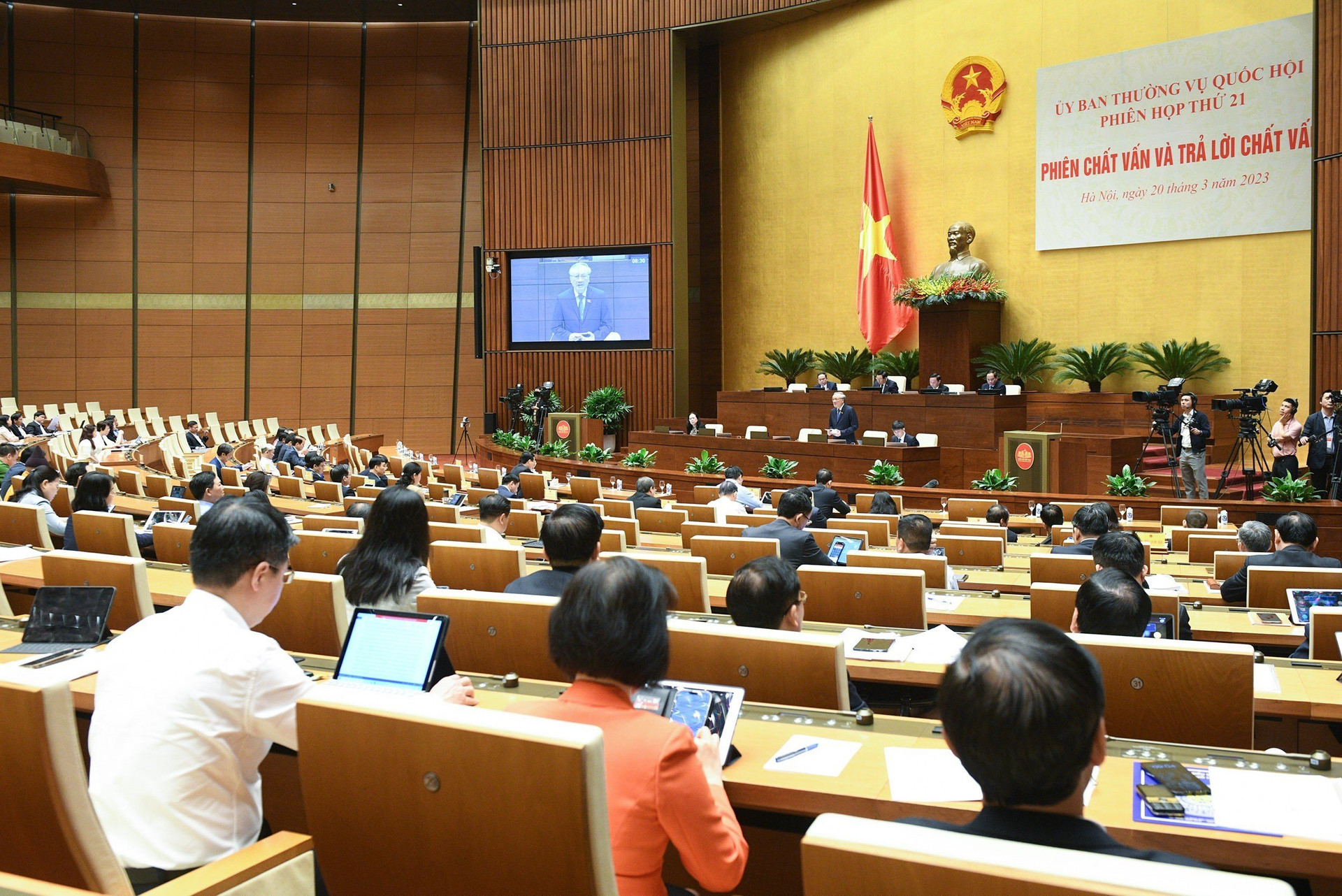
Trả lời tại Phiên chất vấn và trả lời chất vấn nhóm vấn đề thuộc lĩnh vực tòa án, Chánh án Tòa án Nhân dân tối cao Nguyễn Hòa Bình cho biết, tổng kết 10 năm đã thu được 40% số tài sản tham nhũng.

tai-san-tham-nhung.jpg
Toàn cảnh phiên chất vấn và trả lời chất vấn tại Phiên họp Thứ 21 Ủy ban Thường vụ Quốc hội

Sáng ngày 20/3, dưới sự chủ trì của Chủ tịch Quốc hội Vương Đình Huệ, Ủy ban Thường vụ Quốc hội tổ chức chất vấn và trả lời chất vấn nhóm vấn đề thuộc lĩnh vực tòa án.

Tiếp tục đọc “Thu hồi được 40% tài sản tham nhũng”

Khủng hoảng đăng kiểm

VNE – Thứ hai, 13/3/2023, 09:00 (GMT+7)

4 tháng từ khi những bê bối trong đăng kiểm bị phát hiện, toàn ngành chao đảo trước khủng hoảng chưa từng có trong lịch sử gần 30 năm.

Tham khảo ý tưởng từ Reuters

Đi hai trạm đăng kiểm đều đóng cửa, anh Nguyễn Hữu Trung vượt 30 km từ nhà ở huyện Ứng Hoà tới trung tâm 29-06V tại Tam Hiệp, huyện Thanh Trì, Hà Nội. Trước mặt anh, ôtô xếp hàng dài gần hai km trên đường 70 dẫn vào nơi kiểm định. Chiếc xe 5 chỗ – “cần câu cơm” duy nhất nuôi sống cả gia đình, sẽ hết hạn đăng kiểm trong 4 ngày tới. Không có lựa chọn, anh đành nhập vào hàng xe, chờ đợi.

Tiếp tục đọc “Khủng hoảng đăng kiểm”

In Vietnam, a forest grown from the ashes of war falls to a resort project

mongabay – by Le Quynh on 19 December 2022

  • Planted in the 1970s as part of Vietnam’s post-war reforestation program, the Dak Doa forest has become both a burgeoning tourist attraction and a lifeline for ethnic minority farmers living in the district.
  • The forest is under threat due to a planned tourism, housing and golf complex slated to cover 517 of the forest’s 601 hectares (1,278 of 1,485 acres).
  • Work on the project is currently suspended due to the death of more than 4,500 trees in a botched relocation operation, as well as sanctions imposed on local leaders by central party leadership, which found local officials to have committed a series of violations related to land management.
  • While currently suspended, the project could still be revitalized if a new investor takes over.

DAK DOA, Vietnam — At the end of the rainy season, the hillsides in Dak Doa district, in central Vietnam’s Gia Lai province, turn pink as the Cỏ Hồng grass blushes in the basaltic soil of a 50-year-old pine forest.

Tiếp tục đọc “In Vietnam, a forest grown from the ashes of war falls to a resort project”

Transparency International – The week in corruption

16/12/2022: Eye on the ball

For years, controversy has surrounded FIFA’s choice of the 2022 World Cup host. Thanks to new Qatargate revelations, scathing headlines will haunt this year’s World Cup well after the final showdown between Argentina and France this weekend.

Last Friday, allegations emerged that the Qatari government has bribed current and former members of the European Parliament and their staff to tone down criticism in the lead-up to the prestigious tournament and win other favours.
European Parliament’s Bureau met without Eva Kaili, who has been implicated in the Qatargate scandal, on 12 December. Photo: Daina Le Lardic/European Parliament

Belgian authorities have already conducted 20 raids, seized 1.5 million euros in cash and arrested four people – including Eva Kaili, now-former Vice President of the European Parliament. If corruption allegations are true, they would explain why last month Kaili praised Qatar’s progress on labour rights despite well-documented abuses.
Tiếp tục đọc “Transparency International – The week in corruption”

CPI 2021 for Asia Pacific: Grand corruption and lack of freedoms holding back progress

Protest against the weakening of Indonesia’s anti-corruption agency. (Image: Kevin Herbian/Shutterstock.com)

transparency – 25 January 2022

While countries in Asia Pacific have made great strides in controlling bribery for public services, an average score of 45 out of 100 on the 2021 Corruption Perceptions Index (CPI) shows much more needs to be done to solve the region’s corruption problems.

Some higher-scoring countries are even experiencing a decline as governments fail to address grand corruption, uphold rights and consult citizens.

The top performers in Asia Pacific are New Zealand (CPI score: 88), Singapore (85) and Hong Kong (76). However, most countries sit firmly below the global average of 43. This includes three countries with some of the lowest scores in the world: Cambodia (23), Afghanistan (16) and North Korea (16).

Among those with weak scores are some of the world’s most populous countries, such as China (45) and India (40), and other large economies such as Indonesia (38), Pakistan (28) and Bangladesh (26). A concerning trend across some of these nations is a weakening of anti-corruption institutions or, in some cases, absence of an agency to coordinate action against corruption.

Tiếp tục đọc “CPI 2021 for Asia Pacific: Grand corruption and lack of freedoms holding back progress”