Chính xác từ năm 1945, hơn 70 năm qua, số liệu về các cơn bão và áp thấp nhiệt đới đổ bộ vào đất liền thuộc địa phận Việt Nam đã được ghi nhận khá đầy đủ bởi NOAA (Tổng cục Hải Dương và Khí quyển Hoa Kỳ). Những ghi nhận này cho phép chúng ta nhìn lại các cơn bão từ quá khứ tới hiện tại về thời điểm đổ bộ, tốc độ gió, mức độ cảnh báo, vị trí trung tâm bão, và những thông tin thú vị khác. Nhóm nghiên cứu của P-GIS đã tiến hành phân tích 459 cơn bão đổ bộ vào đất liền Việt Nam trong 70 năm qua. Những dữ liệu này được chiết xuất từ cơ sở dữ liệu đường đi của bão khu vực Châu Á – Thái Bình Dương với hơn 227 nghìn cơn bão trong cùng thời gian.
Đường đi của các cơn bão đổ bộ vào Biển Đông và Việt Nam trong 70 năm qua
Tiêu chí và phạm vi đánh giá được P-GIS thống nhất như sau:
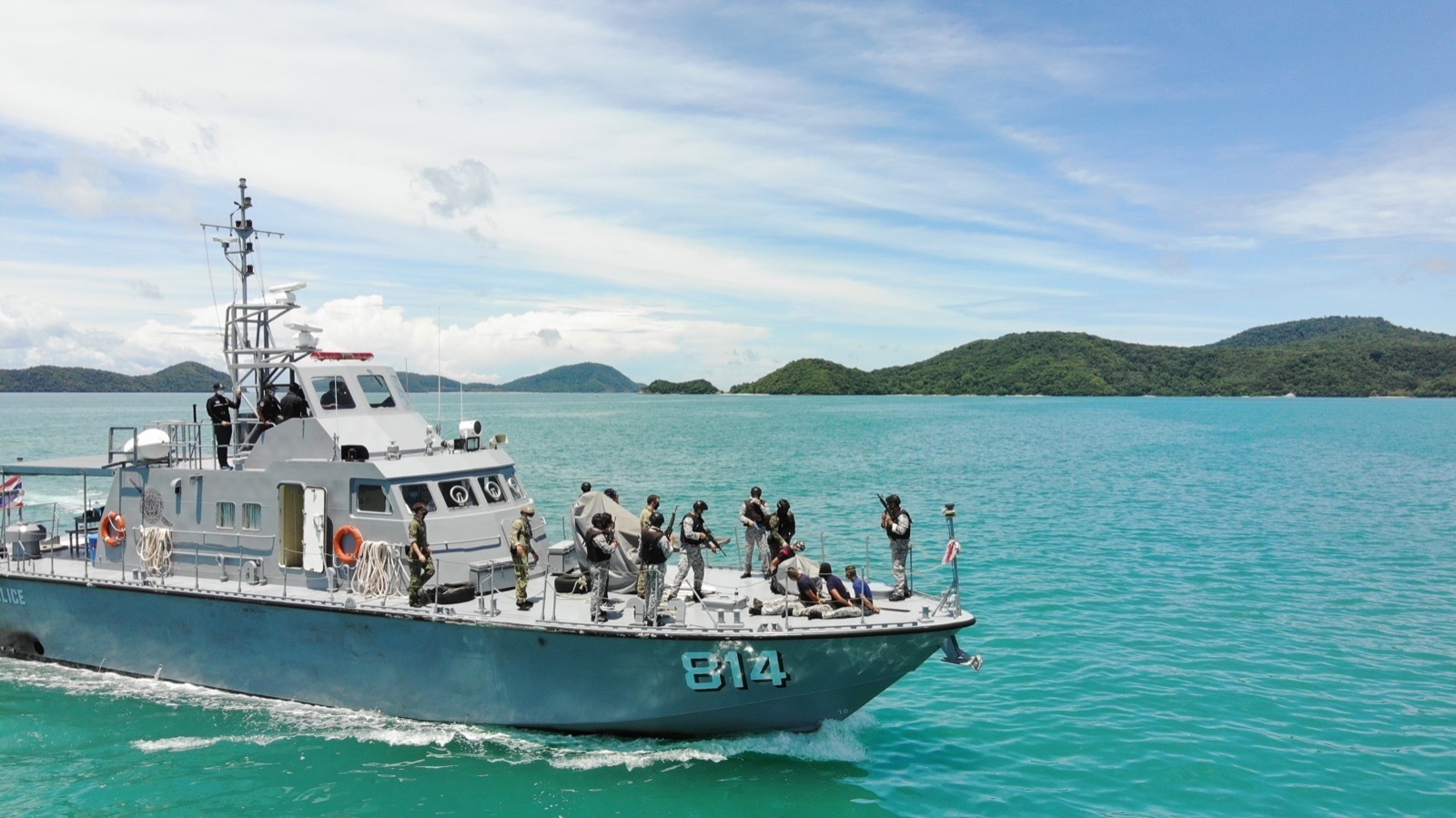
The maritime militia fleet is the vanguard of Beijing’s strategy to reshape the geopolitical landscape in the region, experts say, with its blue-hulled ships a frequent sight at territorial standoffs in the South China Sea.
The maritime militia is considered by analysts to be China’s third sea force alongside its navy and coast guard. The Chinese government maintains the fleet is little more than a group of patriotic fishermen.
Dubbed “little blue men” by Andrew Erickson, professor of strategy at the U.S. Naval War College’s China Maritime Studies Institute, the ships regularly join China’s coast guard in blockades against supply missions to a Philippine military outpost at the Spratly Islands’ Second Thomas Shoal, including the most recent tense showdown on December 10. A blockading militia ship was involved in a collision with a Philippine coast guard boat in October, and Manila accused another of using a sonic weapon against a fisheries bureau convoy on December 9.
“Maritime Security” has emerged as a central concept in Southeast Asia’s policy lexicon. However, as is the case in much of the world, the term’s precise meaning is not consistently clear. Which challenges and state activities should be categorized as maritime security and which should be considered elements of another domain is generally ambiguous. This ambiguity can be useful to leaders seeking to build unity of action among government agencies with overlapping maritime policy mandates and to diplomats seeking to rely on euphemistic qualities to support flexible political narratives that minimize the risks associated with security dilemmas. However such linguistic polysemy only works for so long and introduces risk. Left unclarified, terms will develop assumed meanings. For example, many Southeast Asians regard contemporary American talk about maritime security as a thin veil for something better understood as “Great Power Competition at Sea.” Therefore, even the most benign initiatives are factored into regional calculations aimed at balancing between external powers. Within the region, it is also possible for lexical disconnects to lead to problematic misinterpretations of policy intent and diplomatic signals.
Recognizing that understanding the varied conceptualizations of maritime security is an academic puzzle with real-world practical implications in Southeast Asia, the S. Rajaratnam School of International Studies convened a roundtable of experts to take stock of regional maritime security definitions. These specialists surveyed national policy documents and policymaker discourse to assess how maritime security is defined, used, and conceptualized in seven key Southeast Asian coastal states (the Philippines, Vietnam, Brunei, Malaysia, Indonesia, Singapore, and Thailand), ASEAN as a multinational institution, and the Quad members (Australia, Japan, India, and the United States). This stocktaking enabled the team to identify and discuss the significance of the convergences and divergences. Noting the transnational nature of discourse, the phrase “Southeast Asian conceptualizations” was adopted as a shorthand. This does not specifically mean usage by Southeast Asian individuals or the region’s national governments but refers to the security-related discourse taking place in the region. While the primary goal of the project was to improve communication by providing common reference points, the project also discovered findings of practical policy importance.
Discussions of each country’s conceptualization of maritime security and the implications of the term’s varying definitions across the region are available in the following 14 article series:
Sailors signal to an MH-60S Sea Hawk helicopter as it hovers over the flight deck of the guided-missile destroyer USS McCampbell during a training exercise in the South China Sea, July 22, 2016.Credit: Flickr/U.S. Navy
As the incoming Biden administration formulates its South China Sea strategy, one regional partner that looms large is Vietnam. Over the last few years, tensions between China and Vietnam in the South China Sea have remained high, impacting fishing and natural resource exploration in disputed waters. While the Biden administration is likely to continue the positive momentum in bilateral ties, it is less clear what specifically Hanoi seeks from Washington to help it effectively deter Beijing.
By Liu Xuanzun and Guo Yuandan Source: Global Times Published: 2020/8/2 18:28:40 Last Updated: 2020/8/2 20:48:40 Global Times
Editor’s note:
At 2:22 pm on Saturday, China’s Army Day, think tank South China Sea Strategic Situation Probing Initiative (SCSPI) released the latest movement of US warships on its Weibo account, including the USS Ronald Reagan aircraft carrier and USS America amphibious assault ship in the East China Sea.
From July 15 to 30, SCSPI’s Weibo account has released a total of 24 updates on the activity tracks of US warships and warplanes in regions including South China Sea and East China Sea. This has attracted wide domestic and foreign attention.
The film briefly shows the ‘nine-dash line’, which China claims as its territory, though other East Asian countries say it belongs to them
Associated Press
‘Abominable’ is about a teenage Chinese girl named Yi who helps a yeti return to Mount Everest.
Photo: Universal Studios
The animated movie Abominable will skip Malaysian theaters after producers decided against cutting out a scene showing a map supporting Chinese claims to the disputed South China Sea.
Vietnam already pulled the U.S.-Chinese production from theaters over a fleeting image of the so-called nine-dash line, a vague and broken outline depicting much of the resource-rich sea as Chinese territory. China’s claims to the sea overlap with claims by Vietnam, Malaysia and other Asian governments.
After a sharp drop-off in activity from 2016 to late 2018, Chinese clam harvesting fleets have returned to the South China Sea in force over the last six months. These fleets, which typically include dozens of small fishing vessels accompanied by a handful of larger “motherships,” destroy vast swaths of coral reef in order to extract endangered giant clams. The clam shells are transported back to Hainan Province where they fetch thousands of dollars each in a thriving market for jewelry and statuary. Since late 2018, satellite imagery has shown these fleets operating frequently at Scarborough Shoal and throughout the Paracels, including at Bombay Reef. Tiếp tục đọc “China’s Most Destructive Boats Return to the South China Sea”→
Senior Research Fellow in International Regulatory Affairs
The UN Convention on the Law of the Sea requires that coastal nations pay royalties on their seabed resources to landlocked and developing countries.mizoula/Getty Images
KEY TAKEAWAYS
U.S. accession would provide no benefits not already available to the U.S., while creating unnecessary burdens and risks.
The U.S. does not need to join the convention in order to access oil and gas resources on its extended continental shelf, in the Arctic, or in the Gulf of Mexico.
Despite subsequent changes in 1994 that led the Clinton administration to support U.S. accession, the Trump administration should oppose accession to this treaty.
The ability of global trade to feed the world is one of the great success stories of the past generation. More than 1 billion people faced hunger on a planet of 5.6 billion a quarter-century ago; that number has fallen to 800 million, even as the population has grown to 7.6 billion. Trade has brought much of that progress: Shippers and exporters have become better and better at getting affordable food from places of surplus to regions of scarcity.
But the planet is at rising risk of choking on its good fortune.
Vox_Since 2014, China has been building islands in the middle of the South China Sea. What were once underwater reefs are now sandy islands complete with airfields, roads, buildings, and missile systems. In less than two years, China has turned seven reefs into seven military bases in the South China Sea, one of the most contentious bodies of water in the world.
href=””>United Nations Law of the Seas, which says a country’s territory extends 200 miles off its shores, an area called the exclusive economic zone, or EEZ. Any trade or resources that fall in a country’s EEZ belong to that country; they’re its sovereign territory. Any area that is not in an EEZ is considered international waters and subject to UN maritime law, meaning it’s shared by everyone. Every country in the region, which includes Malaysia, the Philippines, Brunei, and Vietnam, bases its claim to the South China Sea on the UN’s EEZ laws — except China.
China argues it has a historical claim to the South China Sea, dating back to naval expeditions in the 15th century. After World War II, the Japanese Empire lost control of the South China Sea, and China took advantage of the moment to reclaim it. On maps, it started drawing a dashed line that encompassed most of the South China Sea. This line became its official claim and is known today as the Nine-Dash Line, because it always has nine dashes. In 1973, when the UN law established EEZs, China reaffirmed its Nine-Dash Line, refusing to clarify the line’s boundaries and rejecting other countries’ claims.
Since then, tensions have built around who rightfully owns the South China Sea. The dispute has centered on the Spratly Islands, an archipelago at the heart of the South China Sea. Currently, China, Malaysia, the Philippines, and Vietnam claim some part of the Spratly Island chain. They’ve asserted their claims by putting small buildings, ports, and even some people on what are essentially rocks in the middle of the ocean.
But the Spratlys are very important, because whichever country can successfully claim themcan extend its EEZ to include them, thus gaining miles of precious sovereign territory. This is why China began building up islands in 2014. By turning these rocks into military bases, the Chinese are now able to support hundreds of ships, bolstering their presence in the region. They are using fishing boats, surveillance ships, and navy destroyers to set up blockades around other countries’ islands and defend their own. This is all done very cautiously and in small steps in order to avoid sparking a wider conflict.
Since China began building islands, the disputes have not become violent.But tensions are building in the region. As China deploys more of its military to the Spratlys, other countries are getting nervous and building up their own islands. It’s a complex situation that will continue to gain international attention, for better or for worse.
Courtesy Photo151002-N-MK881-291 BAY OF BENGAL (October 1, 2015) Ships from the Bangladesh and U.S. navies gather in formation during Cooperation Afloat Readiness and Training (CARAT) Bangladesh 2015. CARAT is an annual, bilateral exercise series with the U.S. Navy, U.S. Marine Corps and the armed forces of nine partner nations. (U.S. Navy photo by Mass Communication Specialist 2nd Class Joe Bishop/Released) Tiếp tục đọc “CARAT 2016 series kicks off in Malaysia, aiming for increased complexity with allies and partners”→
Mỹ và Liên minh châu Âu cùng chia sẻ lợi ích và các mục tiêu chung trong khu vực châu Á Thái Bình Dương. Thương mại và đầu tư là các thành phần chính yếu của chính sách của Mỹ và của Liên minh châu Âu, và cả hai đã mở nhiều điều đình đầy kỳ vọng với các đối tác trong vùng để tự do hóa thương mại với các nền kinh tế phát triển mạnh ở Đông Á. Cả hai cũng đã tìm cách củng cố các quy luật quốc tế, thủ tục pháp lý và khả năng của các tổ chức trong vùng. Tuy nhiên, bất chấp những mục tiêu chung, Hoa Kỳ và Liên minh châu Âu dường như đã theo đuổi các chính sách độc lập – và có lúc cạnh tranh với nhau – tại Châu Á Thái Bình Dương, do đó thỉnh thoảng gây cản trở việc thực hiện các lợi ích chiến lược chung. Khi Hoa Kỳ và Liên minh châu Âu tham gia sâu thêm vào khu vực và với các quyết định quan trọng dần xuất hiện ở tầm nhìn (đáng chú ý liên quan đến việc chấp nhận Trung Quốc là nền kinh tế thị trường và phán quyết của Tòa án trọng tài về chủ quyền lãnh thổ ở Biển Đông), làm thế nào các mối quan hệ xuyên Đại Tây Dương được sử dụng hiệu quả hơn để thúc đẩy phát triển kinh tế của khu vực, đảm bảo việc áp dụng các tiêu chuẩn kinh tế mạnh mẽ, tăng cường cấu trúc thể chế của khu vực, và duy trì các nguyên tắc pháp lý quốc tế? Tiếp tục đọc “Chính sách tái cân bằng Xuyên Đại Tây Dương hướng tới Châu Á-Thái Bình Dương”→





 CVD
CVD 
Commentary By
Senior Research Fellow in Anglo-American Relations
Vice President, Kathryn and Shelby Cullom Davis Institute
Senior Research Fellow in International Regulatory Affairs
KEY TAKEAWAYS
U.S. accession would provide no benefits not already available to the U.S., while creating unnecessary burdens and risks.
The U.S. does not need to join the convention in order to access oil and gas resources on its extended continental shelf, in the Arctic, or in the Gulf of Mexico.
Despite subsequent changes in 1994 that led the Clinton administration to support U.S. accession, the Trump administration should oppose accession to this treaty.