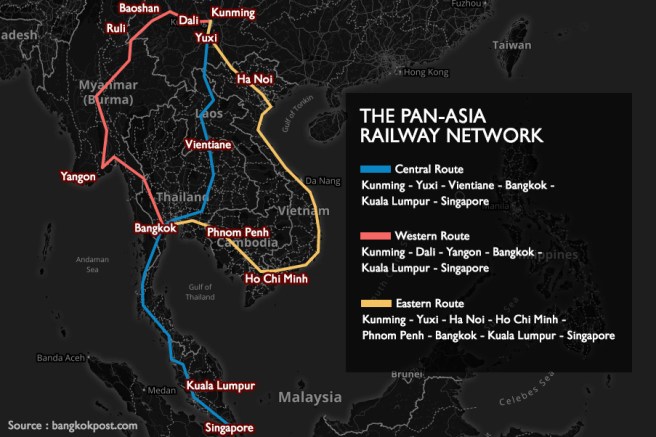
(GDVN) – Nhà ga đường sắt cao tốc từ điểm khởi đầu ở Côn Minh đã sắp hoàn thành thì phần đường sắt chạy qua lãnh thổ Lào đến nay vẫn chưa có…
Tiếp tục đọc “Ý tưởng “Một vành đai, một con đường” tắc ngay ở Đông Nam Á”
Conversations on Vietnam Development

(GDVN) – Nhà ga đường sắt cao tốc từ điểm khởi đầu ở Côn Minh đã sắp hoàn thành thì phần đường sắt chạy qua lãnh thổ Lào đến nay vẫn chưa có…
Tiếp tục đọc “Ý tưởng “Một vành đai, một con đường” tắc ngay ở Đông Nam Á”

asiapathways-abdi: Looking at the varying patterns of the capital flows into Asia in the last decade, the period after the taper tantrum on 21 May 2013 until 31 October 2015 is of particular interest from both global and local perspectives. Globally, the wave of capital flows became more volatile due to various international factors: (i) the pace of monetary policy normalization in the United States (US), (ii) the slowdown in the People’s Republic of China, (iii) the slide in oil prices, and (iv) higher political uncertainty and elevated geopolitical tensions. Locally, the growth momentum in Asia slowed down due to weaker balance of payments, worsening external debt conditions, and reduction in real economic activity. Monetary policy in Asia therefore became more accommodative to support growth. This, in turn, lowered expected relative interest returns and caused capital to flow out of Asia. Moreover, the exchange rate return on investing in Asian assets, which previously had been a byproduct of investment, declined. This is because there was greater risk aversion on Asian assets and there was downward pressure on all emerging Asian currencies due to weaker economic fundamentals. Tiếp tục đọc “The pattern of capital flows into Asia in the last decade”
 (Nguồn: tribune.com.pk)
Các nhà phân tích cho rằng việc cử tri Anh bỏ phiếu rời khỏi Liên minh châu Âu (EU), và sự bất mãn ở các nước phương Tây khác đang được xem là dấu hiệu sẽ mở đường cho một “Thế kỷ châu Á,” với sự đi đầu của Trung Quốc và Ấn Độ. Tiếp tục đọc “Brexit được xem là dấu hiệu mở đường cho “Thế kỷ châu Á””
 Print | Send by email |En español
ADB president Takehiko Nakao speaks at the Food Security Forum in Manila. Credit: Diana G. Mendoza/IPS
– Farming and agriculture may not seem cool to young people, but if they can learn the thrill of nurturing plants to produce food, and are provided with their favorite apps and communications software on agriculture, food insecurity will not be an issue, food and agriculture experts said during the Asian Development Bank (ADB)’s Food Security Forum from June 22 to 24 at the ADB headquarters here. Tiếp tục đọc “Can Better Technology Lure Asia’s Youth Back to Farming?”

The hazy smog of Hanoi and the Red River via Flickr (Addison Berry)
asiancorrespondent – ON March 5, the U.S. Embassy in Hanoi issued a startling report on local pollution levels that caused considerable alarm for a city not used to Beijing-style waves of smog. Tiếp tục đọc “Boom times lead to record pollution levels in Vietnam and beyond”
The LNG Industry has long regarded the Asian markets of Japan, South Korea, Taiwan, China and India as high growth importing markets, willing to sign long term contracts with price terms linked to crude oil prices. The rebound in Asian LNG demand in 2010, following the post-financial crisis year of 2009, re-affirmed this paradigm with LNG markets further tightening following the Fukushima tragedy. The signal for new LNG supply projects could not have been clearer in 2010 and 2011.
While the LNG supply projects triggered by such high demand growth and price signals were being constructed however, Asian demand for LNG began to wane. This appeared to be partly a consequence of mild winters but also LNG import prices and a general regional economic slowdown, perhaps led by China, also contributed. This paper seeks to provide a ‘ground level’ understanding of the existing, emerging and potential Asian LNG markets and highlights data sources from in-country government departments, often overlooked from a European or North American perspective.
The picture presented in this paper is one of LNG having to shed its mantle of a premium fuel whose import price is linked to that of oil and ‘re-market’ itself as fuel which can contribute to a lower carbon future, by displacing coal in national energy mixes, and equally importantly reducing particulate emissions. This however calls for a radical renaissance in marketing by upstream LNG producers and strenuous efforts in cost reduction through competition in the liquefaction equipment sector.
The paper provides a framework for analysing and monitoring these markets which, if not currently deemed to offer the high levels of future LNG demand anticipated from the standpoint of the early 2010s, will nevertheless constitute a key element of the global LNG balance for the foreseeable future. As such they will significantly impact the fundamentals and pricing dynamics of the increasingly ‘connected’ global regional gas markets.
Thứ tư, 20 Tháng 1 2016 16:58

Tiếp tục đọc “Chiến lược xoay trục, tái cân bằng của Mỹ đối với châu Á – Thái Bình Dương”

Animals Asia has called on all stakeholders to make a commitment to ending bear bile farming in Vietnam by 2020.
It follows today’s announcement by Vietnam’s Traditional Medicine Association that says its members must continue to pursue alternatives to bear bile and has promised a complete end to its use by 2020.
The announcement came at a press conference in Hanoi this morning – arranged by animal welfare NGO Animals Asia and the Traditional Medicine Association.
With bear numbers dropping fast and indications that the market for bear bile is also diminishing, Animals Asia is confident that bear bile farming can be entirely ended in Vietnam by 2020. The NGO – which has worked with local authorities this year to end bear bile farming in Quang Ninh province – will be pushing authorities across Vietnam to make the same commitments ahead of 2020. Tiếp tục đọc “BREAKING NEWS: Bear bile farming to be eradicated in Vietnam by 2020”
13/09/2015 08:40
TN – Cuối tháng 8, quốc hội Mỹ nhận báo cáo “Chiến lược an ninh hàng hải đối với châu Á – Thái Bình Dương” do Lầu Năm Góc đệ trình để vạch rõ chiến lược hành động trong thời gian tới.
 |
Phần đầu tiên của báo cáo đã đánh giá tổng quan tình hình khu vực cũng như các mối nguy cơ đối với an ninh hàng hải tại đây. Trong đó, vấn đề tranh chấp chủ quyền tại biển Hoa Đông và Biển Đông bị cho là ảnh hưởng mạnh mẽ đến các sự ổn định trong khu vực.
Là một bên tranh chấp, Trung Quốc liên tục có nhiều hành động gây lo ngại, đe dọa nhằm vào các bên liên quan. Chứng minh điều này, báo cáo chỉ ra một loạt hành vi của Bắc Kinh: Tiếp tục đọc “Chiến lược an ninh hàng hải của Mỹ ở châu Á – Thái Bình Dương”
New findings show Asia produces twice as much mercury emissions as previously thought
August 12, 2015
Jennifer Chu, MIT News

MIT – Once mercury is emitted into the atmosphere from the smokestacks of power plants, the pollutant has a complicated trajectory; even after it settles onto land and sinks into oceans, mercury can be re-emitted back into the atmosphere repeatedly. This so-called “grasshopper effect” keeps the highly toxic substance circulating as “legacy emissions” that, combined with new smokestack emissions, can extend the environmental effects of mercury for decades.
Now an international team led by MIT researchers has conducted a new analysis that provides more accurate estimates of sources of mercury emissions around the world. The analysis pairs measured air concentrations of mercury with a global simulation to calculate the fraction of mercury that is either re-emitted or that originates from power plants and other anthropogenic activities. The result of this work, researchers say, could improve estimates of mercury pollution, and help refine pollution-control strategies around the world.
The new analysis shows that Asia now releases a surprisingly large amount of anthropogenic mercury. While its increased burning of coal was known to exacerbate mercury emissions and air pollution, the MIT team estimates that Asia produces more than double the mercury emissions previously estimated. Tiếp tục đọc “Better estimates of worldwide mercury pollution”

