In Tokyo on May 23, President Biden announced the formation of the Indo-Pacific Economic Framework for Prosperity (IPEF). The framework will bring together the United States and a dozen other Indo-Pacific countries. The agreement will cover both traditional and digital trade standards, decarbonization and infrastructure, supply chain resiliency, taxation, and anti-corruption.
President Joe Biden is keeping Iran’s Islamic Revolutionary Guards Corps on a list of foreign terrorist organizations, according to officials. The decision could complicate international efforts to restore a 2015 deal meant to restrict Iran’s nuclear activities in exchange for sanctions relief. Lifting the IRGC’s 2019 terrorist designation (see background) has been a precondition for Iran to return to talks with global leaders, who have been working on reviving the deal for over a year amid rising tensions between Arab nations and Iran-allied groups.
The Charter of the United Nations is the founding document of the United Nations. It was signed on 26 June 1945, in San Francisco, at the conclusion of the United Nations Conference on International Organization, and came into force on 24 October 1945.
The United Nations can take action on a wide variety of issues due to its unique international character and the powers vested in its Charter, which is considered an international treaty. As such, the UN Charter is an instrument of international law, and UN Member States are bound by it. The UN Charter codifies the major principles of international relations, from sovereign equality of States to the prohibition of the use of force in international relations.
Since the UN’s founding in 1945, the mission and work of the Organization have been guided by the purposes and principles contained in its founding Charter, which has been amended three times in 1963, 1965, and 1973.
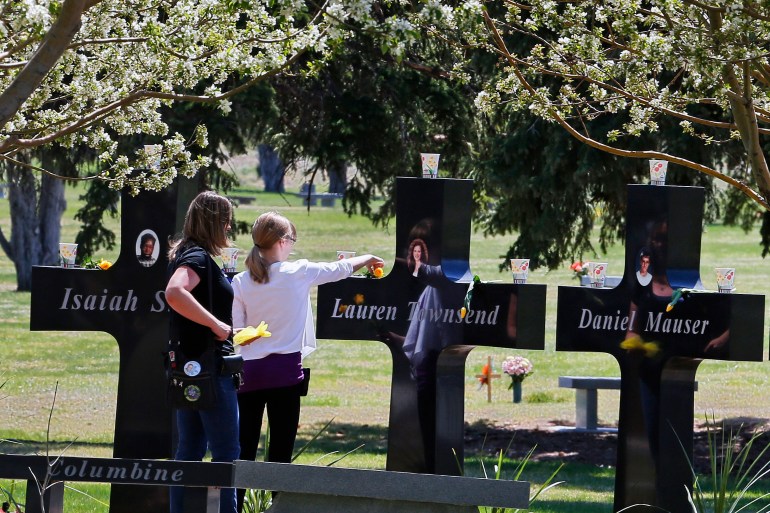
A massacre at a Texas primary school has again drawn attention to the powerful gun lobby in the United States, with Democratic officials blaming Republican legislators for remaining beholden to influential pro-gun interests that advocates say have stalled national gun reforms.
President Joe Biden, speaking hours after an 18-year-old gunman stormed the Robb Elementary School in Uvalde, Texas, fatally shooting 19 children and two teachers on Tuesday, asked: “When, in God’s name, are we going to stand up to the gun lobby?”.
Former President Barack Obama, who was in office when a gunman killed 20 children and six adults at the Sandy Hook Elementary School in Newtown, Connecticut in 2012, said the US “is paralysed, not by fear, but by a gun lobby and a political party that have shown no willingness to act in any way that might help prevent these tragedies”.
By Graeme DobellGraeme Dobell (graemedobell@aspi.org.au) is Journalist Fellow at the Australian Strategic Policy Institute. He has been reporting on Australian and international politics, foreign affairs and defense, and the Asia-Pacific since 1975.
Australia’s election: Quad continuity and climate alignment, with nuclear disagreements
Sworn-in as Australia’s new prime minister, within hours Anthony Albanese was flying to Japan for the summit of the Quadrilateral Security Dialogue (“Quad”).
An accident of timing—the May 24 summit following Australia’s May 21 election—offered the leader of the Australian Labor Party plenty of flying-start symbolism.
On February 11, 2022, the Biden administration released its Indo-Pacific Strategy. The document covers a vast geographic area including many nations and touches on a wide range of issues. What does the new strategy mean for U.S.-Vietnam cooperation?
Diplomatic Cooperation
The strategy names Vietnam as one of the United States’ leading regional partners. Keen observers have anticipated the U.S.-Vietnam Comprehensive Partnership signed in 2013 to be upgraded to a strategic partnership. Although some U.S. and Vietnamese officials have said that the name does not matter, formally upgrading to a strategic partnership with a written joint statement will assure both sides’ commitments.
Economic Cooperation
Vietnam’s digital economy is rapidly expanding. In 2011, only 35 percent of the Vietnamese population used the internet, which doubled to 70 percent by 2020. According to the e-Conomy SEA 2021 report, 71 percent of Vietnamese internet users have made at least one purchase online. The report projected Vietnam’s gross merchandise value (GMV) to reach a total value of $21 billion in 2021, when all sectors, except online travel, experienced double-digit growth. E-commerce is leading the pack, with a 53 percent increase from $8 billion to $13 billion. Vietnam’s GMV is expected to grow from $21 billion in 2021 to $57 billion in 2025.
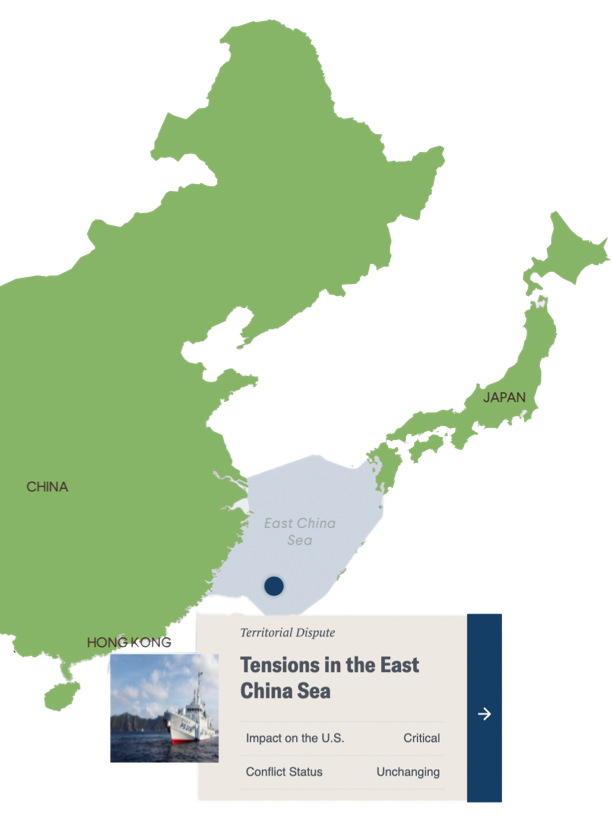
Council on Foreign Relations: Monitor World Conflicts
The Global Conflict Tracker identifies conflicts around the world, follows their evolution, and assesses their impact on U.S. national security. Our newly redesigned and expertly researched tool from CFR’s Center for Preventive Action includes live data, background information, the latest developments, and critical resources to provide insight on the world’s strife.
Conflict in Ukraine Conflict status: Worsening Russia’s military invasion risks a wider European conflict. Stay up to date.
War in Afghanistan Conflict status: Worsening Decades of instability continue amid the 2021 Taliban takeover. Read about the history.
North Korea Crisis Conflict status: Unchanging The nation’s leader continues to provoke a global crisis with his nuclear ambitions. Learn about attempts at rapprochement.
Conflict with Al-Shabab Conflict status: Unchanging Up to 450 U.S. troops return to Somalia for a mission against the al-Qaeda affiliate. Stay current.
Despite being outlawed under the 1961 Dowry Prohibition Act, India’s dowry system remains deeply entrenched in society and has become associated with violence against women.
Vismaya Nair is seen in this undated image.
(CNN)A court in southern India on Tuesday sentenced a man to 10 years in prison in a ruling that found he abused his wife over their wedding dowry, leading to her death by suicide.
The district court in Kerala state found Kiran Kumar guilty under India’s “dowry death” law, which allows charges to be brought against people for causing the death of a woman within the first seven years of a marriage featuring dowry gifts and payments.
1. For the purpose of this Statute, “crime of aggression” means the planning, preparation, initiation or execution, by a person in a position effectively to exercise control over or to direct the political or military action of a State, of an act of aggression which, by its character, gravity and scale, constitutes a manifest violation of the Charter of the United Nations.
1. Cho mục đích của Đạo luật này, “tội xâm lược” nghĩa là lập kế hoạch, chuẩn bị, khởi sự hay xúc tiến, bởi một người trong một chức vị hành xử hiệu lực sự kiểm soát hay điều khiển hành vi chính trị hay quân sự của một Quốc gia, một hành vi xâm lược mà, bởi bản chất, tính nghiêm trọng và quy mô của nó, tạo nên một vi phạm hiển nhiên đến Hiến chương Liên hợp quốc.
2. For the purpose of paragraph 1, “act of aggression” means the use of armed force by a State against the sovereignty, territorial integrity or political independence of another State, or in any other manner inconsistent with the Charter of the United Nations. Any of the following acts, regardless of a declaration of war, shall, in accordance with United Nations General Assembly resolution 3314 (XXIX) of 14 December 1974, qualify as an act of aggression:
a) The invasion or attack by the armed forces of a State of the territory of another State, or any military occupation, however temporary, resulting from such invasion or attack, or any annexation by the use of force of the territory of another State or part thereof;
b) Bombardment by the armed forces of a State against the territory of another State or the use of any weapons by a State against the territory of another State;
c) The blockade of the ports or coasts of a State by the armed forces of another State;
d) An attack by the armed forces of a State on the land, sea or air forces, or marine and air fleets of another State;
e) The use of armed forces of one State which are within the territory of another State with the agreement of the receiving State, in contravention of the conditions provided for in the agreement or any extension of their presence in such territory beyond the termination of the agreement;
f) The action of a State in allowing its territory, which it has placed at the disposal of another State, to be used by that other State for perpetrating an act of aggression against a third State;
g) The sending by or on behalf of a State of armed bands, groups, irregulars or mercenaries, which carry out acts of armed force against another State of such gravity as to amount to the acts listed above, or its substantial involvement therein.
2. Cho mục đích của đoạn 1, “hành vi xâm lược” nghĩa là sự sử dụng vũ lực quân sự bởi một Quốc gia chống lại chủ quyền, toàn vẹn lãnh thổ hay độc lập chính trị của một Quốc gia khác, hay dưới bất kỳ hình thức nào không phù hợp với Hiến chương Liên hợp quốc. Bất kỳ hành vi nào sau đây, dù có tuyên chiến hay không, đều, theo đúng Nghị quyết 2214 (XXIX) ngày 14 tháng 12 năm 1974, là hành vi xâm lược:
a) Xâm lấn hay tấn công do các lực lượng vũ trang của một Quốc gia vào lãnh thổ của một Quốc gia khác, hay sự chiếm đóng quân sự, dù tạm thời đến đâu, sinh ra từ sự xâm lấn hay tấn công đó, hay bất kỳ sự sát nhập nào bằng vũ lực lãnh thổ hay một phần lãnh thổ của một Quốc gia khác;
b) Oanh kích do các lực lượng vũ trang của một Quốc gia vào lãnh thổ của một Quốc gia khác hay sự sử dụng bất kỳ vũ khí nào bởi một Quốc gia vào lãnh thổ của một Quốc gia khác;
c) Phong tỏa các cảng và bờ biển của một Quốc gia bằng các lực lượng vũ trang của một Quốc gia khác;
d) Một cuộc tấn công do các lực lượng vũ trang của một Quốc gia vào các lực lượng trên bộ, trên biển hay trên không hay các hạm đội hoặc phi đội của một Quốc gia khác;
e) Sử dụng các lực lượng vũ trang của một Quốc gia đang ở trong lãnh thổ của một Quốc gia khác với sự thỏa thuận của Quốc gia tiếp nhận, ngược với những điều kiện đã quy định trong thỏa thuận hay trong bất kỳ sự gia hạn hiện diện nào của các lực lượng vũ trang đó trong lãnh thổ đó sau khi sự thỏa thuận đã hết hạn.
f) Hành động của một Quốc gia, đã đặt lãnh thổ của mình dưới quyền sử dụng của một Quốc gia khác, cho phép lãnh thổ của mình được Quốc gia khác đó sử dụng để thực hiện một hành vi xâm lược chống lại một Quốc gia thứ ba;
g) Việc gửi, bởi hay thay mặt một Quốc gia, các băng đảng, các nhóm, các lực lượng không chính quy hay lính đánh thuê vũ trang, để thực hiện các hành vi vũ lực quân sự vào một Quốc gia khác nghiêm trọng đến mức tạo thành các hành vi xâm lược kể trên, hay nhúng tay đáng kể vào việc gửi quân đó.
A Nikkei reporter reflects on a milestone in the country’s path out of pandemic
Roadblocks in Ho Chi Minh City were common in October, but now Vietnam has eliminated almost all COVID restrictions for foreign and domestic travel. (Photo by Lien Hoang)
HO CHI MINH CITY — Last week after a trip to California, I returned to Vietnam with a COVID vaccine certificate, negative PCR test and smartphone tracing app in hand. The green-uniformed immigration officer at the airport asked for none of it. Inside his plexiglass cage, the 20-something officer gestured for me to pull down my mask for a second. I spent less than a minute and zero words at passport control and then was back outside on the balmy, car horn-filled streets of Ho Chi Minh City.
Today, we – Prime Minister Anthony Albanese of Australia, Prime Minister Narendra Modi of India, Prime Minister Fumio Kishida of Japan, and President Joe Biden of the United States – convene in Tokyo to renew our steadfast commitment to a free and open Indo-Pacific that is inclusive and resilient.
Just over one year ago, Leaders met for the first time. Today in Tokyo, we convene for our fourth meeting, and our second in person, to demonstrate, at a time of profound global challenge, that the Quad is a force for good, committed to bringing tangible benefits to the region. In our first year of cooperation, we established the Quad’s dedication to a positive and practical agenda; in our second year, we are committed to deliver on this promise, making the region more resilient for the 21st century.
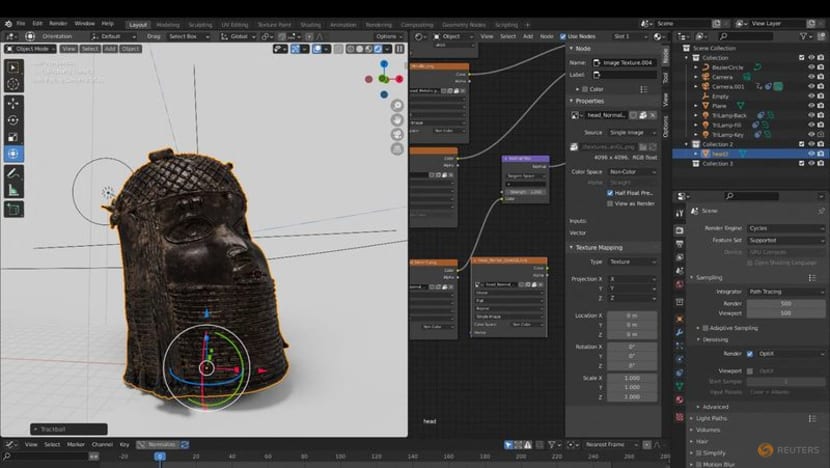
View of a computer-rendered image, with an added design to a looted artwork from Nigeria, that now resides in a British museum, with project’s aim to give part of its non-fungible token (NFT) sale proceeds to fund young African artists, in this handout obtained May 23, 2022. Looty Art/Handout via REUTERSScreenshot of the design process on an image of a looted artwork from Nigeria, that now resides in a British museum, with project’s aim to give part of its non-fungible token (NFT) sale proceeds to fund young African artists, in this handout obtained May 23, 2022. Looty Art/Handout via REUTERS
Credit: Courtesy of Chelsea Ryoko Wong, Jessica Silverman, San Francisco, and Jeffrey Deitch, New York
Tired of being ‘fetishized and invisible,’ Asian artists are changing the narrative
SHARE
Written byAnn Binlot, CNN
In much of Western art, Asian women have often appeared as one-dimensional characters — sometimes seen as meek and docile, and at other times hypersexualized and exoticized. But such portrayals fail to show individuals coming from a myriad of cultural backgrounds, their identities rooted in distinctly different countries and histories.
“Wonder Women,” a new exhibition at the Jeffrey Deitch gallery in New York, seeks to counter stereotypical representations made by outsiders, presenting works by Asian American and diasporic women and non-binary artists “portraying themselves or their family members as heroes in their own ways,” explained show curator Kathy Huang.
“I had always grappled with ideas of being both fetishized and invisible in pop culture and visual culture,” said Huang, adding that she drew inspiration from the 1981 poem “Wonder Woman” by Genny Lim.
“In the poem, the narrator is observing the different lives of Asian women,” she explained. “That’s something that I had wondered myself … because I have my individual experience as a Chinese American woman, but there were so many other experiences that I don’t know about.”




 We believe in the free flow of information

 The
The 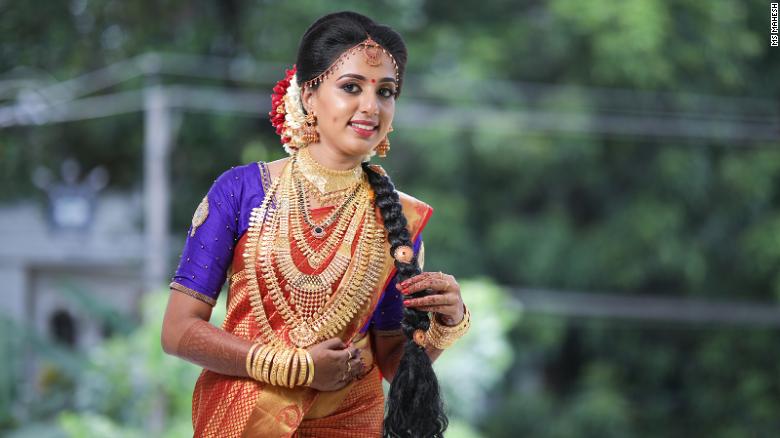




 CVD
CVD 