Council on Foreign Relations -Daily News Brief, Nov. 3, 2022

Top of the Agenda

Ethiopian Government Agrees to Truce With Tigrayan Rebels

After two years of fighting, the Ethiopian government and rebel Tigray People’s Liberation Front (TPLF) agreed to end hostilities (WaPo), disarm, and restore “law and order,” said Olusegun Obasanjo, the Horn of Africa envoy for the African Union (AU). The AU-mediated truce has raised hopes for an end to a war that has killed tens of thousands of people and displaced millions (Reuters).  The AU stepped in to mediate after a cease-fire declared by the government in March fell apart after five months. Obasanjo said the AU will monitor the implementation of the new peace deal, which stipulates that Ethiopia’s government will take control of Mekelle, the capital of the Tigray region, and that the TPLF will once again be recognized as a political party. Eritrea, which sent troops to fight alongside the Ethiopian government’s forces, was not part of the talks. 
Analysis

This is a huge breakthrough that involved major concessions from both sides, even if the parties punted the thorniest details to future peace talks,” the International Crisis Group’s Alan Boswell tells Reuters. “If they do stop fighting, then today will just be the start of what will surely prove a very bumpy, long, and difficult peace process.” 

“The African Union-mediated deal in Ethiopia is important for watchers of regional organizations & world order. While too early to celebrate, AU shows the way when European regional institutions are weakening or busy fighting each other,” American University’s Amitav Acharya tweets. 

For the Africa in Transition blog, CFR’s Michelle Gavin explains the challenges that have hindered the AU-mediated negotiation process.
Tiếp tục đọc “Council on Foreign Relations -Daily News Brief, Nov. 3, 2022”

ISDS case map

facebook sharing button
twitter sharing button
whatsapp sharing button
linkedin sharing button

Click here for map >>

Click on the dots on the map to explore ISDS cases or look at the list below


Additional resources:

ISDS cases displayed on this map

AfricaAsiaEurope
Ampal-American vs. Egypt
Unión Fenosa vs. Egypt
Veolia vs. Egypt
Al-Kharafi vs. Libya
Carlyle vs. Morocco
Foresti vs. South Africa
Agro EcoEnergy vs. Tanzania
Total vs. Uganda
Border Timbers & Von Pezold vs. Zimbabwe
Bechtel, Enron and seven European banks vs. India
Vodafone vs. India
Churchill Mining vs. Indonesia
Newmont Mining vs. Indonesia
Khan Resources Inc. vs. Mongolia
Tethyan Copper vs. Pakistan
Fraport vs. Philippines
Hanocal & IPIC International vs. South Korea
Kingsgate vs. Thailand
ConocoPhillips & Perenco vs. Vietnam
Razvoj Golf & Elitech vs. Croatia
CME & Lauder vs. Czech Republic
Saluka vs. Czech Republic
Vermilion vs. France
Vattenfall vs. Germany I
Vattenfall vs. Germany II
Rockhopper vs. Italy
RWE vs. Netherlands
Eureko vs. Poland
Gabriel Resources vs. Romania
Micula vs.. Romania
Yukos vs. Russia
Achmea vs. Slovakia
Ascent Resources vs. Slovenia
NextEra vs. Spain
Latin AmericaNorth AmericaPacific
Abaclat vs. Argentina
Azurix vs. Argentina
CMS Gas vs. Argentina
Aguas del Tunari vs. Bolivia
Eco Oro vs. Colombia
Novartis vs. Colombia
Infinito Gold vs. Costa Rica
TCW vs. Dominican Republic
Chevron vs. Ecuador
Copper Mesa vs. Ecuador
Occidental Petroleum vs. Ecuador
Pac Rim vs. El Salvador
Kappes, Cassidy & Associates vs. Guatemala
RDC vs. Guatemala
Abengoa vs. Mexico
Cargill vs. Mexico
Metalclad vs. Mexico
Renco vs. Peru
Philip Morris vs. Uruguay
ConocoPhilips vs. Venezuela
Crystallex vs. Venezuela
Eli Lilly vs. Canada
Ethyl vs. Canada
ExxonMobil and Murphy Oil vs. Canada
Lone Pine vs. Canada
TC Energy vs. United States
Philip Morris vs. Australia
Barrick Gold vs. Papua New Guinea

Key ISDS facts

  • Amount of ISDS cases: 1104 (2020)
  • Total claimed amount: $US 570 billion (2018)
  • Average amount claimed by investors: US$ 1.5 billion
  • Average amount awarded by tribunals: US$ 438 million
  • Largest award: US$ 50 billion (Yukos vs. Russia)
  • Results of decisions (on the merits): 61% in favour of investors (2019)
  • Most invoked treaty in ISDS arbitrations: Energy Charter Treaty (135 cases)
  • Investor legal costs on average: US$ 6.4 million
  • States legal costs on average: US$ 4.7 million
  • ISDS proceedings average length: 4 years and a half

(Source: UNCTADBIICLSOMO)

keywords: investor-state disputes | ISDS

source:

Nỗi lo thiếu nước của Sài Gòn

vnexpress.net

TP HCM chỉ có thể cầm cự không quá một ngày nếu mất nước, bởi đô thị 10 triệu dân chưa có đủ nguồn dự phòng trong tình huống khẩn nguy.

Năm 1975, dân số TP HCM khoảng 3 triệu người. 47 năm sau, số người sinh sống tại thành phố là gần 10 triệu, chưa tính khách vãng lai. Để đáp ứng nhu cầu người dân và phát triển kinh tế của đô thị lớn nhất nước, hơn 4 thập niên qua, ngành cấp nước thành phố liên tục tăng công suất, từ 450.000 m3 lên 2,4 triệu m3 – hơn gấp 5 lần.

https://flo.uri.sh/visualisation/10730503/embed?auto=1Công suất cấp nước 47 năm qua tăng hơn gấp 5 lần.

Thống kê thời gian gần đây cứ 5 năm, thành phố lại tăng một triệu người. Nếu tính mỗi người cần trung bình 200 lít nước một ngày, đô thị lớn nhất Việt Nam sẽ tiêu thụ thêm 365 triệu m3 nước mỗi năm – bằng gần 1/4 dung tích hồ Dầu Tiếng (1,5 tỷ m3). Đó là chưa kể nhu cầu về nước cho các hoạt động sản xuất, dịch vụ còn cao hơn nhiều so với nước sinh hoạt.

Tiếp tục đọc “Nỗi lo thiếu nước của Sài Gòn”

EU warns of pesticide residues found in Vietnamese agricultural products

nongnghiep.vn

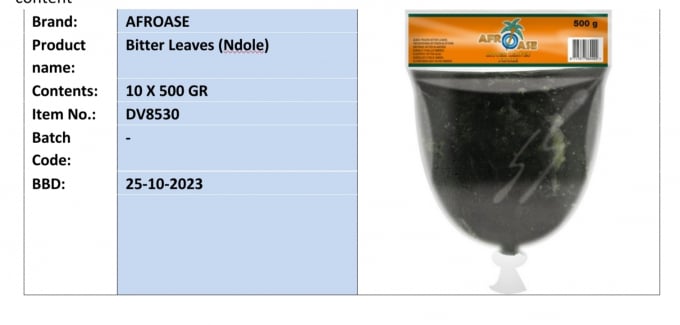
(VAN) The EU has warned that bitter leaves and some other agricultural products exported from Vietnam have exceeded the maximum residue level of many active ingredients and banned substances.

According to the Vietnam Sanitary and Phytosanitary Notification Authorities and Enquiry Point (SPS Vietnam Office), RASFF – Rapid Alert System for Food and Feed of the European Union (EU) has just sent a warning notice, stating that the product of frozen ground bitter leaves of An Van Co., Ltd. Thinh (Address: 60 Ly Thuong Kiet, Ward 1, Bao Loc City, Lam Dong Province) was found to have exceeded the maximum residue level (MRL) of many active ingredients and banned substances.

The product of frozen ground bitter leaves receives warning from the EU.

In which, some active ingredients have high residue levels such as: Thiamethoxam (54 mg/kg); Tebuconazole (26 mg/kg); Propiconazole (34 mg/kg); Diniconazole (86 mg/kg).

The country issuing the notification is the Netherlands, which has notified the consignee. Finland has initiated the recall of the product.

In addition to frozen ground bitter leaves, Vietnam has also received warning on tea exported to Hong Kong. This product contains three banned substances and pesticide residues exceeding EU regulations, including: Chlorfluazuron (0.11 mg/kg); Imidacloprid (0.15 mg/kg) and Chlorpyrifos (0.043 mg/kg).

Being the focal point for transparent information about SPS measures and regulations to WTO members, the Vietnam SPS Office has notified this issue to the Plant Protection Department and related units.

Tiếp tục đọc “EU warns of pesticide residues found in Vietnamese agricultural products”

Functional Jurisdiction in the Law of the Sea

Functional Jurisdiction in the Law of the Sea – Download >>

It is a commonplace observation that the 1982 UN Convention on the Law of the Sea establishes a framework for the Law of the Sea that is based upontwo different concepts. One is a zonal analysis, which takes the juridicalzones into which the seas are divided and stipulates the basic rules applica- ble to each of them in turn. The other is a topical analysis, taking some of themain activities on the seas, such as fishing, marine research and pollution,and again setting out the basic rules for each.

The framework is, however,incomplete, and a great deal is left open, not only to be worked out in moredetailed treaties but also to be governed by more general principles of inter-national law. In this way the 1982 regime will continue to develop to meet new challenges and changed circumstances.

In this monograph Dr Gavouneli explores these issues and offers an expertinsight into the jurisdictional developments that are clearly discernable aquarter-century after the adoption of the Convention. Her keen analysismoves from fundamental principles governing jurisdiction in internationallaw to shrewd reflections on the significance of current developments suchas the Proliferation Security Initiative and questions of jurisdiction over theinternational seabed area. This thoughtful text will be of real interest to allwho have a concern with the directions in which the contemporary Law of the Sea is growing.

Vaughan Lowe
Oxford, August 2007

Functional Jurisdiction in the Law of the Sea – Download >>

Council on Foreign Relations: Daily news brief, Nov. 2, 2022

November 2, 2022
Top of the Agenda

Seoul Fires Back After Barrage of North Korean Missile Tests

North Korea fired a missile that crossed the Northern Limit Line, a maritime border with South Korea that Pyongyang does not recognize (CNN), for the first time since the 1950–53 Korean War. South Korea’s military called the launch “rare and intolerable” and responded by firing three missiles (Yonhap) into waters north of the line. North Korea’s missile was one of as many as twenty-three it test-fired into the seas off of South Korea’s east and west coasts today. The missile deployment was North Korea’s largest in a single day. The launches came after U.S.-South Korea military drills began on Monday. U.S. Defense Secretary Lloyd Austin is set to meet with his South Korean counterpart at the Pentagon tomorrow.  
Tiếp tục đọc “Council on Foreign Relations: Daily news brief, Nov. 2, 2022”

Russia bans 45 foreign-owned banks or banking units from selling their shares

Logo of Swiss bank Credit Suisse is seen in Zurich

[1/3] The logo of Swiss bank Credit Suisse is seen at its headquarters in Zurich, Switzerland October 4, 2022. REUTERS/Arnd Wiegmann

  • This content was produced in Russia where the law restricts coverage of Russian military operations in Ukraine

MOSCOW, Oct 26 (Reuters) – Russia on Wednesday banned dealings in the shares or share capital of 45 banks or banking units, all either owned by parties in countries that Russia terms “unfriendly” or owned through foreign capital.

Western countries and allies, including Japan, have piled financial restrictions on Russia since it sent troops into Ukraine in late February. Moscow retaliated with obstacles for Western businesses and their allies leaving Russia, and in some cases seized their assets.

The list followed a decree issued on Aug. 5 by President Vladimir Putin banning dealings in stakes in the financial and energy sectors owned by parties in “unfriendly” countries unless specific permission was given. read more read more

The list, published on Wednesday, included Russian units of Intesa (ISP.MI), Credit Suisse (CSGN.S), Raiffeisen (RBIV.VI), Citi (C.N), OTP bank <OTPB.BU> and UniCredit Bank (CRDI.MI), as well as the Russian Yandex-Bank and Ozon-Bank.

Citi, the largest Wall Street bank to have a presence in Russia with an exposure of $8 billion, plans to wind down nearly all of the institutional banking services as it is unable to sell the business amid the recent sanctions-related laws. read more read more read more

Xinjiang exports to US dip in September but still higher year on year despite forced labour law

Machinery and mechanical equipment top category of products shipped from region, whose month-on-month decline aligns with weakening in Chinese exportsUS customs chief insists ‘seeing good examples of compliance so far’ with recently implemented Uygur Forced Labour Prevention Act

Published: 2:00am, 25 Oct, 2022

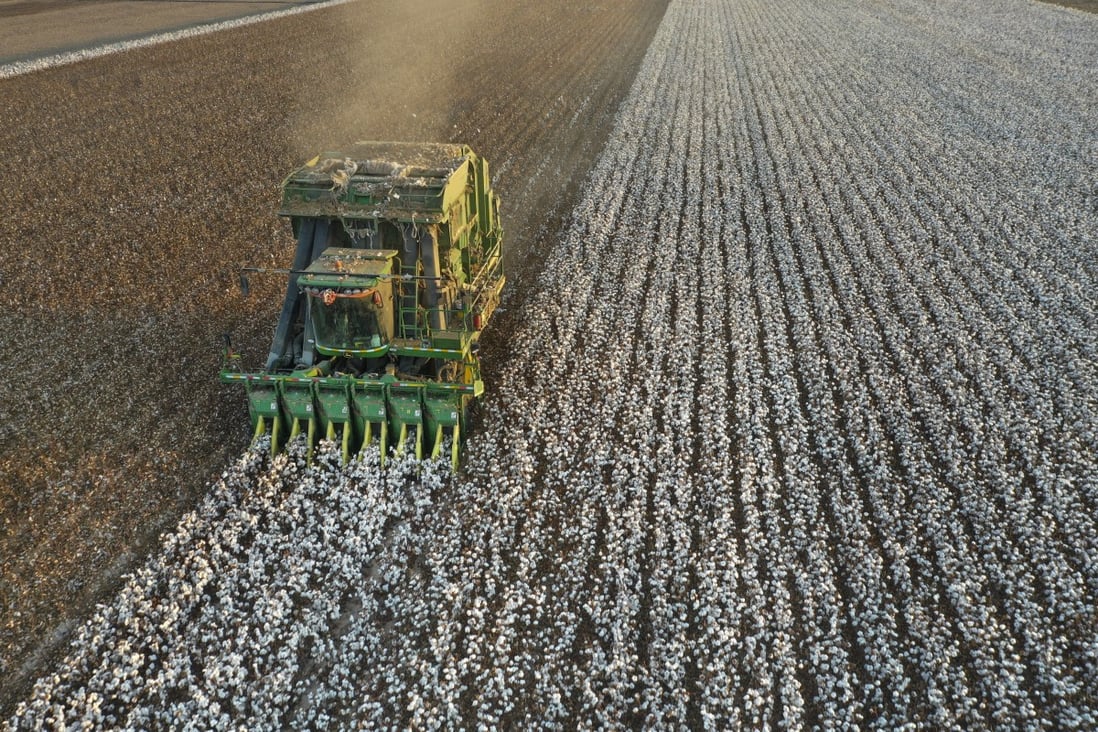
Xinjiang’s exports to the United States dropped in September after soaring for two consecutive months, but were still nearly three times as high as the same month last year, according to the latest Chinese customs data – despite a Washington law that seeks to ban goods from the far-west region of China due to forced labour allegations.

The shipments from Xinjiang to the US have appeared to continue even as officials from the US customs agency insist that they have been effectively enforcing the Uygur Forced Labour Prevention Act, which kicked in on June 21.

Companies from the Xinjiang Uygur autonomous region in September exported US$21.05 million worth of goods to the US, slashed by more than half compared with the figure for August, but more than double the tally in June, trade data showed.

The month-on-month decline of Xinjiang exports to the US was in line with the overall weakening of Chinese exports.

https://multimedia.scmp.com/widgets/graphicsEmbeds/charts2/chart/?id=CHG2022092115_columnN2UB

Tiếp tục đọc “Xinjiang exports to US dip in September but still higher year on year despite forced labour law”

Vietnam wires into global electronics

EAF – 25 October 2022

Author: Suiwah Leung, ANU

Vietnam currently benefits from China’s COVID-19 lockdowns and the geopolitical tensions between the United States and China — especially in electronics manufacturing. The country flirted with its own zero-COVID-19 policy and lockdowns in 2021 but changed course quickly to have two-thirds of its population vaccinated by December 2021.

Employees pass a billboard advertisement for the Samsung Galaxy Note 7 on the way to work at the Samsung factory in Thai Nguyen province, Vietnam 13 October 2016 (Photo: Reuters/Nguyen Huy Kham)

News leaked that Apple would move its iPad production from China to Vietnam in June 2022. China’s Xiaomi also moved the production of some of its devices to Vietnam in June 2021 thanks to investments by DBG Technology, a subsidiary of Hong Kong’s DBG Electronics Investment Limited.

Samsung, an early entrant into Vietnam, invested in a US$670 million manufacturing plant in the northern province of Bac Ninh in 2014. It increased its investment to US$17.3 billion nationwide in a little over a decade. Intel, another early entrant, opened a US$1 billion semiconductor assembly and testing facility in Ho Chi Minh City in 2006. It made additional investments in 2019 and 2020, taking the total to US$1.5 billion. Indeed, all this Foreign Direct Investment (FDI) gave rise to a popular saying that ‘the US–China trade war is over and Vietnam is the winner’.

Tiếp tục đọc “Vietnam wires into global electronics”

Doi moi’s time comes again for Vietnam

EAF – 18 October 2022

Authors: Guanie Lim, GRIPS and Chengwei Xu, NTU

In late August 2022, news broke that Apple was in talks to manufacture its famed Apple Watches and MacBooks in Vietnam for the first time. Some view this as a move by transnational corporations and their core suppliers to diversify their production away from China, buffering themselves from intensifying US–China geoeconomic competition.

Laborers work at an assembly line to produce ventilators at Vsmart factory of Vingroup outside Hanoi, Vietnam, 3 August 2020. (PHOTO: REUTERS/Kham)

Others interpret this as a sign of Vietnam’s deepening manufacturing prowess built on its famed 1986 doi moi (renovation) program. The reforms sought to reintegrate the country into the global economy. Among the more significant moves were the creation of stock exchanges, the promotion of private ownership and encouragement of private–public partnerships.

Tiếp tục đọc “Doi moi’s time comes again for Vietnam”

The Buddhist Church suggested not to use the name ‘KFC Thich Quang Duc’

VP – Monday 31st October 2022 04:56 PM

The name of the KFC branch on Thich Quang Duc street (HCMC) has changed to KFC Thich Quang Duc street – Screenshot

On October 31, Venerable Thich Gia Quang – Vice Chairman of the Executive Council, Head of the Information and Communication Department of the Central Committee of the Vietnam Buddhist Sangha – signed and promulgated Official Letter No. 08 to KFC Vietnam. the fact that this company opened a new branch on Thich Quang Duc Street (Phu Nhuan District, Ho Chi Minh City) and used the legal name of Bodhisattva Thich Quang Duc named “KFC Thich Quang Duc”.

Tiếp tục đọc “The Buddhist Church suggested not to use the name ‘KFC Thich Quang Duc’”

Home away from home: The untold story of Canada’s ‘Little Tibet’

Al Jazeera English – 27 thg 10, 2022

Tucked away within Toronto’s inner city is a small enclave known as “Little Tibet”.

Located in the Parkdale neighbourhood, the restaurants here are famous for delicious Tibetan dumplings known as momos.

Parkdale is also home to one of the largest concentrations of Tibetans outside Asia, stemming from the 1970s when Tibetan refugees flocked to Canada. The community has thrived here, establishing Little Tibet’s reputation as a food mecca and setting up a cultural centre.

But today, rapid gentrification and Toronto’s sky-high rents threaten the area’s unique social fabric. Amid China’s increasing global influence, the Tibetan community is striving to hold on to its past and maintain its traditions in an adopted land.

Explore Little Tibet and meet an immigrant community working to preserve its identity in this episode of A Sense of Community, a four-part series about unique neighbourhoods around the world and the challenges they face.

How small modular reactors may fuel nuclear power’s comeback

Al Jazeera English – 1 thg 11, 2022

Nuclear power gained a bad reputation following the disasters at Chernobyl, Fukushima and Three Mile Island.

Now, with global energy disruptions caused by Russia’s war in Ukraine and sky-high fuel prices means aging nuclear plants are getting a new lease on life.

And there is new type of nuclear plant is on the horizon- one that could revolutionize the industry.

They are called Small Modular Reactors, or SMRs for short.

Al Jazeera’s Rob Renolds reports from San Luis Obispo California.

Vietnam’s wood trade under pressure from logging, Ukraine war

nikkei Murky origins plague furniture sector coming down from COVID-fueled buying spree

A company displays lumber in Vietnam, whose wood products industry is grappling with risks ranging from the Ukraine war to fake forest certificates and U.S. trade probes. (Photo by Lien Hoang)

LIEN HOANG, Nikkei staff writerOctober 28, 2022 16:08 JST

HO CHI MINH CITY — Reputational risks are piling up for a Vietnamese lumber industry already beset by a falloff in demand from the heights of the pandemic.

One of the world’s biggest wood and furniture exporters, Vietnam enjoyed a surge in orders when overseas buyers spent COVID lockdowns renovating their home offices and kitchens.

But the Southeast Asian country faces accusations of importing Chinese goods for re-export with “Made in Vietnam” labels since the onset of the China-U.S. tariff war in 2018. Now an actual war in Ukraine is stoking concern that sanctioned products from Russia may be routed through Vietnam, which maintains a neutral stance on the conflict between Kyiv and Moscow, as it does with Beijing and Washington. A third concern, about logging of fuel wood, has added to the pressure.

Tiếp tục đọc “Vietnam’s wood trade under pressure from logging, Ukraine war”