TTCT – Chục ngày qua, tòa xử đại án “chuyến bay giải cứu” hai năm trước. Nhưng tôi không muốn nhắc lại phiên tòa buồn bã ngày hôm nay, mà muốn nhắc về một quá khứ vẫn còn nóng hổi, của lòng trắc ẩn trong đại dịch…
Người di cư về tới đèo Lò Xo đầu tháng 10-2021. Ảnh: Calvin Tran
Một trong những sợi dây quan trọng giúp hình thành, cố kết, duy trì cộng đồng xuyên suốt trong chiều dài lịch sử và chiều ngang không gian của mọi cộng đồng là đạo đức, là nhân tính. Và một biểu hiện cụ thể của nó là không quay lưng bỏ rơi đồng loại trong những khúc nguy nan.
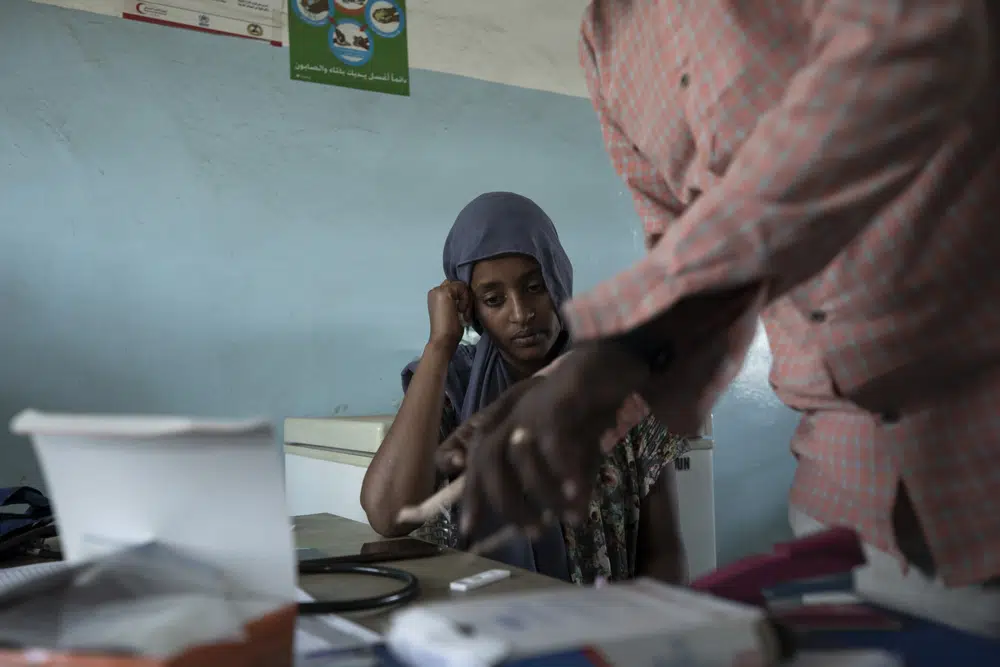
FILE – Surgeon and doctor-turned-refugee, Dr. Tewodros Tefera, prepares a malaria test for 23-year-old Tigrayan refugee Hareg from Mekele, Ethiopia, at the Sudanese Red Crescent clinic in Hamdayet, eastern Sudan, near the border with Ethiopia, on March 17, 2021. The coronavirus pandemic interrupted efforts to control malaria, resulting in 63,000 more deaths and 13 million more infections. That’s according to a World Health Organization report released Thursday Dec. 8, 2022. (AP Photo/Nariman El-Mofty, File)
The coronavirus pandemic interrupted efforts to control malaria, resulting in 63,000 additional deaths and 13 million more infections globally over two years, according to a report from the World Health Organization published Thursday.
Cases of the parasitic disease went up in 2020 and continued to climb in 2021, though at a slower pace, the U.N. health agency said Thursday. About 95% of the world’s 247 million malaria infections and 619,000 deaths last year were in Africa.
“We were off track before the pandemic and the pandemic has now made things worse,” said Abdisalan Noor, a senior official in WHO’s malaria department.
Alister Craig, dean of biological sciences at the Liverpool School of Tropical Medicine, noted that progress in reducing malaria deaths had stalled even before COVID-19.
“It is almost as if we have reached a limit of effectiveness for the tools we have now,” said Lister, who was not linked to the WHO report.
ADVERTISEMENT
Noor said he expected the wider rollout of the world’s first authorized malaria vaccine next year to have a “considerable impact” on reducing the number of severe illnesses and deaths if enough children get immunized, adding that more than 20 countries have applied to vaccines alliance Gavi for help in securing the shot. Still, the vaccine is only about 30% effective and requires four doses.
Bed nets can protect people from being bitten by the mosquitoes that spread malaria. The WHO report found that about three-quarters of nets provided by donors have been distributed, but there are major gaps in some of the worst-hit countries. Authorities in Nigeria, for example, gave out just over half their nets, while Congo distributed about 42% of theirs.
Officials also raised concerns about a new invasive mosquito species that thrives in cities, is resistant to many pesticides and which could undo years of progress against malaria. The invasive species has not yet significantly contributed to the continent’s overall malaria burden, but the insects are likely responsible for a recent spike in parts of the horn of Africa, Noor said.
David Schellenberg, a professor at the London School of Hygiene and Tropical Medicine, said there were promising new tools and strategies to tackle malaria, but that “the elephant in the room is the level of funding.” WHO estimated the total investment into malaria — about $3.5 billion — was less than half of what was needed to dramatically reduce its impact.
___
The Associated Press Health and Science Department receives support from the Howard Hughes Medical Institute’s Science and Educational Media Group. The AP is solely responsible for all content.
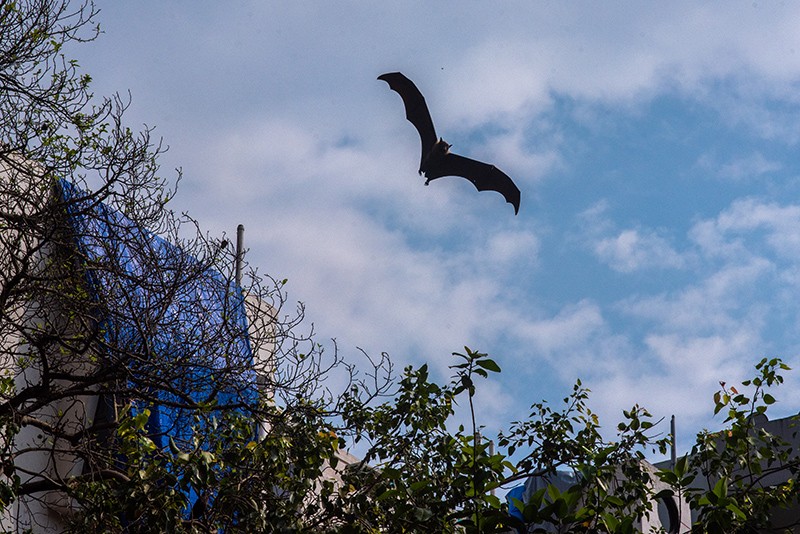
Bats will have a large contribution to virus transmission between species in the future, a modelling study finds.Credit: Pratik Chorge/Hindustan Times via Getty
Over the next 50 years, climate change could drive more than 15,000 new cases of mammals transmitting viruses to other mammals, according to a study published in Nature1. It’s one of the first to predict how global warming will shift wildlife habitats and increase encounters between species capable of swapping pathogens, and to quantify how many times viruses are expected to jump between species.
Many researchers say that the COVID-19 pandemic probably started when a previously unknown coronavirus passed from a wild animal to a human: a process called zoonotic transmission. A predicted rise in viruses jumping between species could trigger more outbreaks, posing a serious threat to human and animal health alike, the study warns — providing all the more reason for governments and health organizations to invest in pathogen surveillance and to improve health-care infrastructure.
The study is “a critical first step in understanding the future risk of climate and land-use change on the next pandemic”, says Kate Jones, who models interactions between ecosystems and human health at University College London.
The research predicts that much of the new virus transmission will happen when species meet for the first time as they move to cooler locales because of rising temperatures. And it projects that this will occur most often in species-rich ecosystems at high elevations, particularly areas of Africa and Asia, and in areas that are densely populated by humans, including Africa’s Sahel region, India and Indonesia. Assuming that the planet warms by no more than 2 °C above pre-industrial temperatures this century — a future predicted by some climate analyses — the number of first-time meetings between species will double by 2070, creating virus-transmission hotspots, the study says.
Marnie Hunter and Forrest Brown, CNN • Updated 1st March 2022
Tourists take boat tours through the Thu Bon River on April 24, 2021, in Hoi An, Vietnam. (Linh Pham/Getty Images)
(CNN) — Vietnam was the only destination added to the US Centers for Disease Control and Prevention’s highest-risk Level 4 category for travel on Monday.
The “very high” risk category still contains more destinations than all the other levels put together, with nearly 140 places now at Level 4. In early January, there were around 80 destinations listed there.
The CDC places a destination at “Level 4: Covid-19 Very High” risk when more than 500 cases per 100,000 residents are registered in the past 28 days.
To recap, a single destination was added to Level 4 on February 28:
By Thu Anh November 5, 2021 | 09:33 am GMT+7A doctor takes care of a coronavirus patient in HCMC’s Thu Duc City. Photo by VnExpress/Quynh TranAround 86 percent of people hospitalized with Covid-19 in HCMC have been vaccinated at least once, a survey by its Department of Health found.
The survey began on Tuesday at hospitals, deputy director of the city Department of Health, Nguyen Van Vinh Chau, said.
Of the remaining 14 percent, 90 percent are children under 18, and were found mostly at industrial parks and quarantine zones around the city, he said.
Having overcome the challenges of developing coronavirus vaccines and begun the process of distributing them worldwide, a crucial question has cropped up: will people in high-risk areas voluntarily take the jab? In this issue of Global Impact, we explore the resistance to vaccinations amid concerns about quality, effectiveness and possible side effects.
Bhavan Jaipragas, Senior Correspondent, Asia Desk
You can bring the vaccine to the people, but will they take the jab?
In the span of a year, Singapore has gone from being hailed as the gold standard in curbing the Covid-19 pandemic to suffering an embarrassing surge of cases among migrant workers to once again reasserting itself as a success story.What lies ahead for the wealthy Southeast Asian city state in its fight against the virus may well be a harbinger of what’s to come for the rest of Asia – and the world. One big problem on the horizon is “vaccine hesitancy” among sceptical Singaporeans who argue they don’t need to be inoculated since the country has done such a good job keeping the numbers down. Tiếp tục đọc “Scepticism about vaccines clouds outlook for defeating coronavirus”→
Wednesday, August 19, 2020, 22:04 GMT+7 tuoitrenews
A health worker handles a piece of equipment at a hospital in Vietnam. Photo: Xuan Mai / Tuoi Tre
Vietnam recorded four new coronavirus cases on Wednesday, with its total nearing 1,000, according to the National Steering Committee for COVID-19 Prevention and Control.
The four patients include two in Da Nang, one in neighboring Quang Nam Province, and one in northern Hai Duong Province.
Patient No. 990 is a 25-year-old medical worker at Da Nang Family Hospital.
“The death penalty could be considered for such act in accordance with the Penal Code. In this very urgent situation, when the whole country is trying hard to fight Covid-19, it is necessary to strictly punish such acts for deterrence.”
Chinese people who illegally entered Vietnam are detected by traffic police on Noi Bai – Lao Cai expressway. (Photo: Lao Cai newspaper)
This is the opinion of National Assembly (NA) deputy Bui Van Phuong, member of the NA Economic Committee, vice head of the NA delegation of Ninh Binh province in response to the proposal of the HCM City Center for Disease Control (HCDC): “It is necessary to impose heavy sanctions against people who illegally enter the country, to consider imposing special criminal penalties on those who give a hand to illegal entry.”
“Bệnh nhân 832″, 37 tuổi, ở Quảng Trị, chiều nay được xác định tử vong vì suy tim trên nền bệnh lý nặng và mắc Covid-19.
Thứ trưởng Y tế Nguyễn Trường Sơn, Trưởng Bộ phận thường trực đặc biệt chống dịch Covid-19 của Bộ Y tế tại Đà Nẵng, chiều 11/8 xác nhận “bệnh nhân 832” qua đời và là ca tử vong thứ 16 kể từ đầu dịch.
Vietnam has confirmed 29 new coronavirus cases and another fatality of the disease, all closely tied to Da Nang outbreak, the Ministry of Health said in its August 9 update at 18.00hrs.
19 cases aged 7 to 85 were registered in Da Nang City, the epicenter of the outbreak. They include 8 people who had close contact with COVID-19 patients, 3 patients given treatment at Da Nang Hospital, three caregivers, a medical worker, a servant, along with three others.
A medical staff takes samples of a person to test for the novel coronavirus in Quang Nam Province on August 9, 2020. Photo by VnExpress/Dac Thanh.
A 55-year old woman in Da Nang is the country’s 11th Covid-19 fatality, the Healthy Ministry confirmed Sunday afternoon.
“Patient 456”, a resident of the central city’s Hai Chau District, was admitted to the Hoan My-Da Nang General Hospital on July 28 and tested positive for the novel coronavirus on July 29. She’d had hypertension for years.
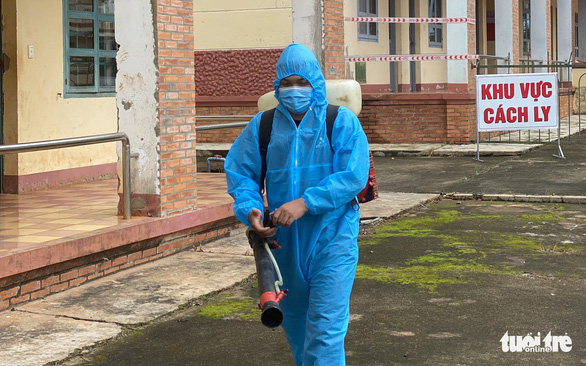
A health worker disinfects an area visited by a novel coronavirus disease (COVID-19) patient in Vietnam. Photo: Tr. T. / Tuoi Tre
Vietnam documented a total of 43 new cases of novel coronavirus disease (COVID-19) on Wednesday, including 42 local infections and one imported patient who was quarantined upon arrival, the second-largest single-day increase in cases since January.
Vietnam reported two new coronavirus patients on Wednesday morning, both registered in the central province of Quang Nam and traced to Da Nang, a neighboring city that is the country’s outbreak epicenter.
Lực lượng liên ngành tỉnh Đắk Lắk đã trang bị hoàn chỉnh 2 cơ sở cách ly tiếp theo, để chiều ngày 5/8 tiếp tục đón số người danh sách F2 (tiếp xúc gián tiếp với bệnh nhân covid-19) về từ các huyện thị, sau khi khu cách ly đầu tiên kín chỗ.
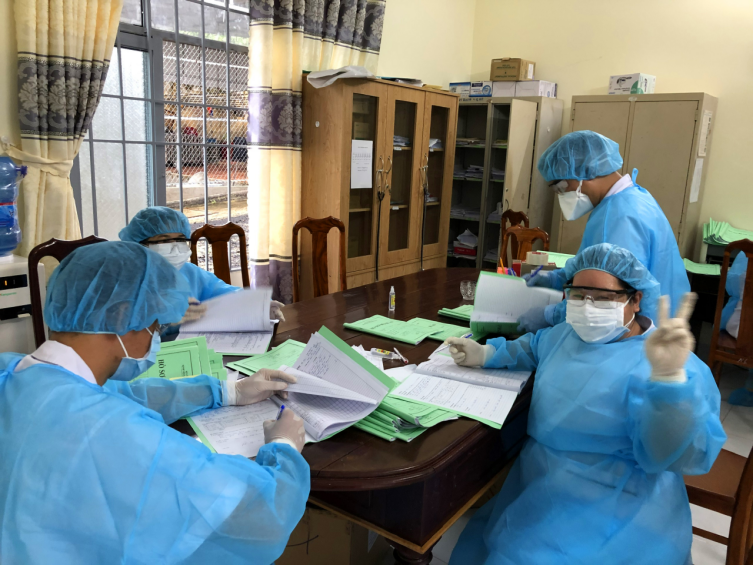
Cán bộ nhân viên y tế mừng vui khi biết tất cả âm tính Covid19-đợt 1 xét nghiệm
Người dân ở thành phố không đeo khẩu trang nơi công cộng sẽ bị xử phạt mức cao nhất 300.000 đồng, từ ngày 5/8.
Đội trật tự đô thị phường Bến Nghé, quận 1, xử phạt người không đeo khẩu trang trên phố đi bộ Nguyễn Huệ, chiều 15/4. Ảnh: Quỳnh Trần
Yêu cầu này được Chủ tịch UBND thành phố Nguyễn Thành Phong đưa ra tại cuộc họp Ban chỉ đạo phòng chống dịch bệnh Covid-19 của TP HCM chiều 3/8.
Việc xử phạt không đeo khẩu trang nơi công cộng được TP HCM cũng như các địa phương khác thực hiện từ cuối tháng 3 khi Covid-19 bùng phát. Tuy nhiên, sau khi hết thực hiện cách ly xã hội từ ngày 23/4, việc đeo khẩu trang nơi công cộng chỉ dừng lại ở mức khuyến cáo.
Theo Nghị định số 176/2013, người dân không đeo khẩu trang nơi công cộng sẽ bị xử phạt từ 100.000 đến 300.000 đồng. Trong khoảng một tháng áp dụng trước đó, TP HCM đã xử phạt hơn 4.300 trường hợp với gần 870 triệu đồng.
Theo ông Phong, việc đeo khẩu trang đã được khẳng định có thể tránh lây lan dịch bệnh cho người khác và bảo vệ sức khỏe cho người sử dụng. “Sở Công thương phải nắm nguồn cung ứng khẩu trang, chủ động thông báo các điểm bán để người dân dễ dàng mua vì đã xử phạt thì phải bảo đảm đủ nguồn cung”, ông Phong nói.
Bí thư Thành uỷ Nguyễn Thiện Nhân cũng cho rằng việc đeo khẩu trang là một trong những biện pháp cơ bản để tránh dịch bệnh lây lan. Việc này rất dễ làm, không tốn nhiều tiền nhưng nhiều nước bỏ lơi và đã bị “vỡ trận”.
“Ngoài đường hiện có ít nhất 20% người không đeo khẩu trang. Người không đeo không những tự rước bệnh vào mình mà còn nguy cơ lây cho người khác. Đeo khẩu trang hơi cực tí thôi nhưng đi đâu cũng nên đeo để giữ an toàn”, ông Nhân nói và khẳng định thành phố bảo đảm không thiếu khẩu trang cho người dân.
Chủ tịch UBND thành phố Nguyễn Thành Phong cũng cho biết đã đồng ý việc tái lập các chốt kiểm soát ở cửa ngõTP HCM để phòng chống Covid-19.
Trước đó, thành phố đã lập 62 chốt kiểm soát, hoạt động 24/24 từ ngày 4/4 để phòng chống dịch. Lực lượng tham gia là Công an thành phố, Sở Y tế, Bộ Tư lệnh thành phố, Thanh tra giao thông, Ban Quản lý An toàn thực phẩm, quản lý thị trường.
Trong đó, 16 chốt chính (cấp thành phố) đặt tại: Trạm thu phí Long Phước (cao tốc TP HCM – Long Thành – Dầu Giây), cao tốc Trung Lương, cầu Đôi (đường Trần Văn Giàu), đường Ba Làng, đường Xuyên Á (quốc lộ 22), cầu Phú Cường, cầu Vĩnh Bình, cầu vượt Sóng Thần, quốc lộ 1K, quốc lộ 50, quốc lộ 1A, cầu Đồng Nai, Bến xe Miền Tây, Bến xe miền Đông, sân bay Tân Sơn Nhất, cảng Cát Lái.
Đến ngày 23/4, chính quyền thành phố dừng hoạt động các chốt này vì dịch bệnh đã được khống chế, TP HCM dừng cách ly xã hội theo Chỉ thị 19 của Thủ tướng.
Sau 19 ngày hoạt động, các chốt chính đã kiểm tra gần 270.000 xe, trong đó có 235.000 ôtô; gần 600.000 người được kiểm tra y tế, đo thân nhiệt, bao gồm cả 3.000 người nước ngoài; hơn 130.000 người được yêu cầu khai báo y tế.
Sáng 4-8, Thứ trưởng Bộ Y tế Nguyễn Trường Sơn – trưởng bộ phận thường trực đặc biệt chống dịch COVID-19 của Bộ Y tế tại Đà Nẵng, thông tin về trường hợp tử vong của bệnh nhân COVID-19 và cho biết hiện nay còn một số bệnh nhân có nguy cơ tử vong cao trong thời gian sắp tới do bệnh lý nền nặng và tuổi cao. Tiếp tục đọc “Bệnh nhân COVID-19 thứ 8 tử vong”→



 A doctor takes care of a coronavirus patient in HCMC’s Thu Duc City. Photo by VnExpress/Quynh TranAround 86 percent of people hospitalized with Covid-19 in HCMC have been vaccinated at least once, a survey by its Department of Health found.
 John CarterSenior Editor, Political Economy


 Vietnam has confirmed 29 new coronavirus cases and another fatality of the disease, all closely tied to Da Nang outbreak, the Ministry of Health said in its August 9 update at 18.00hrs.

 CVD
CVD 