Vietnamese agencies and businesses have actively coordinated with the US Department of Commerce to provide many convincing arguments affirming that Việt Nam’s economy has fully met six market economy criteria in line with the US law.
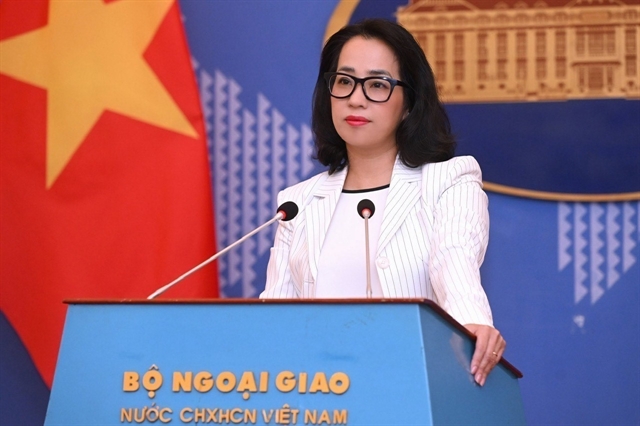
Spokeswoman of the Ministry of Foreign Affairs Phạm Thu Hằng. — VNA/VNS Photo
HÀ NỘI — Việt Nam requests the US to continue implementing its commitment to broad, strong and constructive coordination and to soon recognise the market economy status of Việt Nam, Spokeswoman of the Ministry of Foreign Affairs Phạm Thu Hằng has said.
Hằng made the statement on August 3 while answering a reporter’s question about Việt Nam’s reaction to the US Department of Commerce (DOC)’s decision on continuing to identify Việt Nam as a non-market economy.
“Mặc dù đã 3 lần bị tòa án Mỹ bác đơn kiện nhưng Hội Nạn nhân chất độc da cam/dioxin vẫn tiếp tục theo đuổi đến cùng vụ kiện, ở lần thứ 4 này, chúng tôi kiện các công ty sản xuất hóa chất Mỹ, buộc họ phải chịu trách nhiệm cho việc đã hỗ trợ quân đội Mỹ rải chất độc hóa học da cam/dioxin gây ra hậu quả nặng nề trong giai đoạn từ năm 1961 đến năm 1971”.
Đây là thông tin được Thiếu tướng Nguyễn Hồng Sơn, Phó Chủ tịch Hội Nạn nhân chất độc da cam/dioxin Việt Nam cho biết tại buổi giới thiệu Chương trình “Đi bộ đồng hành cùng nạn nhân da cam/dioxin”, ngày 30/7.
The U.S. Citizenship and Immigration Services (USCIS) reports that 32,800 Vietnamese nationals were naturalized as U.S. citizens in 2023, ranking Vietnam among the top ten nations with most citizenship naturalization in the U.S.
A Vietnamese-American man paints the Vietnamese Thien Hau Temple beside the U.S. flag in Los Angeles, California on Dec. 16, 2018. Photo by AFP
The government agency’s recent report reveals that the U.S. naturalized 878,000 individuals in 2023, marking one of the highest counts in recent years. Naturalizations during the fiscal years 2022 and 2023 account for 24% of all U.S. naturalizations in the last decade, with over 7.7 million new citizens welcomed during this time.
Vietnam was ranked sixth among the countries with the highest numbers of citizens gaining U.S. citizenship in 2023, with 32,800 individuals naturalized—an increase of 500 from 2022.
The US lifting the embargo on Việt Nam was considered to mark a new chapter in the diplomatic history of the two countries.
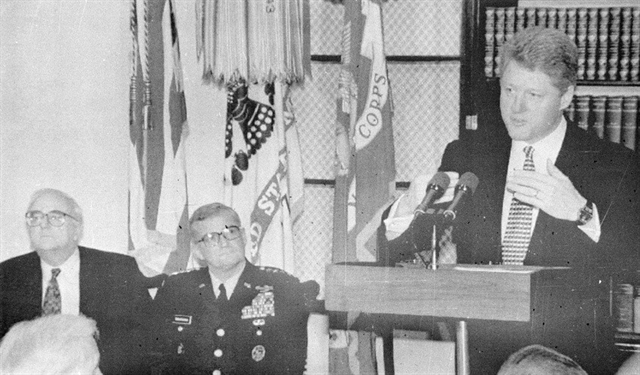
From right: US President Bill Clinton, Chairman of Joint Chiefs John Shalikashvili, and Secretary of Defense Leslie Aspin, Jr at a press conference on dropping the 19-year ban on US trade with Việt Nam on February 3,1994. — AFP/VNA Photo
HÀ NỘI — US Ambassador to Việt Nam Marc Knapper affirmed that the lifting of the trade embargo by US President Bill Clinton 30 years ago paved the way for terrific advances in bilateral trade and economic relations between Việt Nam and the US.
He made the statement on the occasion of the 30th anniversary of the US lifting the embargo on Việt Nam (1994-2024). The event was considered to mark a new chapter in the diplomatic history of the two countries.
President Joe Biden visited Hanoi in September and announced that the United States and Vietnam had upgraded relations from a “comprehensive partnership” to a “comprehensive strategic partnership.” Washington and Hanoi agreed to deepen cooperation in areas of diplomacy, trade, investment, and collaboration in the areas of artificial intelligence, R&D, governance, health and medical science, climate science, biotechnology, and conservation. Yet despite the pledges of cooperation and partnership, economic, security, and political factors limit full expression of the enhanced partnership.
The Vietnamese People’s Air Force currently maintains a fleet of ten Su-27 Flanker combat aircraft, complemented by 35 Su-30s and 34 Su-22s. In a surprising twist, there’s speculation of a possible addition of American aircraft to Vietnam’s arsenal soon.
The first indication of this evolution came in 2021, as Vietnam placed an order for at least three T-6 Texan II trainers from American manufacturer Beechcraft. The delivery of these aircraft is still pending. This apparent shift is concurrent with the thawing of relations between Vietnam and the United States, a development largely driven by shared concerns regarding China. Tiếp tục đọc “F-16 Viper could fly alongside Su-30 in Vietnam People’s Air Force”→
This winter marks 50 years since U.S. and Vietnamese diplomats in Paris ceremoniously signed “peace accords” that did not end the Vietnam War, but that achieved America’s withdrawal from it. Thus, the accords permitted, a half-century later, what is now a durable American-Vietnamese reconciliation. In the face of seemingly intractable wars — in Ukraine, Afghanistan, the eastern Congo basin, Yemen or elsewhere — the growing U.S.-Vietnamese relationship shows that even a peace that seems impossible today can indeed be built for our children.
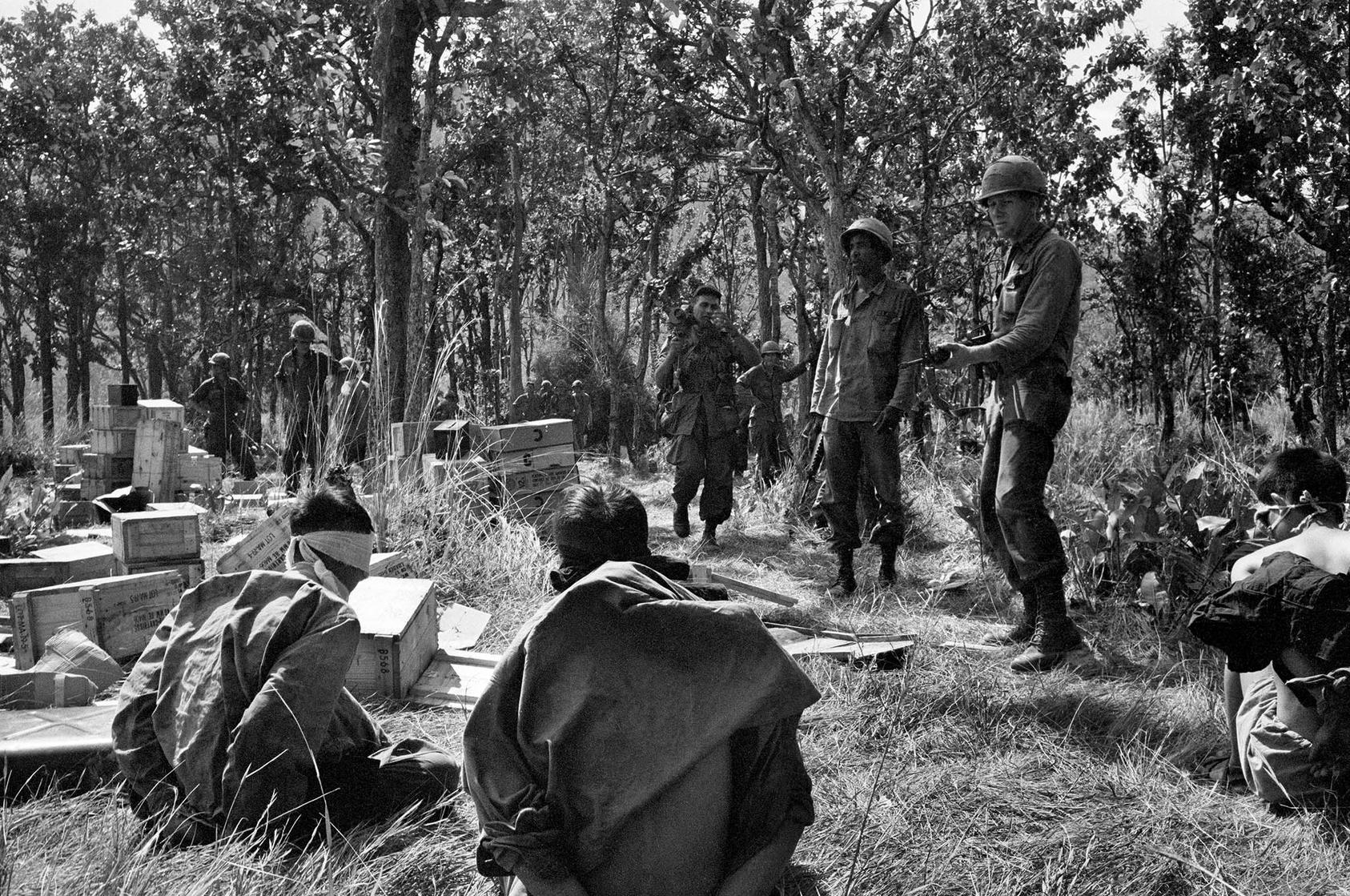
U.S. troops guard North Vietnamese prisoners in 1965, early in the Vietnam War. U.S. and Vietnamese veterans have led reconciliation work in decades since, notably in searching for remains of those killed in the war. (Neil Sheehan/The New York Times)Tiếp tục đọc “We Can Heal War’s Traumas; U.S. and Vietnam Show How”→
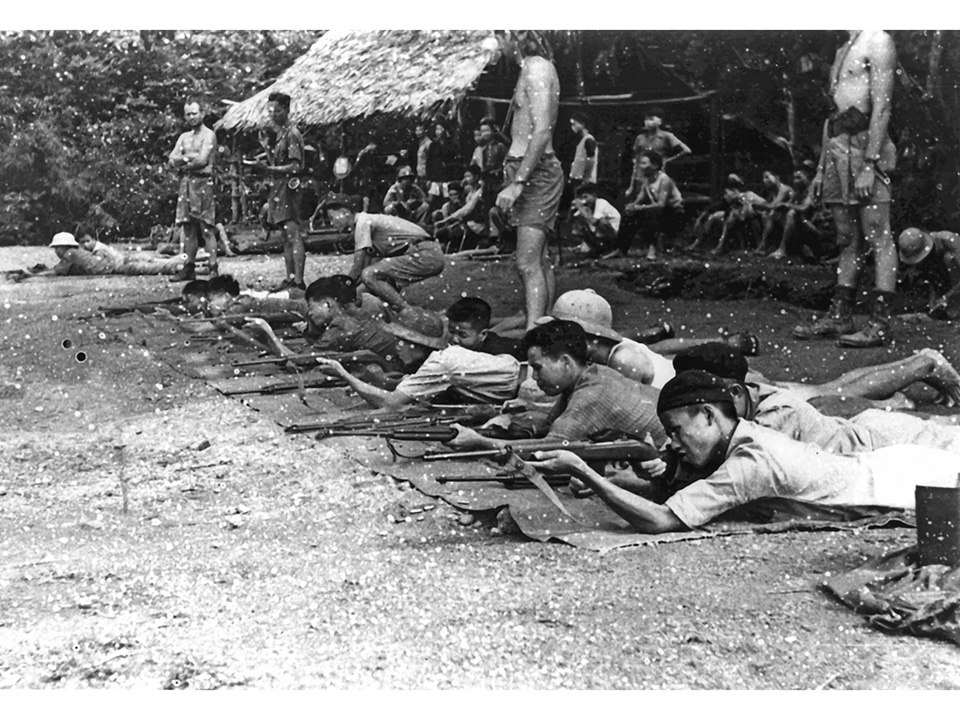
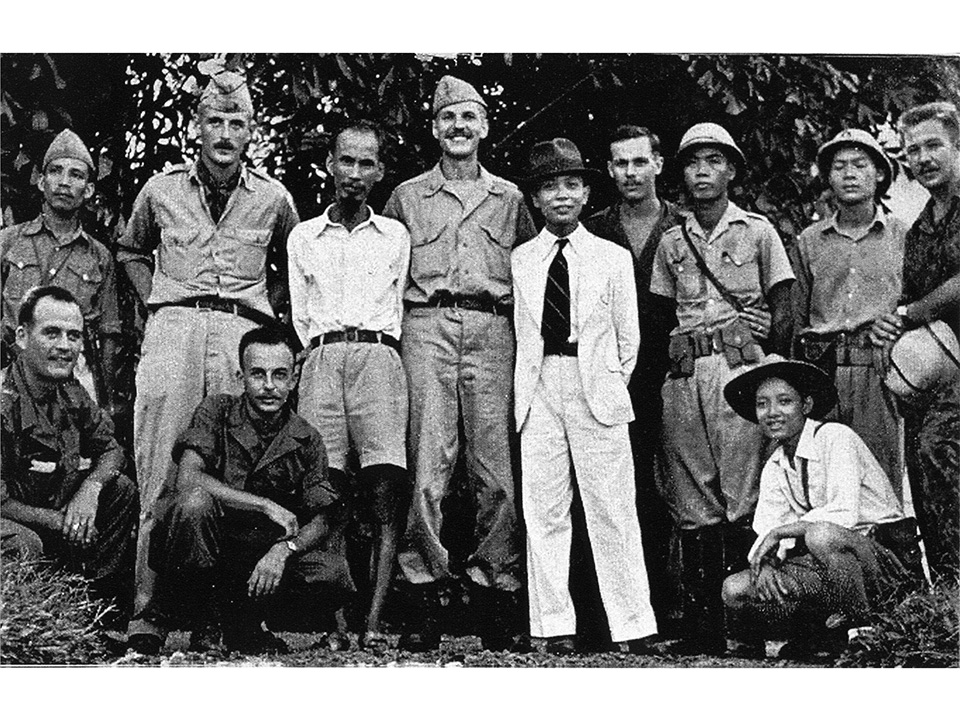
In 1945, members of the American “Deer Team,” part of the OSS, worked with Vietnamese guerrilla fighters to throw Japanese troops out of Indochina. As the war ended, the people of Vietnam looked to the United States to support their dreams of independence.
For most of World War II, the United States considered Vietnam to be a relatively unimportant French colony to someday be reclaimed from the Japanese; but America showed little interest in enlisting Vietnamese aid in that effort. All this changed rapidly in March 1945. Though the Japanese had invaded Vietnam in 1940, they allowed French colonial authorities to retain power so long as they controlled the Vietnamese and maintained the colony as a supply base for the Emperor’s army fighting in China. However, this also allowed the French to maintain covert Allied intelligence networks that supplied information to Allied personnel aiding the Chinese in their war against Japan. By early 1945, however, the war in the Pacific had shifted in favor of the Allies and the Japanese became increasingly suspicious of French activities in Vietnam. As a result, on March 10, 1945, Japanese forces launched Operation Meigo, a swift military takeover that effectively ended French colonial rule of Vietnam.
Members of the Deer Team providing instruction to the Vietnamese on use of the M-1 carbine, August 16, 1945. Photo by the National Archives and Records Administration.
With the loss of French control over the colony during Meigo, Allied intelligence networks operating in Vietnam collapsed. One such group, known as the “GBT,” had been providing information on weather conditions, the movement of Japanese troop trains and naval vessels, and on escape routes for downed Allied airmen to the 14th US Air Force stationed in China. Up to this point the GBT refused to employ Vietnamese as agents because the French claimed they were untrustworthy and were only interested in acquiring weapons to fight the French, not the Japanese. With their normally busy wires now silent, native agents became necessary.
Both the GBT and the US Office of Strategic Services (the OSS) reached out to a Vietnamese man who had drawn positive attention from the 14th Air Force the previous year when he escorted a downed American pilot out of Vietnam and into China. OSS agent Charles Fenn tracked down the man in question—Ho Chi Minh—describing him as articulate and charismatic, and both open and friendly to Americans. Fenn was convinced Ho would be an excellent intelligence agent and the group he represented, the Viet Minh, would also be valuable assets in the war against Japan. Soon thereafter, Ho Chi Minh became OSS agent “Lucius.”
Members of the Deer Team and Viet Minh at training camp. Allison Thomas stands in the center and is flanked on his left by Vo Nguyen Giap and on his right by Ho Chi Minh. Photo by the National Archives and Records Administration.
Central Office of Communist Party of Vietnam Hanoi, Vietnam
6:33 P.M. ICT
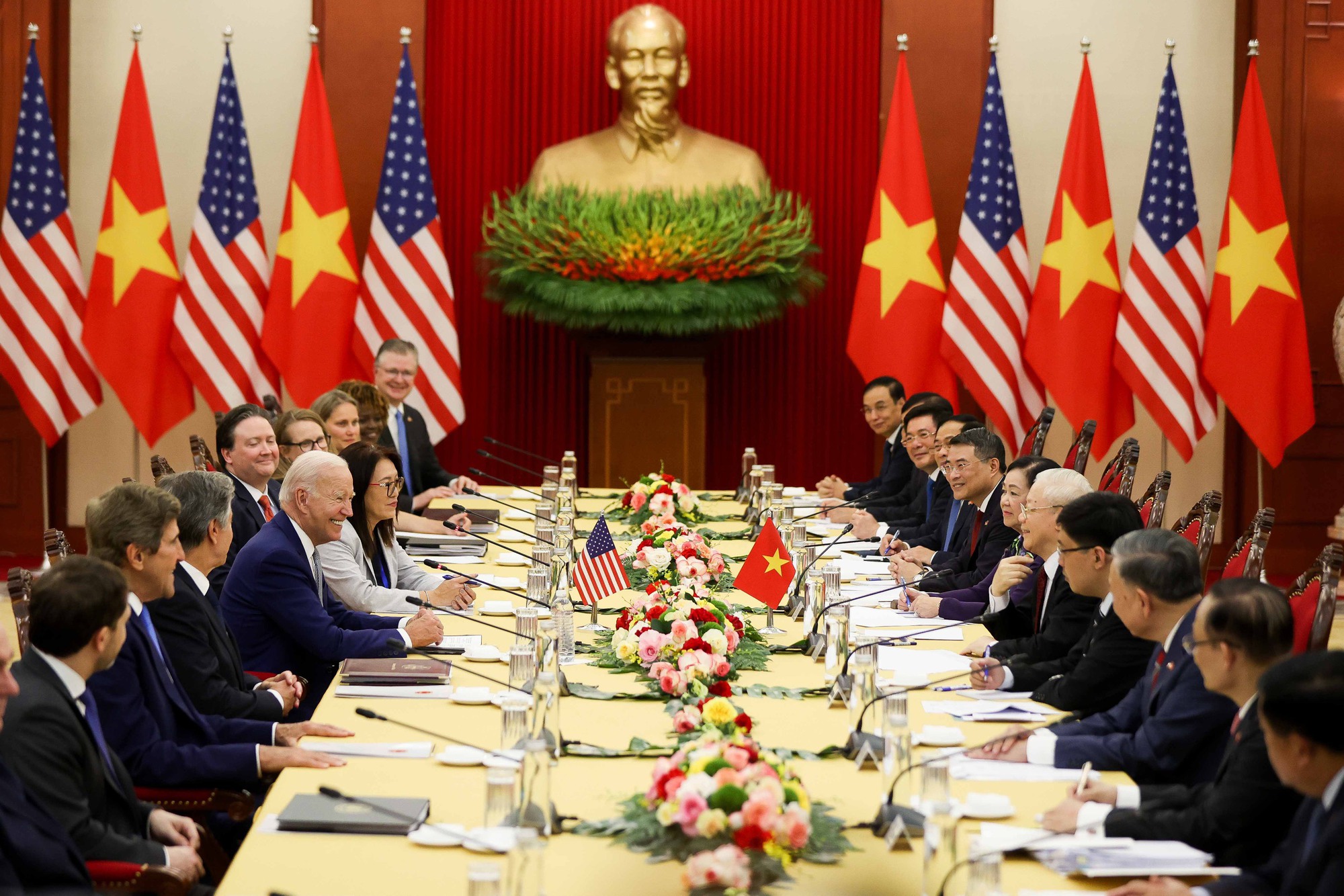
GENERAL SECRETARY TRỌNG: (As interpreted.) Your Honorable Joe Biden, President of the United States of America, distinguished delegates, on behalf of the leaders of the party, state, and people of Vietnam, I’d like to extend my warmest welcome to his Honorable President Joe Biden, who has great affection for the country and people of Vietnam, and for his various contributions to the strengthening of the friendship and cooperation between Vietnam and the U.S. in different capacities.
His visit to Vietnam on this occasion is of great significance, for it coincides with the celebration of the 10th anniversary of the Comprehensive Partnership between the two countries.
Tổng Bí thư Nguyễn Phú Trọng và Tổng thống Mỹ Joe Biden thông báo Việt Nam – Mỹ thống nhất nâng cấp quan hệ lên đối tác chiến lược toàn diện.
Chiều 10.9, tại trụ sở Văn phòng T.Ư Đảng, ngay sau khi kết thúc hội đàm, Tổng Bí thư Nguyễn Phú Trọng và Tổng thống Mỹ Joe Biden thông báo Việt Nam – Mỹ thống nhất nâng cấp quan hệ từ đối tác toàn diện lên đối tác chiến lược toàn diện – cấp cao nhất trong quan hệ ngoại giao nhà nước.