Fury in Cambodia as US asks to be paid back hundreds of millions in war debts

    I forwarded this first to a delegation of Veterans For Peace who are now touring Viet Nam for 17 days, and I am accompanying them. They have seen some of the terrible legacies of the war in Viet Nam — consequences very similar to what neighboring Laos and Cambodia have experienced.  So this article has special resonance for them.

    It is also a reminder of the hard bargain the U.S. insisted upon during negotiations with Viet Nam which led to normalization of diplomatic relations in 1995.  The current government of Viet Nam was required to repay an old debt of the Saigon regime which collapsed in 1975, loans which had been provided during the war totaling some $145 million US dollars.  The Vietnamese eventually agreed, and repaid the first installments totaling about $15 million before then-Sen. John Kerry and Sen. John McCain intervened (and rightly so, in the opinion of many veterans) with congressional action which converted that debt to an “education” fund to provide study opportunities for Vietnamese students in the U.S. and American students in Viet Nam.  That was better than an outright repayment, of course — particularly when U.S. humanitarian assistance at that time was less than $4 million a year, for efforts related to UXO cleanup and disability programs that might bring some relief to families facing the awful consequences of Agent Orange.

    Sometimes simple fairness and justice, common decency, and morality must take precedence over the U.S. government’s bookkeeping requirements.  (It might occur to some of us that the U.S. Ambassador in Cambodia should be reminded of that.)
    CS

MARCH 11 201

Fury in Cambodia as US asks to be paid back hundreds of millions in war debts


Lindsay Murdoch

Half a century after United States B-52 bombers dropped more than 500,000 tonnes of explosives on Cambodia’s countryside Washington wants the country to repay a $US500 million ($662 million) war debt.

The demand has prompted expressions of indignation and outrage from Cambodia’s capital, Phnom Penh.

Over 200 nights in 1973 alone, 257,456 tons of explosives fell in secret carpet-bombing sweeps – half as many as were dropped on Japan during the Second World War.

The pilots flew at such great heights they were incapable of discriminating between a Cambodian village and their targets, North Vietnamese supply lines – nicknamed the “Ho Chi Minh Trail.” Tiếp tục đọc “Fury in Cambodia as US asks to be paid back hundreds of millions in war debts”

Seoul finding looming THAAD deployment a hot potato politically, economically

japan  times AP Mar 8, 2017

As South Korea begins the deployment of an advanced U.S. anti-missile system that it says will allow it to better cope with North Korean threats, the reaction from its belligerent rival is hardly its only concern.

The plan to deploy the Terminal High-Altitude Area Defense system, or THAAD, this year has angered not only North Korea, but also China, South Korea’s largest trade partner, which considers the system a security threat.

Residents in a rural South Korean town where THAAD is planned to sit have furiously protested over rumored health hazards they link to the system’s powerful radar, and some of the country’s potential presidential candidates have vowed to walk back on the deal if they win office. Tiếp tục đọc “Seoul finding looming THAAD deployment a hot potato politically, economically”

US rebuffs China over North Korea talks

UNITED NATIONS: The United States on Wednesday (Mar 8) rebuffed China’s appeal for talks with North Korea, saying leader Kim Jong-Un was behaving irrationally and that it was reassessing its approach to dealing with Pyongyang.

China, Pyongyang’s main ally, earlier called on North Korea to suspend its nuclear and missile activities in exchange for a halt to the annual US-South Korean military drills.

Foreign Minister Wang Yi said in Beijing that the proposal could help bring the United States and North Korea back to negotiations and avert what he termed a “head-on collision”.

After a closed-door meeting of the UN Security Council, US Ambassador Nikki Haley said North Korea’s actions called for a different response. Tiếp tục đọc “US rebuffs China over North Korea talks”

US deploys missile defence system to South Korea

Al Jazeera

China is warning it will take measures against a US missile defence system deployed in South Korea, with the stated objective of countering threats from North Korea.

The equipment needed to set up Terminal High-Altitude Area Defence system (THAAD), a missile defence system, have arrived in South Korea, according to American and South Korean defence forces.

The deployment announcement was made on Tuesday, a day after North Korea test-launched four ballistic missiles into the sea near Japan.

Admiral Harry Harris, head of the US Pacific Command, said in the statement that “continued provocative actions by North Korea, to include yesterday’s launch of multiple missiles, only confirm the prudence of our alliance decision last year to deploy THAAD to South Korea”. Tiếp tục đọc “US deploys missile defence system to South Korea”

Don’t Believe the New Trump

Don’t Believe the New Trump

Donald Trump’s address to Congress on Tuesday night was the first truly presidential speech he has ever given and therefore the best — far superior to his egomaniacal “I alone can fix it” Republican National Convention acceptance speech or his dark and divisive “American carnage” inaugural address. His tribute to fallen Navy SEAL William “Ryan” Owens, delivered while his widow sobbed in the balcony, was a genuinely moving moment, even if earlier in the day he refused to accept any personal responsibility for ordering the raid in which Owens died. For once he did not vilify the media or his opponents. Tiếp tục đọc “Don’t Believe the New Trump”

Merkel ally calls for Europe to retaliate if Trump imposes trade tariffs

 Telegraph
German Chancellor Angela Merkel and Volker Kauder (L), 
German Chancellor Angela Merkel and Volker Kauder (L),  Credit: Steffi Loos/Getty Images

Europe should impose punitive tariffs on imports from the United States if President Donald Trump acts to shield U.S. industries from foreign competitors, a senior ally of German Chancellor Angela Merkel said in a newspaper interview.

Trump has already formally withdrawn the United States from the Trans-Pacific Partnership trade deal, distancing America from its Asian allies, and vowed to renegotiate the U.S. free-trade deal with Canada and Mexico.

The tycoon-turned-president has also threatened German carmakers with a border tax of 35 percent on vehicles imported into the U.S. market, saying such a levy would help create more jobs on American soil.

Tiếp tục đọc “Merkel ally calls for Europe to retaliate if Trump imposes trade tariffs”

China hits back at Donald Trump’s ‘champion of currency manipulation’ jibe

US president risks ratcheting up tensions with latest currency claims and repetition of desire for nuclear supremacy

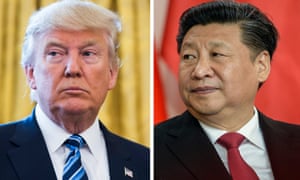
Donald Trump (left) and Xi Jinping
Strained relations between Donald Trump (left) and Xi Jinping appeared to have settled after their phone call a fortnight ago. Photograph: EPA

Beijing has hit back at Donald Trump after the US president risked reigniting a simmering feud with China by accusing it of being the “grand champion” of currency manipulation.

After months of turbulence and uncertainty between the world’s two biggest economies, relations appeared to settle two weeks ago after the US president and his Chinese counterpart, Xi Jinping, held their first phone conversation since the billionaire’s inauguration.

However, in an interview with Reuters on Thursday that also saw Trump reiterate his desire for American nuclear supremacy, the US president, who has attacked China over trade, Taiwan, North Korea and the South China Sea, threatened to undermine the tentative rapprochement with a fresh verbal assault.

Why China is building islands in the South China Sea

Vox – 17 thg 2, 2017

China claims they aren’t military bases, but their actions say otherwise.

China is building islands in the South China sea and its causing disputes among the other nations in the region; Malaysia, the Philippines, Brunei, Vietnam, and Indonesia. The US has many allies in the region and uses its massive Navy to patrol international waters, keeping shipping lanes open for trade.

Asia-Pacific freedom tested: US admiral

By Peter Mitchell, AAP US Correspondent Australian Associated Press

One of America’s top military commanders has painted a bleak picture of the Asia-Pacific, declaring freedom, justice and the rules-based international order hang in the balance.

Admiral Harry Harris, head of the US Pacific Command, told a conference in San Diego the path to stability in the region faces four considerable challenges: North Korea, China, Russia and Islamic State.

He warned the US would “co-operate where we can, but we’ll be ready to confront where we must”. Tiếp tục đọc “Asia-Pacific freedom tested: US admiral”

CƠ SỞ DỮ LIỆU VỀ BOM CÓ ÍCH CHO CHIẾN TRANH TRONG QUÁ KHỨ VÀ HIỆN TẠI

Lieutenant Colonel Jenns Robertson’s project is aiding efforts to spot unexploded bombs that still endanger civilians.

MEG MCKINNEY FOR THE BOSTON GLOBE

Dự án của Trung tá Colonel Jenns Robertson đang hỗ trợ các nỗ lực định vị các quả bom chưa phát nổ vẫn đang gây nguy hiểm cho người dân.

Cách đây 6 năm, dường như là một ý tưởng ngây thơ khi Trung tá Colonel Jenns Robertson, 45 tuổi, một người bản xứ ở Minnesota đeo kính hạng ngoại hạng thậm chí hơn cả các tiêu chuẩn của quân đội, đã bắt đầu một sở thích khá bất thường: ghi lại dữ liệu về bom của không lực Mỹ trong một thế kỷ – từng quả bom một Tiếp tục đọc “CƠ SỞ DỮ LIỆU VỀ BOM CÓ ÍCH CHO CHIẾN TRANH TRONG QUÁ KHỨ VÀ HIỆN TẠI”

2 maps that explain US strategy in Asia-Pacific

Business Insider

The two countries are crucial US allies in Asia, and both face serious threats in their near abroad.

Discussing security threats, though, wasn’t the main goal of Mattis’s trip. He was there to assure both countries that the Trump administration will not abandon the US alliance structure in the Pacific. Tiếp tục đọc “2 maps that explain US strategy in Asia-Pacific”

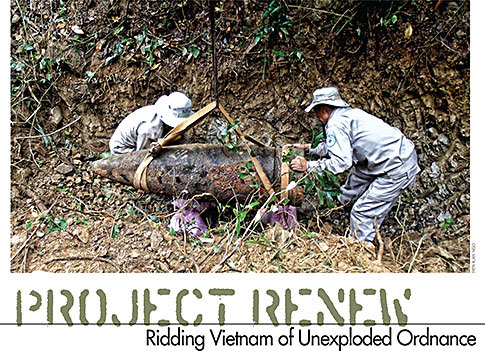
Project Renew: Ridding Vietnam of Unexploded Ordnance

I was invited by the editors of The VVA Veteran, publication of Vietnam Veterans of America, to submit an article reviewing the history of mine action efforts in Viet Nam, including the role of American veterans and U.S. veterans organizations. Over the past couple of decades of cooperation with our Vietnamese colleagues, and with support from the U.S. government and other international donors and project partners, we are coming very close to the reality of “making Viet Nam safe” from the daily threat of cluster bombs and other ordnance left from the war. CS
The VVA Veteran
January/February 2017

Project RENEW: Ridding Vietnam of Unexploded Ordnance

BY CHUCK SEARCY

For most Americans, the Vietnam War ended in 1975. But for too many Vietnamese, the war didn’t end then. They continued to suffer death, injury, and lifetime disabilities from munitions that remained on the surface or just under the soil. These weapons posed a constant danger to unsuspecting residents throughout the country—but especially along the former demilitarized zone.

Tiếp tục đọc “Project Renew: Ridding Vietnam of Unexploded Ordnance”

US carrier group patrols in tense South China Sea

BANGKOK: A United States aircraft carrier strike group has begun patrols in the South China Sea amid growing tension with China over control of the disputed waterway and concerns it could become a flashpoint under the new U.S. administration.

China’s Foreign Ministry on Wednesday warned Washington against challenging its sovereignty in the South China Sea.

The U.S. navy said the force, including Nimitz-class aircraft carrier USS Carl Vinson, began routine operations in the South China Sea on Saturday. The announcement was posted on the Vinson’s Facebook page.

The strike group’s commander, Rear Admiral James Kilby, said that weeks of training in the Pacific had improved the group’s effectiveness and readiness. Tiếp tục đọc “US carrier group patrols in tense South China Sea”

US pledges nuclear defence for Japan and South Korea

“The United States remains steadfast in its defence commitments to its allies, the Republic of Korea and Japan, including the commitment to provide extended deterrence, backed by the full range of its nuclear and conventional defence capabilities,” Tillerson said in a joint statement after meeting the foreign ministers in Bonn.

North Korea has carried out repeated missile launches despite UN sanctions and last year conducted two nuclear tests in a bid to develop a weapons system capable of hitting the US mainland.

Pyongyang said the latest missile tested on Sunday could carry a nuclear warhead.

Continue reading on ChannelNewsAsia

The Pentagon said it wouldn’t use depleted uranium rounds against ISIS. Months later, it did — thousands of times.

February 16 at 7:00 AM

Months after the Pentagon said it wouldn’t use a controversial type of armor-piercing ammunition that has been blamed for long-term health complications, U.S. aircraft fired thousands of the rounds during two high-profile air raids in Syria in November 2015, the Pentagon acknowledged Wednesday.

The use of the ammunition, a 30mm depleted-uranium bullet called PGU-14, was first reported by a joint Air Wars-Foreign Policy investigation on Tuesday. The roughly 5,265 rounds of the munition were fired from multiple A-10 ground attack aircraft on Nov 16, 2015, and Nov. 22, 2015, in airstrikes in Syria’s eastern desert that targeted the Islamic State’s oil supply during Operation Tidal Wave II, said Maj. Josh Jacques, a U.S. Central Command spokesman.

When loaded with depleted-uranium bullets, the A-10s fired what is called a “combat-mix,” meaning the aircraft’s cannon fires five depleted-uranium rounds to one high explosive incendiary bullet.