Source: BloombergNEF. Note: The map indicates for each country the technology with the lowest LCOE per MWh for new-build solar (yellow) and wind (blue) or running costs fo existing coal (black) or gas (gray). Running costs include a carbon price where applicable. Calculations exclude subsidies and tax-credits. Natural gas reflects combined-cycle gas turbines.
This week, BloombergNEF’s released estimates for its global benchmark that tracks the levelized cost of electricity, or LCOE, for utility-scale PV and onshore wind. The LCOE looks at the all-in cost to build, operate, and maintain power plants and then calculates the cost per megawatt-hour (MWh) of the energy produced based on all of those inputs.
Vietnam has been a Southeast Asia solar success story. It went from having barely any generation in 2018 to a quarter of its total installed capacity being solar – a 100-fold increase in two years.
This rapid growth is mainly down to the Vietnamese government’s feed-in tariff which provides a guaranteed above-market price for renewable energy producers; other incentives signed off in 2017 in an attempt to pivot away from lagging fossil fuel projects; and cheaper solar panels, some of which are assembled domestically.
Around 99% of the installed solar panels in Vietnam come from China. At the same time, China is one of the few countries that still lends Vietnam money to build coal plants.
China’s future role in Vietnam’s power system will be shaped by the latter’s newest plan for its power sector. The final version of the Power Development Plan 8 is due to be published in June, though it has been postponed before and may be again.
China, India, Indonesia, Japan and Vietnam plan to build more than 600 new coal-fired power projects, with a combined capacity of more than 300 gigawatts. Most would prove uneconomical and the new plants would put international climate goals out of reach.
By Reuters June 30, 2021 | 08:37 am GMT+7 VNExpressA coal power plant in Vietnam’s northern province of Thai Binh in 2019. photo by VnExpress/Gia Chinh.
Five Asian countries including Vietnam are responsible for 80 percent of new coal power plants planned around the world, the Carbon Tracker group said on Wednesday.
China, India, Indonesia, Japan and Vietnam plan to build more than 600 new coal-fired power projects, with a combined capacity of more than 300 gigawatts, the group said, adding most would prove uneconomical and the new plants would put international climate goals out of reach.
Từ năm 2013, Quốc hội đã loại gần 500 thủy điện ra khỏi quy hoạch để bảo vệ môi trường. Nhưng tỉnh Kon Tum lại phê duyệt 5 dự án thủy điện trong 1 ngày.
Với nguồn thủy năng phong phú, tỉnh Kon Tum là điểm đến lý tưởng cho các nhà đầu tư xây dựng thủy điện trong nhiều năm qua. Hệ quả, các dự án thủy điện ngày càng gia tăng, kéo theo tình trạng hạn hán, lũ lụt ngày một lớn. Quan ngại hơn, cuộc sống người dân đang sinh sống quanh lưu vực các con sông càng trở nên cơ cực.
Đăk Pxi đã thành dòng sông chết
Gánh trên mình hàng chục nhà máy thủy điện, sông Đăk Pxi được ví như “dòng sông chết”. Mùa khô thì dòng sông Đăk Pxi (Kon Tum) khô hạn, mùa mưa thì ngập lụt nặng nề. Chưa bao giờ, người dân đang sinh sống quanh lưu vực sông Đăk Pxi trở nên bất an như bây giờ.
Thủy điện Đăk Pxi bậc 2 (Công ty cổ phần thủy điện Đức Nhân) xây dựng chắn ngang dòng sông Đăk Pxi khiến phía hạ du khô hạn, người dân không có nước phục vụ sản xuất. Ảnh: T.A.
America invented silicon solar cells in the 1950s. It spent more on solar R&D than any other country in the 1980s. It lost its technological advantage anyway.
American researchers experimented with unconventional solar-energy designs, such as this thermoelectric panel. (Universal History Archive / Universal Images Group / Getty)
You wouldn’t know it today, but the silicon photovoltaic solar cell—the standard, black-and-copper solar panel you can find on suburban rooftops and solar farms—was born and raised in America.
The technology was invented here. In 1954, three American engineers at Bell Labs discovered that electrons flow freely through silicon wafers when they are exposed to sunlight.
It was deployed here. In 1958, the U.S. Navy bolted solar panels to Vanguard 1, the second American satellite in space.
NN – Phan Thanh, Tân Lập là hai xã phía Nam của huyện Lục Yên, một vùng đất sầm uất bên dòng sông Chảy, khi thủy điện Thác Bà hoàn thành nơi đây trở thành ‘ốc đảo’…
Con đường Tân Lập – Phan Thanh được người dân góp tiền mở rộng các khúc cua. Ảnh: Thái Sinh.
Trong ký ức của nhiều người trước khi nhà máy thủy điện Thác Bà chưa được xây dựng, dòng sông Chảy trở thành tuyến giao thông huyết mạch nối các tỉnh Phú Thọ, Tuyên Quang, Yên Bái, Lào Cai. Hai anh em Vũ Văn Uyên, Vũ Văn Mật đã chọn vùng đất ven sông Chảy lập đại bản doanh chống lại quan lại địa phương hà hiếp dân chúng, sau đó mở rộng sang tận Tuyên Quang, Lào Cai đào thành đắp lũy giúp vua Lê Anh Tông và Lê Trang Tông chống lại nhà Mạc, được phong là Gia quốc công, hay còn gọi là Chúa Bầu. Phần lớn những thành quách đã trở thành phế tích hay chìm dưới lòng hồ Thác Bà.
The U.S. has fallen way behind Europe partly because of an old shipping law and opposition from homeowners and fishing groups.
Dominion Energy’s wind turbine project off Virginia Beach took a year to install. In Europe, it would have taken a few weeks.Credit…Eze Amos for The New York Times
With more than 90,000 miles of coastline, the country has plenty of places to plunk down turbines. But legal, environmental and economic obstacles and even vanity have stood in the way.
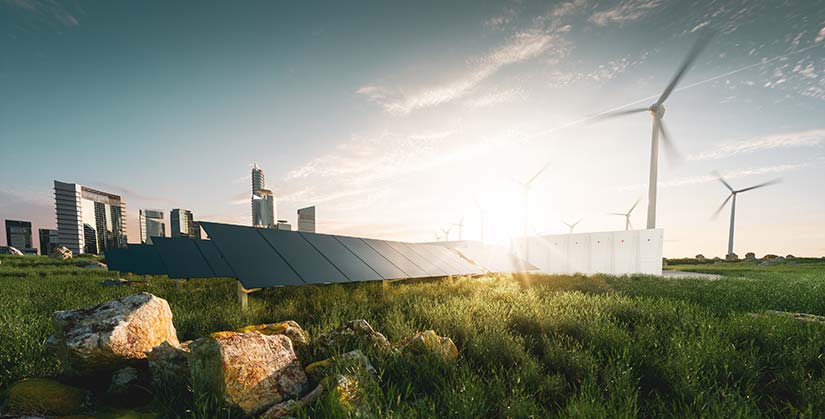
A renewable energy future is within our grasp: the technology is now widely available and cost-effective in most places around the world. But the current rates of deployment remain well below what is required to avert the worst impacts of climate change. The private sector is poised to invest billions of dollars to massively speed up, scale and support the energy transition. However, many investors, particularly in the private sector, are deterred by some of the risks related to renewable energy investments. As the energy transition is likely to be financed largely by the private sector, governments must work with the private sector to remove barriers and incentivize investment in renewable energy.
This working paper, produced in partnership with Ørsted, focuses on the challenges and solutions to scaling investment in renewable energy generation and provides actionable policy solutions to unlock the private sector investment needed to support the energy transition.
Key Findings
The global transition to renewable energy is likely to be financed largely by the private sector, including utility companies, corporations, project developers, and various investment funds.
One critical element of the energy transition will be decarbonization of the world’s electricity supply. The needed technology is developing rapidly and the scale of the requisite investment is manageable, but current rates of deployment remain well below what is required to avert the worst impacts of climate change.
Challenges that inhibit decarbonization of the power sector fall into three categories: market structure that lacks appropriate incentives to catalyze private investment in new projects, lack of public support for siting renewable energy development, and incompatible or inadequate grid infrastructure.
Governments will play a critical role in scaling renewable energy capacity by providing regulatory frameworks and policy solutions to the challenges that are slowing down private sector investment.
Top priorities for governments will be to establish renewable energy targets, policies, and market instruments that incentivize and de-risk green energy investments; improve planning and permitting, and address community concerns, while balancing other concerns; and invest in modern electricity grids and infrastructure.
Clean energy technologies are now big business. Vast sums of money in clean energy supply chains promise to rearrange the geopolitics of industrial competition and energy security. Further, to achieve their increasingly ambitious climate goals, countries are likely to do far more to reshape industrial sectors, compressing in a few years a process that normally takes decades.
NREL and DOE Experts Offer Fresh Perspective on Technical and Economic Challenges, Call for Collaborative Solutions to Decarbonization
May 19, 2021
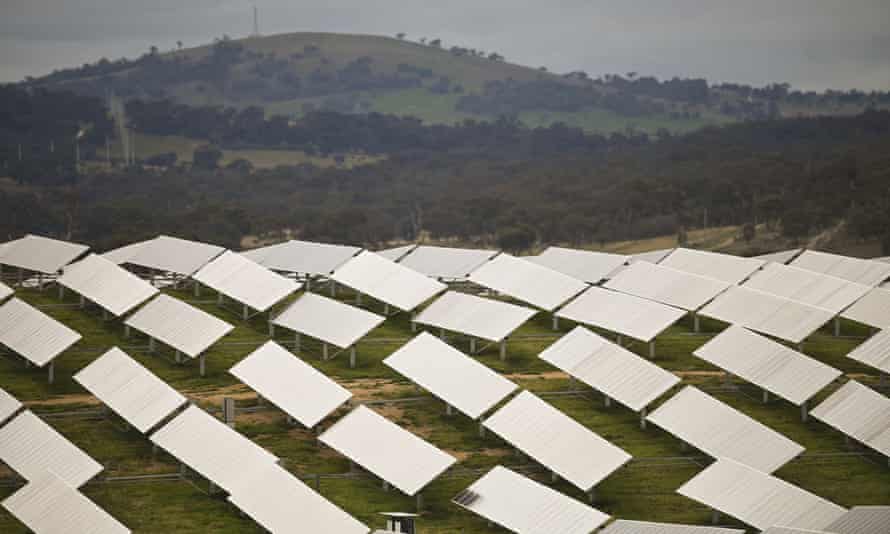
With recently announced federal emissions-reduction targets, a push for national power-sector decarbonization, and plummeting wind and solar costs, the United States is poised to deploy major amounts of renewables, and fast.
At smaller scales, hundreds of U.S. cities, states, and corporations have already taken bold action in setting their own local targets for 100% renewable energy—and with recent analyses like the Los Angeles 100% Renewable Energy Study (LA100), we have growing confidence that reliable, 100% renewable power grids are feasible.
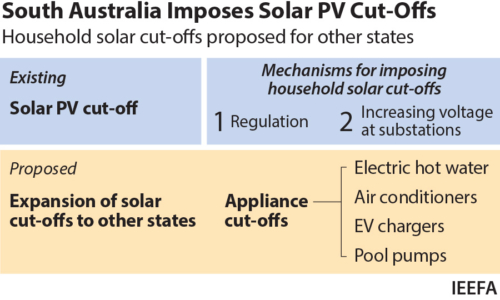
Everyone agrees we want to avoid another ‘system black’ in South Australia. What’s contested is whether household solar exports should be allowed to be cut off by the system operator, under what circumstances, and who gets to decide?
New measures giving energy authorities powers to remotely switch off solar panels without householders’ knowledge has set a worrying precedent.
Now state energy ministers are considering adopting a similar rule that would allow behind-the-meter appliances such as hot water systems, air conditioners, electric vehicle chargers and pool pumps to also be switched off.
South Australia’s rooftop solar cut-off measure was used for the first time on 14 March 2021 affecting around 12,500 households in Adelaide.
When this cut-off occurred, solar households were not compensated, and everyone affected had to purchase electricity from the grid.
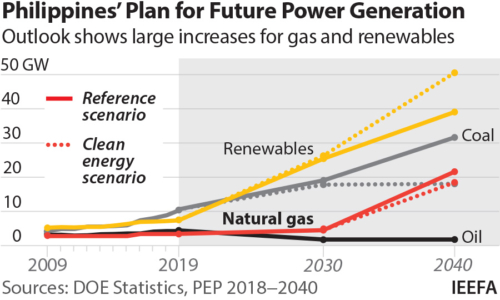
5 May 2021 (IEEFA Philippines): The race to develop liquified natural gas (LNG) facilities in the Philippines has gone from a marathon to a sprint but potential LNG investors must proceed at their own risk, according to a new report from the Institute for Energy Economics and Financial Analysis (IEEFA).
“Officials in the Philippines have endorsed a rapid buildout of LNG import infrastructure due to the anticipated depletion of the Malampaya deepwater development, the country’s only domestic source of natural gas, and high GDP growth expected over the next decade,” says the report’s author IEEFA Energy Finance Analyst, Sam Reynolds.
Exporting countries and industry players have pushed the narrative that natural gas, a fossil fuel alternative to coal, represents a viable transition fuel from coal to renewables. The United States, in particular, has encouraged legal and regulatory reforms to stimulate LNG demand creation.
By Anh Minh May 6, 2021 | 09:14 am GMT+7Workers fix electric cables in the southern province of Bac Lieu. Photo by VnExpress/Nguyet Nhi.The Vietnamese government has asked the Ministry of Industry and Trade to complete the 2021-2030 energy development plan and submit it by mid-June this year.
It has also tasked the ministry with evaluating more carefully the capability of the national grid to prevent the problem of energy oversupply and make needed changes to the proposed Power Development Master Plan VIII.


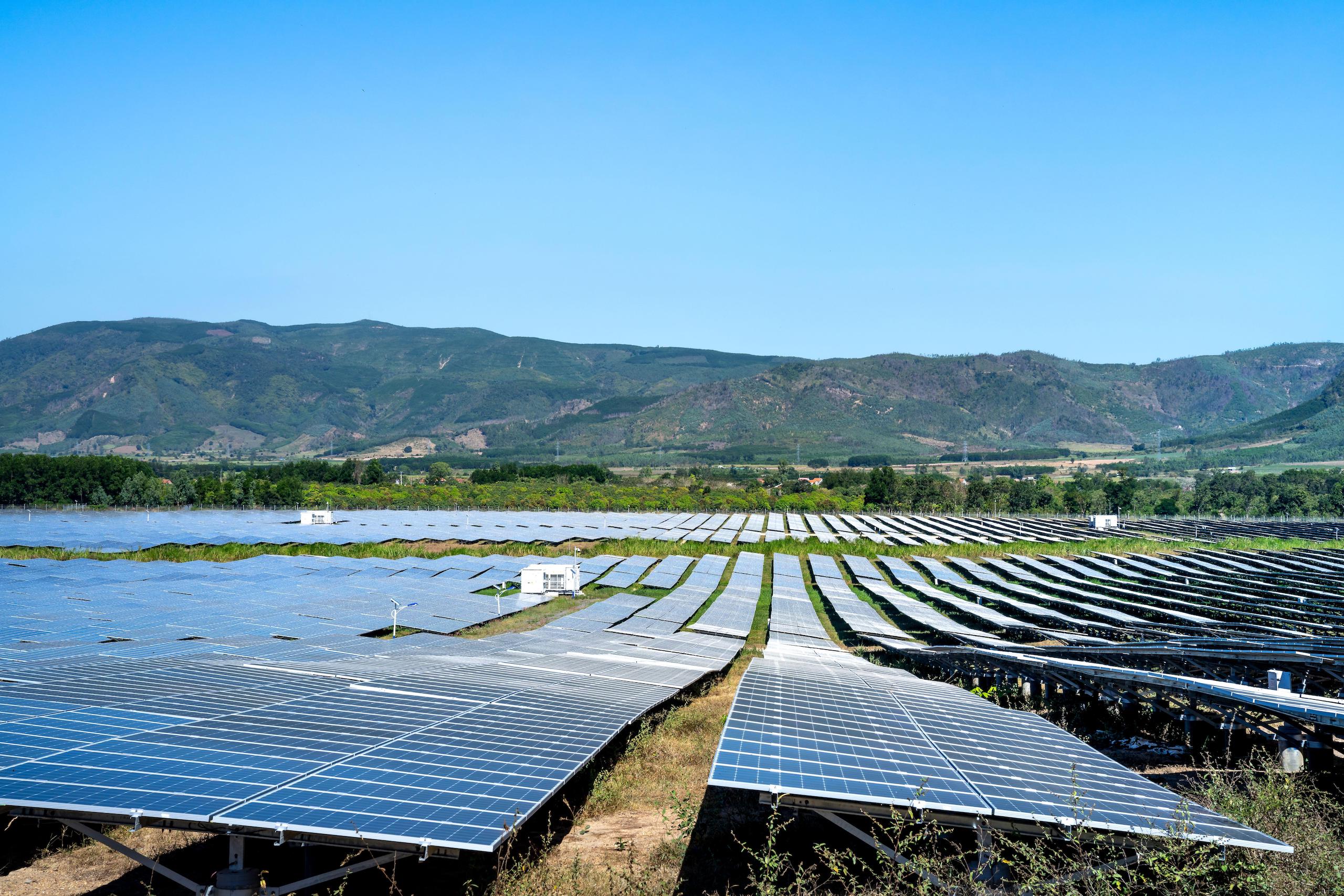 Solar energy in Vietnam has grown rapidly since 2018, supported by Chinese finance and technology (Image: Alamy)
 A coal power plant in Vietnam’s northern province of Thai Binh in 2019. photo by VnExpress/Gia Chinh.



 Workers fix electric cables in the southern province of Bac Lieu. Photo by VnExpress/Nguyet Nhi.The Vietnamese government has asked the Ministry of Industry and Trade to complete the 2021-2030 energy development plan and submit it by mid-June this year.
 CVD
CVD 