Mobilising finance for a renewable and sustainable future

eco-business – Global momentum is building towards greater investment in renewables. Renewable energy is no longer seen as an indulgence that needs to be tolerated. Prospects are looking bright for the renewable energy industry as a growing number of countries, including the United States are realizing that the rapidly increasing use of renewable energy has become a beacon for optimism.

In fact, renewable energy sources are becoming affordable thanks to enhanced infrastructure and policies. Over the next decades, huge investments will be flowing into the energy sector. It is critical to seek ways to green those investments. According to UNEP’s 9th “Global Trends in Renewable Energy Investment 2015,” renewables are growing rapidly in both developed and developing countries, with China leading the way. Tiếp tục đọc “Mobilising finance for a renewable and sustainable future”

Study Looks at Renewable Energy in Germany and Texas

Dec 29, 2015

renewablenergyworld – A report published by Stanford’s Steyer-Taylor Center for Energy Policy and Finance looks at three of the world’s largest economies and largest energy jurisdictions in an attempt to compare their approaches to ramping up renewable energy.  Included in the report is a comparison of electricity rates in Germany to those in Texas and California as well a discussion of how renewables contribute to overall costs.

The report compares Germany, the world’s fourth largest economy and an aggressive adopter of renewable energy, with the states of California and Texas.  California and Texas are the world’s 8th and 12th largest economies respectively, and are both leaders in the U.S. with respect to wind and solar deployment. Tiếp tục đọc “Study Looks at Renewable Energy in Germany and Texas”

Powering the Internet with renewable energy

December 3, 2015

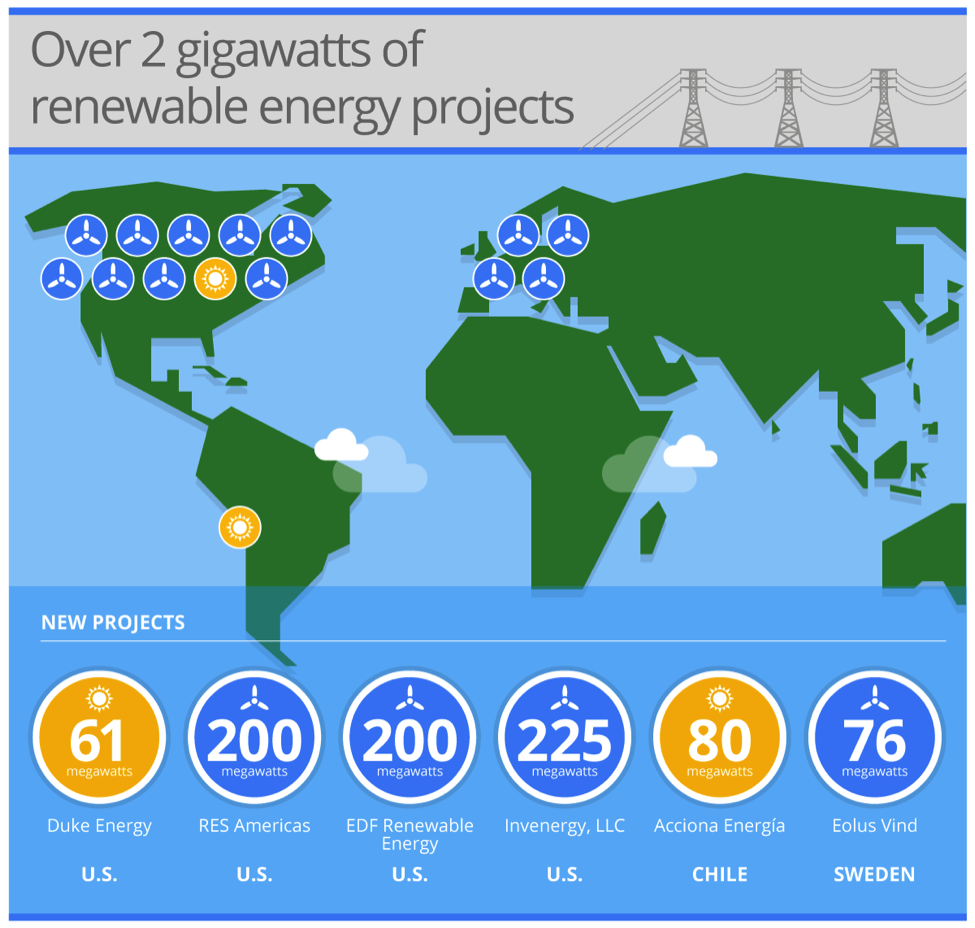
Googleblog – Today we’re announcing the largest, and most diverse, purchase of renewable energy ever made by a non-utility company. Google has already committed to purchase more renewable energy than any other company. Now, through a series of new wind and solar projects around the world, we’re one step closer to our commitment to triple our purchases of renewable energy by 2025 and our goal of powering 100% of our operations with clean energy. 842 MW of renewable energy around the world Today’s agreements will add an additional 842 megawatts of renewable energy capacity to power our data centers. Across three countries, we’re nearly doubling the amount of renewable energy we’ve purchased to date. We’re now up to 2 gigawatts—the equivalent to taking nearly 1 million cars off the road. These additional 842 megawatts represent a range of locations and technologies, from a wind farm in Sweden to a solar plant in Chile.

These long-term contracts range from 10-20 years and provide projects with the financial certainty and scale necessary to build these wind and solar facilities—thus bringing new renewable energy onto the grid in these regions. For our part, these contracts not only help minimize the environmental impact of our services—they also make good business sense by ensuring good prices. Our commitment to a sustainable energy future Since we opened our very first owned data center in 2006, we’ve been working to promote renewable and sustainable energy use in several ways:

  • First, we’re building the world’s most efficient computer infrastructure by designing our data centers to use as little energy as possible.

Tiếp tục đọc “Powering the Internet with renewable energy”

Top 5 Developments Enabling Shift to 100 Percent Renewable Energy

Renewableenergyworld – A growing number of companies, cities, states and countries are aiming for, and achieving, a goal of obtaining power from 50 percent, 75 percent or even 100 percent renewable energy, thanks, in part, to a set of major developments that are enabling the resource shift, according to a new report from Clean Edge.

Commissioned by SolarCity, the report Getting to 100 discusses what is driving the transition to increasing levels of renewable energy consumption and identifies the successes and challenges of both governments and companies in targeting, and/or achieving, 100 percent renewable energy goals.

According to the report, these five developments are supporting the trend toward higher penetrations of renewable energy:

  • A resilient grid
  • A rise in net zero buildings and smart connected devices
  • Energy storage availability and affordability
  • Proliferation of utility-scale renewables
  • Cost-effective status of distributed solar across geographies

Distributed Solar Becomes Cost-Effective Across Geographies

The proliferation of ever-cheaper distributed solar generation – residential, commercial and community – is a key driver toward the 100 percent renewable energy goal, according to the report.

“The cost curves are undeniable,” the report said. “The plummeting prices of solar panels have been well-documented, but the industry has recently been attacking balance-of-system costs and so-called soft costs (such as marketing, customer acquisition, permitting, and installation) as well.” Tiếp tục đọc “Top 5 Developments Enabling Shift to 100 Percent Renewable Energy”

How Thailand’s Solar Power Visionary Built an Industry with a Boost from IFC

Image

Courtesy of Solar Power Company Group

STORY HIGHLIGHTS
  • One of the winners of this year’s UN Momentum for Change awards has been transforming Thailand’s renewable energy capacity with utility-scale solar farms.
  • To get finance flowing for what was then a new industry in the country, she worked with the World Bank Group’s International Finance Corporation (IFC) and the Clean Technology Fund to access blended finance.
  • The project is increasing clean energy capacity while helping drive economic growth in one of Thailand’s most impoverished regions.

Worldbank – Thailand’s solar power market was at a standstill in 2008, with solar energy accounting for less than 2 MW of installed capacity. Technology costs were falling, though, and the government was starting incentives for renewable energy developers. Wandee Khunchornyakong, a retired solar panel manufacturing executive, saw potential. Tiếp tục đọc “How Thailand’s Solar Power Visionary Built an Industry with a Boost from IFC”

Renewables: Asean’s new energy frontier?

Renewable energy is rapidly becoming a mainstream source of power in Southeast Asia, accounting for more than 15 per cent of electricity generation in the region. This number will grow over the next decade and beyond, driven by climate change, energy security and economics.

At the same time, governments of the ten-country Asean (Association of Southeast Asian Nations) bloc need to provide access to the 120 million people in the region still lacking round-the-clock electricity while capping carbon emissions that will worsen climate change. Tiếp tục đọc “Renewables: Asean’s new energy frontier?”

Myanmar’s Path to Electrification: The Role of Distributed Energy Systems

By Rachel Posner Ross

Power lines in Labutta, Myanmar. Source: AX's flickr photostream, used under a creative commons license.

Power lines in Labutta, Myanmar. Source: AX’s flickr photostream, used under a creative commons license.

CSIS – With Myanmar’s historic elections around the corner, the international community has focused its attention on this former military regime’s transformation toward democracy. But in every political scenario following the November 2015 elections, Myanmar has immense needs for investments to mitigate problems with energy access, capacity, and reliability that hinder the country’s prospects for economic development. Today, Myanmar has one of the lowest electrification rates in Asia. The recent census documented only 32 percent of households use electricity as the main energy source for lighting and 69 percent still use firewood as the primary energy source for cooking. The communities and businesses already connected to the national grid experience frequent power outages due to inadequate supplies and degraded infrastructure. As Myanmar’s rural population seeks tangible improvements to their quality of life, electrification represents an opportunity for the government to bring near-term legitimacy to the political and economic reform agenda. Tiếp tục đọc “Myanmar’s Path to Electrification: The Role of Distributed Energy Systems”

Renewables to lead world power market growth to 2020

GLOBE-NET: ISTANBUL, 2 October – Renewable energy will represent the largest single source of electricity growth over the next five years, driven by falling costs and aggressive expansion in emerging economies, the IEA said Friday in an annual market report.

Pointing to the great promise renewables hold for affordably mitigating climate change and enhancing energy security, the report warns governments to reduce policy uncertainties that are acting as brakes on greater deployment.

Renewables are poised to seize the crucial top spot in global power supply growth, but this is hardly time for complacency,” said IEA Executive Director Fatih Birol as he released the IEA’s Medium-Term Renewable Energy Market Report 2015 (MTRMR) at the G20 Energy Ministers Meeting.

“Governments must remove the question marks over renewables if these technologies are to achieve their full potential, and put our energy system on a more secure, sustainable path.”

Renewable electricity additions over the next five years will top 700 gigawatts (GW) – more than twice Japan’s current installed power capacity. Tiếp tục đọc “Renewables to lead world power market growth to 2020”

Launch of Southeast Asia Energy Outlook 2015

Launch of Southeast Asia Energy Outlook 2015

Kuala Lumpur: 8 October 2015World Energy Outlook Special Report

Details

IEA – The ten countries that make up the Association of Southeast Asian Nations (ASEAN) are exerting an increasingly important influence on global energy trends. Underpinned by rapid economic and demographic growth, energy demand in the region has more than doubled in the last 25 years, a trend that is set to continue over the period to 2040. Given Southeast Asia’s role as a global growth engine, understanding what is shaping energy markets in this vibrant region and the implications for energy security and the environment is vital for policy makers and anyone with a stake in the energy sector.

The International Energy Agency, in collaboration with the Economic Research Institute for ASEAN and East Asia (ERIA) prepared the Southeast Asia Energy Outlook 2015 in response to a request from ministers at the Seventh East Asia Summit Energy in Bali, Indonesia, in 2013. Drawing on the latest data and policy and market developments, this report examines the current status and future prospects for energy markets in the region and their implications for energy security, the environment and economic development.

The report highlights:

  • Trends in domestic energy demand and supply prospects to 2040, broken down by fuel and sector.
  • The outlook for the power sector and the increasing share of coal in the region’s electricity generation.
  • The role that Southeast Asia will play in international energy trade and the implications for its energy expenditures.
  • The potential energy and environmental benefits of implementing pragmatic measures that would help limit the rise in the region’s greenhouse gas emissions.
  • An in-depth analysis of energy prospects in Malaysia to 2040.
  • A focus on four key issues that will shape the direction of the region’s energy system: power grid interconnection, energy investment, energy access and fossil fuel subsidies.

The same event will also feature the launch of the IEA publication Development Prospects for ASEAN Power Sector: Towards Electricity Market Integration.

Free Trade for Green Trade: To Support Clean Power, Open Up Trade In Green Technology

Snapshot August 4, 2015 Trade Energy

By Jonas Meckling and Llewelyn Hughes

Foreignaffair – In the run-up to the Paris talks at the end of the year, governments are preparing their strategies to negotiate national emissions reduction targets. But elsewhere, a different battle is unfolding as firms and governments compete to try to capture the benefits of the rise of the new green economy. A wave of trade disputes in clean energy industries is one result. Since 2010, at least 11 such cases have been initiated. Trade cases in solar photovoltaics, in particular, have emerged as some of the most politically charged in recent history.

Trade disputes over subsidies and price dumping have the potential to stymie the deployment of low-carbon energy technologies by increasing their price relative to fossil fuels. And they are unnecessary; most arise out of the assumption that the clean energy race is a zero-sum game between competing national and regional economies. But that isn’t how green industries work, and government policy needs to catch up with the reality that domestic firms (and efforts to protect the environment) benefit from free trade in the clean energy industry.

Sprott Power Corporation's Wind Asset Manager Peder Schlanbusch looks out from on top one of the 15 wind turbines which were officially opened in Amherst, Nova Scotia, June 25, 2012.

Sprott Power Corporation’s Wind Asset Manager Peder Schlanbusch looks out from on top one of the 15 wind turbines which were officially opened in Amherst, Nova Scotia, June 25, 2012.

GLOBAL GREEN
Tiếp tục đọc “Free Trade for Green Trade: To Support Clean Power, Open Up Trade In Green Technology”

Năng lượng tái tạo có thể cung cấp 48% nhu cầu năng lượng của ngành công nghệ thông tin – viễn thông vào năm 2020

English: Renewables Could Generate 48% of ICT Industry’s Power Supply By 2020

Gia tăng truy cập Internet, cộng thêm với điện thoại thông minh phổ biến đang tiếp tục làm gia tang nhu cầu năng lượng của ngành công nghệ thông tin và truyền thông – ICT – 1.5% tổng điện năng tiêu thụ của nước Mỹ năm 2014 là nhu cầu từ 113 công ty công nghệ thông tin và truyền thông.

Khi nhu cầu năng lượng của ngành này tăng lên, lượng năng lượng cung cấp bởi năng lượng tái tạo cũng tăng đáng kể, và theo như một nghiên cứu bởi Phòng Thí nghiệm Quốc gia về năng lượng tái tạo (NREL), năng lượng tái tạo có thể cung cấp một lượng khổng lồ lên đến 48% nhu cầu điện năng cho ngành công nghiệp này vào năm 2020, tăng từ ở mức chỉ 14% vào năm ngoái.

Tiếp tục đọc “Năng lượng tái tạo có thể cung cấp 48% nhu cầu năng lượng của ngành công nghệ thông tin – viễn thông vào năm 2020”

New centre promotes clean technology for Asia-Pacific

The UN Framework Convention on Climate Change (UNFCCC) opened (1 September) its first Asia-Pacific regional hub to promote clean technology.The UNFCCC Regional Collaboration Centre (RCC), formed in partnership with the non-profit Institute for Global Environmental Strategies in Japan, will help developing countries in the region to identify and develop clean development mechanism (CDM) projects to help limit damage from climate change. Tiếp tục đọc “New centre promotes clean technology for Asia-Pacific”

Innovation: The Uber of solar power?

R. Kress | Sep 04, 2015

EnergyBiz – The peer-to-peer sharing economy is finding its way into every industry. From Uber to Airbnb, companies are doing all they can to take advantage of crowdsourcing to create a large-scale, paying consumer base. Now, solar start-up Yeloha thinks it has found a way to apply this new, social way of doing business to clean energy.

Solar energy, of course, is becoming an increasingly viable way of powering the home. Over the last decade alone, the cost of installing solar power has dropped by more than 73% according to the Solar Energy Industries Association. Residential solar costs alone have plummeted by 45% in just the last five years and there is currently enough solar electricity generated in the U.S. to run more than 4 million homes. So why are fewer than 1% of American households running on solar energy?

Yeloha Co-founder and CEO Amit Rosner says the problem is simple: access. Tiếp tục đọc “Innovation: The Uber of solar power?”

Các chiến lược năng lượng phải xem xét tất cả các khía cạnh của ‘Bộ ba vấn đề năng lượng’

A woman installs a solar panels on the roof of her house in rural Bhutan

Nội dung cuộc trao đổi tuần vừa rồi của chúng tôi trong Diễn đàn Năng lượng sạch Châu Á 2015 đã thay đổi rất nhiều so với năm ngoái. Chúng tôi nhận thấy sự sụt giảm mạnh của giá dầu mỏ, điều này đã tạo ra làn sóng trong toàn bộ lĩnh vực năng lượng. Biến động trở thành điều bình thường mới, trong một lĩnh vực được biết đến là khá bảo thủ, điều này dẫn đến thách thức năng lượng hàng đầu là cần đánh giá lại các tiêu chuẩn truyền thống. Tuy nhiên, chúng tôi thấy rằng không chỉ cú sốc về giá này làm cho các nhà lãnh đạo năng lượng lo lắng ngày đêm: ngoài ra đó là thời tiết khắc nghiệt và các tai nạn/ sự phá hủy trên diện rộng cùng đứng đầu trong các vấn đề phải đối mặt của các nhà lãnh đạo năng lượng tại Châu Á.

Tiếp tục đọc “Các chiến lược năng lượng phải xem xét tất cả các khía cạnh của ‘Bộ ba vấn đề năng lượng’”

Hoa Kỳ và Việt Nam tăng cường hợp tác về biến đổi khí hậu trong lĩnh vực năng lượng sạch và hiệu quả năng lượng

Giám đốc USAID Việt Nam Joakim Parker (bên phải) và Bộ trưởng Bộ Công Thương Cao Quốc Hưng tại lễ ký kết.
USAID/Vietnam

For Immediate Release

Wednesday, July 29, 2015

HÀ NỘI, 29/7/2015 — Hôm nay, Cơ quan Phát triển Quốc tế Hoa Kỳ (USAID) và Bộ Công Thương Việt Nam nhất trí hợp tác tăng cường các chính sách về năng lượng tái tạo và hiệu quả năng lượng để thúc đẩy phát triển phát thải thấp bền vững ở Việt Nam. Tiếp tục đọc “Hoa Kỳ và Việt Nam tăng cường hợp tác về biến đổi khí hậu trong lĩnh vực năng lượng sạch và hiệu quả năng lượng”