Monday, October 23, 2017 (Mekong-Cuulong blog)
.

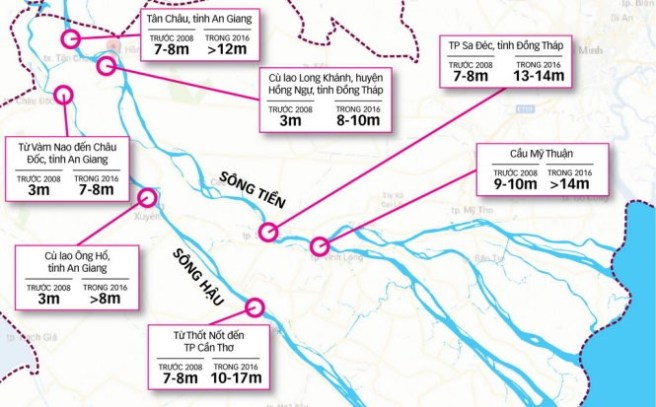
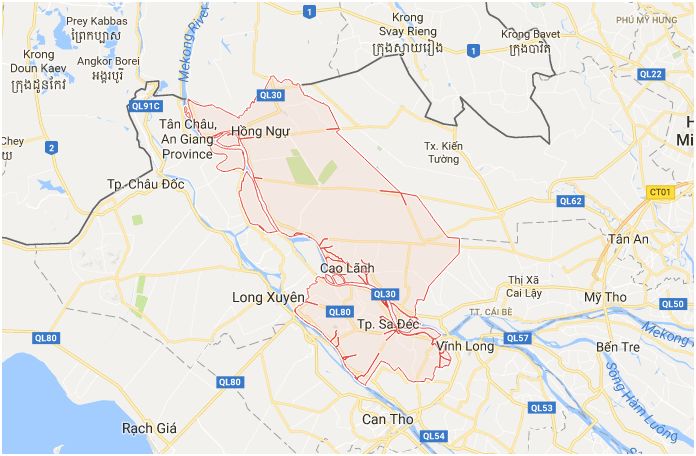
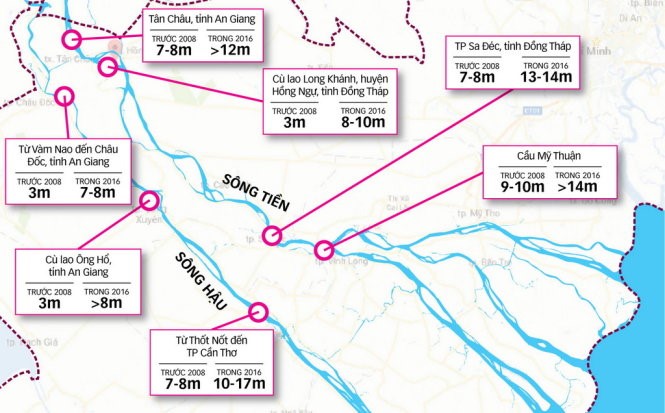
So sánh độ sâu của hai con sông Tiền và sông Hậu trước năm 2008 – năm 2016 – năm 2017
Conversations on Vietnam Development

Monday, October 23, 2017 (Mekong-Cuulong blog)
 |
| Nghiên cứu và khảo sát mới nhất của các nhà khoa học cho thấy sông Tiền – sông Hậu ngày càng sâu bất thường, gây ảnh hưởng nghiêm trọng đến môi trường sống. Trong ảnh: một trong những thiệt hại thấy rõ ở đoạn sông Tiền khu vực huyện Cái Bè, tỉnh Tiền Giang bị sạt lở kéo nhà dân xuống sông – Ảnh: T.B. |
Theo các chuyên gia, có nhiều nguyên nhân dẫn đến tình trạng này, trong đó quan trọng nhất là việc khai thác cát bừa bãi và xây các đập thủy điện trên dòng chính Mekong. Tiếp tục đọc “Vì sao sông Tiền, sông Hậu sâu bất thường?”

The floodgates of the largest and most controversial dam project in the country’s history officially closed yesterday at an inauguration ceremony presided over by Prime Minister Hun Sen, who took aim at environmentalists, ambassadors and NGOs in a wide-ranging speech.
During his one-hour address, the prime minister said the Lower Sesan II Dam, near the border with Laos in Stung Treng province, would lower electricity costs and put the Kingdom on its way to hooking up every village in the country to the electricity grid by 2022. Tiếp tục đọc “Sesan dam goes online, while PM dismisses environmental concerns”
Laos’ Pak Beng dam, developed by China and supported by Thailand, has divided riparian nations over how best to manage the river’s resources


MẠNG LƯỚI SÔNG NGÒI VIỆT NAM PHÁT ĐỘNG CUỘC THI ẢNH
ĐỐI THOẠI VỚI DÒNG SÔNG 2017:
“Đồng bằng sông Cửu Long – Giới trong quản trị tài nguyên nước”
Trong cộng đồng dân cư, phụ nữ luôn là một trong các đối tượng chịu tác động lớn nhất trước các thách thức từ gia tăng dân số hay các vấn đề môi trường. Tuy nhiên, vai trò của họ trong phát triển kinh tế – xã hội cũng như sự tham gia của người phụ nữ nói chung vào các vấn đề môi trường vẫn chưa được ghi nhận rõ nét, đặc biệt là tại Đồng bằng sông Cửu Long. Tiếp tục đọc “Phát động cuộc thi ảnh Đối thoại với dòng sông lần thứ III – năm 2017”

Nguồn lợi thủy sản Đồng bằng sông Cửu Long sẽ bị ảnh hưởng nghiêm trọng
ĐBSCL sẽ tiếp tục đối mặt với nguy cơ xâm nhập mặn, xói lở, mất nguồn lợi thủy sản nếu dự án thủy điện Pắc-Beng do Trung Quốc đầu tư xây dựng ở Lào hoạt động.
Tại hội thảo Tham vấn dự án (DA) thủy điện Pắc-Beng của Lào trên dòng chính sông Mê Kông ngày 5.5, ông Trần Đức Cường, Phó chánh văn phòng thường trực Ủy ban Sông Mê Kông VN, cho biết DA thủy điện Pắc-Beng thuộc H.Pắc Beng, tỉnh Oudomxay, Lào, cách thủ đô Vientiane hơn 600 km về phía thượng lưu, cách biên giới VN 1.933 km. Tiếp tục đọc “Thủy điện Pắc-Beng (Lào): Nguy cơ lớn cho đồng bằng Sông Cửu Long”
Updated : 06/29/2017 14:30 GMT + 7

Residents on an islet in Ben Tre Province, located in Vietnam’s Mekong Delta, are taking a stand against sand thieves.
The illegal exploitation of sand along the Tien (Front) River has been the main cause of subsidence and house collapse in Con Doi (Doi Islet) in Tan Phu Commune, Chau Thanh District, but locals have finally had enough.
Residents of the area have begun patrolling it to protect their home, despite threats from sand thieves. Tiếp tục đọc “Locals team up against sand thieves in Vietnam’s Mekong Delta”
 |
| An eroded riverbank in the Mekong Delta city of Cần Thơ. — VNS File Photo. |
Unrelenting rain last month washed away riverbanks in Hoà Định Hamlet in Đồng Tháp Province’s Lai Vung District, causing several stretches of rural roads to plunge into the river. Tiếp tục đọc “Mekong blighted by river erosion”
VietNamNet Bridge – The weaker water flow towards the downstream Mekong River has caused drought in The Mekong Delta, affecting the livelihood of millions of people in the area.

The rains in June 2017 helped cool down the land in the Delta. The Central Hydrometeorological Forecast Center said the floods this year may be a little higher than previous years.
This is a great opportunity for locals to store water in the context of big changes in the Mekong water flow due to water exploitation in the upper course by hydropower plants and water diversion projects. Tiếp tục đọc “Vietnam’s rice granary endangered by water shortage”
CGIAR: Consultative Group for International Agriculture Research
WLE: CGIAR Research Program on Water, Land and Ecosystems
Greater Mekong: The Greater Mekong Region
______
https://wle-mekong.cgiar.org/search/
WLE Greater Mekong resources include:
Resource Repository
A searchable repository of resource outputs including papers, posters, videos and presentations. Many from the 12 years (2002-2014) of CPWF. Access here.
State of Knowledge Papers
Highlighted separately, this series presents easy-to-read and comprehensive papers about subjects relevant to Mekong hydropower development. Access here
Maps
The Dams Map and Portal displays all known dams in our four focus river basins. Here you can also find access to our dams database. Access here.

BĐV – Bài viết của GS.TSKH Nguyễn Ngọc Trân – Nguyên Chủ nhiệm Chương trình cấp Nhà nước Điều tra cơ bản tổng hợp ĐBSCL về tình hình sạt lở ở khu vực này.
Tình hình sạt lở bờ sông, bờ biển ở ĐBSCL ngày càng nhiều và nghiêm trọng.
Các nguyên nhân cơ bản thường được nói đến thời gian gần đây là do thiếu hụt trầm tích bị các đập thủy điện trên dòng chính sông Lancang – Mekong giữ lại, và do lạm khai thác cát sông.
Hiểu sâu để có giải pháp tốt. Nhằm mục đích này, xin đóng góp một số ý kiến vào nhận thức khách quan vấn đề sạt lở và từ đó một số việc cần làm theo thiện ý của tác giả.
Tiếp tục đọc “Chỉ đúng nguyên nhân ĐBSCL sạt lở và các khuyến nghị”
The Mekong River Commission (“MRC”) governs the allocation and utilization of the Mekong River waters by four countries – Thailand, Cambodia, Vietnam, and Laos. The MRC was founded in 1995 pursuant to the Agreement on the Cooperation for Sustainable Development of the Mekong River Basin (the “1995 Agreement”), which was signed and entered into force at Chiang Rai, Thailand on 5 April 1995. On 5 April 2010, the heads of state of Thailand, Cambodia, Vietnam, and Laos met in Hua Hin, Thailand for the first MRC Summit to mark the 15th anniversary of the adoption of the 1995 Agreement. The parties adopted a joint declaration—the Hua Hin Declaration—reaffirming their commitment to implementing the 1995 Agreement. The 1995 Agreement was the result of more than 40 years of regional and supra-regional efforts to manage the resources of the Mekong River Delta. In the mid-1950s, the United Nation’s Economic Commission for Asia and the Far East (“ECAFE”) and the U.S. Bureau of Reclamation sent teams to the Mekong to examine water management issues. Both ECAFE and the U.S. Government published detailed reports of their findings. Tiếp tục đọc “International Waters Governance – Mekong”
By Z.K RUBIN, G.M. KONDOLF, AND P. CARLING (2014)

Dam locations are indicated for two scenarios: definite future, and full-build.
Main stream dams are included in full-build scenario, but represented separately.

Bedrock channel of the Mekong River with surficial sand deposits 1-2 m thick, near Xayaburi, Laos. (photo by Kondolf, January 2012) Tiếp tục đọc “ANTICIPATED GEOMORPHIC IMPACTS FROM MEKONG BASIN DAM CONSTRUCTION”
VietNamNet Bridge – Every year, 55 million tons of sediment is lost from the rivers in Mekong Delta, 90 percent of which is sand.

Nguyen Huu Thien, an independent expert, said the Mekong Delta has been taking shape for the last 6,000 years thanks to alluvial accretion. But the volume of sediment in the river and canal system has decreased gradually, leading to an increased risk of landslides.
The coastal provinces in the western part of the southern region are also directly affected by the change.
The alluvium from river mouths to the sea has the function of protecting the coast, easing the impact from waves hitting the coast. When there is not enough silt, the sea water will cause erosion. Tiếp tục đọc “Mekong Delta faces increased risk of landslides as sediment loss continues”
Updated : 05/13/2017 14:00 GMT + 7

The environment and lives of dozens of millions of people living in the Lower Mekong Basin are being threatened as the Mekong River is expected to see yet another hydropower dam construction, experts said at an international conference on Friday.
Experts all express concerns over the Laos-proposed Pak Beng dam, the latest to be built on the Mekong River, as they convened for a consultation process held by the Vietnam Mekong River Commission in the southern Vietnamese city of Can Tho. Tiếp tục đọc “Proposed dam to poses more threat to Vietnam’s Mekong Delta: conference”


