
Với nhiều người, rác là nguồn thu nhập, là sinh kế không chỉ giúp họ mưu sin; mà còn nuôi sống cả gia đình, là tiền học phí của con, là viện phí của cha mẹ… Thậm chí, những người dân mưu sinh tại bãi rác Nam Sơn (Sóc Sơn, Hà Nội) còn tự nhận cuộc đời của họ là “sống trong rác, chết vùi trong rác”.
Chuyên mục: Ô nhiễm – Pollution
Liệu ô nhiễm không khí đang gây sạt lở đất ở Trung Quốc? – Is air pollution causing landslides in China?
Show more
Highlights
- • Cracks caused by mining under the potential slide rock mass ruptured the aquiclude.
- • Acid rain supplied nutrients to organisms decomposing organic matrix in the shale.
- • Acid rain reduced strength of the shale layer on which the failure surface formed.
Việc không nhẹ nhàng
Gánh nặng bệnh tật do nhiệt điện đốt than ở Đông Nam Á – Burden of Disease from Rising Coal-Fired Power Plant Emissions in Southeast Asia
Shannon N. Koplitz*†  , Daniel J. Jacob‡, Melissa P. Sulprizio‡, Lauri Myllyvirta§, and Colleen Reid∥
, Daniel J. Jacob‡, Melissa P. Sulprizio‡, Lauri Myllyvirta§, and Colleen Reid∥† Department of Earth and Planetary Sciences, Harvard University, Cambridge, Massachusetts 02138 United States
‡ John A. Paulson School of Engineering and Applied Sciences, Harvard University, Cambridge, Massachusetts 02138 United States
§ Greenpeace International, 1066 AZ Amsterdam, The Netherlands
∥ Department of Geography, University of Colorado, Boulder, Colorado 80309 United States
Environ. Sci. Technol., 2017, 51 (3), pp 1467–1476
DOI: 10.1021/acs.est.6b03731
Publication Date (Web): January 12, 2017
Copyright © 2017 American Chemical Society
*Phone: 617 496 9428; e-mail: skoplitz@fas.harvard.edu.
Abstract

Southeast Asia has a very high population density and is on a fast track to economic development, with most of the growth in electricity demand currently projected to be met by coal. From a detailed analysis of coal-fired power plants presently planned or under construction in Southeast Asia, we project in a business-as-usual scenario that emissions from coal in the region will triple to 2.6 Tg a–1 SO2 and 2.6 Tg a–1 NOx by 2030, with the largest increases occurring in Indonesia and Vietnam. Simulations with the GEOS-Chem chemical transport model show large resulting increases in surface air pollution, up to 11 μg m–3 for annual mean fine particulate matter (PM2.5) in northern Vietnam and up to 15 ppb for seasonal maximum 1 h ozone in Indonesia. We estimate 19 880 (11 400–28 400) excess deaths per year from Southeast Asian coal emissions at present, increasing to 69 660 (40 080–126 710) by 2030. 9000 of these excess deaths in 2030 are in China. As Chinese emissions from coal decline in coming decades, transboundary pollution influence from rising coal emissions in Southeast Asia may become an increasing issue.
Phát hiện ô nhiễm môi trường, hãy gọi ngay: 086.900.0660
11:26, 31/10/2017 (GMT+7)
(TN&MT) – Ngày 30/10, Tổng cục Môi trường (Bộ TN&MT) đã công bố đường dây nóng cấp trung ương để tiếp nhận phản ánh, kiến nghị về ô nhiễm môi trường theo số điện thoại 086.900.0660
baotainguyenmoitruong_Theo đó, khi phát hiện những hành vi xả chất thải gây ô nhiễm môi trường; các vụ việc ô nhiễm, suy thoái môi trường, người dân có thể gọi ngay đến Đường dây nóng của Tổng cục môi trường theo số 086.900.0660
Đường dây nóng 086.900.0660 sẽ tiếp nhận thông tin phản ánh, kiến nghị về ô nhiễm môi trường liên tục 24/24 giờ trong ngày và 7 ngày trong tuần (bao gồm cả ngày nghỉ, ngày lễ).
 |
| Phát hiện ô nhiễm môi trường, hãy gọi ngay: 086.900.0660 |
Tiếp tục đọc “Phát hiện ô nhiễm môi trường, hãy gọi ngay: 086.900.0660”
Beyond recycling: solving e-waste problems must include designers and consumers
E-Waste in East and South-East Asia Jumps 63% in Five Years
-
2017•01•15 BONN
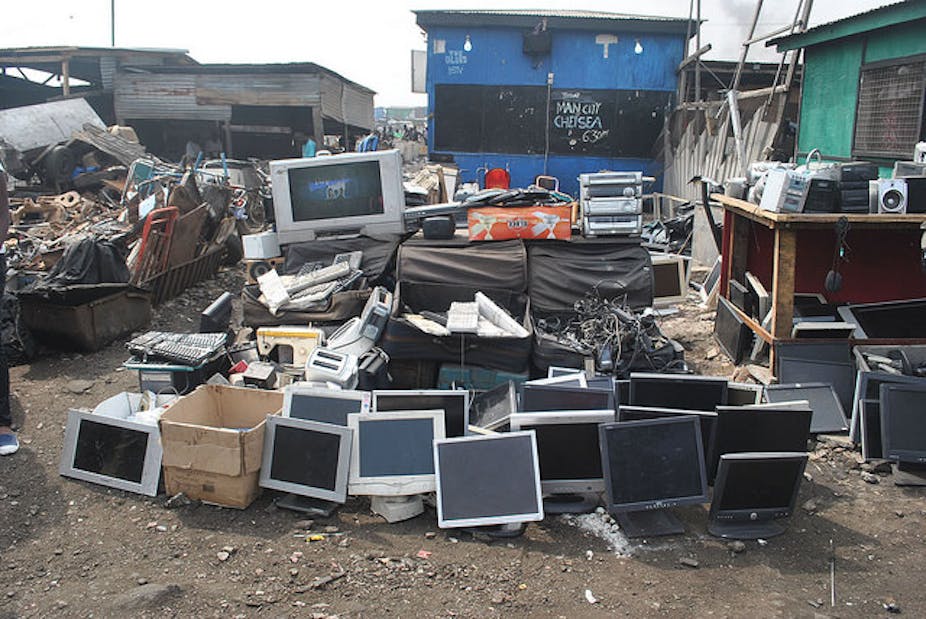
The volume of discarded electronics in East and South-East Asia jumped almost two-thirds between 2010 and 2015, and e-waste generation is growing fast in both total volume and per capita measures, new UNU research shows.
Driven by rising incomes and high demand for new gadgets and appliances, the average increase in e-waste across all 12 countries and areas analysed — Cambodia, China, Hong Kong, Indonesia, Japan, Malaysia, the Philippines, Singapore, South Korea, Taiwan, Province of China, Thailand and Vietnam — was 63% in the five years ending in 2015 and totalled 12.3 million tonnes, a weight 2.4 times that of the Great Pyramid of Giza.
China alone more than doubled its generation of e-waste between 2010 and 2015 to 6.7 million tonnes, up 107%. Tiếp tục đọc “E-Waste in East and South-East Asia Jumps 63% in Five Years”
Cơ hội cuối cùng cho Việt Nam – Du lịch bền vững
English: Vietnam’s last chance: Sustainable tourism
 Xe máy trên đường phố Hanoi, Vietnam June 30, 2016. Source: Reuters/Kham
Ba mươi năm sau khi Đảng Cộng sản Việt Nam ban hành chính sách “đổi mới”, mở cửa cho nền kinh tế quốc doanh và tập trung vào thị trường toàn cầu thì các chỉ số kinh tế của đất nước đã được cải thiện đáng kể. Theo số liệu của Ngân hàng Thế giới, GDP bình quân đầu người của Việt Nam đã tăng từ 437,13 USD năm 1986 lên 2,185.69 USD vào năm 2016. Tỷ lệ nghèo đói cũng giảm đáng kể, từ 60% năm 1993 xuống còn 14% năm 2016. Tuy nhiên người Việt Nam đang phải trả phí cho những tiến bộ kinh tế này bằng việc đánh đổi các nguồn tài nguyên thiên nhiên, các bờ biển rộng lớn của quốc gia đang phải chịu ảnh hưởng nặng nề. Tiếp tục đọc “Cơ hội cuối cùng cho Việt Nam – Du lịch bền vững”
Phương tiện truyền thông xã hội tại Việt Nam đang định hình làn sóng môi trường mới
|
English: Vietnam’s Social Media Shaping New Environmentalism “Tôi thường xuyên tham gia vào một số diễn đàn trực tuyến và các chiến dịch về môi trường do người Việt đứng đầu – những người đã đưa ra các giải pháp về việc chặt 6.700 cây xanh ở Hà Nội, phá rừng Thái Bình để phát triển kinh tế và xây dựng ở Cát Bà “, bà Trần Thị Thuý Bình nói – một thành viên của Diễn đàn các Nhà báo Môi trường Việt Nam tại Hà Nội. Bình, cùng với 40 triệu người Việt trẻ thành thạo internet, xuất hiện là một phần của làn sóng mới nổi của chủ nghĩa quốc gia môi trường đang tràn khắp quốc gia. Điều đáng ngạc nhiên nhất là Facebook, từng bị cấm ở Việt Nam, đã minh chứng là một nền tảng hấp dẫn để tổ chức các diễn đàn môi trường. Với dân số 93 triệu người và số người sử dụng Internet ngày càng tăng, các phương tiện truyền thông xã hội đã chứng tỏ là sự lựa chọn hàng đầu của người Việt trẻ có giáo dục. Hoạt động trực tuyến của giới trẻ đã gây được sự chú ý vào năm ngoái ở tỉnh Hà Tĩnh – nơi xảy ra tội phạm môi trường của Công ty thép Formosa, nơi người dân đã xuống đường, thậm chí tập trung gần Hồ Hoàn Kiếm ở Hà Nội để phản đối việc xả nước thải chứa độc tố chưa qua xử lý của công ty Đài Loan ra biển Đông. |
Pollution killing more people than war and violence, says report
DW_Pollution kills more people each year than wars, disasters and hunger, also causing huge economic damage, a study says. Almost half the total deaths occur in just two countries.

Environmental pollution is killing more people every year than smoking, hunger or natural disasters, according to a major study released in The Lancet medical journal on Thursday.
One in every six premature deaths worldwide in 2015, could be attributed to diseases caused by toxins in air or water, the study says. Tiếp tục đọc “Pollution killing more people than war and violence, says report”
Phú Quốc Island drowning in rubbish
vietnamnews Update: October, 20/2017 – 09:00


 |
| Garbage heap in Phú Quốc Island’s Dương Đông Town in the Mekong Delta province of Kiên Giang. — VNS Photo Thái Hà |
Viet Nam News KIÊN GIANG — Phú Quốc Island in the southern province of Kiên Giang – among the most popular tourist destinations in Việt Nam – is being threatened by environmental pollution caused by rubbish dumps, Lao động (Labour) newspaper reported. Tiếp tục đọc “Phú Quốc Island drowning in rubbish”
Ministry suggests community-based environmental monitoring for papermaker
vietnamnews Update: October, 20/2017 – 12:40
 |
| Lee & Man Vietnam Ltd.’s waste water treatment system. The Ministry of Natural Resources and Environment has suggested Ministry suggests community-based environmental monitoring for the papermaker. — VNA/VNS Photo Duy Khương |
HÀ NỘI – The Mekong Delta province of Hậu Giang has been urged to establish a community-based monitoring mechanism to evaluate papermaker Lee & Man Vietnam Ltd.’s environmental treatment.During a visit to the company’s paper mill on Thursday, Minister of Natural Resources and Environment, Trần Hồng Hà, asked the papermaker to complete a standard procedure for management and operation of its waste treatment, and to keep daily records of materials used for environmental treatment and to publicise them. Tiếp tục đọc “Ministry suggests community-based environmental monitoring for papermaker”
China is now the world’s biggest producer of solar power
How environmental crime became an EU security priority for 2018-21

euractive_In May 2017, EU justice ministers decided that environmental crimes – including wildlife trafficking and waste crimes – would be one of the EU’s ten priorities for the fight against serious and organised crime during the 2018-21 policy cycle. Catherine Bearder evokes how this decision came to being.
Tiếp tục đọc “How environmental crime became an EU security priority for 2018-21”
Air quality getting worse as legal loopholes still exists
Last update 14:17 | 11/10/2017
VietNamNet Bridge – The air pollution in Vietnam is increasing in urban areas and industrial zones, mostly due to legal loopholes. 
The air quality measured at different monitoring stations in Hanoi and HCMC has been continuously ‘unhealthy’.
At 8am on October 6, the air quality index (AQI) measured at the US Embassy area in Hanoi was 126, meaning it is ‘unhealthy for sensitive groups’. Tiếp tục đọc “Air quality getting worse as legal loopholes still exists”
 CVD
CVD 