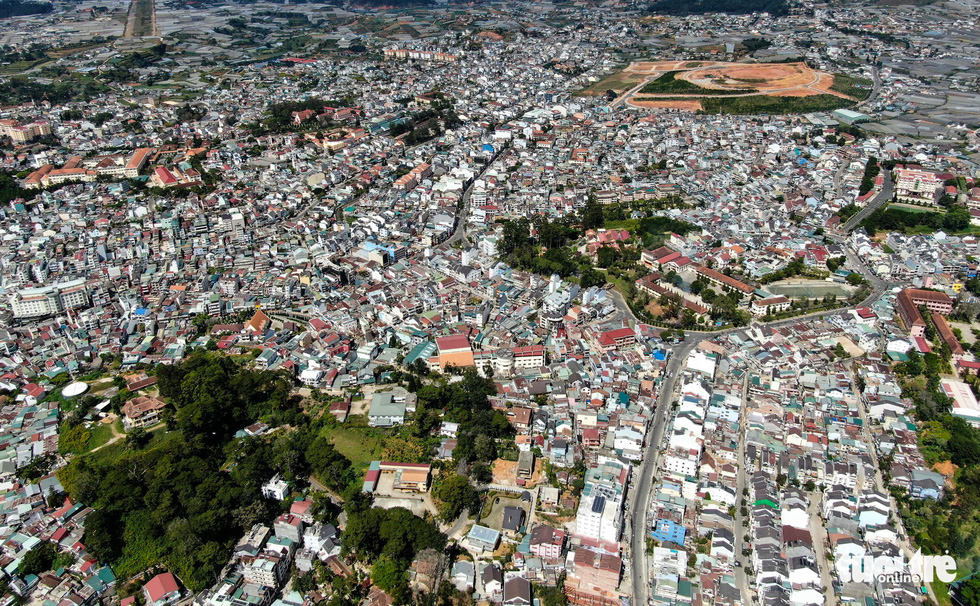
Khi dùng thiết bị bay chụp ảnh (flycam) ở độ cao hơn 300m, phóng viên Tuổi Trẻ ghi nhận rừng nội ô Đà Lạt không còn, đặc biệt trong bán kính 4km tính từ hồ Xuân Hương.
Ngay từ khi hình thành, Đà Lạt đã được mệnh danh “thành phố trong rừng – rừng trong thành phố”. Nhưng hoạt động xây dựng thiếu kiểm soát đã khiến phong cách đô thị đặc biệt của thành phố này biến dạng, lộn xộn.
Vùng nội ô Đà Lạt ở được chụp ở độ cao khoảng 300m, có thể thấy bê tông lấn lướt, chỉ còn vài mảng xanh rải rác trong khu vục đô thị
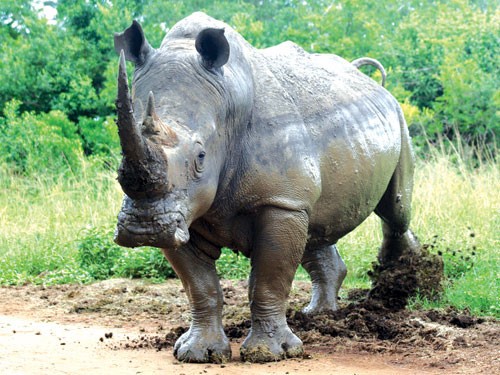
Sự kỳ diệu đó không nằm ở chiếc sừng, mà ở chỗ tê giác là một nhà nông nghiệp đại tài, một chiến sĩ chống cháy rừng kiệt xuất, một nhà bảo vệ động vật và một thầy thuốc giỏi…
Một vai trò rất quan trọng của tê giác là chống cháy rừng – Ảnh: Shutterstock
Nước ta khởi thủy là vùng đầm lầy, là một trong những quê hương của loài tê giác, trong khi Trung Quốc hầu như không có tê giác. Do tổ tiên ta chủ yếu lấy sừng của những con tê giác chết già, nên số lượng tê giác ở Việt Nam trước chiến tranh vẫn rất nhiều, cho đến những năm 60 của thế kỷ trước người ta vẫn nhìn thấy tê giác trong những cánh rừng ở Đà Lạt và nhiều nơi khác. Tiếp tục đọc “Sự kỳ diệu của tê giác”→
Nước ta đang sở hữu một loại báu vật cổ xưa duy nhất có trên toàn cầu, đó là 2 quần thể thủy tùng tự nhiên tuyệt đẹp, cực kỳ quý giá ở tỉnh Đắk Lắk. Sau hơn nửa thế kỷ rơi vào trạng thái vô sinh, lứa Thủy tùng đầu tiên được nhân giống bằng phương pháp đặc biệt đã sinh trưởng nhanh bất ngờ, hứa hẹn có thể đem lại nhiều lợi ích tuyệt vời cho đất nước, nếu …
Cán bộ nhân viên Ban quản ký Khu bảo tồn bên cây Thủy tùng 700 năm tuổi ở Ea Ran
More than VNĐ28.5 trillion (US$1.23 billion) has been earmarked for a project to protect, restore and sustainably develop forests in the Central Highlands until 2030. — VNA/VNS Photo
HÀ NỘI — More than VNĐ28.5 trillion (US$1.23 billion) has been earmarked for a project to protect, restore and sustainably develop forests in the Central Highlands until 2030.
Rich in wildlife, Southeast Asia includes at least six of the world’s 25 “biodiversity hotspots” – the areas of the world that contain an exceptional concentration of species, and are exceptionally endangered. The region contains 20% of the planet’s vertebrate and plant species and the world’s third-largest tropical forest.
Global comparisons are difficult but it seems the Mekong region has a higher rate of species discovery than other parts of the tropics, with hundreds of new species described annually.
Việt Nam, có lịch sử lâu dài cho hành vi trộm gỗ từ nước láng giềng Lào và Campuchia, gần đây đã khởi động một hiệp định thương mại gỗ tự do với Liên Minh Châu Âu EU. Điều này có nghĩa là Việt Nam sẽ phải thực thi pháp luật để giải quyết việc nhập khẩu gỗ được khai thác hoặc buôn bán trái phép, để đổi lấy quyền xuất khẩu gỗ sang EU theo quy định của Quy chế Gỗ bởi Liên Minh Châu ÂU (EUTR).
Với việc ký kết và phê chuẩn chính thức hiệp định này dự kiến được thực hiện vào năm 2018, Cơ quan điều tra Môi trường EIA đã đến khu vực này vào mùa khô năm 2017-2018 để điều tra việc buôn bán gỗ trái phép ở Campuchia đã chấm dứt hay chưa. Tiếp tục đọc “Hàng loạt vi phạm: Việt Nam tiếp tục nhập gỗ lậu từ Campuchia”→
Phan Huu Phuong, in gray T-shirt and jeans, is seen after his arrest in Dak Nong Province, located in Vietnam’s Central Highlands, on April 27, 2018. Photo: Tuoi Tre
The man behind a ring that managed to illegally fell down and transport a large amount of logs with impunity in Vietnam’s Central Highlands has been arrested, along with several members of the racket, police said on Friday.
Ringleader Phan Huu Phuong, 48, was nabbed and taken into custody after police raided his residence in Ea T’Linh, a town in Cu Jut District, Dak Nong Province.
Phuong and some of his ring members are being investigated for their involvement in serious illegal logging activities at the local Yok Don National Park, located at the border of Vietnam and Cambodia, according to police.
Police come and arrest Pham Huu Phuong at his residence.
During Friday’s raid, officers also confiscated 37 cubic meters of illegally logged timber, stored inside two trucks, at a workshop owned by Phuong, and various logging tools and piles of logs at an illegal logging site inside the park.
Phuong had managed to take the illegal logs out of the national part without impunity, even though he had to pass several check points run by the local border guard and forest ranger units.
Police thus hold suspicion that the ring had been abetted by local authorities.
The Vietnamese Ministry of Public Security has sent a team of officers to help local police in further investigation of the case.
Curious neighbors surround the residence of Pham Huu Phuong when police raid the house. Photo: Tuoi Tre
Illegal logs are seized by local Police in Dak Nong. Photo: Tuoi Tre
Global Forest Watch (GFW) is an online platform that provides data and tools for monitoring forests. By harnessing cutting-edge technology, GFW allows anyone to access near real-time information about where and how forests are changing around the world.
TVN – Theo như châm ngôn của Eisenhower về việc xới tung vấn đề để giải quyết nó, việc mở rộng hợp tác vượt quá khuôn khổ nguồn nước tiến tới năng lượng và các lĩnh vực tài nguyên khác sẽ mở ra những cơ hội mới cho hợp tác khu vực trên cơ sở có qua có lại và hiệp lực.
Khi được hỏi về thành công của mình với tư cách là một người lính và một chính trị gia, Tổng thống Mỹ Eisenhower đã trả lời: Bất cứ lúc nào tôi gặp phải vấn đề không thể giải quyết, tôi luôn luôn xới to nó lên. Tôi không thể giải quyết nó bằng cách cố gắng ép nó nhỏ đi, nhưng nếu tôi làm cho nó đủ lớn, tôi có thể nhìn thấy bản phác họa của giải pháp”.
Cách tiếp cận của Eisenhower có thể tương tự với tình hình của sông Mekong ngày nay.
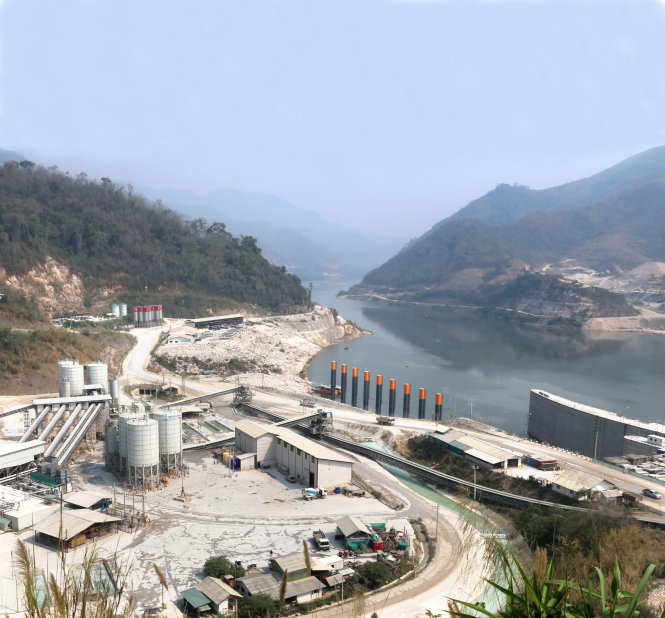
Hình ảnh công trình xây dựng đập thủy điện Xayaburi của Lào trong quá trình gấp rút hoàn thành (tháng 4/2016). Ảnh: TTO
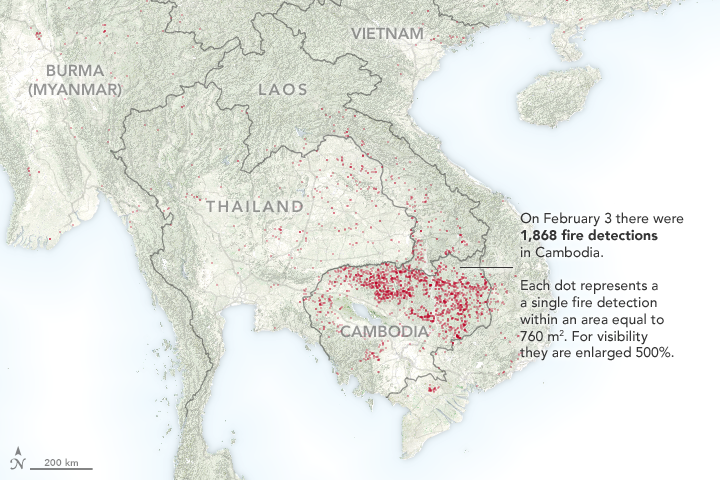
Every January through March, vast numbers of small fires spring up across the countryside in Southeast Asia. Those months usually bring cool, dry weather—perfect conditions for burning.
On that day, there were significantly more fires in Cambodia than in neighboring countries. VIIRS detected 1,868 hot spots in Cambodia, 185 in Laos, 77 in Myanmar, 217 in Thailand, and 114 in Vietnam. The large number of fires in Cambodia were the most VIIRS has observed on a single day in 2018. The pattern is consistent with recent years: As depicted in the map below, the instrument has detected four-to-five times as many fires in northern Cambodia as it did in Vietnam and Thailand between August 2016 and February 2018. Northern Laos also had a relatively high number of fires. Tiếp tục đọc “Fire season in Southeast Asia”→
These are Southern white rhinoceros (Ceratotherium simum simum) in an undisclosed protected area in South Africa.
Credit: Enrico Di Minin
Illegal wildlife trade is one of the biggest threats to biodiversity conservation and is currently expanding to social media. This is a worrisome trend, given the ease of access and popularity of social media. Efficient monitoring of illegal wildlife trade on social media is therefore crucial for conserving biodiversity.
DW_How can you tell if mahogany is really mahogany? And can you really know whether the wood in your table wasn’t illegally felled? Germany’s wood detectives are on the case with DNA analysis.
Cambodia’s forests are being felled at a shocking rate, as poachers and corrupt officials profit from the black market trade in rare wood species, which is being exported to Vietnam — and beyond.
The Aoral Wildlife Sanctuary in Kampong Speu province is just a three-hour drive from Cambodia’s capital, Phnom Penh. But the scenery here couldn’t be more different than in the sprawling metropolis — even a military outpost in the reserve is peaceful and picturesque. A traditional stilt house has hammocks, chickens and ice-cold beer. Outside, a few soldiers are playing pétanque as a black pig snuffles the earth.
In collaboration with local and international conservation groups, the Peruvian government has established Yaguas National Park in the country’s far eastern territory to permanently protect millions of acres of pristine rainforest. “This is a place where the forest stretches to the horizon,” Corine Vriesendorp, a conservation ecologist at The Field Museum in Chicago, told the New York Times. “This is one of the last great intact forests on the globe.” The forest is so massive that the clouds which form above it may impact precipitation in the Western United States while many unique species of animals and plants are found only in Yaguas. The National Park designation also protects land inhabited by several tribes of indigenous peoples.










 CVD
CVD 