All Railroads Lead to China: China’s Borderlands Strategy of Integration in Laos

Laos shift from landlocked to land-linked by lowering transport costs, boosting trade, attracting investment and tourism

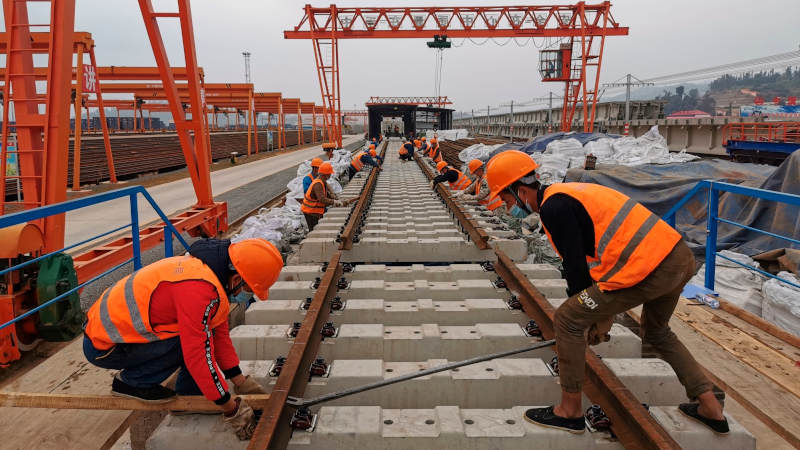
Stepping onto the Laos-China Railway (LCR) in Luang Prabang, the picturesque former royal capital in Northern Laos, brings a rush of aesthetic familiarity to anyone who has ridden the high-speed rail in China. From the train station massage chairs to the voice over the loudspeaker and the advertisements on seatbacks, the experience is decidedly Chinese. The result is both comforting and disorienting: riders feel they are not quite in China, but not quite all the way out of it either. China’s borderlands strategy of integration through connectivity results in borders that are blurred and shifted. The LCR is a physical manifestation of this new kind of borderland.

Opened in December 2021, the LCR is celebrated by China and Laos as a major accomplishment. President Xi Jinping called the LCR a “landmark project of high-quality Belt and Road cooperation.”1 The railway connects the Yunnan provincial capital of Kunming to Laos’s national capital of Vientiane, covering one thousand kilometers in less than ten hours—a trip that previously took days.2 It is a marvel of modern engineering, traversing the mountain jungle terrain of southern Yunnan and northern Laos with a long series of tunnels and bridges. It is the first leg constructed of China’s vision for a pan-Asia railway system connecting Kunming to Singapore via three trunks: Myanmar in the west, Laos and Thailand in the center, and Vietnam and Cambodia in the east.


The Laos-China Railway in Luang Prabang, Laos. By author, September 2025.

Tiếp tục đọc “All Railroads Lead to China: China’s Borderlands Strategy of Integration in Laos”
Laos Orders Reduced School Week to Offset Fuel Cost Pressures

kpl.gov.la 20/03/2026 07:54

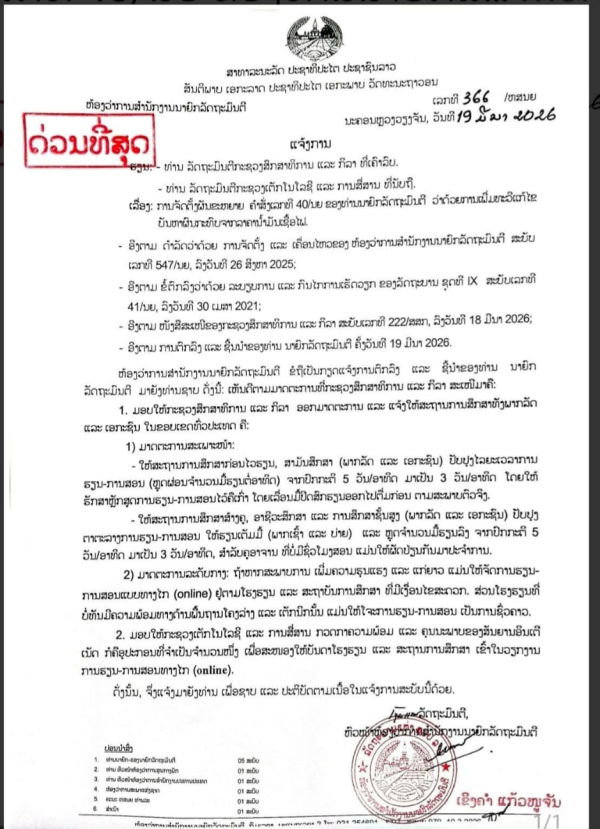
On March 19, 2026, the Prime Minister’s Office of the Lao PDR issued Notice No. 366/PMO mandating nationwide adjustments to school operations, as part of emergency measures to ease the financial strain on families amid continued fuel price volatility.

The directive, addressed to the Ministry of Education and Sports, introduces immediate changes to learning schedules while preserving academic standards and signaling further contingency steps if economic conditions worsen.

Under the order, all general education institutions—public and private—are required to scale back in-person instruction from five days to three days per week. Schools must continue delivering the full curriculum, with the academic calendar extended to compensate for reduced classroom time.

For teacher training institutes, vocational schools, and higher education institutions, schedules will be restructured into full-day sessions, combining morning and afternoon classes, while similarly reducing attendance to three days per week. Teaching personnel without assigned classes are instructed to report for duty on a rotating basis.

Officials said the policy is aimed at lowering transportation-related expenses for households while ensuring continuity in education delivery.

The government also outlined escalation measures should fuel-related pressures persist. Institutions with adequate digital infrastructure will transition to remote learning, while those lacking technical readiness may be required to temporarily suspend operations.

To support potential online learning, the Ministry of Technology and Communications has been tasked with verifying internet reliability nationwide and assessing the availability of essential equipment.

Authorities stressed that parents, teachers, and students must prepare for immediate implementation, highlighting the government’s broader effort to balance economic relief with uninterrupted access to education during a period of heightened cost pressures.

Mekong: The River That Feeds 70 Million People – Now in Danger

What happens when the river that feeds 70 million people is pushed to the brink?

The Mekong River runs over 5,000 km and across 6 countries: China, Burma, Laos, Thailand, Cambodia, and Vietnam, where it ends with its famous delta.

For hundreds of years, it has provided shelter, food, and all kinds of natural resources to over 60 million people who lived in harmony with the generous mother of all rivers. However, with the rapid growth that South East Asia is experiencing, as witnessed by the ever-increasing constructions and economic development projects, the fragile balance of communities living by and from its waters is at stake.

Facing a threat as well as an opportunity, the future of the Mekong lies in the diversity of its cultures and the beauty of its landscapes, shaped both by the river and its inhabitants.

00:00 – Introduction: Mother of All Rivers
01:33 – Laos: Boatmakers & River Traditions
06:57 – Prosperity and Struggles Along the Mekong
08:33 – Food, Insects & Rice: Life by the River
15:49 – Giant Fish and Ancient Conflicts
22:36 – Cambodia: The Mekong and Tonle Sap Lake
29:35 – Cambodia’s Dependence on the River
35:28 – Vietnam’s Mekong Delta: Nine Dragons of Asia
43:19 – Floating Markets & Rice Harvests
46:09 – Shrimp Farms and Environmental Challenges
50:55 – The Mekong’s Fragile Future

Fast and dubious: How electric cars are tiring the Mekong – Xe điện phát triển nóng đang bào mòn Mê Kông

mekongeye.com

This five-part series explores how the acceleration of electric vehicle adoption could increase the demand for rubber—a commodity that has historically driven deforestation and land grabbing across the Mekong region. Experts say the EV transition will boost rubber demand, as EVs need specialized tires that can bear heavier vehicle weight and high torque.

This matters to the Mekong region. Our data analysis shows that Cambodia, Laos, Myanmar, Thailand, and Viet Nam together supply nearly 50% of the world’s natural rubber. About 70% of global rubber goes into tires. Without effective traceability in place, deforestation and land conflicts, many of which are ongoing and affecting the lives and livelihoods of local communities—are unlikely to be solved.

Story by Mekong Eye’s investigation team
This series was produced in partnership with Earth Journalism Network and the Pulitzer Center

Electric vehicles (EVs) are on the rise — from Bangkok to Hanoi to Vientiane — promising a cleaner future as part of the global shift to clean energy, with more than 17 million electric cars sold worldwide in 2024.

But there is still a cost to pay for these ‘green cars’. With their heavier battery weight and higher torque, EVs wear out their tires faster than gasoline-powered cars, and therefore consume more tires throughout their lifetime.

In every tire is natural rubber, the key raw material that ensures durability, elasticity and strength.

The growing demand for EV tires has had significant implications for the Mekong region — Cambodia, Laos, Myanmar, Thailand and Viet Nam — which produces about 50% of the world’s natural rubber and hosts major plants for multinational tire manufacturers and EV makers.

Tiếp tục đọc “Fast and dubious: How electric cars are tiring the Mekong – Xe điện phát triển nóng đang bào mòn Mê Kông”

Fruits of spoil: Laos’ forests disappearing as fruit farms flourish (2 parts)

Fruits of spoil: Laos’ forests disappearing as fruit farms flourish

Mekong eyes – 16 December 2024 at 9:27 (Updated on 16 December 2024 at 15:40)

The country’s improved railway connectivity facilitates fruit exports to China but has also sparked a boom in foreign-owned banana and durian farms, leading to forest clearance

A Chinese-owned banana plantation on land that was once forested, located in Attapeu province, southern Laos, in August 2024.

The report was produced with support from the Pulitzer Center’s Rainforest Investigations Network (RIN) and Internews’ Earth Journalism Network as part of the “Ground Truths” collaborative reporting project on soils. 

ATTAPEU, LAOS — The new high-speed railway has enabled faster fruit exports from Laos to China, attracting more investment in large-scale plantations. However, this growth has come at the cost of deforestation.

Bananas and the “king of tropical fruit” – durians – are very popular in China, but they typically ripen within a few days of harvesting.

However, that problem was resolved with the launch of the Laos-China Railway in 2021, which has enabled landlocked Laos to deliver its fruit quickly to China’s 1.4 billion consumers.

Tiếp tục đọc “Fruits of spoil: Laos’ forests disappearing as fruit farms flourish (2 parts)”

Opinion: Energy importers must consider true ‘sustainability’ of Laos hydropower

Proponents describe regional power grids as a way to promote economic growth, energy security and renewables in Southeast Asia, but this might come at a heavy cost

Lat Tha Hae temple in Luang Prabang province, Laos, half submerged by the Nam Ou 1 hydropower dam (Image: Ton Ka/China Dialogue)

Ming Li Yong

the third pole – August 23, 2022

On 23 June 2022, the import of 100 megawatts (MW) of hydropower from Laos to Singapore through Thailand and Malaysia was hailed as a historic milestone. Part of a pilot project known as the Lao PDR-Thailand-Malaysia-Singapore Power Integration Project (LTMS-PIP), this event represented Singapore’s first ever import of renewable energy, and also the first instance of cross-border electricity trade involving four countries from the Association of Southeast Asian Nations (ASEAN).

However, this development takes place amid rising concerns for the ecological future of the transboundary Mekong River and the millions of people who depend on it. A 2018 study by the Mekong River Commission concluded that further hydropower development on the river would negatively affect ecosystems, and would reduce soil fertility, rice production, fish yields and food security, while increasing poverty in the river basin.

Tiếp tục đọc “Opinion: Energy importers must consider true ‘sustainability’ of Laos hydropower”

The lost tribe: The CIA’s secret army in Laos

The lost tribe: The CIA’s secret army in Laos | REWIND

Al Jazeera English – 24-8-2019

We trace a forgotten Hmong community in the jungles of northern Laos who helped the US during the Vietnam War.

Half a century ago, as war raged in Vietnam, an isolated community in the jungles of northern Laos was recruited by the CIA to help fight the Pathet Lao – the Laotian equivalent of Vietnam’s Viet Cong.

Over 50,000 of the Hmong tribe became part of the United States’s secret army, helping disrupt Communist supply lines along the Ho Chi Minh trail.

Tiếp tục đọc “The lost tribe: The CIA’s secret army in Laos”

Laos economic crisis intensifies amid massive Chinese debt

DW – 09.08.2022 – Enno Hinz

Laos is facing one of its worst economic crises in decades, with the country experiencing galloping inflation and staring at a debt default.   

Inflation in Laos has hit a 22-year high, causing a scarcity of essential commodities like fuel

Laos’ economy has been on the brink of collapse due to a spiraling debt crisis that is crippling the country’s finances and bringing it perilously close to default.

In June, the Southeast Asian nation’s Statistics Bureau announced that inflation hit a 22-year high of 23.6%, causing staple goods to become scarce and eroding the population’s purchasing power.

Tiếp tục đọc “Laos economic crisis intensifies amid massive Chinese debt”

Mỏ kim loại khủng ở Lào: Việt Nam dừng bước, “của hiếm” đổ hết sang Trung Quốc

vpdf – Ngày đăng: 09/12/2021 – 17:17

Dự kiến hàng triệu tấn kali khai thác ở Lào sẽ được xuất khẩu sang Trung Quốc nhờ tuyến đường sắt cao tốc mới khánh thành.

Mỏ kim loại khủng ở Lào: Việt Nam dừng bước, "của hiếm" đổ hết sang Trung

Tiếp tục đọc “Mỏ kim loại khủng ở Lào: Việt Nam dừng bước, “của hiếm” đổ hết sang Trung Quốc”

Laos to move on third Mekong dam project despite neighbours’ green concerns

FILE PHOTO: A local villager drive a boat where the future site of the Luang Prabang dam will be on
FILE PHOTO: A local villager drive a boat where the future site of the Luang Prabang dam will be on the Mekong River, outskirt of Luang Prabang province, Laos, February 5, 2020. REUTERS/Panu Wongcha-um/File Photo

BANGKOK: Laos is pushing ahead with a hydropower project on the Mekong River, despite reservations aired by neighbouring countries over its potential to harm fisheries and farming downstream, the Mekong River Commission (MRC) said on Wednesday (Jul 10.

The 1,400-megawatt (MW) Luang Prabang project will be Laos’s third and largest dam on the river, with construction originally set to begin this year. Tiếp tục đọc “Laos to move on third Mekong dam project despite neighbours’ green concerns”

Càng xây đập ồ ạt, Lào càng lún vào bẫy nợ Trung Quốc

baovemoitruong – 09/06/2020

Covid-19 khiến Lào khá điêu đứng và chật vật trong việc bán trái phiếu đô la, gây thêm áp lực cho quốc gia trong cơn xoay sở trả nợ, đặc biệt là với chủ nợ Trung Quốc.

Các nguồn tin thân cận cho hay Chính phủ Lào đã và đang áp dụng thái độ “kiên nhẫn chờ đợi” trước khi tiến hành bán trái phiếu. Tuy nhiên, Ngân hàng Trung ương Lào vẫn xác nhận liệu việc bán trái phiếu có tiếp tục diễn ra trong năm nay hay không.

Công nhân thi công tuyến đường sắt cao tốc Côn Minh-Vientiane, đoạn ở Ngọc Khê, phía tây nam tỉnh Vâm Nam, Trung Quốc. (Ảnh: AP) Tiếp tục đọc “Càng xây đập ồ ạt, Lào càng lún vào bẫy nợ Trung Quốc”

Hổ tuyệt chủng ở Lào

BVR&MT – Đó là kết luận của một nghiên cứu mới không tìm thấy bằng chứng hổ hoang dã còn tồn tại ở nước này.

Sau năm năm khảo sát bằng bẫy ảnh ở Khu bảo tồn Nam Et-Phou Louey giàu đa dạng sinh học, nhóm nghiên cứu không tìm thấy bất cứ bằng chứng nào về hổ ngoài cơ man những cái bẫy chết người.

Ảnh: Bill Robichaud/Global Wildlife Conservation

Dường như những cá thể hổ phải trả giá đắt nhất cho cuộc khủng hoảng bẫy thú đang hoành hành ở Lào và các nước khác tại Đông Nam Á. Tiếp tục đọc “Hổ tuyệt chủng ở Lào”

Việt Nam triển khai dự án khai thác mỏ lớn nhất tại Lào

(TTXVN/VIETNAM+

Bộ trưởng Kế hoạch và Đầu tư Lào, ông Suphan Keomisay và bà Phương Minh Huệ, Tổng Giám đốc Tập đoàn đầu tư Việt Phương đang trao cho nhau Hợp đồng tại lễ ký. (Ảnh: Kiên Phạm/Vietnam+)

Theo phóng viên TTXVN tại Vientiane, chiều 11/9, lễ ký Hợp đồng Khai thác và chế biến quặng bauxite và xây dựng nhà máy sản xuất aluminat giữa Chính phủ Lào và đại diện Tập đoàn đầu tư Việt Phương (VPG) của Việt Nam đã diễn ra tại Bộ Kế hoạch Đầu tư Lào.

Với tổng trị giá đầu tư ước tính 650 triệu USD, đây sẽ là dự án đầu tư vào lĩnh vực khai thác mỏ lớn nhất của Việt Nam từ trước tới nay tại Lào. Tiếp tục đọc “Việt Nam triển khai dự án khai thác mỏ lớn nhất tại Lào”

“Khai quật” thế giới ngầm buôn bán động vật hoang dã ở Việt Nam – 6 kỳ

Chợ trung tâm ở Sầm Nưa với nhiều sạp thịt thú rừng được bày bán.

***

“Khai quật” thế giới ngầm buôn bán động vật hoang dã ở Việt Nam

BVR&MT – Nhập vai đệ tử của một quan chức có máu mặt đang cần gấp nguồn “hàng hiếm”, nhóm phóng viênBảo vệ Rừng và Môi trườngđã thâm nhập được vào đường dây buôn bán động vật hoang dã tương đối lớn mà ở đó không chỉ có sự móc ngoặc giữa những “ông trùm” nội địa mà còn thông qua rất nhiều đầu nậu xuyên biên giới, đặc biệt là từ Lào, Campuchia và châu Phi. Tiếp tục đọc ““Khai quật” thế giới ngầm buôn bán động vật hoang dã ở Việt Nam – 6 kỳ”

Vietnam Rubber Group stripped of Forest Stewardship Council certification for forest destruction, illegal land grabs and human rights abuses

globalwitness – Press release / Oct. 26, 2015 

Rubber giant Vietnam Rubber Group (VRG) has been expelled from the world’s leading forest certification body, the Forest Stewardship Council (FSC), following an investigation into illegal land and forest clearance in Cambodia. Responding to a complaint submitted by Global Witness last November, the FSC found that the state-owned company had illegally destroyed at least 50,000 hectares of forest for its rubber plantations in Cambodia alone, including wildlife sanctuaries and protected areas.

“The FSC investigation provides further evidence that VRG has destroyed some of South East Asia’s most important remaining forests, with indigenous communities forcibly displaced in the process, and is forcibly taking land from its rightful owners and destroying livelihoods – with untold and irreversible effects,” said Patrick Alley, a Founding Director of Global Witness. “The FSC has done the right thing by dropping them from its certification scheme. Now VRG needs to urgently take action to address the damage it has caused.” Tiếp tục đọc “Vietnam Rubber Group stripped of Forest Stewardship Council certification for forest destruction, illegal land grabs and human rights abuses”