Năm 2017, tại bản Huổi Luông, xã Mường Lèo, huyện Sốp Cộp, xuất hiện một tổ chức tôn giáo lạ mang tên “Bà cô Dợ”. Tổ chức này đã lợi dụng niềm tin tín ngưỡng, tôn giáo của đồng bào, tuyên truyền, tập hợp lực lượng thành lập “Nhà nước Mông”, gây phức tạp về an ninh, trật tự và tác động tiêu cực đến đời sống văn hóa, xã hội của một bộ phận quần chúng nhân dân trên địa bàn.
Elon Musk warned in a new interview that artificial intelligence could lead to “civilization destruction,” even as he remains deeply involved in the growth of AI through his many companies, including a rumored new venture.
“AI is more dangerous than, say, mismanaged aircraft design or production maintenance or bad car production, in the sense that it is, it has the potential — however small one may regard that probability, but it is non-trivial — it has the potential of civilization destruction,” Musk said in a teaser clip Fox News shared of his interview with Tucker Carlson, which is set to air in two parts on Monday and Tuesday nights.
A fake website that masquerade as the Viecombank banking app. Photo by VnExpress/Luu QuyVietnamese citizens have been reporting fake text messages with user interfaces nearly identical to official apps and websites that ask recipients to provide bank information.
Bui Huyen from Hanoi said she nearly lost around VND280 million ($11,930) after receiving a scam text message from a number identified as “Vietcombank.”
The message came on Saturday last week, telling her that her VCB Digibank banking app had been logged into on an unknown device. The message provided a link to log into her account.
Huyen immediately clicked the link to secure her account because the text appeared on an official SMS thread from Vietcombank, so harbored no suspicions.
“The interface for logging in was identical to the app I often use, so I entered my account name and password as requested,” Huyen said.
Presidential Directive Will Serve as a Cornerstone Initiative During the Second Summit for Democracy
Today, President Biden signed an Executive Order that prohibits, for the first time, operational use by the United States Government of commercial spyware that poses risks to national security or has been misused by foreign actors to enable human rights abuses around the world.
Commercial spyware – sophisticated and invasive cyber surveillance tools sold by vendors to access electronic devices remotely, extract their content, and manipulate their components, all without the knowledge or consent of the devices’ users – has proliferated in recent years with few controls and high risk of abuse.
The proliferation of commercial spyware poses distinct and growing counterintelligence and security risks to the United States, including to the safety and security of U.S. Government personnel and their families. U.S. Government personnel overseas have been targeted by commercial spyware, and untrustworthy commercial vendors and tools can present significant risks to the security and integrity of U.S. Government information and information systems.
TN – Người Việt vẫn nằm trong top truy cập các sàn tiền ảo, tiền số lớn trên thế giới dù đã có nhiều người bị thua lỗ nặng nề.
Một khách sạn ở Phan Thiết mới đây thực hiện niêm yết, thanh toán tiền phòng bằng tiền ảo (Pi). Sau khi phát hiện, Công an Bình Thuận đã kiểm tra và buộc phải dừng niêm yết. Chủ khách sạn thừa nhận việc niêm yết và cho thanh toán tiền ảo từ cuối tháng 2.2023 do học cách làm của một số khách sạn ở P.Q đem về áp dụng. Chủ khách sạn cho hay đã niêm yết 0,5Pi/phòng/đêm và chỉ trao đổi chứ không mua bán đồng Pi.
Today, the Biden-Harris Administration released the National Cybersecurity Strategy to secure the full benefits of a safe and secure digital ecosystem for all Americans. In this decisive decade, the United States will reimagine cyberspace as a tool to achieve our goals in a way that reflects our values: economic security and prosperity; respect for human rights and fundamental freedoms; trust in our democracy and democratic institutions; and an equitable and diverse society. To realize this vision, we must make fundamental shifts in how the United States allocates roles, responsibilities, and resources in cyberspace.
(Illustration by Hailey Haymond/The Washington Post; iStock)
Hosts on Venezuelan state-owned television station VTV have been touting positive news coverage about their country from “una agencia gringa” — an American news agency. “This information isn’t coming from VTV, it’s not coming from me … these are numbers from an American news outlet,” one host exclaimed while showing clips of English-speaking anchors reporting favorably on Venezuela hosting baseball’s Caribbean Series and the country’s tourism industry.
But the reporters in those videos aren’t real. Their names are Daren and Noah, and they’re computer-generated avatars crafted by Synthesia, a London-based artificial intelligence company.
Digital technology has caused the biggest changes to teenage life in many decades. Typical American teenagers spend about half of their waking hours on their smartphones. They are on the phones when they are alone at home and when they are hanging out with friends.
TĐH: Traditional cybersecurity strategies are no longer sufficient for today’s cyberwar. The Zero Trust strategy is a new concept in cyberwar. To help understand this concept, I post here a paper by the US Department of Defense entitle “DOD Zero Trust Strategy.” This concept will involve not just DOD or military institutions, but also many private enterprises and individuals. Indeed, it involves the entire nation. I select the DOD presentation to post because, by nature of its job, DOD is probaly concerned about cybersecurity more than anyone else. Below is the Foreword of the DOD paper.
Our adversaries are in our networks, exfiltrating our data, and exploiting the Department’s users. The rapid growth of these offensive threats emphasizes the need for the Department of Defense (DoD) to adapt and significantly improve our deterrence strategies and cybersecurity implementations. Defending DoD networks with high-powered and ever-more sophisticated perimeter defenses is no longer sufficient for achieving cyber resiliency and securing our information enterprise that spans geographic borders, interfaces with external partners, and support to millions of authorized users, many of which now require access to DoD networks outside traditional boundaries, such as work from home. To meet these challenges, the DoD requires an enhanced cybersecurity framework built upon Zero Trust principles that must be adopted across the Department, enterprise-wide, as quickly as possible as described within this document.
The Nazis prepared for war from the moment Hitler came into power in 1933. In the feverish building up of German striking power, they had the support of the professional military men. The Nazis not only produced the weapons of war; they geared their economy for the strain of a future conflict. They carried on political intrigues to promote their purposes. Their propaganda machine had long been a going concern when Hitler felt ready to strike at Poland, the first step in an ambitious plan to lay the world at his feet.
Military, economic, political, and propaganda weapons were forged for the fray. Britain and France and, soon after, other peaceful nations were compelled to forge them to resist the Nazi onrush.
Today’s war is four-dimensional. It is a combination of military, economic, political, and propaganda pressure against the enemy. An appeal to force alone is not regarded as enough, in the twentieth century, to win final and lasting victory. War is fought on all four fronts at once—the military front, the economic front, the political front, and the propaganda front.
To understand how this four-dimensional warfare has come about, we have to look at history. We have to go back to the rise of nationalism in the eighteenth century.
Before the American and French revolutions took place at the end of the eighteenth century, many armies fought in the pay of monarchies, such as the Bourbons, Hapsburgs, and Hohenzollerns, or of individual leaders. They were mercenary armies. They did not fight for patriotic motives. They did not fight for causes. They fought because fighting was their business. No fight, no pay!
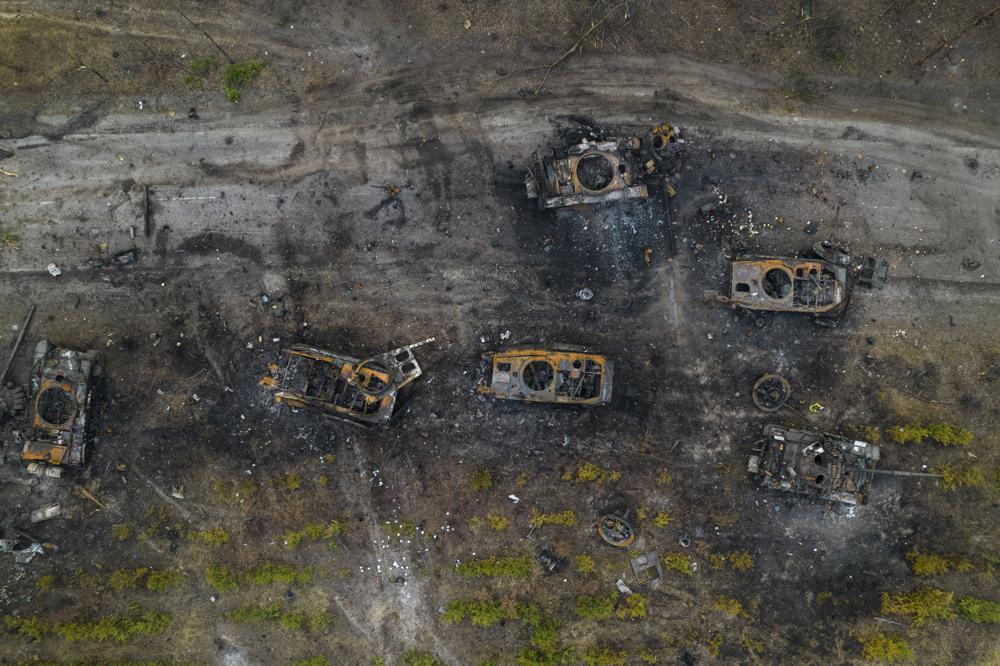
FILE – Destroyed Russian armored vehicles sit on the outskirts of Kyiv, Ukraine, March 31, 2022. In the year since Russia invaded Ukraine, disinformation and propaganda have emerged as key weapons in the Kremlin’s arsenal. (AP Photo/Rodrigo Abd, File)
WASHINGTON (AP) — Russia’s invasion of Ukraine is the deadliest conflict in Europe since World War II, and the first to see algorithms and TikTok videos deployed alongside fighter planes and tanks.
The online fight has played out on computer screens and smartphones around the globe as Russia used disinformation, propaganda and conspiracy theories to justify its invasion, silence domestic opposition and sow discord among its adversaries.
Now in its second year, the war is likely to spawn even more disinformation as Russia looks to break the will of Ukraine and its allies.
When we rise in the morning and listen to the radio or read the newspaper, we are confronted with the same sad news: violence, crime, wars, and disasters. I cannot recall a single day without a report of something terrible happening somewhere. Even in these modern times it is clear that one’s precious life is not safe. No former generation has had to experience so much bad news as we face today; this constant awareness of fear and tension should make any sensitive and compassionate person question seriously the progress of our modern world.
It is ironic that the more serious problems emanate from the more industrially advanced societies. Science and technology have worked wonders in many fields, but the basic human problems remain. There is unprecedented literacy, yet this universal education does not seem to have fostered goodness, but only mental restlessness and discontent instead. There is no doubt about the increase in our material progress and technology, but somehow this is not sufficient as we have not yet succeeded in bringing about peace and happiness or in overcoming suffering.
We can only conclude that there must be something seriously wrong with our progress and development, and if we do not check it in time there could be disastrous consequences for the future of humanity. I am not at all against science and technology – they have contributed immensely to the overall experience of humankind; to our material comfort and well-being and to our greater understanding of the world we live in. But if we give too much emphasis to science and technology we are in danger of losing touch with those aspects of human knowledge and understanding that aspire towards honesty and altruism.
Science and technology, though capable of creating immeasurable material comfort, cannot replace the age-old spiritual and humanitarian values that have largely shaped world civilization, in all its national forms, as we know it today. No one can deny the unprecedented material benefit of science and technology, but our basic human problems remain; we are still faced with the same, if not more, suffering, fear, and tension. Thus it is only logical to try to strike a balance between material developments on the one hand and the development of spiritual, human values on the other. In order to bring about this great adjustment, we need to revive our humanitarian values.
I am sure that many people share my concern about the present worldwide moral crisis and will join in my appeal to all humanitarians and religious practitioners who also share this concern to help make our societies more compassionate, just, and equitable. I do not speak as a Buddhist or even as a Tibetan. Nor do I speak as an expert on international politics (though I unavoidably comment on these matters). Rather, I speak simply as a human being, as an upholder of the humanitarian values that are the bedrock not only of Mahayana Buddhism but of all the great world religions. From this perspective I share with you my personal outlook – that:
The Microsoft Bing logo and the website’s page are shown in this photo taken in New York on Tuesday, Feb. 7, 2023. Microsoft is fusing ChatGPT-like technology into its search engine Bing, transforming an internet service that now trails far behind Google into a new way of communicating with artificial intelligence. (AP Photo/Richard Drew)
The race among tech companies to roll out generative artificial intelligence (AI) tools is raising concerns about how mistakes in technology and blind spots in regulation could hasten the spread of misinformation, elevate biases in results and increase the harvesting and use of Americans’ personal data.
So far tech giants Microsoft and Google are leading the race in releasing new AI tools to the public, but smaller companies and startups are expected to make progress in the field.
Ultimately, “[t]he [BAYC NFT] series serves as a kind of fan club on
steroids that encourages owners of the NFTs to move through an ever-growing and
exclusive list of events and opportunities.”32 And the Company presents the Bored
Ape ecosystem as a brand that is organically beloved by some of the most famous
celebrities in the world. But the truth is that the Company’s entire business model
relies on using insidious marketing and promotional activities from A-list celebrities
that are highly compensated (without disclosing such), to increase demand of the
Yuga securities by convincing potential retail investors that the price of these digital
assets would appreciate and that, as members of “the club,” these investors would be
given exclusive access to additional financial products and benefits.
Sitting across from Jimmy Fallon on “The Tonight Show,” Paris Hilton, wearing a sparkling neon green turtleneck dress and a high ponytail, looked at a picture of a glum cartoon ape and said it “reminds me of me.” The audience laughed. It did not look like her at all.
Hilton and Fallon were chatting about their NFTs – non-fungible tokens, typically digital art bought with cryptocurrency – from the Bored Ape Yacht Club. The camera zoomed in on framed printouts of the ape cartoons. “We’re both apes,” Fallon said. Hilton, with her signature vocal fry, replied, “Love it.”
“The Tonight Show” episode from January 2022 is a YouTube time capsule showing the temporary alliance between celebrity marketing and the crypto industry. Bored Ape Yacht Club was not the biggest crypto phenomenon, but it was one of the top beneficiaries of celebrity hype. That celebrity hype, in turn, helped draw new consumers to crypto — an industry rife with manipulation and fraud, and one that US regulators are now giving more scrutiny in the wake of the collapse of crypto exchange FTX. But for a time, when crypto’s prices seemed to have no limit, the money appeared too good for some to ask questions — questions like: Why are some of those apes wearing prison clothes?
Artificial Intelligence (AI) has the potential to address some of the biggest challenges in education today, innovate teaching and learning practices, and ultimately accelerate the progress towards SDG 4. However, these rapid technological developments inevitably bring multiple risks and challenges, which have so far outpaced policy debates and regulatory frameworks. This publication offers guidance for policy-makers on how best to leverage the opportunities and address the risks, presented by the growing connection between AI and education. It starts with the essentials of AI: definitions, techniques and technologies. It continues with a detailed analysis of the emerging trends and implications of AI for teaching and learning, including how we can ensure the ethical, inclusive and equitable use of AI in education, how education can prepare humans to live and work with AI, and how AI can be applied to enhance education. It finally introduces the challenges of harnessing AI to achieve SDG 4 and offers concrete actionable recommendations for policy-makers to plan policies and programmes for local contexts.








 CVD
CVD 