For nearly 60 days, no food, fuel, medicine or other item has entered the Gaza Strip, blocked by Israel. Aid groups are running out of food to distribute. Markets are nearly bare. Palestinian families are left struggling to feed their children. We discussed that with out guest Arwa Damon, founder of the International Network for Aid, Relief and Assistance (INARA)
The World Food Programme runs out of food in Gaza as Israeli blockade continues
The World Food Programme has run out of food 54 days after Israel imposed a complete blockade on the Gaza Strip. NBC News’ Matt Bradley reports on what families in Gaza are facing as Israel’s blockade continues.
WFP runs out of food stocks in Gaza, warns of famine
On 21 September, 2022, an IT specialist with the Austrian Raiffeisen Bank, Timur Izmailov, was leading a normal life in Moscow. Three weeks later Izmailov found himself serving as a soldier in Russia’s 27th motorized rifle brigade near the Ukrainian city of Svatove, when he was eventually killed by mortar fire. How does a 33-year-old techie make his way from his cubicle to the frontline of an unprovoked war in a neighbouring democratic state?
Timur’s journey began on 24 February, 2022, when President Vladimir Putin ordered the all-out military invasion of Ukraine in continuation of a war started in 2014. The response was immediate. The Ukrainian people and their leadership — with the support of the democratic allies — have defended themselves against armed aggression despite gross human rights violations.
Western sanctions imposed on Russia created an extremely hostile commercial environment for companies such as Raiffeisen to continue their operations in the aggressor state. Many international firms pulled out, announcing plans to leave or suspend activity in Russia. But many more international companies continue to operate and pay taxes, thus contributing to the occupation of Ukraine and undermining the financial support provided to Ukraine by their own governments.
On 21 September 2022, President Vladimir Putin issued the mobilization decree that obliged companies to immediately assist in conscripting soldiers and help equip the Russian army. The results of this piece of legislation were immediately felt by many, including Timur Izmailov. Raiffeisen’s attempts to shield their staff from the draft failed.
How do bank employees in other countries feel knowing this is happening to their colleagues in Russia? How does a client of Raiffeisen based in Vienna feel, knowing the employees of his bank might soon become soldiers sent to the battlefield to kill innocent civilians in Ukraine?
An additional stopover on the companies’ journey from compliance to complicity happened last July, when Putin signed a new law allowing the government to impose special economic measures to support “counter-terrorism and other operations outside of Russia”. Once introduced, such measures would require companies to provide goods and services in support of these operations and impose significant penalties for failing to do so. In accordance with the law of 7 October 2022, the Russian subsidiary of Raiffeisen Bank International is now obliged to provide loan payment holidays to the troops fighting in Ukraine. Moreover, the bank is required to write off the entire debt in case of a soldier’s death. This legal requirement concerns other financial institutions that still operate in Russia, namely Intesa Sanpaolo, OTP Bank, ING Bank, Credit Agricole, Citibank, Credit Europe Bank and UniCredit.
This loan relief scheme has already triggered criticism from Ukraine’s central bank, as well as from investors concerned about reputational impact. The requirement for banks to grant payment holidays to soldiers “illustrates the dangers of operating in jurisdictions where companies can…be forced into actions that go directly against their corporate values,” said Eric Christian Pederson of Nordea Asset Management. “We feel that it is right for companies to withdraw from Russia, given its unprovoked attack on Ukraine,” he added.
Fri 11 Nov 2022 05.00 GMT Last modified on Fri 11 Nov 2022 17.40 GMT
Across the country, fact-finding teams are tirelessly gathering evidence and testimony about Russian atrocities, often within hours of troops retreating. Turning this into convictions will not be easy, or quick, but the task has begun
FACT CHECK: Putin falsely claims Ukraine invasion ‘in full conformity’ with UN Charter
Voice of America – 26-8-2022
Addressing the 10th Moscow Conference on International Security on August 16, Russian President Vladimir Putin claimed that his war on Ukraine does not violate the U.N. Charter and was launched to protect the residents of Ukraine’s Donbas region from “genocide.”
“We have taken the decision to conduct a special military operation in Ukraine, a decision which is in full conformity with the Charter of the United Nations. It has been clearly spelled out that the aims of this operation are to ensure the security of Russia and its citizens and protect the residents of Donbas from genocide,” he said.
That statement is false.
The Russian invasion of Ukraine violated not only the U.N. Charter but also international law and even Russian law. Moreover, under international criminal law, the invasion is viewed as a crime of aggression.
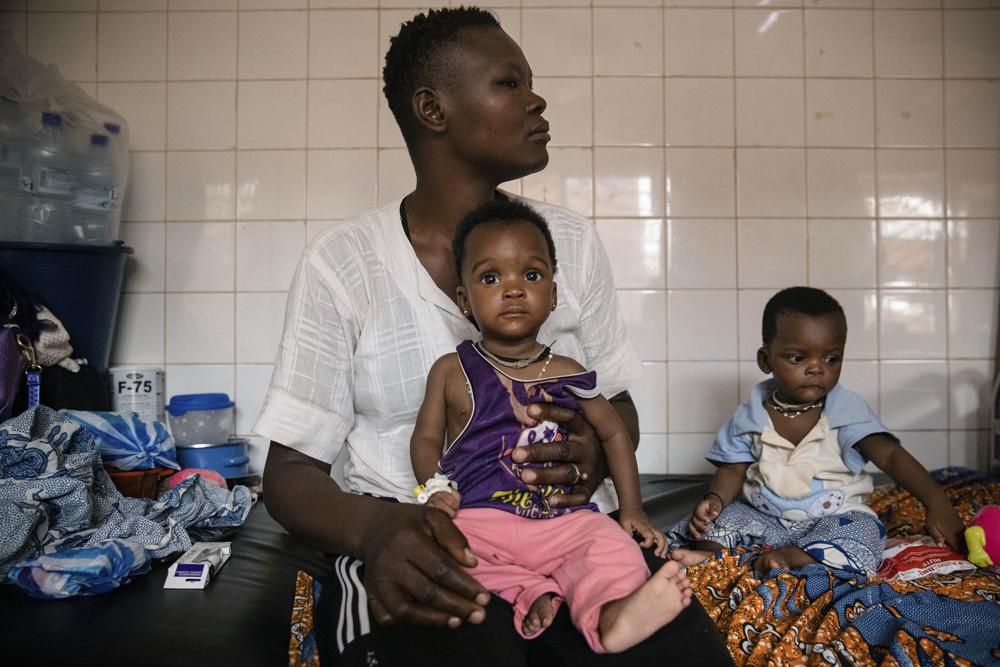
FILE- In this April 15, 2022 file photo, malnourished children wait for treatment in the pediatric department of Boulmiougou hospital in Ouagadougou, Burkina Faso. The U.N. is warning that 18 million people in Africa’s Sahel region face severe hunger in the next three months. Two U.N. agencies are citing the impacts of war in Ukraine, the coronavirus pandemic, climate-induced shocks and rising costs – and warning that people may try to migrate out of the affected areas. (AP Photo/Sophie Garcia, File)
GENEVA (AP) — The head of the U.N. refugee agency says “Europe should be much more worried” that more people from Africa’s Sahel region could seek to move north to escape violence, climate crises like droughts and floods and the impact of growing food shortages caused by Russia’s invasion of Ukraine.Filippo Grandi, the U.N. High Commissioner for Refugees, called for more efforts to build peace in the world as conflicts and crises like those in Ukraine, Venezuela, Myanmar, Syria and beyond have driven over 100 million people to leave their homes — both within their own countries and abroad.
UNHCR, the U.N.’s refugee agency, on Thursday issued its latest “Global Trends” report, which found over 89 million people had been displaced by conflict, climate change, violence and human rights abuses by 2021. The figure has since swelled after at least 12 million people fled their homes in Ukraine to other parts of the country or abroad following Russia’s Feb. 24 invasion.
This year, the world is also facing growing food insecurity — Ukraine is a key European breadbasket and the war has greatly hurt grain exports
The African Union, whose continent relies on imports of wheat and other food from Ukraine, has appealed for help to access grain that is blocked in Ukrainian silos and unable to leave Ukrainian ports amid a Russian naval blockade in the Black Sea.
By Robbie Gramer, a diplomacy and national security reporter at Foreign Policy, and Amy Mackinnon, a national security and intelligence reporter at Foreign Policy.
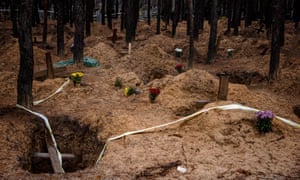
An aerial view of crosses, floral tributes, and photographs of the victims of the battles for Irpin and Bucha that mark the graves in a cemetery in Irpin, Ukraine, on May 16.
JUNE 10, 2022, 3:48 PM
As Russia continues its assault on Ukraine, top Biden administration officials are working behind the scenes with the Ukrainian government and European allies to document a tsunami of war crimes allegedly committed by Russian forces.
But the sheer volume of the documented war crime cases could be too overwhelming for Ukraine’s justice system as well as for the International Criminal Court (ICC), raising questions of how many cases will be brought to trial and how many accused Russian war criminals could ultimately face justice.
Briefing the Security Council on his shuttle diplomacy last week in Russia and Ukraine, Secretary-General António Guterres declared that he “did not mince words” during meetings with Presidents Putin and Zelenskyy, on the need to end the brutal conflict.
“I said the same thing in Moscow as I did in Kyiv…Russia’s invasion of Ukraine is a violation of its territorial integrity and of the Charter of the United Nations,” he told the Ambassadors.
“It must end for the sake of the people of Ukraine, Russia, and the entire world…the cycle of death, destruction, dislocation and disruption must stop.”
The UN chief said he had gone into an active war zone in Ukraine, after first travelling to Moscow, without much prospect of any ceasefire – as the east of the country continues to face “a full-scale ongoing attack”.
Karina Yershova, right, is pictured with her grandmother in an undated photograph provided by the family.
Lviv, Ukraine (CNN)When Russian troops invaded Ukraine and began closing in on its capital, Kyiv, Andrii Dereko begged his 22-year-old stepdaughter Karina Yershova to leave the suburb where she lived.
But Yershova insisted she wanted to remain in Bucha, telling him: “Don’t talk nonsense, everything will be fine — there will be no war,” he said.
With her tattoos and long brown hair, Yershova stood out in a crowd, her stepfather said, adding that despite living with rheumatoid arthritis, she had a fiercely independent spirit: “She herself decided how to live.”
Yershova worked at a sushi restaurant in Bucha, and hoped to earn her university degree in the future, Dereko said: “She wanted to develop herself.”
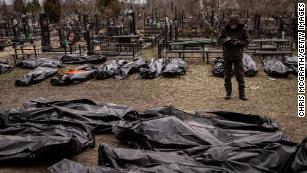
Unclaimed and unidentified: Bucha empties its mass graves 03:24
As Russian soldiers surrounded Bucha in early March, Yershova hid in an apartment with two other friends. On one of the last occasions Dereko and his wife, Olena, heard from Yershova, she told them she had left the apartment to get food from a nearby supermarket.
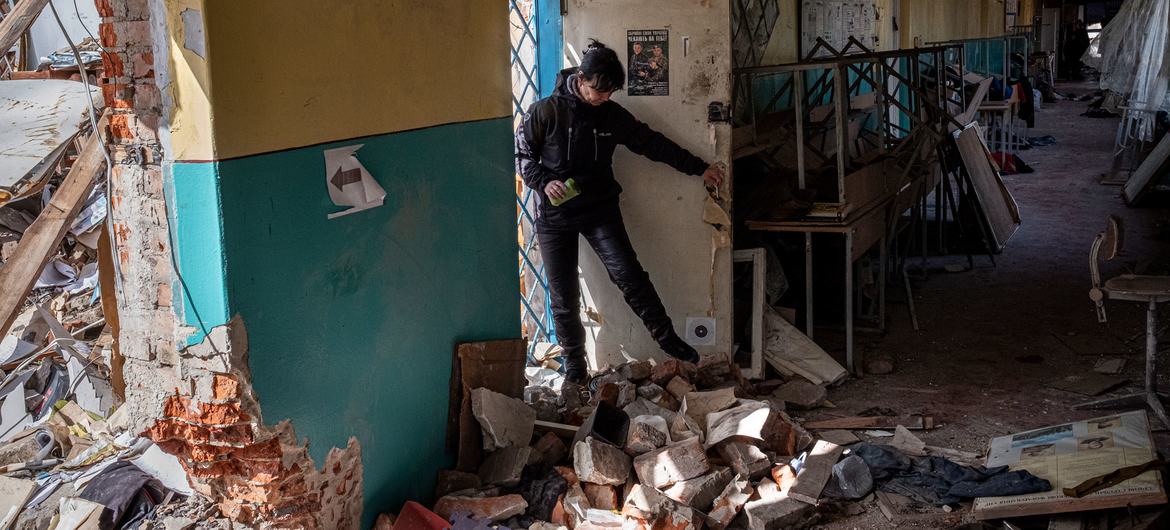
As Russian artillery and rockets land on Ukrainian hospitals and apartment blocks, devastating residential districts with no military value, the world is watching with horror what is, for Russia, an increasingly standard practice.
Its forces conducted similar attacks in Syria, bombing hospitals and other civilian structures as part of Russia’s intervention to prop up that country’s government.
Moscow went even further in Chechnya, a border region that had sought independence in the Soviet Union’s 1991 breakup. During two formative wars there, Russia’s artillery and air forces turned city blocks to rubble and its ground troops massacred civilians in what was widely seen as a deliberate campaign to terrorize the population into submission.
Now, Vladimir V. Putin, whose rise to Russia’s presidency paralleled and was in some ways cemented by the Chechen wars, appears to be deploying a similar playbook in Ukraine, albeit so far only by increments.
Russia’s invasion of Ukraine has already driven millions of people from their homes and left many without water, power and food. As hostilities continue, the humanitarian and economic consequences will expand far beyond the region, putting potentially millions of people around the world at risk of hunger.
And these aren’t just short-term threats. The decisions that farmers and policymakers make over the next few weeks and months will have long-term consequences for the future of the world’s food systems. The right responses can keep the world on track for a sustainable food future. The wrong ones will worsen food insecurity and fuel climate change.
Ukrainian refugees escape to the border town of Medyka, Poland. Millions of Ukrainian residents have fled their homes in recent weeks, due to the Russian invasion. Photo by Damian Pankowiec/Shutterstock
Tuyên cáo về các Nguyên tắc Luật Quốc tế về Liên hệ Hữu nghị và Hợp tác giữa các Quốc gia theo đúng Hiến chương Liên hợp quốc (“Tuyên cáo”) được Đại hội đồng Liên hợp quốc thông qua ngày 17 tháng 10 năm 1970 quy định “Nguyên tắc rằng mọi Quốc gia, trong các liên hệ quốc tế, tự kiềm chế không dùng hăm dọa hay sử dụng vũ lực chống lại toàn vẹn chủ quyền hoặc độc lập chính trị của bất kỳ Quốc gia nào hoặc dưới bất kỳ hình thức nào trái ngược với các mục đích của Hiến chương Liên hợp quốc.”
China’s 3 Crimes of War of Aggression against the Vietnamese People
The UN General Assembly’s Declaration on Principles of International Law concerning Friendly Relations and Co-operation among States in accordance with the Charter of the United Nations (Oct. 17, 1970) (hereinafter “the Declaration”) provided, inter alia, “The principle that States shall refrain in their international relations from the threat or use of force against the territorial integrity or political independence of any State or in any other manner inconsistent with the purposes of the United Nations”.






 CVD
CVD 