‘We are dying of hunger’: Gaza civilians collapse under total Israeli siege

A warning to our viewers – the images in this report are deeply disturbing.

Israel’s ongoing blockade on Gaza has led to an alarming rise in the number of people who have been starved to death. Gaza’s health ministry says 19 Palestinians have died of hunger in 24 hours.

The UN says it’s receiving ‘desperate messages of starvation’ while aid is stockpiled just outside and remains blocked.

Al Jazeera’s Um-e-Kulsoom Shariff reports.

What does the failure of humanitarianism in Gaza mean?

ODI.org 10 June 2025~ Written by. Freddie Carver

A Palestinian healthcare worker wades through the destroyed remains of a pharmaceutical warehouse

Hero image description: A Palestinian healthcare worker wades through the destroyed remains of a pharmaceutical warehouseImage credit:A Palestinian healthcare worker inspects the damage to a pharmaceutical warehouse after it was targeted by Israeli warplanes in Khan Yunis, southern Gaza Strip, in May 2025. Credit: Anas-Mohammed/Shutterstock

Over the next fortnight, crucial discussions will be made in Geneva and New York that will shape the future of humanitarian action, as United Nations (UN) agencies and donor governments try to agree a way forwards after the sweeping cuts of the first half of 2025.

A fight is underway: on one side, those who recognise that this has to be the moment for long-awaited change; on the other, those who are trying to hold on to past ways of working. For anyone still uncertain about the right path, all they need to do is to look at the situation in Gaza.

Tiếp tục đọc “What does the failure of humanitarianism in Gaza mean?”

Myanmar confirms 180,000 Rohingya eligible to return, Bangladesh says

Aljazeera.com

The 180,000 names were part of a list of 800,000 Rohingya that Bangladesh submitted to Myanmar in six batches, Bangladesh government says.

Rohingya refugees wait in Cox's Bazar, Bangladesh
Rohingya refugees wait at the World Food Programme distribution centre to buy grocery items in Cox’s Bazaar [File: Mohammad Ponir Hossain/Reuters]

Published On 4 Apr 20254 Apr 2025

Myanmar has confirmed that 180,000 Rohingya refugees living in Bangladesh since fleeing their homeland are eligible to return, the Bangladeshi government has said.

Friday’s announcement, following talks in Bangkok, offered a possible breakthrough in the long-stalled repatriation process, although many Rohingya refugees say all of them should be allowed to go home.

Tiếp tục đọc “Myanmar confirms 180,000 Rohingya eligible to return, Bangladesh says”

Violent gangs, disease and hunger deepen humanitarian crisis in Haiti

Haiti: UN report says gang violence spreading, urges speedy deployment of multinational security mission

28 November 2023

People in Haiti are Living A Nightmare

GENEVA/PORT-AU-PRINCE (28 November 2023) – A new UN report out today details a further, shocking rise in gang violence in Haiti as criminal gangs forge alliances and expand to rural areas previously considered safe – killing, raping, kidnapping, and destroying property, among other abuses.

The report, released by the UN Human Rights Office and the UN Integrated Office in Haiti (BINUH), calls for the urgent deployment of the Multinational Security Support mission authorized by the UN Security Council in October, in accordance with international human rights norms and standards. Increased efforts will need to be deployed to strengthen Haiti’s rule of law institutions, in particular the police, the judiciary, and the prison system, the report notes.

Tiếp tục đọc “Violent gangs, disease and hunger deepen humanitarian crisis in Haiti”

Jewish New Yorkers occupy Statue of Liberty to demand Israel-Gaza ceasefire

aljazeera.com

Activists from Jewish Voice for Peace group unfurl banners reading ‘Palestinians should be free’ at the base of New York landmark.

Activists from Jewish Voice for Peace occupy the pedestal of the Statue of Liberty
Activists from Jewish Voice for Peace occupy the pedestal of the Statue of Liberty. [Stephanie Keith/Getty Images via AFP]

Published On 7 Nov 20237 Nov 2023

Hundreds of US Jewish activists have peacefully occupied New York’s Statue of Liberty to demand an end to Israel’s “genocidal bombardment” of civilians in Gaza and a ceasefire.

Dressed in black T-shirts emblazoned with the slogans “Jews demand ceasefire now” or “Not in our name”, the protesters from the Jewish Voice for Peace group on Monday unfurled banners reading “The whole world is watching” and “Palestinians should be free” at the base of New York’s landmark.

It was the latest pro-Palestinian protest to take place in the United States since the start of the war a month ago.

On Saturday, tens of thousands of demonstrators, gathered in Washington, DC to call for an immediate ceasefire in the Gaza Strip, and to denounce US policy of support for Israel.

Tiếp tục đọc “Jewish New Yorkers occupy Statue of Liberty to demand Israel-Gaza ceasefire”

Doctor in Gaza’s Hospital Describes the Harrowing Scene

Dr. Mohammed Obeid, a surgeon with Doctors Without Borders/Médecins Sans Frontières (MSF) working inside Al-Shifa hospital in Gaza, described the situation on November 11, 2023. “Since this morning, there is no electricity. There is no water. There is no food,” he said. The hospital and the areas outside the hospital where people are sheltering have been hit with bombs. A sniper has wounded patients inside the hospital. Premature babies have died because the incubator cannot function without electricity. “We need help,” he said. “No one hears us.”

Premature babies are dying at Gaza’s al-Shifa Hospital

Commission of Inquiry finds further evidence of war crimes in Ukraine

UN.org

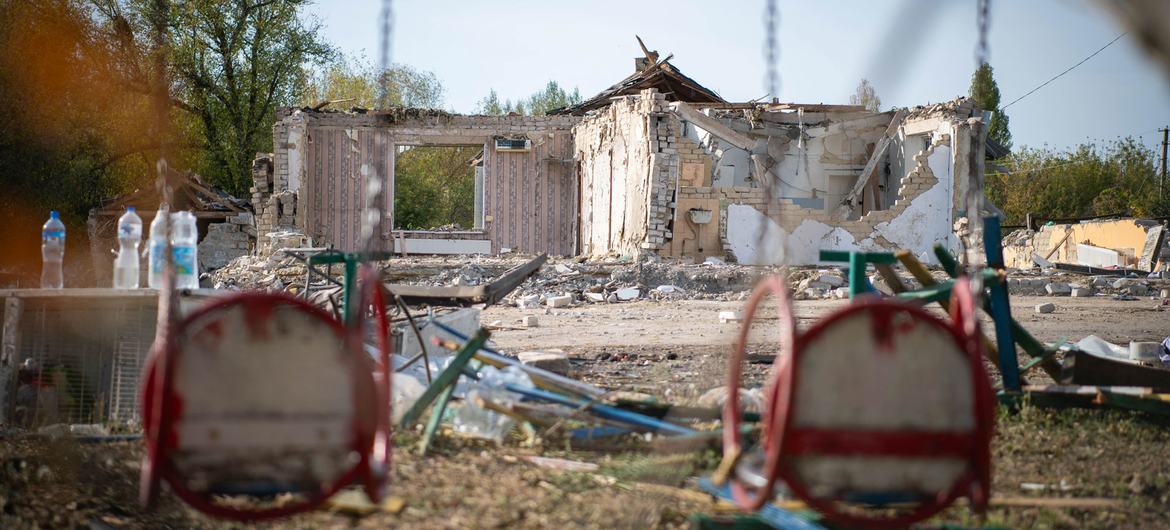
A playground lies in ruins near  in the village of Groza in eastern Ukraine.

© Yevhen Nosenko

A playground lies in ruins near in the village of Groza in eastern Ukraine.

Facebook Twitter Print Email

Human Rights

A new UN report has found continued evidence of war crimes and human rights violations committed by Russian authorities in Ukraine, including torture, rape and the deportation of children. 

Tiếp tục đọc “Commission of Inquiry finds further evidence of war crimes in Ukraine”

How war crimes prosecutions work

Zachary B. Wolf

Analysis by Zachary B. Wolf, CNN

Published 2:42 PM EDT, Fri March 17, 2023

After more than a year of international outrage at Russia’s invasion of Ukraine and shocking atrocities, there’s an arrest warrant out for Russian President Vladimir Putin.

The International Criminal Court on Friday announced charges against Putin and Russian official Maria Lvova-Belova relating to an alleged scheme to forcibly deport thousands of Ukrainian children to Russia.

Read CNN’s full report about the charges and the arrest warrant.

And read about the scheme involving Ukrainian children taken to Russia.

Russia rejected the allegations Friday, and a ministry of foreign affairs spokeswoman said the court has “no meaning” in Russia.

Tiếp tục đọc “How war crimes prosecutions work”

The ICC issued arrest warrants on Friday for Putin and Russian official Maria Lvova-Belov

Russia scoffs but Putin could stand trial for alleged war crimes, ICC chief prosecutor says

By Caitlin Hu, CNN

Updated 9:03 PM EDT, Fri March 17, 2023

Karim Khan ICC vpx

ICC chief prosecutor reacts to Putin arrest warrant

The International Criminal Court’s chief prosecutor believes Russian President Vladimir Putin could stand trial for alleged crimes committed during Russia’s war in Ukraine, he told CNN on Friday, despite Moscow’s arguments that it is not subject to the court’s decisions.

In an interview with CNN’s Clarissa Ward, Chief Prosecutor Karim Khan pointed to historic trials of Nazi war criminals, former Yugoslavian President Slobodan Milošević, and former Liberian leader Charles Taylor, among others.

“All of them were mighty, powerful individuals and yet they found themselves in courtrooms,” he said.

Tiếp tục đọc “The ICC issued arrest warrants on Friday for Putin and Russian official Maria Lvova-Belov”

A Human Approach to World Peace

The 14th Dalai Lama of Tibet

When we rise in the morning and listen to the radio or read the newspaper, we are confronted with the same sad news: violence, crime, wars, and disasters. I cannot recall a single day without a report of something terrible happening somewhere. Even in these modern times it is clear that one’s precious life is not safe. No former generation has had to experience so much bad news as we face today; this constant awareness of fear and tension should make any sensitive and compassionate person question seriously the progress of our modern world.
 
It is ironic that the more serious problems emanate from the more industrially advanced societies. Science and technology have worked wonders in many fields, but the basic human problems remain. There is unprecedented literacy, yet this universal education does not seem to have fostered goodness, but only mental restlessness and discontent instead. There is no doubt about the increase in our material progress and technology, but somehow this is not sufficient as we have not yet succeeded in bringing about peace and happiness or in overcoming suffering.
 
We can only conclude that there must be something seriously wrong with our progress and development, and if we do not check it in time there could be disastrous consequences for the future of humanity. I am not at all against science and technology – they have contributed immensely to the overall experience of humankind; to our material comfort and well-being and to our greater understanding of the world we live in. But if we give too much emphasis to science and technology we are in danger of losing touch with those aspects of human knowledge and understanding that aspire towards honesty and altruism.
 
Science and technology, though capable of creating immeasurable material comfort, cannot replace the age-old spiritual and humanitarian values that have largely shaped world civilization, in all its national forms, as we know it today. No one can deny the unprecedented material benefit of science and technology, but our basic human problems remain; we are still faced with the same, if not more, suffering, fear, and tension. Thus it is only logical to try to strike a balance between material developments on the one hand and the development of spiritual, human values on the other. In order to bring about this great adjustment, we need to revive our humanitarian values.
 
I am sure that many people share my concern about the present worldwide moral crisis and will join in my appeal to all humanitarians and religious practitioners who also share this concern to help make our societies more compassionate, just, and equitable. I do not speak as a Buddhist or even as a Tibetan. Nor do I speak as an expert on international politics (though I unavoidably comment on these matters). Rather, I speak simply as a human being, as an upholder of the humanitarian values that are the bedrock not only of Mahayana Buddhism but of all the great world religions. From this perspective I share with you my personal outlook – that:

Tiếp tục đọc “A Human Approach to World Peace”

Ukraine: ‘Cycle of death, destruction’ must stop, UN chief tells Security Council

UN.org

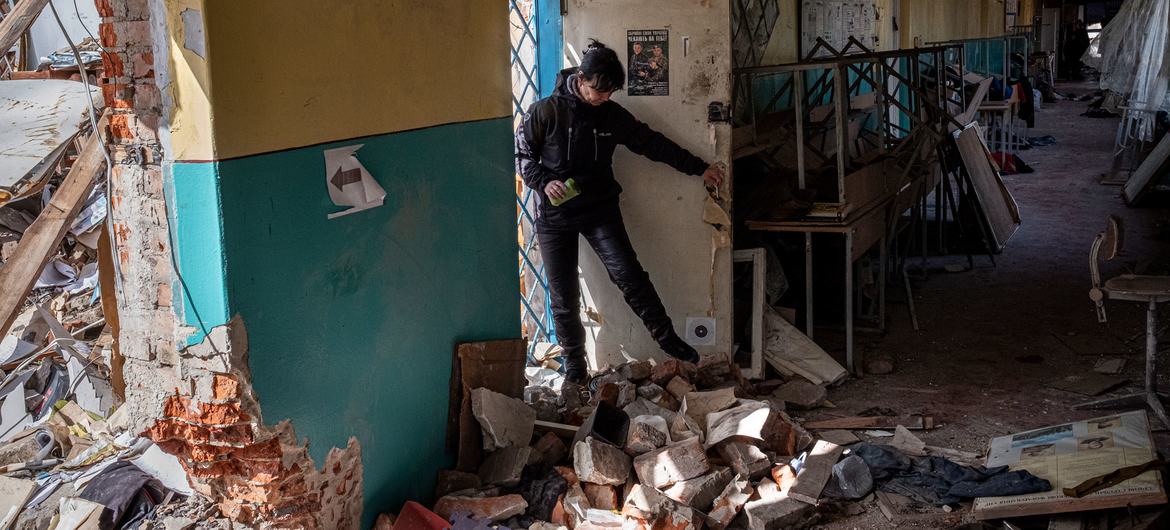
The principal of a school in Chernihiv, Ukraine, surveys the damage caused during an aerial bombardment.

© UNICEF/Ashley Gilbertson VII Photo

The principal of a school in Chernihiv, Ukraine, surveys the damage caused during an aerial bombardment.

5 May 2022

Peace and Security

Briefing the Security Council on his shuttle diplomacy last week in Russia and Ukraine, Secretary-General António Guterres declared that he “did not mince words” during meetings with Presidents Putin and Zelenskyy, on the need to end the brutal conflict.

“I said the same thing in Moscow as I did in Kyiv…Russia’s invasion of Ukraine is a violation of its territorial integrity and of the Charter of the United Nations,” he told the Ambassadors.    

“It must end for the sake of the people of Ukraine, Russia, and the entire world…the cycle of death, destruction, dislocation and disruption must stop.” 

The UN chief said he had gone into an active war zone in Ukraine, after first travelling to Moscow, without much prospect of any ceasefire – as the east of the country continues to face “a full-scale ongoing attack”.

Tiếp tục đọc “Ukraine: ‘Cycle of death, destruction’ must stop, UN chief tells Security Council”

Russia’s Brutality in Ukraine Has Roots in Earlier Conflicts

Its experience in a string of wars led to the conclusion that attacking civilian populations was not only acceptable but militarily sound.

nytimes.com

Ukrainian emergency workers at a maternity hospital damaged by shelling in Mariupol last week.
Ukrainian emergency workers at a maternity hospital damaged by shelling in Mariupol last week.Credit…Evgeniy Maloletka/Associated Press
Max Fisher

By Max Fisher

Published March 18, 2022Updated March 22, 2022

As Russian artillery and rockets land on Ukrainian hospitals and apartment blocksdevastating residential districts with no military value, the world is watching with horror what is, for Russia, an increasingly standard practice.

Its forces conducted similar attacks in Syria, bombing hospitals and other civilian structures as part of Russia’s intervention to prop up that country’s government.

Moscow went even further in Chechnya, a border region that had sought independence in the Soviet Union’s 1991 breakup. During two formative wars there, Russia’s artillery and air forces turned city blocks to rubble and its ground troops massacred civilians in what was widely seen as a deliberate campaign to terrorize the population into submission.

Now, Vladimir V. Putin, whose rise to Russia’s presidency paralleled and was in some ways cemented by the Chechen wars, appears to be deploying a similar playbook in Ukraine, albeit so far only by increments.

Tiếp tục đọc “Russia’s Brutality in Ukraine Has Roots in Earlier Conflicts”

International law: Crimes against humanity – Luật quốc tế: Hình tội chống loài người

Crimes Against Humanity

Definition

Rome Statute of the International Criminal Court

Article 7

Crimes Against Humanity

  1. For the purpose of this Statute, ‘crime against humanity’ means any of the following acts when committed as part of a widespread or systematic attack directed against any civilian population, with knowledge of the attack:
    1. Murder;
    2. Extermination;
    3. Enslavement;
    4. Deportation or forcible transfer of population;
    5. Imprisonment or other severe deprivation of physical liberty in violation of fundamental rules of international law;
    6. Torture;
    7. Rape, sexual slavery, enforced prostitution, forced pregnancy, enforced sterilization, or any other form of sexual violence of comparable gravity;
    8. Persecution against any identifiable group or collectivity on political, racial, national, ethnic, cultural, religious, gender as defined in paragraph 3, or other grounds that are universally recognized as impermissible under international law, in connection with any act referred to in this paragraph or any crime within the jurisdiction of the Court;
    9. Enforced disappearance of persons;
    10. The crime of apartheid;
    11. Other inhumane acts of a similar character intentionally causing great suffering, or serious injury to body or to mental or physical health.
  2. For the purpose of paragraph 1:
    1. ‘Attack directed against any civilian population’ means a course of conduct involving the multiple commission of acts referred to in paragraph 1 against any civilian population, pursuant to or in furtherance of a State or organizational policy to commit such attack;

Nguồn Crimes Against Humanity>>

Hình tội chống loài người

Định nghĩa

Đạo luật Rome về Tòa án Hình sự Quốc tế

Điều 7 

Hình tội chống loài người

  1. Cho mục đích của Đạo luật Rome về Tòa án Hình sự Quốc tế, “tội chống loài người” nghĩa là bất kỳ hành vi nào sau đây khi được thực hiện như một phần của cuộc tấn công trên diện rộng hoặc tấn công có hệ thống, với ý thức về cuộc tấn công, nhằm vào bất kỳ nhóm dân thường nào: 
    1. Giết người;
    2. Tiêu diệt;
    3. Nô lệ hóa;
    4. Trục xuất hoặc cưỡng chế chuyển nhóm dân;
    5. Bỏ tù hoặc tước nghiêm trọng  quyền tự do thể chất vi phạm các quy tắc cơ bản của luật quốc tế;
    6. Tra tấn;
    7. Hiếp dâm, nô lệ tình dục, cưỡng bức mại dâm, cưỡng bức mang thai, cưỡng bức triệt sản, hoặc bất kỳ hình thức bạo lực tình dục nào khác có mức nghiêm trọng tương đương;
    8. Bách hại bất kỳ nhóm nào hoặc tập thể nào có thể nhận dạng về chính trị, chủng tộc, quốc gia, dân tộc, văn hóa, tôn giáo, giới tính như được định nghĩa trong đoạn 3, hoặc với các lý do khác được  công nhận trên thế giới là bị cấm theo luật quốc tế, trong khi thực hiện bất kỳ hành vi nào được nêu trong đoạn này hoặc bất kỳ hình tội  nào thuộc thẩm quyền của Tòa án này;
    9. Cưỡng chế mất tích người;
    10. Tội phân biệt chủng tộc;
    11. Các hành vi tương tự vô nhân đạo khác  cố ý gây ra đau đớn lớn, hoặc làm tổn thương nghiêm trọng đến cơ thể hoặc sức khỏe tinh thần hoặc thể chất.
  2. Cho mục đích của đoạn 1:
    1. ‘Tấn công nhằm vào bất kỳ nhóm dân thường nào’ nghĩa là một quá trình ứng xử  thực hiện nhiều  hành động  được đề cập trong đoạn 1 chống lại bất kỳ nhóm dân thường nào,  thể theo hoặc đẩy mạnh chính sách của Nhà nước hoặc của một tổ chức nhằm thực hiện cuộc tấn công đó;
(Phạm Thu Hương dịch)


 mmmmmmmmmm

Chuỗi bài:

Genocide, Crimes against Humanity, War Crimes, Ethnic Cleansing

United Nations: Office of Genocide Prevention and the Resposibility to Protect

DEFINITIONS

Genocide

Background

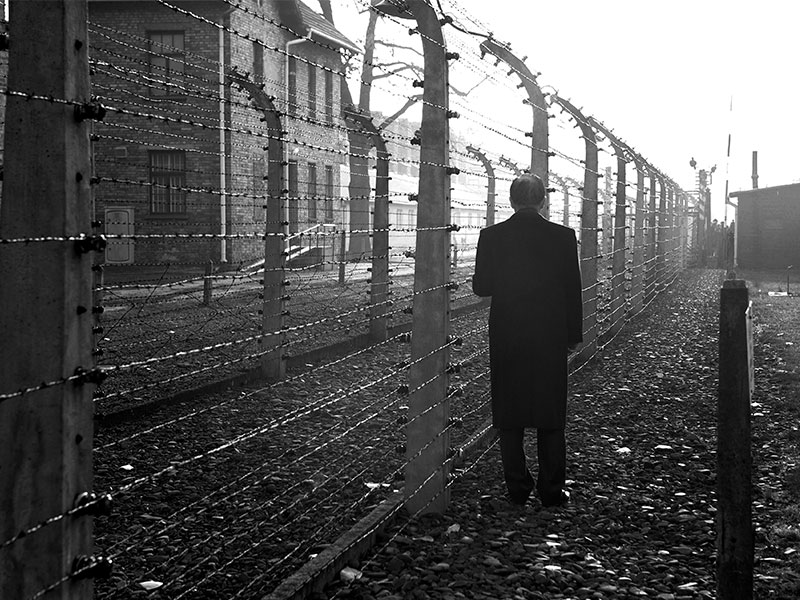
Secretary-General visits Auschwitz-Birkenau, Poland. UN Photo/Evan Schneider

The word “genocide” was first coined by Polish lawyer Raphäel Lemkin in 1944 in his book Axis Rule in Occupied Europe. It consists of the Greek prefix genos, meaning race or tribe, and the Latin suffix cide, meaning killing. Lemkin developed the term partly in response to the Nazi policies of systematic murder of Jewish people during the Holocaust, but also in response to previous instances in history of targeted actions aimed at the destruction of particular groups of people. Later on, Raphäel Lemkin led the campaign to have genocide recognised and codified as an international crime. Tiếp tục đọc “Genocide, Crimes against Humanity, War Crimes, Ethnic Cleansing”