Following an agreement on 1 April by IEA member countries for a new emergency release of oil stocks, the IEA Governing Board confirmed today that the total amount committed to date stands at 120 million barrels, making it the largest stock release in IEA history.
The unanimous agreement among IEA member countries on 1 April for a second collective action this year came in response to the significant strains in oil markets resulting from Russia’s invasion of Ukraine. In the days since the decision, each IEA member country has been considering how much it could contribute to the announced response plan, given its domestic circumstances.
The commitments submitted by members reached 120 million barrels to be released over a six month period, demonstrating strong unity. The United States will contribute about 60 million barrels, which are part of the larger drawdown from its Strategic Petroleum Reserve (SPR) that was announced on 31 March.
Poland’s Deputy Prime Minister and the Minister of Culture Piotr Glinski, 13 October 2021. [EPA-EFE/Jonas Ekströmer]
Poland has shown immense support for Ukraine since the Russian invasion started. What is less known is that the two countries share a history of oppression and bloodshed, but according to Poland’s Deputy Prime Minister Piotr Gliński, the war has given them a chance to achieve full reconciliation.
As Russian artillery and rockets land on Ukrainian hospitals and apartment blocks, devastating residential districts with no military value, the world is watching with horror what is, for Russia, an increasingly standard practice.
Its forces conducted similar attacks in Syria, bombing hospitals and other civilian structures as part of Russia’s intervention to prop up that country’s government.
Moscow went even further in Chechnya, a border region that had sought independence in the Soviet Union’s 1991 breakup. During two formative wars there, Russia’s artillery and air forces turned city blocks to rubble and its ground troops massacred civilians in what was widely seen as a deliberate campaign to terrorize the population into submission.
Now, Vladimir V. Putin, whose rise to Russia’s presidency paralleled and was in some ways cemented by the Chechen wars, appears to be deploying a similar playbook in Ukraine, albeit so far only by increments.
Russia’s invasion of Ukraine has already driven millions of people from their homes and left many without water, power and food. As hostilities continue, the humanitarian and economic consequences will expand far beyond the region, putting potentially millions of people around the world at risk of hunger.
And these aren’t just short-term threats. The decisions that farmers and policymakers make over the next few weeks and months will have long-term consequences for the future of the world’s food systems. The right responses can keep the world on track for a sustainable food future. The wrong ones will worsen food insecurity and fuel climate change.
Ukrainian refugees escape to the border town of Medyka, Poland. Millions of Ukrainian residents have fled their homes in recent weeks, due to the Russian invasion. Photo by Damian Pankowiec/Shutterstock
“And yet, just when the climate scientists and governments across the eight Arctic states should be working together to understand and address the climate crisis, Russia’s war on Ukraine has forced the Arctic Council, an intergovernmental group of Arctic states and Arctic Indigenous Peoples, to suspend their joint activities in protest of Russia’s unprovoked aggression.“
Europe’s energy independence from Russia, including in its financial aspects, will be a key topic of discussion at a two-day summit in Versailles hosted by the French EU presidency. [France Diplomatie – MEAE]
European Union leaders will tackle ways to wean themselves off Russian fossil fuels on Thursday (10 March) and debate how quickly to ditch their key supplier, with countries split over whether to sanction oil and gas imports as Moscow wages war in Ukraine.
A still image taken from a handout video made available by the Russian Defence Ministry press service shows a general view of the Chernobyl Nuclear Power Plant in Pripyat, Ukraine, 7 March 2022. Russian President Putin on 24 February 2022 announced a “special military operation against Ukraine”. Martial law has been introduced in Ukraine, and explosions are heard in many cities including Kyiv. [Handout photo/EPA/EFE]
Ukraine said on Wednesday (9 March) there was a danger of a radiation leak at the Chernobyl nuclear power station after electricity was cut off to the plant, but the UN nuclear watchdog saw “no critical impact on security”.
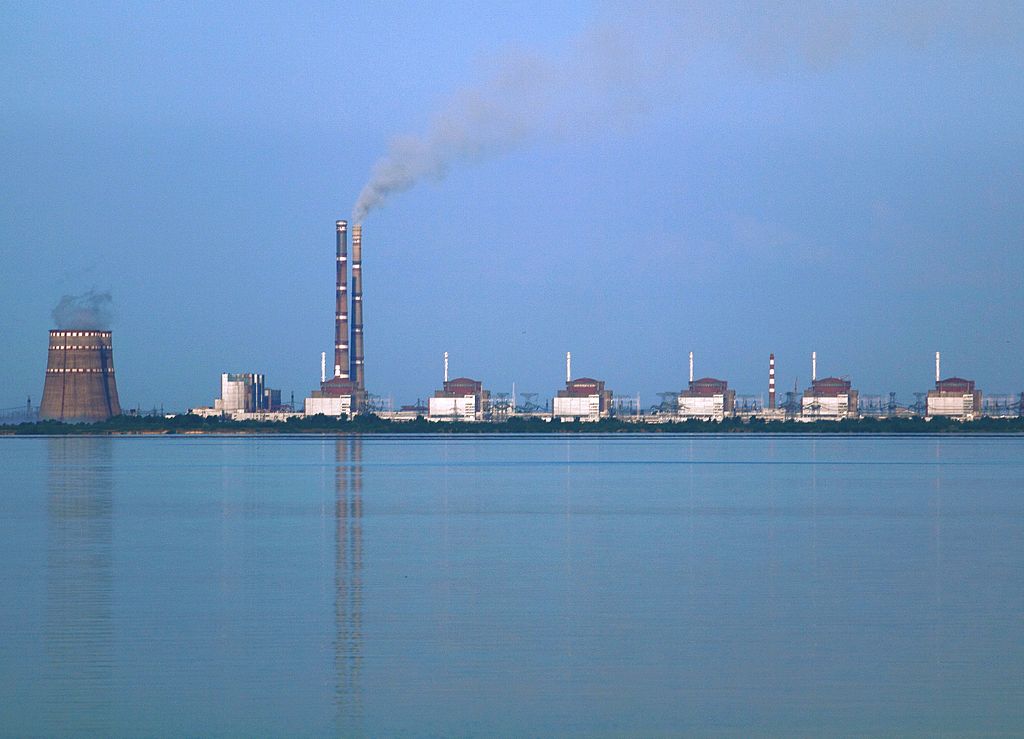
Zaporizhzhia nuclear power plant in southern Ukraine. The two tall smokestacks are at a coal-fired generating station about 3km beyond the nuclear plant. Photo credit: Ralf1969 via Wikimedia Commons.
As the Russian invasion of Ukraine began to unfold, Russia’s swift occupation of the Chernobyl reactor complex and the surrounding exclusion zone sparked widespread speculation and concern.[1] The concern was not limited to whether the occupation would cause further radioactive release from Chernobyl;[2] it also included possible Russian military action against other Ukrainian nuclear facilities. These fears were further accelerated when Russian forces shelled and apparently occupied the Zaporizhzhia nuclear power complex near Enerhodar, Ukraine.[3] There have also been reports of attacks on a former Radon disposal site near Kyiv.[4]
World leaders have expressed concerns, and the UN Security Council held an emergency meeting on Friday to discuss the issue. At the meeting, the US ambassador told the emergency session that the assault on the Zaporizhzhia nuclear power plant “represents a dire threat to the world.” [5] The IAEA’s Board of Governors passed a resolution that deplored the Russian invasion and urged Russia to allow Ukraine to continue to control its nuclear facilities. The board’s resolution was similar to a UN General Assembly resolution passed on March 3rd.[6] Despite the high levels of concern the reactors at Zaporizhzhia do not appear to have been damaged and there has been no reported radiation release from the facility.
It is the first time in 40 years the security council has referred a crisis to the assembly and only the 11th time an emergency session of the UN general assembly has been called since 1950.
The United Nations has voted overwhelmingly for a resolution deploring Russia’s invasion of Ukraine and called for the immediate withdrawal of its forces, in a global expression of outrage that highlighted Russia’s increasing isolation.
In an emergency session of the UN’s general assembly, 141 of the 193 member states voted for the resolution, 35 abstained, and five voted against. The only countries to vote no in support of Moscow were Belarus, North Korea, Eritrea and Syria. Longstanding allies Cuba and Nicaragua joined China in abstaining.
The resolution said the UN “deplores in the strongest terms the aggression by the Russian Federation against Ukraine”. It demanded that “the Russian Federation immediately cease its use of force against Ukraine” and “immediately, completely and unconditionally withdraw all of its military forces”.
The resolution is not legally binding, but is an expression of the views of the UN membership, aimed at increasing pressure on Moscow and its ally, Belarus.
“It isn’t going to stop Russian forces in their stride, but it’s a pretty enormous diplomatic win for the Ukrainians and the US, and everyone who has got behind them,” Richard Gowan, UN director at the International Crisis Group, said.
Speaking before the vote, the US ambassador to the UN, Linda Thomas-Greenfield, compared the Russian invasion to the Nazi conquest of Europe.
“A few of the eldest Ukrainians and Russians might recall a moment like this, a moment when one aggressive European nation invaded another without provocation to claim the territory of its neighbour, a moment when a European dictator declared he would return his empire to its former glory and invasion that caused a war so horrific, that it spurred this organization into existence,” Thomas-Greenfield said.
Đây là buổi trả lời phỏng vấn của Bác Hồ với phóng viên thuộc văn phòng phát thanh truyền hình Pháp (ORTF). Video được thực hiện vào ngày 5 tháng 6 năm 1964, và buổi phỏng vấn được trích từ bộ phim tài liệu sản xuất năm 1964 của Pháp có tên là “Hai miền Việt Nam : Bắc Việt” (Les deux Vietnam: Vietnam du Nord).
e.vnexpress.net_Police and curious people stand outside a house where an explosion killed six people in Khanh Hoa Province on Friday. Photo courtesy of Vietnam’s government news portal
Neighbors said the family had been trying to dismantle a bomb to sell as scrap metal.
Six members of a single family were killed in an explosion in the central province of Khanh Hoa on Friday morning.
Among the victims were three children. Another child was seriously injured and is receiving treatment.
Local witnesses said they rushed to the house after hearing the blast to find the roof had been blown off and the smell of explosives hanging in the air.
An official said the explosion might have been caused by ordnance left over from the war.
Local media reports cited the victims’ neighbors as saying that one member of the family had brought home a bomb that morning and they were cutting it open when it exploded.
Nghệ sĩ người Nhật Isao Hashimoto đã làm nên một bản đồ thời gian thật đẹp, một sự thật đáng sợ không thể phủ nhận của 2053 vụ nổ hạt nhân năm xảy ra từ năm 1945 và đến 1998, bắt đầu với thử nghiệm “Trinity” của dự án Manhattan gần Los Alamos và kết thúc với thử nghiệmhạt nhân của Pakistan vào tháng 5 năm 1998. Bản đồ này thiếy 2 vụ thử nghiệm hạt nhân của Bắc Triều Tiên trong thập niên vừa qua (do tính hợp pháp của hai vụ này chưa rõ ràng 100%).
Trong bản đồ, mỗi quốc gia đều có một đốm sáng và một chấm nhấp nháy trên bản đồ bất cứ khi nào có một vụ nổ vũ khí hạt nhân, với một thanh chạy trên cùng và dưới cùng của màn hình. Hashimoto, bắt đầu dự án vào năm 2003, nói rằng ông đã tạo ra nó với mục tiêu cho thấy “nỗi khiếp sợ và điên cuồng của vũ khí hạt nhân”. Bản đồ bắt đầu rất chậm – nếu bạn muốn xem hành động thực sự, hãy bỏ qua trước năm 1962 hoặc lâu hơn nữa – nhưng sự tích lũy trở nên quá tải.
A Time-Lapse Map of Every Nuclear Explosion Since 1945 – by Isao Hashimoto
Japanese artist Isao Hashimoto has created a beautiful, undeniably scary time-lapse map of the 2053 nuclear explosions which have taken place between 1945 and 1998, beginning with the Manhattan Project’s “Trinity” test near Los Alamos and concluding with Pakistan’s nuclear tests in May of 1998. This leaves out North Korea’s two alleged nuclear tests in this past decade (the legitimacy of both of which is not 100% clear).
Each nation gets a blip and a flashing dot on the map whenever they detonate a nuclear weapon, with a running tally kept on the top and bottom bars of the screen. Hashimoto, who began the project in 2003, says that he created it with the goal of showing”the fear and folly of nuclear weapons.” It starts really slow — if you want to see real action, skip ahead to 1962 or so — but the buildup becomes overwhelming.


 Lake Baikal, Siberia, Russia (Photo by

 Zaporizhzhia nuclear power plant in southern Ukraine. The two tall smokestacks are at a coal-fired generating station about 3km beyond the nuclear plant. Photo credit: Ralf1969 via Wikimedia Commons.
 CVD
CVD 