China’s top judge calls judicial independence an ‘erroneous Western ideal’

japan times

AP, Jan 18, 2017

China’s top judge has drawn criticism from legal professionals after he dismissed the concept of judicial independence as an “erroneous Western ideal,” a statement seemingly aimed at emphasizing the ruling Communist Party’s ultimate control over all areas of public life.

Zhou Qiang, the head of the Supreme People’s Court, has at times been seen as a reformer keen on limiting the influence of government officials on the courts.

However, Chinese state media quoted him over the weekend as instructing leading judges to “draw your sword” against words and actions running counter to the ruling Communist Party’s dictates. Tiếp tục đọc “China’s top judge calls judicial independence an ‘erroneous Western ideal’”

Philippines defense chief calls China arms on South China Sea islands ‘troubling’

Japan Times

Reuters, Jan 17, 2017

China’s recent installation of weapons on artificial islands in the disputed South China Sea was “very troubling”, the Philippines’ defense minister said Tuesday, after Manila quietly protested Beijing’s activities.

The Philippine Foreign Ministry sent a note verbale to the Chinese Embassy last month after confirming a report from the U.S.-based Center for Strategic and International Studies about China’s arms buildup in the Spratlys. Tiếp tục đọc “Philippines defense chief calls China arms on South China Sea islands ‘troubling’”

Bắc Kinh làm gì nếu ông Trump quyết bác ‘Một Trung Quốc’?

13/12/2016 15:45 GMT+7

TTO – Sau khi Tổng thống đắc cử Donald Trump nêu quan điểm sẽ phải xem xét lại chính sách “Một Trung Quốc”, tờ Thời báo Hoàn Cầu của Trung Quốc chê bai ông Trump “ngây ngô như đứa trẻ trong vấn đề ngoại giao”.

Bắc Kinh làm gì nếu ông Trump quyết bác 'Một Trung Quốc'?
Tổng thống đắc cử Donald Trump trả lời phỏng vấn trong chương trình Fox News Sunday tại tòa nhà Trump Tower ở New York ngày 10-12 – Ảnh: AP

Tiếp tục đọc “Bắc Kinh làm gì nếu ông Trump quyết bác ‘Một Trung Quốc’?”

Ông Trump có bài gì trong tay để đấu với Trung Quốc?

16/01/2017 08:58 GMT+7

TTO – Một khi chính thức nhậm chức, Tổng thống Mỹ Donald Trump có thể khiến Bắc Kinh đau đầu hơn họ tưởng.

Ông Trump có bài gì trong tay để đấu với Trung Quốc?
Tổng thống Mỹ đắc cử Donald Trump – ảnh: Reuters

Tổng thống đắc cử Donald Trump đã tuyên bố ông có thể dùng chính sách “một Trung Quốc” để mặc cả với Bắc Kinh về thương mại và các vấn đề khác. Nhưng bên cạnh đó vẫn còn một số “quân bài” ông Trump có thể dùng sắp tới, theo phân tích của báo South China Morning Post: Tiếp tục đọc “Ông Trump có bài gì trong tay để đấu với Trung Quốc?”

It Can Power a Small Nation. But This Wind Farm in China Is Mostly Idle

Japan pledges boats to Vietnam as China dispute simmers

ChannelNewsAsia

HANOI: Japan’s Prime Minister Shinzo Abe on Monday promised Vietnam six new patrol boats during a visit to the Southeast Asian country, which is locked in a dispute with China over the busy South China Sea.

Abe’s stop in Vietnam completes a tour through an arc of a region where Japan stakes a leadership claim in the face of China’s growing dominance and uncertainty over what policy change Donald Trump will bring as U.S. president. Tiếp tục đọc “Japan pledges boats to Vietnam as China dispute simmers”

China voices economic fears about Donald Trump presidency

Beijing’s concerns about a further slowdown in trade come as political uncertainty and social tensions spread anxiety about global economy

Trucks line up at a container port in Qingdao, east China.
Trucks line up at a container port in Qingdao, east China. Photograph: AP

China suffered a sharp drop in exports last year and there are fears its trading position will weaken further in 2017 with repercussions for the global economy if Donald Trump’s protectionist policies prompt a trade war.

A week before the billionaire’s inauguration as US president, Chinese authorities expressed their concern that Trump would follow through on pledges to impose high tariffs on imports from China and to brand the country a currency manipulator. The president-elect has long maintained that China has been devaluing its currency in order to make its exports more competitive on overseas markets. Tiếp tục đọc “China voices economic fears about Donald Trump presidency”

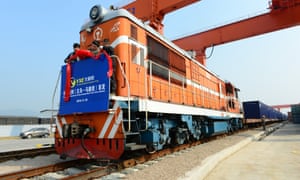
Silk Road route back in business as China train rolls into London

After 16 days and 7,456 miles, the locomotive’s arrival heralds the dawn of a new commercial era

East Wind freight train
The East Wind freight train prepares for its journey at Yiwu station in Zhejiang province of China. Photograph: VCG/Getty Images

When the East Wind locomotive rumbles into east London this week, it will be at the head of 34 carriages full of socks, bags and wallets for London’s tourist souvenir shops, as well as the dust and grime accumulated through eight countries and 7,456 miles.

The train will be the first to make the 16-day journey from Yiwu in west China to Britain, reviving the ancient trading Silk Road route and shunting in a new era of UK-China relations.

Due to arrive on Wednesday, the train will have passed through China, Kazakhstan, Russia, Belarus, Poland, Germany, Belgium and France before crossing under the Channel and arriving in the east end of London at Barking rail freight terminal.
Tiếp tục đọc “Silk Road route back in business as China train rolls into London”

Beijing says ‘one-China’ policy can’t be bargaining chip after Trump calls principle negotiable

Japan  Times

by

Staff Writer Jan 15, 2017

China has pushed back against U.S. President-elect Donald Trump’s suggestions that the “one-China” policy on Taiwan is negotiable, with the Foreign Ministry in Beijing urging the incoming administration to “recognize the high sensitivity of the Taiwan question.”

Foreign Ministry spokesman Lu Kang on Saturday called the one-China principle “nonnegotiable” and “the political foundation” of China-U.S. relations. Tiếp tục đọc “Beijing says ‘one-China’ policy can’t be bargaining chip after Trump calls principle negotiable”

Critics attacked, history revised as China nationalism rises


by

Jan 15, 2017

Writer Lu Yong had merely wanted to show support for a professor who had taken flak online for criticizing Mao Zedong, the founder of the communist state who died more than four decades ago.

Yet minutes after raising a sign to defend Deng Xiangchao’s right to free speech, Lu found himself surrounded by a group of Mao supporters who grappled at his face. Other companions were punched and kicked. Tiếp tục đọc “Critics attacked, history revised as China nationalism rises”

China Orders Registration of App Stores

In a notice published on its website, the Cyberspace Administration of China said late Friday that its offices across China should ensure that records are kept on the country’s many app stores, starting Monday.

Tiếp tục đọc “China Orders Registration of App Stores”

China, Russia take aim at U.S. anti-missile system planned for deployment in South Korea

by Jan 13, 2017

China and Russia have agreed to take unspecified “countermeasures” in response to the planned U.S. deployment of an anti-missile system to South Korea — a move that came as Defense Minister Tomomi Inada inspected a version of the system on the U.S. territory of Guam on Friday.

The countermeasures in response to the U.S. deployment of the Terminal High Altitude Area Defense (THAAD) system will be “aimed at safeguarding interests of China and Russia and the strategic balance in the region,” China’s state-run Xinhua News Agency reported, quoting a statement released after a meeting of Russian and Chinese security officials. Tiếp tục đọc “China, Russia take aim at U.S. anti-missile system planned for deployment in South Korea”

Taiwan Works to Keep Its Central America Friends (Among Its Few)

President Tsai Ing-wen of Taiwan and President Juan Orlando Hernández of Honduras at the presidential palace in Tegucigalpa, the capital of Honduras, on Monday. Taiwan has diplomatic relations with only 20 countries, along with the Vatican; the largest cluster of those is in Latin America and the Caribbean. Credit Fernando Antonio/Associated Press

MEXICO CITY — President Tsai Ing-wen of Taiwan has been hopscotching across Central America this week, attending the inauguration of Nicaragua’s president, Daniel Ortega, touring Guatemala’s colonial city of Antigua and visiting the shrine of Honduras’s patron saint.

From a global perspective, it is the sort of tour that looks like a diplomatic asterisk. But there is nothing trivial about it for Ms. Tsai, who is in Central America to shore up relationships as she faces increasing pressure from China.

Taiwan, which China considers a breakaway province, has diplomatic relations with only 20 countries, along with the Vatican; the largest cluster of those is in Latin America and the Caribbean. These relationships, complete with embassies, trade agreements and foreign aid, strengthen Taiwan’s effective sovereignty.

That is particularly important now for Taiwan, which fears becoming a casualty as President-elect Donald J. Trump threatens to roil the China-America relationship. Mr. Trump accepted a congratulatory phone call from Ms. Tsai after his election, a break from protocol that prompted a series of angry responses from China.

Continue reading on New York Times

Pro-democracy Hong Kong lawmaker condemns ‘violent attacks’