China’s economy showed further signs of weakness in May. Industrial output and retail sales both missed forecasts. Beijing is expected to increase its efforts to boost the economy to try to shore up its post-COVID-19 recovery.
Al Jazeera’s Katrina Yu reports from Beijing, China.
Vượt qua biên giới chỉ chục km vào chợ đầu mối hoa quả lớn nhất Quảng Tây, giá vải Lục Ngạn (Bắc Giang) tăng gấp đôi.
Xe container Việt Nam và Trung Quốc tại Trung tâm Hoa quả Bằng Tường, chợ đầu mối hoa quả lớn bậc nhất Quảng Tây. Các xe sẽ sang tải tại đây, từ đó xe container Trung Quốc sẽ tiếp tục đi tới các thị trường nội địa nước này. Ảnh: Văn Việt.
An opinion piece in Bloomberg titled ‘Trying to Replace China’s Supply Chains? Don’t Bother?’, published March 1, 2023, claims that ‘Vietnamese factories were supposed to save globalization’ but that they cannot. This is incorrect and here’s why, writes Dezan Shira and Associates, Head of Business Intelligence, Pritesh Samuel.
Vietnam’s factories were never supposed to save globalization. They offer businesses an alternate location for manufacturing – in line with a China+1 strategy that myriad companies now pursue due to rising costs in China.
Globalization is shaped by several factors, including geopolitics, national interests of governments, regional trade and investment initiatives, public policymaking directives by key trade bodies, and so on. It cannot be trivialized into the assumption that a single country can save it.
China’s advanced supply chain and supplier network, driven by the government’s long-term national policies, make it a manufacturing giant. At present, no single country, including Vietnam, can fully replace China’s manufacturing capacity.
China is on track to massively expand its nuclear arsenal, just as Russia suspends the last major arms control treaty. It augurs a new world in which Beijing, Moscow and Washington will likely be atomic peers.
By David E. Sanger, William J. Broad and Chris Buckley David E. Sanger and William J. Broad have covered nuclear weapons for The Times for four decades. Chris Buckley reports on China’s military from Taiwan.
WASHINGTON — On the Chinese coast, just 135 miles from Taiwan, Beijing is preparing to start a new reactor the Pentagon sees as delivering fuel for a vast expansion of China’s nuclear arsenal, potentially making it an atomic peer of the United States and Russia. The reactor, known as a fast breeder, excels at making plutonium, a top fuel of atom bombs.
The nuclear material for the reactor is being supplied by Russia, whose Rosatom nuclear giant has in the past few months completed the delivery of 25 tons of highly enriched uranium to get production started. That deal means that Russia and China are now cooperating on a project that will aid their own nuclear modernizations and, by the Pentagon’s estimates, produce arsenals whose combined size could dwarf that of the United States.
This new reality is prompting a broad rethinking of American nuclear strategy that few anticipated a dozen years ago, when President Barack Obama envisioned a world that was inexorably moving toward eliminating all nuclear weapons. Instead, the United States is now facing questions about how to manage a three-way nuclear rivalry, which upends much of the deterrence strategy that has successfully avoided nuclear war.
China’s expansion, at a moment when Russia is deploying new types of arms and threatening to use battlefield nuclear weapons against Ukraine, is just the latest example of what American strategists see as a new, far more complex era compared to what the United States lived through during the Cold War.
China insists the breeder reactors on the coast will be purely for civilian purposes, and there is no evidence that China and Russia are working together on the weapons themselves, or a coordinated nuclear strategy to confront their common adversary.
But John F. Plumb, a senior Pentagon official, told Congress recently: “There’s no getting around the fact that breeder reactors are plutonium, and plutonium is for weapons.”
It may only be the beginning. In a little-noticed announcement when President Xi Jinping of China met President Vladimir V. Putin in Moscow last month, Rosatom and the China Atomic Energy Authority signed an agreement to extend their cooperation for years, if not decades.
When President Xi Jinping of China met President Vladimir V. Putin in Moscow last month, Russia and China’s nuclear authorities signed an agreement to extend their cooperation for years.Credit…Grigory Sysoyev/Agence France-Presse, via Sputnik
Kênh đào Bình Lục đổ vào Vịnh Bắc Bộ với kinh phí 10,3 tỉ USD mà Trung Quốc đang xây dựng có thể giúp nước này xích lại gần hơn với khu vực Đông Nam Á.
TN – Gần 80 năm sau ngày lập nước, Lai Châu vẫn là tỉnh khó khăn, đi lại xa xôi vất vả và có mật độ dân số thấp nhất toàn quốc. Trong 7 tỉnh biên giới phía bắc, Lai Châu có chiều dài đường biên thứ 3, nhưng sự khó khăn trong quản lý, bảo vệ biên giới thì vẫn… đứng đầu cả nước.
Qua một đêm, tôi tới TP.Lai Châu (tỉnh Lai Châu), thêm nửa ngày nữa mới tới huyện lỵ Mường Tè và lên Đồn biên phòng Pa Vệ Sử (đóng ở xã Pa Vệ Sử, H.Mường Tè, Lai Châu), nghỉ qua đêm để sáng hôm sau lên mốc 42 – nóc nhà biên cương, đi lại khó khăn vất vả nhất toàn quốc.
Mốc “3 ngày 2 đêm”
Đại tá Nguyễn Văn Hưng, Chính ủy Bộ đội biên phòng (BĐBP) Lai Châu, bảo: Ở Lai Châu, có 2 cột mốc cao nhất nhì VN là mốc 79 và 42. Mốc 79 tuy cao nhất (2.880,69 m) nhưng đi lại vẫn dễ hơn so với mốc 42 (2.856,5 m); bộ đội đi tuần tra, thường là đi bộ 3 ngày 2 đêm…
KENJI KAWASE, Nikkei Asia chief business news correspondentMAY 24, 2023 04:30 JST
OMAHA, U.S. — For Antonius Budianto, an independent stock investor from Indonesia, it was a dream come true to be in Omaha, Nebraska for the first time.
Traveling from East Java with his wife and 14-year-old daughter, Antonius was standing in a queue in front of Omaha’s CHI Health Center at 3 a.m. to grab a seat at the annual general shareholders meeting of investment company Berkshire Hathaway on May 6. Antonius said they wanted to be “as close as possible” to the podium as his two business idols — Warren Buffett and Charlie Munger — sat and took questions from shareholders in the audience and around the world.
Antonius has been investing in listed stocks in Indonesia for over 20 years, faithfully following the Buffett method: focus on a few companies with strong earnings, handsome dividend payments and sound corporate governance, and hold on to them, sometimes for decades. At Berkshire, this strategy has been distilled into the oft-repeated maxim: “Just hold the goddamn stock,” as Munger put it that day.
For his part, Antonius has been making a living as a full-time professional investor since 2010.
Beijing clamps down on ‘expert networks’ over threats to national security, sending shockwaves through the financial world with experts saying the move will derail China’s push to attract foreign investors
Private conversations with corporate insiders and ex-government officials that cost upwards of US$10,000 an hour. Coded language and blurred regulatory lines.
For hedge funds and other global investors, China’s vast web of “expert networks” has become a key tool for navigating an opaque but potentially lucrative economic powerhouse. For Xi Jinping’s (習近平) Communist Party, the secretive industry represents something far more ominous: a threat to national security that must be reined in.
That contradiction is now sending shockwaves through the financial world as China’s government cracks down on the expert networks it had showered in praise less than a decade ago during Xi’s first term as president. The anti-espionage campaign — which centers on Capvision, a giant of the industry with offices in Shanghai and New York — has reignited concern among China watchers that Xi’s fixation on security and tightening grip on information will derail his push to attract foreign investors.
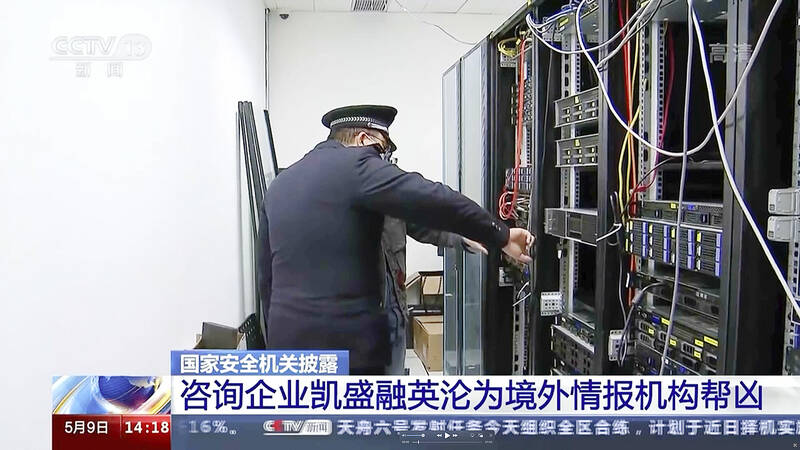
In this image taken from undated video footage run by China’s CCTV, Chinese police raid the Capvision office in Shanghai. China’s chief foreign intelligence agency has raided the offices of business consulting firm Capvision in Beijing and other Chinese cities as part of an ongoing crackdown on foreign businesses that provide sensitive economic data. Photo: AP
Visitors stand in front of a giant screen displaying Chinese leader Xi Jinping next to a flag of the Communist Party of China, at the Military Museum of the Chinese People’s Revolution in Beijing last October. | REUTERS
With the U.S. and its allies rapidly bolstering military capabilities around Taiwan, a successful Chinese invasion, let alone an occupation, of the self-ruled island is becoming an increasingly difficult proposition.
But with the Chinese People’s Liberation Army (PLA) increasingly focused on “intelligent warfare” — a reference to artificial intelligence-enabled military systems and operational concepts — experts warn that Beijing could eventually have a new card up its sleeve: “cognitive warfare.”
The electrified metal fence, topped with razor wire and cameras, has prompted criminals to seek out new destinations.
China’s new ‘mega fence’, seen here in Ha Giang, runs for more than 1,000km along its border with Vietnam, Laos and Myanmar. [Courtesy of Blue Dragon Children’s Foundation]
Hanoi, Vietnam – When she arrived at her destination in Myanmar’s northern Shan state, expecting to start a new job, Diep* a 19-year-old Vietnamese woman, realised she had been trafficked.
Left in a locked room alone, she could hear other people but not see them. Armed men were guarding the house.
Updated May. 22, 2023 7:18AM ET / Published May. 22, 2023 4:59AM ET
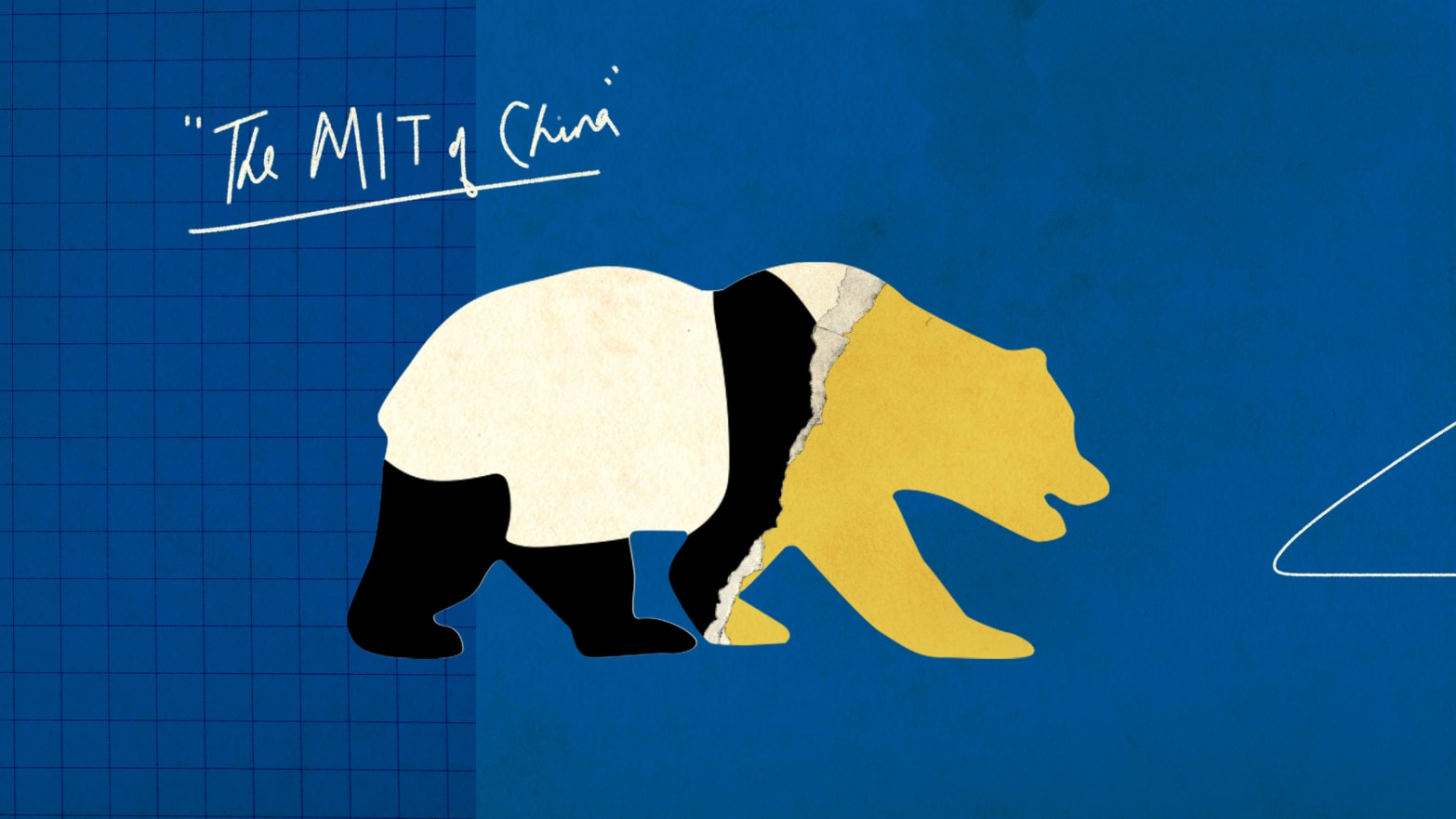
U.C. Berkeley has failed to disclose to the U.S. government massive Chinese state funding for a highly sensitive $240 million joint tech venture in China that has been running for the last eight years.
The Californian university has not registered with the U.S. government that it received huge financial support from the city of Shenzhen for a tech project inside China, which also included partnerships with Chinese companies that have since been sanctioned by the U.S. or accused of complicity in human rights abuses.
The university has failed to declare a $220 million investment from the municipal government of Shenzhen to build a research campus in China. A Berkeley spokesperson told The Daily Beast that the university had yet to declare the investment—announced in 2018—because the campus is still under construction. However, a former Department of Education official who used to help manage the department’s foreign gifts and contracts disclosure program said that investment agreements must be disclosed within six months of signing, not when they are fully executed.
Nếu trước đây việc xuất khẩu tiểu ngạch sang thị trường Trung Quốc khá dễ dàng thì gần đây thị trường này đã có nhiều thay đổi về tiêu chuẩn nhập khẩu.
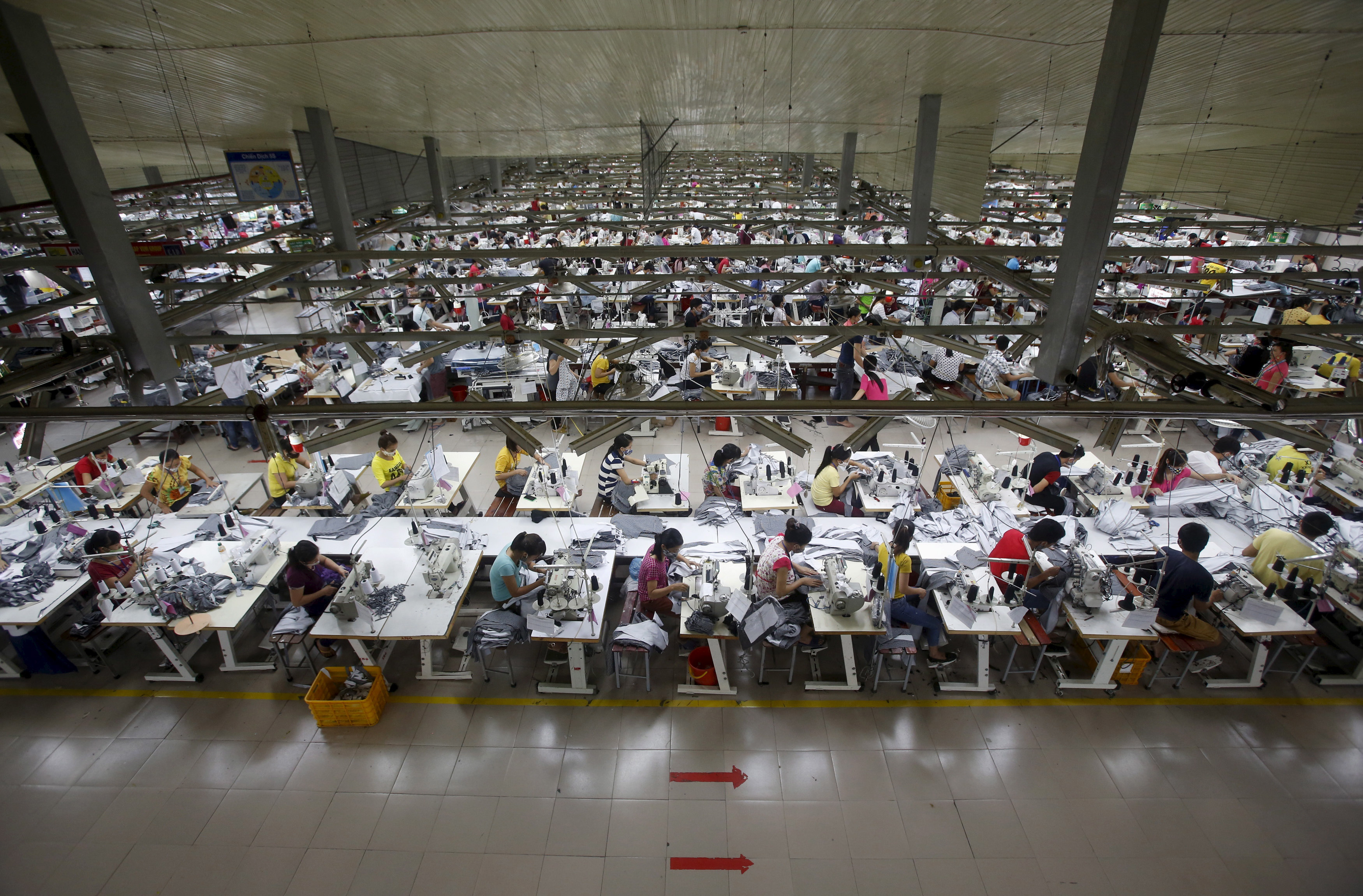
Labourers work at a garment factory in Bac Giang province, near Hanoi October 21, 2015. Vietnam’s textiles and footwear would gain strongly from the TPP, after exports of $31 billion last year for brands such as Nike, Adidas, H&M, Gap, Zara, Armani and Lacoste. REUTERS/Kham
Summary
Companies
Vietnam apparel worst hit by U.S. curbs, data show
Apparel suppliers to big brands depend on Chinese input
Blow to apparel exports hurts Vietnam’s growth
HANOI, April 27 (Reuters) – Tighter U.S. rules to ban imports from China’s Xinjiang are compounding pressure on Vietnam’s apparel and footwear makers, hitting a sector that has already shed nearly 90,000 jobs since October in the global manufacturing hub as demand slowed.
Among garment exporters, Vietnam has faced the worst hit from the the Uyghur Forced Labor Protection Act (UFLPA), a Reuters review of official U.S. data showed. The law, in place since June, requires companies to prove that they do not use raw material or components produced with Xinjiang’s forced labor.
Civilians are being killed by Russian weapons just like in Ukraine, says special rapporteur Tom Andrews in call for global action
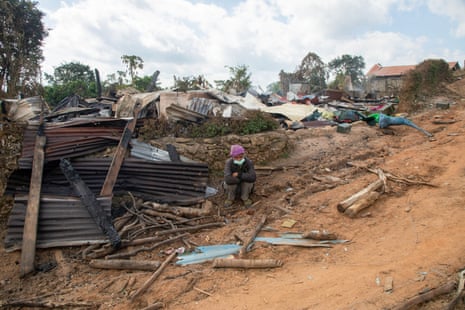
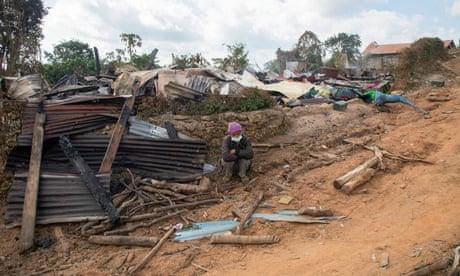
A man sits in front of a house destroyed by a Myanmar junta air strike. The UN special rapporteur for human rights there has called for an arms embargo. Photograph: SOPA Images/LightRocket/Getty Images
Rebecca Ratcliffe South-east Asia correspondentWed 15 Mar 2023 19.00 GMT
Myanmar is a “failing state” and the crisis is getting exponentially worse, a UN special rapporteur for the country has warned, urging countries to adopt the same unified resolve that followed the invasion of Ukraine.
“The same types of weapons that are killing Ukrainians are killing people in Myanmar,” Tom Andrews, special rapporteur on the situation of human rights in Myanmar, told the Guardian in an interview, citing the supply of Russian weapons to the junta since the coup two years ago. The junta relies heavily on aircraft from China and Russia, and has increasingly resorted to airstrikes to attempt to quell determined resistance forces.
The international response to Myanmar has been inadequate and some countries are continuing to enable the junta’s atrocities, Andrews said, calling for an arms embargo.





 CVD
CVD 