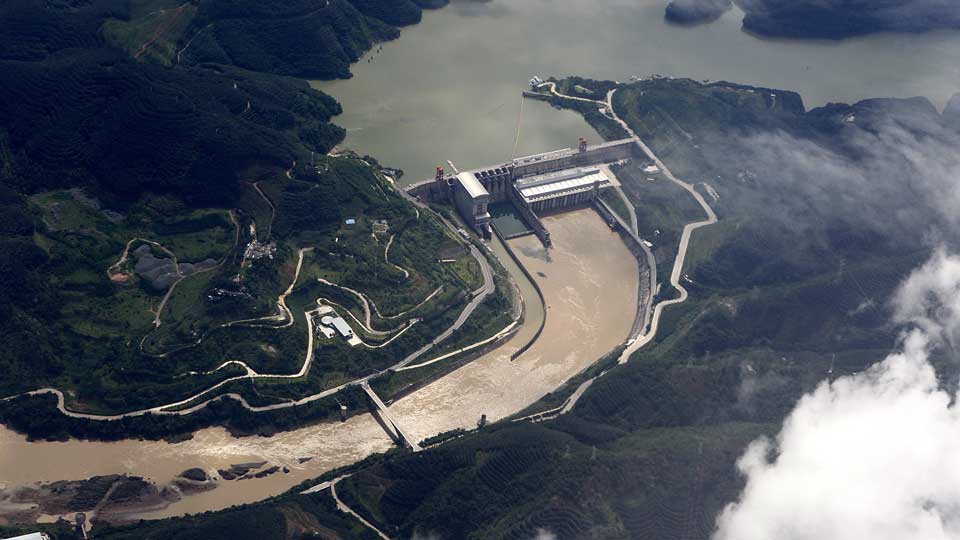
File image of the aerial view of the Jinghong Hydropower Station on the Lancang River, the Chinese part of the Mekong River, in Jinghong city, Xishuangbanna Dai Autonomous Prefecture, southwest China’s Yunnan province. Imaginechina Limited / Alamy Stock Photo
The rainy season would usually start in May, but this was late June and it was still not raining much. Niwat Roykaew, who grew up on the bank of the Mekong River in Thailand’s northern Chiang Rai province, noticed.
Born and raised in the Chiang Khong district, Roykaew, 63, was taught to observe the Mekong River to tell the season. But, in the past two decades, the river has become unpredictable like it has “pulsated out of tune”.
Niwat Roykaew is a Thai activist who campaigns for China to share data about water restrictions by its dams upstream.
“The water would get high for two days, then on the third day it would suddenly drop, even during the rainy season,” said Roykaew.
Local residents like him knew that this delay could mean another year of drought. Since at least 2019, that’s what has happened: the monsoon rain is late, and when it comes, it departs early.
The Mekong River’s water levels in the lower basin, including in Thailand, are now very unstable, being heavily affected both by climate change and hydropower dams upstream that are mostly powered by China, according to local residents, activists, and experts.
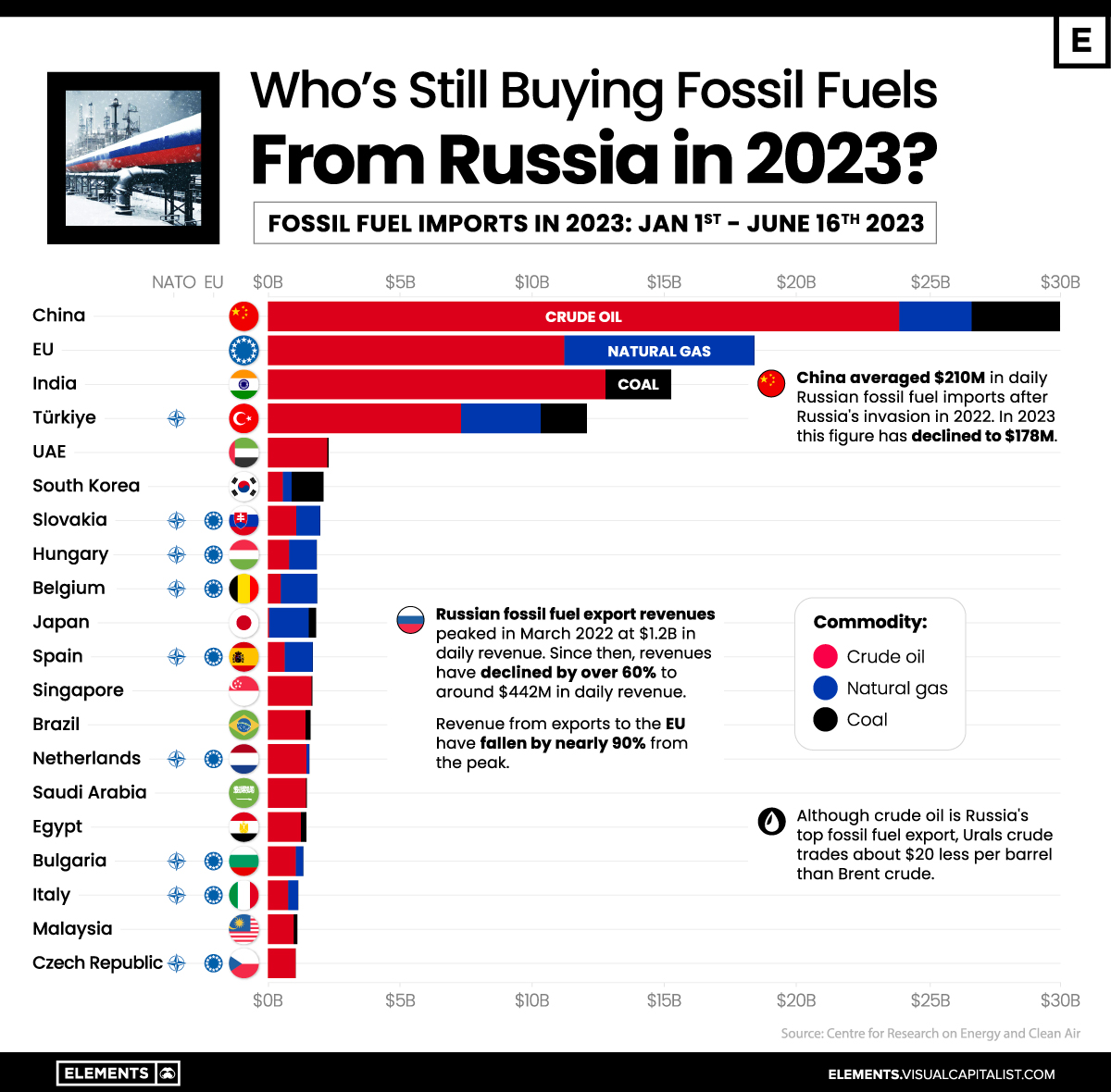
While Russia’s revenues from fossil fuel exports have declined significantly since their peak in March of 2022, many countries are still importing millions of dollars a day worth of fossil fuels from Russia.
Revenue from fossil fuels exported to the EU has declined more than 90% from their peak, but in 2023 the bloc has still imported more than $18 billion of crude oil and natural gas so far.
This graphic uses data from the Centre for Research on Energy and Clean Air (CREA) to visualize the top-importing countries of fossil fuels from Russia so far this year.
China Remains Russia’s Top Fossil Fuel Importer
China continues to be Russia’s top buyer of fossil fuels, with imports reaching $30 billion in 2023 up until June 16, 2023.
With nearly 80% of China’s fuel imports being crude oil, Russia’s average daily revenues from Chinese fossil fuel imports have declined from $210 million in 2022 to $178 million in 2023 largely due to the falling price of Russian crude oil.
Following China are EU nations collectively, which despite no longer importing coal from Russia since August of 2022, still imported $18.4 billion of fossil fuels in a 60/40 split of crude oil and natural gas respectively.
Country
Russian Fossil Fuel Imports* (Total)
Crude Oil
Natural Gas
Coal
China
$30B
$23.9B
$2.7B
$3.3B
EU
$18.4B
$11.2B
$7.2B
$0
India
$15.2B
$12.8B
$0
$2.5B
Türkiye
$12.1B
$7.3B
$3B
$1.7B
UAE
$2.3B
$2.3B
$0
$0
South Korea
$2.1B
$0.6B
$0.3B
$1.2B
Slovakia
$2.0B
$1.1B
$0.9B
$0
Hungary
$1.9B
$0.8B
$1.1B
$0
Belgium
$1.9B
$0.5B
$1.4B
$0
Japan
$1.8B
$0
$1.5B
$0.3B
Spain
$1.7B
$0.6B
$1.1B
$0
Singapore
$1.7B
$1.7B
$0
$0
Brazil
$1.6B
$1.4B
$0
$0.2B
Netherlands
$1.6B
$1.5B
$0.1B
$0
Saudi Arabia
$1.5B
$1.4B
$0
$0
Egypt
$1.4B
$1.3B
$0
$0.2B
Bulgaria
$1.3B
$1.1B
$0.3B
$0
Italy
$1.2B
$0.8B
$0.4B
$0
Malaysia
$1.1B
$1.0B
$0
$0.1B
Czech Republic
$1.0B
$1.1B
$0
$0
*Over the time period of Jan 1, 2023 to June 16, 2023 in U.S. dollars
After China and the EU bloc, India is the next-largest importer of Russian fossil fuels, having ramped up the amount of fossil fuels imported by more than 10x since before Russia’s invasion of Ukraine, largely due to discounted Russian oil.
Türkiye is the only other nation to have imported more than $10 billion worth of Russian fossil fuels in 2023, with every other country having imported fewer than $3 billion worth of fuels from Russia this year.
Navigating the Crude Reality of Oil Exports
Although crude oil is Russia’s chief fossil fuel export, the nation’s Urals crude traded at a $20 per barrel discount to Brent crude throughout most of 2023. While this discount has narrowed to around $16 following Russia’s announcement of further oil export cuts of 500,000 bpd (barrels per day), the price of Urals crude oil remains just 40 cents below the $60 price cap put in place by G7 and EU nations.
Nickel is an essential component of electric-vehicle batteries and Indonesia is by far the world’s largest producer. A rare visit to one of its biggest nickel plants reveals the heavy environmental cost of mining and processing the metal. Photo: Ulet Ifansasti
Across the Indonesian archipelago, new industrial plants are going up to process chunks of nickel ore for use in electric-car batteries. Five years ago, there were none.
What changed? Chinese companies had a breakthrough.
TTCT – Nếu như Trung Quốc có bao giờ thực hiện thành công một cuộc Đại nhảy vọt, thì đó chính là ở Thâm Quyến. Và lý do cơ bản của thành công này là vì thành phố này được phân quyền một cách đích thực.
Tôi vẫn còn nhớ cách đây khoảng 10 năm, một người bạn Hong Kong dẫn tôi tới dải đất sát bờ biển Hong Kong, chỉ vào một dãy nhà cao tầng san sát ở bờ bên kia và nói đó là thành phố Thâm Quyến.
Anh kể trước đây rất nhiều người Trung Quốc đại lục bị hấp dẫn bởi Hong Kong phồn hoa đã bơi từ Trung Quốc đại lục để vượt biên, nhập cảnh trái phép vào Hong Kong. Tôi bèn hỏi vui: “Bây giờ còn không anh?”. Anh trả lời rất nhanh: “Bên đó bây giờ thậm chí còn giàu hơn bên đây thì vượt biên làm gì”.
Một góc Thâm Quyến nhìn từ trên cao. Ảnh: Tân Hoa xã (chụp ngày 13-8-2020).
Anh bạn Hong Kong không quá lời. Giờ đây, GDP của Thâm Quyến đã vượt Hong Kong. Thành phố đại lục này cũng đi trước Hong Kong về đổi mới công nghệ và là nơi có nhiều công ty nằm trong top 500 công ty thành công nhất thế giới. Năm 2019, Liên đoàn Công nghiệp và Thương mại toàn Trung Quốc đã thực hiện cuộc khảo sát cho thấy Thâm Quyến được coi là thành phố kinh doanh số 1 Trung Quốc. Tiếp tục đọc “Thâm Quyến: Trao quyền phải trao cho tới”→
Throughout most of the ongoing war in Ukraine, a truism has held across most of the American political spectrum, from left to right, about the second-order effects of the conflict’s outcome. A Ukrainian victory would strengthen the position of the United States vis-à-vis China globally, while a Russian victory would achieve the opposite.
It is easy to see how takes like this gain such a strong foothold. Analysts are quick to apply sweeping, abstract constructs to their assessments of major world events. This time, that has meant a supposed worldwide faceoff between authoritarianism and democracy. Beyond such considerations, many have tried to imagine the Ukraine conflict’s effects on Chinese thinking about Taiwan. Here again, it is supposed that a Ukrainian victory against a vastly larger invading adversary would be deflating for China, lowering the risk of any near-term attempt to take control of Taiwan by force. And a Russian victory, which now seems quite unlikely, would produce the opposite effect.
Sau 5 năm dài vắng bóng, Mỹ đã chính thức tái gia nhập Tổ chức Văn hóa, Khoa học và Giáo dục của Liên Hợp Quốc (UNESCO) vào ngày 30/6.
Trong một phiên họp bất thường hôm 30/6, 193 quốc gia thành viên của UNESCO đã phê duyệt đề xuất tái gia nhập tổ chức của Mỹ với 132 phiếu thuận và 10 phiếu chống.
Mỹ đã rút khỏi UNESCO vào năm 1984, dưới thời chính quyền Tổng thống Ronald Reagan, sau đó quay trở lại vào năm 2004.
Tuy nhiên, mối quan hệ của chính phủ Mỹ với UNESCO này trở nên căng thẳng vào tháng 10/2011, khi các thành viên của cơ quan này bỏ phiếu chấp nhận Palestine là thành viên của tổ chức.
Động thái này đã khiến Hoa Kỳ và đồng minh thân cận Israel tức giận, đồng thời buộc chính quyền của Barack Obama phải ngừng tài trợ cho cơ quan này. Năm 2017, Tổng thống Donald Trump tuyên bố, đất nước của ông sẽ rời khỏi UNESCO hoàn toàn với cáo buộc tổ chức này thiên vị và chống lại Israel. Mỹ và Israel sau đó đã chính thức rời UNESCO vào cuối năm 2018.
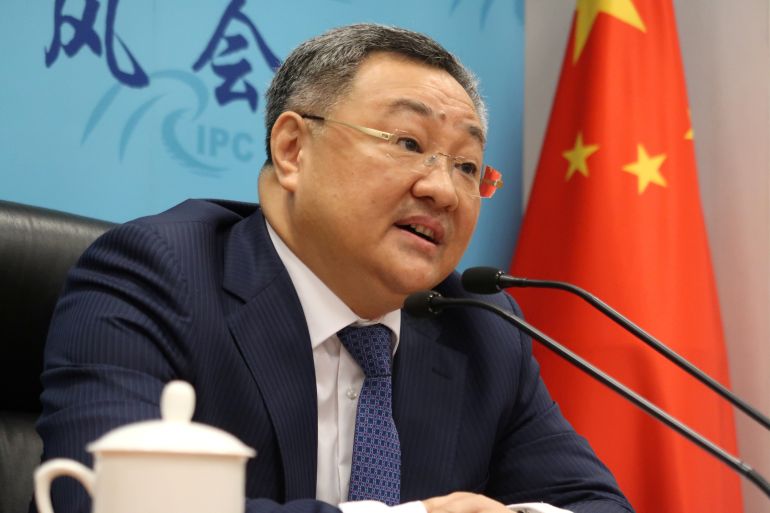
China’s EU envoy, Fu Cong, says Beijing respects the territorial integrity of all countries and stands for peace.
Fu Cong, China’s ambassador to the EU and former head of the arms control department of the Chinese foreign ministry, speaks at a news conference in Beijing [File Photo: Shubing Wang/Reuters]
Brussels, Belgium – China’s envoy to the European Union has suggested that Beijing could back Ukraine’s aims of reclaiming its 1991 territorial integrity, which includes Crimea – the peninsula annexed by Russia in 2014.
In a recent interview with Al Jazeera and two other media outlets, when Fu Cong was asked about supporting Kyiv’s goals, which includes reclaiming other Ukrainian regions now occupied by Russia, the senior Chinese diplomat said: “I don’t see why not.
China’s economy showed further signs of weakness in May. Industrial output and retail sales both missed forecasts. Beijing is expected to increase its efforts to boost the economy to try to shore up its post-COVID-19 recovery.
Al Jazeera’s Katrina Yu reports from Beijing, China.
Vượt qua biên giới chỉ chục km vào chợ đầu mối hoa quả lớn nhất Quảng Tây, giá vải Lục Ngạn (Bắc Giang) tăng gấp đôi.
Xe container Việt Nam và Trung Quốc tại Trung tâm Hoa quả Bằng Tường, chợ đầu mối hoa quả lớn bậc nhất Quảng Tây. Các xe sẽ sang tải tại đây, từ đó xe container Trung Quốc sẽ tiếp tục đi tới các thị trường nội địa nước này. Ảnh: Văn Việt.
An opinion piece in Bloomberg titled ‘Trying to Replace China’s Supply Chains? Don’t Bother?’, published March 1, 2023, claims that ‘Vietnamese factories were supposed to save globalization’ but that they cannot. This is incorrect and here’s why, writes Dezan Shira and Associates, Head of Business Intelligence, Pritesh Samuel.
Vietnam’s factories were never supposed to save globalization. They offer businesses an alternate location for manufacturing – in line with a China+1 strategy that myriad companies now pursue due to rising costs in China.
Globalization is shaped by several factors, including geopolitics, national interests of governments, regional trade and investment initiatives, public policymaking directives by key trade bodies, and so on. It cannot be trivialized into the assumption that a single country can save it.
China’s advanced supply chain and supplier network, driven by the government’s long-term national policies, make it a manufacturing giant. At present, no single country, including Vietnam, can fully replace China’s manufacturing capacity.
China is on track to massively expand its nuclear arsenal, just as Russia suspends the last major arms control treaty. It augurs a new world in which Beijing, Moscow and Washington will likely be atomic peers.
By David E. Sanger, William J. Broad and Chris Buckley David E. Sanger and William J. Broad have covered nuclear weapons for The Times for four decades. Chris Buckley reports on China’s military from Taiwan.
WASHINGTON — On the Chinese coast, just 135 miles from Taiwan, Beijing is preparing to start a new reactor the Pentagon sees as delivering fuel for a vast expansion of China’s nuclear arsenal, potentially making it an atomic peer of the United States and Russia. The reactor, known as a fast breeder, excels at making plutonium, a top fuel of atom bombs.
The nuclear material for the reactor is being supplied by Russia, whose Rosatom nuclear giant has in the past few months completed the delivery of 25 tons of highly enriched uranium to get production started. That deal means that Russia and China are now cooperating on a project that will aid their own nuclear modernizations and, by the Pentagon’s estimates, produce arsenals whose combined size could dwarf that of the United States.
This new reality is prompting a broad rethinking of American nuclear strategy that few anticipated a dozen years ago, when President Barack Obama envisioned a world that was inexorably moving toward eliminating all nuclear weapons. Instead, the United States is now facing questions about how to manage a three-way nuclear rivalry, which upends much of the deterrence strategy that has successfully avoided nuclear war.
China’s expansion, at a moment when Russia is deploying new types of arms and threatening to use battlefield nuclear weapons against Ukraine, is just the latest example of what American strategists see as a new, far more complex era compared to what the United States lived through during the Cold War.
China insists the breeder reactors on the coast will be purely for civilian purposes, and there is no evidence that China and Russia are working together on the weapons themselves, or a coordinated nuclear strategy to confront their common adversary.
But John F. Plumb, a senior Pentagon official, told Congress recently: “There’s no getting around the fact that breeder reactors are plutonium, and plutonium is for weapons.”
It may only be the beginning. In a little-noticed announcement when President Xi Jinping of China met President Vladimir V. Putin in Moscow last month, Rosatom and the China Atomic Energy Authority signed an agreement to extend their cooperation for years, if not decades.
When President Xi Jinping of China met President Vladimir V. Putin in Moscow last month, Russia and China’s nuclear authorities signed an agreement to extend their cooperation for years.Credit…Grigory Sysoyev/Agence France-Presse, via Sputnik
Kênh đào Bình Lục đổ vào Vịnh Bắc Bộ với kinh phí 10,3 tỉ USD mà Trung Quốc đang xây dựng có thể giúp nước này xích lại gần hơn với khu vực Đông Nam Á.
TN – Gần 80 năm sau ngày lập nước, Lai Châu vẫn là tỉnh khó khăn, đi lại xa xôi vất vả và có mật độ dân số thấp nhất toàn quốc. Trong 7 tỉnh biên giới phía bắc, Lai Châu có chiều dài đường biên thứ 3, nhưng sự khó khăn trong quản lý, bảo vệ biên giới thì vẫn… đứng đầu cả nước.
Qua một đêm, tôi tới TP.Lai Châu (tỉnh Lai Châu), thêm nửa ngày nữa mới tới huyện lỵ Mường Tè và lên Đồn biên phòng Pa Vệ Sử (đóng ở xã Pa Vệ Sử, H.Mường Tè, Lai Châu), nghỉ qua đêm để sáng hôm sau lên mốc 42 – nóc nhà biên cương, đi lại khó khăn vất vả nhất toàn quốc.
Mốc “3 ngày 2 đêm”
Đại tá Nguyễn Văn Hưng, Chính ủy Bộ đội biên phòng (BĐBP) Lai Châu, bảo: Ở Lai Châu, có 2 cột mốc cao nhất nhì VN là mốc 79 và 42. Mốc 79 tuy cao nhất (2.880,69 m) nhưng đi lại vẫn dễ hơn so với mốc 42 (2.856,5 m); bộ đội đi tuần tra, thường là đi bộ 3 ngày 2 đêm…
KENJI KAWASE, Nikkei Asia chief business news correspondentMAY 24, 2023 04:30 JST
OMAHA, U.S. — For Antonius Budianto, an independent stock investor from Indonesia, it was a dream come true to be in Omaha, Nebraska for the first time.
Traveling from East Java with his wife and 14-year-old daughter, Antonius was standing in a queue in front of Omaha’s CHI Health Center at 3 a.m. to grab a seat at the annual general shareholders meeting of investment company Berkshire Hathaway on May 6. Antonius said they wanted to be “as close as possible” to the podium as his two business idols — Warren Buffett and Charlie Munger — sat and took questions from shareholders in the audience and around the world.
Antonius has been investing in listed stocks in Indonesia for over 20 years, faithfully following the Buffett method: focus on a few companies with strong earnings, handsome dividend payments and sound corporate governance, and hold on to them, sometimes for decades. At Berkshire, this strategy has been distilled into the oft-repeated maxim: “Just hold the goddamn stock,” as Munger put it that day.
For his part, Antonius has been making a living as a full-time professional investor since 2010.


 China
China EU
EU India
India Türkiye
 UAE
UAE South Korea
 Slovakia
 Hungary
 Belgium
 Japan
Japan Spain
Spain Singapore
 Brazil
 Netherlands
 Saudi Arabia
 Egypt
Egypt Bulgaria
 Italy
Italy Malaysia
 Czech Republic




 CVD
CVD 