Tiếp tục đọc “China could overwhelm US military in Asia in hours, Australian report says”
Chuyên mục: ASIA
US Department of Defense: Indo-Pacific Strategy Report (June 1, 2019)
The Asian Century Is Over
The air forces of four of Asia’s leading powers nearly came to blows in the skies over the Sea of Japan, or East Sea, last week. As Russia and China conducted their first joint aerial patrol, South Korean fighters fired more than 300 warning shots at a Russian command and control aircraft that crossed into South Korea’s air defense identification zone. Meanwhile, Japanese fighters scrambled in case Japanese territory came under fire. Tiếp tục đọc “The Asian Century Is Over”
A Rising China Is Driving the U.S. Army’s New Game Plan in the Pacific
New missiles and large-scale exercises part of long-term strategy to deter Beijing.
FORT SHAFTER, Hawaii—As an organization based solidly on dry land, the U.S. Army’s increasing focus on the Pacific might seem puzzling to some.
But with China continuing to expand its military, building islands in the South China Sea, and spreading fear among neighbors, the Army wants to up its game in the region with more firepower and additional rotations of U.S. troops—not only to reassure key U.S. allies such as Japan, South Korea, and Thailand that the United States has their back, but also to prevent a potential war.
“China is the priority,” said Gen. Robert Brown, U.S. Army Pacific commander, during a March 19 roundtable with a handful of reporters at Fort Shafter in Hawaii. Tiếp tục đọc “A Rising China Is Driving the U.S. Army’s New Game Plan in the Pacific”
GLOBAL ECONOMY-Growing China downdraft chills Asia factory activity
Reuters
* China factory activity remains in contraction territory
Japan, Vietnam PMI slumps as China slowdown hits
* South Korean exports contract at steepest pace in nearly 3 yrs
* Weak readings add pressure on central banks, China, for stimulus
By Leika Kihara
TOKYO, March 1 (Reuters) – Weak demand in China and growing global fallout from the Sino-U.S. trade war took a heavier toll on factories across much of Asia in February, business surveys showed on Friday.
Activity in China’s vast manufacturing sector contracted for the third straight month, pointing to more strains on its major trading partners and raising questions over whether Beijing needs to do more to stabilise the slowing economy.
In many cases, business conditions were the worst Asian companies have faced since 2016, with demand weakening not only in China but globally. Tiếp tục đọc “GLOBAL ECONOMY-Growing China downdraft chills Asia factory activity”
The State of Southeast Asia 2019
Abstract: The ASEAN Studies Centre at ISEAS-Yusof Ishak Institute conducted the “State of Southeast Asia: 2019” online survey between 18 November and 5 December 2018 to seek the views of Southeast Asians onregional affairs. The survey used the purposive sampling method, canvassing views from a total of 1,008 Southeast Asians who are regional experts and stakeholders from the policy, research, business, civil society, and media communities. As such, the results of this survey are not meant to be representative. Rather, it aims to present a general view of prevailing attitudes among those in a position to inform or influence policy on regional political, economic and social issues and concerns.
The survey is divided into five sections.
The first section sketches out the nationality and affiliation of the respondents.
Section II explores the political and economic outlook for 2019, as well as providing views on major developments in the year ahead and security concerns. Some of the issues covered in this section include the Regional Comprehensive Economic Partnership (RCEP), the Comprehensive and Progressive Agreement for Trans-Pacific Partnership (CPTPP), the US-China trade war, denuclearisation in the Korean Peninsula and Rohingya issue.
Section III examines major power relations in the region, with a specific focus on the US and China.
Section IV looks into the region’s perception of the major powers (China, the European Union, India, Japan, Russia and the US) and provides some clues as to which major power does the region trust the most (or the least).
The survey concludes with Section V which looks at three aspects of soft power – tertiary education, tourism and foreign language – as proxies of the major powers’ influence in Southeast Asia.
Narcos: the hidden drug highways linking Asia and Latin America
NOVEMBER 24, 2018 SCMP
As Chinese gangs, Latin American cartels and Nigerian brokers widen their international networks, a rising number of vulnerable women and children are being tangled in their web.
It was one of those hot summer days in early August when the skin has no rest from the burning sun, drier than usual. Daniela, from Venezuela, was landing for the first time in Hong Kong, wearing a black jacket, white shirt, bell-bottomed jeans, and high heels. Tiếp tục đọc “Narcos: the hidden drug highways linking Asia and Latin America”
2019: The Year Ahead in Asia
January 2, 2019 By The Asia Foundation
Happy New Year, and welcome to the first edition of InAsia for 2019. In our last issue we looked at some of our top stories from the year just ended, stories that chronicled the successes and failures, the triumphs, and the tribulations of 2018 through the eyes of our experts in Asia. This week, we invite you to look ahead with us to a still-young 2019, as The Asia Foundation’s country representatives offer their predictions of the stories that will dominate the news from Asia in the coming year. Here, to kick off 2019, are perspectives from our 18 offices in Asia. —John Rieger, editor, InAsia Tiếp tục đọc “2019: The Year Ahead in Asia”
The Best of InAsia 2018
In Asia, December 19, 2018
Season’s Greetings. 2018 has been an eventful year, in Asia and in the stories shared here in the InAsia blog, where I had the pleasure in May to take over the reins from longtime editor Alma Freeman. We’re all grateful, at year’s end, for the continued engagement of our readers, and for the thoughtful contributions of our bloggers, who brought us their unique perspectives and insights on developments in Asia. Here are a few of the year’s most fascinating essays, some of them favorites of our readers and some favorites of yours truly. Enjoy! And be sure to join us in 2019, when our January 2 edition will feature predictions for the year ahead from our country representatives across Asia.
John Rieger
Editor, InAsia
From Myanmar, Kim Ninh looked back on an astonishing time in a country suddenly emerging from decades of dictatorship and isolation, and reflected on that country’s remarkable transformation. Matthew Arnold drew on the Foundation’s Myanmar Strategic Support Program for an analysis of the surprising institutional costs of dictatorship—in this case, a lack of institutions or experience to conduct effective policymaking. And economist James Owen took a look at municipalities snapping up the latest technologies to leapfrog traditional developmental hurdles.
Challenging the Pacific Powers: China’s Strategic Inroads in Context
This post is reprinted from Michael Green’s foreword to the newly released report from CSIS, China’s Maritime Silk Road: Strategic and Economic Implications for the Indo-Pacific Region.
|
|||
|
|||
|
HOW SOUTHEAST ASIANS REALLY PERCEIVE THE QUADRILATERAL SECURITY DIALOGUE
The Quadrilateral Security Dialogue between India, the United States, Japan, and Australia (the Quad, sometimes referred to as the QSD) was created over a decade ago, but it has been given a new lease on life by more compelling strategic circumstances in the Indo-Pacific. Xi Jinping’s China actively challenges the existing order, while Donald Trump’s United States sends mixed signals on whether it even wants to maintain its de facto global leadership. More active participation by other major powers in Asia, joined with the United States, sounds like an uncontroversially good idea. But the debate about the revived Quadrilateral Security Dialogue, or Quad 2.0, has been centered on the negatives: the harm it could cause, rather than what it can really contribute. Those assumptions are based on perceptions (or more correctly, misperceptions), whereby the Quad is seen as too confrontational towards China, and challenging or sidelining the centrality of the Association of Southeast Asian Nations (ASEAN) to discussions of security in the Indo-Pacific. These misperceptions have been so strong, that more ink has been spilled explaining what the Quad is not and what it does not intend, rather than on what it is and what objectives it has. Tiếp tục đọc “HOW SOUTHEAST ASIANS REALLY PERCEIVE THE QUADRILATERAL SECURITY DIALOGUE”
China blames ‘excuses’ for APEC discord, as US ties sour again
A major Asia-Pacific summit’s failure to agree on a communique resulted from certain countries “excusing” protectionism, a top Chinese diplomat said, in a veiled criticism of Washington that further sours the tone of China-U.S. ties ahead of a G20 meet.

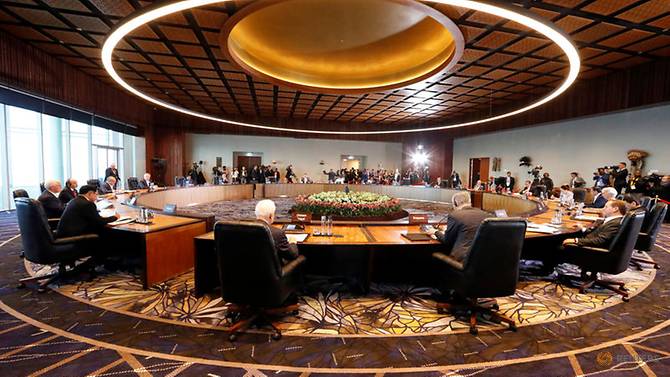
Leaders attend the retreat session of the APEC Summit in Port Moresby, Papua New Guinea November 18, 2018. REUTERS/David Gray
BEIJING: A major Asia-Pacific summit’s failure to agree on a communique resulted from certain countries “excusing” protectionism, a top Chinese diplomat said, in a veiled criticism of Washington that further sours the tone of China-U.S. ties ahead of a G20 meet. Tiếp tục đọc “China blames ‘excuses’ for APEC discord, as US ties sour again”
US seeks further cooperation with Vietnam in defence industry
US Defence Minister James Mattis urged Vietnam and the US to enhance cooperation in defence industry and consider signing suitable documents to create a foundation for the collaboration.

US Defence Minister James Mattis and Vietnamese Defence Minister General Ngo Xuan Lich (Source: qdnd.vn)
He made the proposals at a meeting with Vietnamese Defence Minister General Ngo Xuan Lich on the sidelines of the 17th Shangri-La Dialogue in Singapore on June 1.
The US is taking into account the transfer of jet trainers and other equipment to Vietnam, the US officer said.
He used the occasion to thank Vietnam for hosting aircraft carrier USS Carl Vinson in the central city of Da Nang last March. Tiếp tục đọc “US seeks further cooperation with Vietnam in defence industry”
Migrant workers sent $256 billion home to Asia-Pacific last year: U.N.
KUALA LUMPUR (Thomson Reuters Foundation) – Migrant workers from the Asia-Pacific region sent $256 billion home last year, but more needs to be done to cut costs and make money transfers easier, said a United Nations report on Monday.
Remittances, which have risen about 5 percent since 2008, helped about 320 million family members across the region last year, according to the United Nations’ International Fund for Agricultural Development (IFAD). Tiếp tục đọc “Migrant workers sent $256 billion home to Asia-Pacific last year: U.N.”
China’s Maritime Silk Road: Strategic and Economic Implications for the Indo-Pacific Region
Download the Report from CSIS
Download from CVD
China unveiled the concept for the Twenty-First Century Maritime Silk Road (MSR) in 2013 as a development strategy to boost infrastructure connectivity throughout Southeast Asia, Oceania, the Indian Ocean, and East Africa. The MSR is the maritime complement to the Silk Road Economic Belt, which focuses on infrastructure development across Central Asia. Together these initiatives form the One Belt One Road (OBOR) initiative designed to enhance China’s influence across Asia. Tiếp tục đọc “China’s Maritime Silk Road: Strategic and Economic Implications for the Indo-Pacific Region”