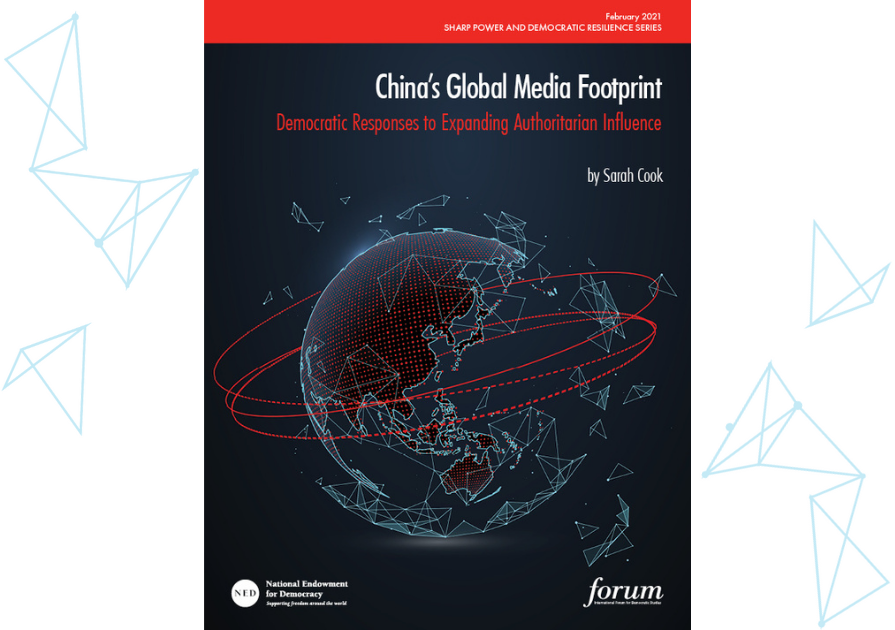
China’s Global Media Footprint – Democratic Responses to Expanding Authoritarian Influence

ABOUT THE SERIES

The Sharp Power and Democratic Resilience series aims to contextualize the nature of sharp power, inventory key authoritarian efforts and domains, and illuminate ideas for non-governmental action that are essential to strengthening democratic resilience.

SERIES HOME

ABOUT THE AUTHOR

Sarah Cook is research director for China, Hong Kong, and Taiwan at Freedom House. She directs the China Media Bulletin, a monthly digest providing news and analysis on media freedom developments related to China. Cook is the author of several Asian country reports for Freedom House’s annual publications, as well as four special reports about China.

This report describes the Chinese Communist Party’s (CCP) sharp power efforts to shape media content around the world. It also documents how nongovernmental actors contribute to a growing accumulation of activities aimed at countering Beijing’s media influence while protecting democratic institutions.

Leveraging propaganda, disinformation, censorship, and influence over key nodes in the information flow, Beijing’s expanding efforts to shape global narratives go beyond simply “telling China’s story.” Their sharper edge undermines democratic norms, erodes national sovereignty, weakens the financial sustainability of independent media, and violates local laws. An acknowledgment and understanding of the challenges that China’s party-state and related actors pose to media freedom globally—not only by China experts, but by the full array of nongovernmental actors engaged in the media, news, and technology sectors—must be central to a comprehensive response.

It is imperative that anyone engaged in the media space—be they journalists, regulators, technology firms, press freedom groups, or even news consumers—acknowledge the influence exerted by China’s authoritarian regime on the news and information circulating in their print publications, radio broadcasts, television programs, and social media feeds.

KEY IDEAS FOR NONGOVERNMENTAL RESPONSES:

  • Investigation and research: Academic institutions, think tanks, research entities, and donors should continue existing work and ensure resources are available to monitor and expose CCP media influence activities in a credible, professional, and sustained way in the coming years.
  • Action by media outlets: Local media should improve their awareness of the potential journalistic and political pitfalls of accepting Chinese state or proxy investment, paid supplements, or coproduction deals.
  • Civil society advocacy: International and local press freedom groups should consider whether and how to incorporate a CCP media influence dimension into current or future projects, with support from donors. Such initiatives could support internal capacity building, journalism trainings and education, media literacy, policy advocacy, and information sharing and coordination.
  • Technology sector collaboration: Technology firms should seek further opportunities to work with researchers and civil society in identifying emerging threats and problematic accounts tied to the Chinese party-state. They must also ensure that independent voices, activists, and content producers who are critical of the Chinese government have a clear avenue for appeal if they encounter problems on the companies’ platforms.

The report also highlights specific actions taken by media outlets and civil society to counter the CCP’s expanding global footprint. Categorized by sector, these responses illustrate ways for media, civil society, think tanks, and the technology sector to build resilience to sharp power across the information ecosystem.

DOWNLOAD THE REPORT


China’s Global Media Footprint: Democratic Responses to Expanding Authoritarian Influence [PDF]
Gender norms, LGBTQI issues and development

Author: Evie BrownePublished by: ALIGN

View online guide View guide as pdf

LGBTQI+ and norms guide cover featuring a rainbow flag.

Lesbian, gay, bisexual, transgender and intersex (LGBTI) rights have become an important topic of discussion in the development sector in recent years. Moving from the provision of HIV and AIDS care for the disproportionate number of LGBT people affected, through to same-sex marriage legalisation, the landscape has shifted to promote an LGBTI-inclusive approach in many areas. This is supported by a series of international and national human rights provisions affirming all people’s rights to nondiscrimination, freedom of expression and freedom from violence. In some contexts, these changes have been possible due to shifts in social norms towards greater tolerance and acceptance of LGBTQI people. Norm change has largely been the result of long-term and increasingly visible and vibrant activist engagement, drawing on strategies such as media coverage, peer interventions, ally-building and institutional training. This guide reviews some of the literature on the norm changes that are leading to greater acceptance of and less discrimination towards LGBTQI people, focusing on low income countries in the global South. 

This topic guide is primarily intended for policy-makers and practitioners who may not be familiar with a queer theory approach to norms. It provides an overview of some important ideas and ways of thinking about how gendered social norms affect LGBTQI people in developing countries, moving the discussion beyond a rights-based approach to be more inclusive of all kinds of non-normative sexualities and genders. The guide aims to summarise the main theoretical points of a queer approach to gender norms, to identify the key issues and challenges affecting LGBTQI people, and to provide some examples of where norm change has happened.

Vietnam Boy: US ambassador raps to celebrate Tet

By Minh Nga   February 9, 2021 | 02:47 pm GMT+7

Ambassador Daniel Kritenbrink collaborated with Vietnamese rapper Wowy to make a song about the Lunar New Year vibe in Vietnam.

Throughout the song, the ambassador raps several Vietnamese lines to wish people a peaceful new lunar year.

He also lists what should be done throughout Tet in Vietnamese traditions, including preparing the yellow mai and peach plants, of which flowers are signature for home decoration during Tet in Vietnam, cleaning up the house to welcome guests, and giving li xi (lucky money) to children.

He ends the video with the line saying “Tet den roi” which means Tet has arrived.

This is the Ambassador’s fourth Tet in Vietnam, and he has always enjoyed this time of year. “Tet gives us an opportunity to slow down, reconnect with loved ones, and reflect on the passing year while looking ahead to the coming year,” said the U.S. Consulate General in HCMC.

“Our two countries cooperate closely on everything from security, trade, and education, to war legacies, energy, and health, and now we can add music to the list,” it added.

Tet is what Vietnamese calls Lunar New Year, which is so far the nation’s biggest holiday and most important occasion for family reunion.

Related News:

Men arrested for Facebook posts defaming leaders

SOCIETYFace BookTwitterBình luậnTin nóng

Chia sẻ | FaceBookTwitter Email Copy LinkInterested111/02/2021    07:52 GMT+7

Police in the central province of Quang Tri on February 10 launched legal proceedings against two men for compiling and spreading documents with defamatory contents via social networks.

Men arrested for Facebook posts defaming leaders hinh anh 1
Phan Bui Bao Thi (Photo: laodong.vn)

The documents were posted on Facebook accounts like Thu Ha and Hoang Le, and such fanpages as Ly Duong Tu, Quang Tri 357, and Tin Quang Tri 246 (Quang Tri news 246).

Those articles, photos and video clips have contents defaming and insulting the prestige of individuals, including some leaders of Quang Tri province, ministries and centrally-run agencies.

They have harmed the leaders’ prestige and dignity as well as the role, position and function of State agencies for a long time, triggering concern among Party members, officials and the public, while affecting political security in the locality.

Local competent forces on February 4 stopped 56-year-old Le Anh Dung, residing in An Phu ward, district 2, Ho Chi Minh City, while he was on the way from Dong Ha city, Quang Tri province, to HCM City.

They found documents stored in Dung’s mobile phone proving that he had directly published the documents on social networks.

Dung’s accomplice is Phan Bui Bao Thi, 50, from Son Tra district, the central city of Da Nang, who is working at the Giao duc & Thoi dai (The Education and Times) newspaper.

Thi confessed that he and Dung wrote many articles defaming Quang Tri leaders and posted more than 10,000 pages on social networks.

The local police on February 5-6 decided to detain the duo for abusing the rights to freedom and democracy, and violating the State’s interests, as well as legal rights and interests of organisations and individuals as prescribed in Article 331 of the Penal Code./.VNA

The Second Island Cloud: A Deeper and Broader Concept for American Presence in the Pacific Islands

By Andrew Rhodes Joint Force Quarterly 959PRINT  |  E-MAIL Nov. 18, 2019 — Washington Headquarters Services

Download PDF

Andrew Rhodes wrote this essay while a student at the U.S. Naval War College. It won the Strategic Research Paper category of the 2019 Chairman of the Joint Chiefs of Staff Strategic Essay Competition.

In the early 20th century, the visionary Marine officer Earl “Pete” Ellis compiled remarkable studies of islands in the Western Pacific and considered the practical means for the seizure or defense of advanced bases. A century after Ellis’s work, China presents new strategic and operational challenges to the U.S. position in Asia, and it is time for Washington to develop a coherent strategy, one that will last another 100 years, for the islands of the Western Pacific. It has become common to consider the second island chain as a defining feature of Pacific geography, but when Ellis mastered its geography, he saw not a “chain,” but a “cloud.” He wrote in 1921 that the “Marshall, Caroline, and Pelew Islands form a ‘cloud’ of islands stretching east and west.” His apt description of these archipelagoes serves well for a broader conception of the islands in, and adjacent to, traditional definitions of the second island chain. A new U.S. strategy should abandon the narrow lens of the “chain” and emphasize a broader second island cloud that highlights the U.S. regional role and invests in a resilient, distributed, and enduring presence in the Pacific.

Tiếp tục đọc “The Second Island Cloud: A Deeper and Broader Concept for American Presence in the Pacific Islands”

Powers Jockey for Pacific Island Chain Influence

By: Christopher P. Cavas    February 1, 2016 Defense News

WASHINGTON — The extensive chains of Pacific islands ringing China have been described as a wall, a barrier to be breached by an attacker or strengthened by a defender. They are seen as springboards, potential bases for operations to attack or invade others in the region. In a territorial sense, they are benchmarks marking the extent of a country’s influence.

“It’s truly a case of where you stand. Perspective is shaped by one’s geographic and geostrategic position,” said Andrew Erickson, a professor with the China Maritime Studies Institute at the Naval War College.

Tiếp tục đọc “Powers Jockey for Pacific Island Chain Influence”

How the United States Can Effectively Contain China

| May 21, 2020

Pluralism and freedom vs. Communist autocracy

During his Senate confirmation hearing last week to be the next director of national intelligence, Texas Republican Rep. John Ratcliffe emphasized China is this country’s “greatest threat actor,” a status only confirmed by rising acrimony over Beijing’s handling of the coronavirus pandemic. But though tensions are rising in the South China Sea, where U.S. Navy missions challenge China’s unsubstantiated claims of hegemony over the region, an actual war between the two powers appears unlikely.

But are the United States and China on a path to a new Cold War?

Tiếp tục đọc “How the United States Can Effectively Contain China”

A China Strategy

CEPA

A China Strategy

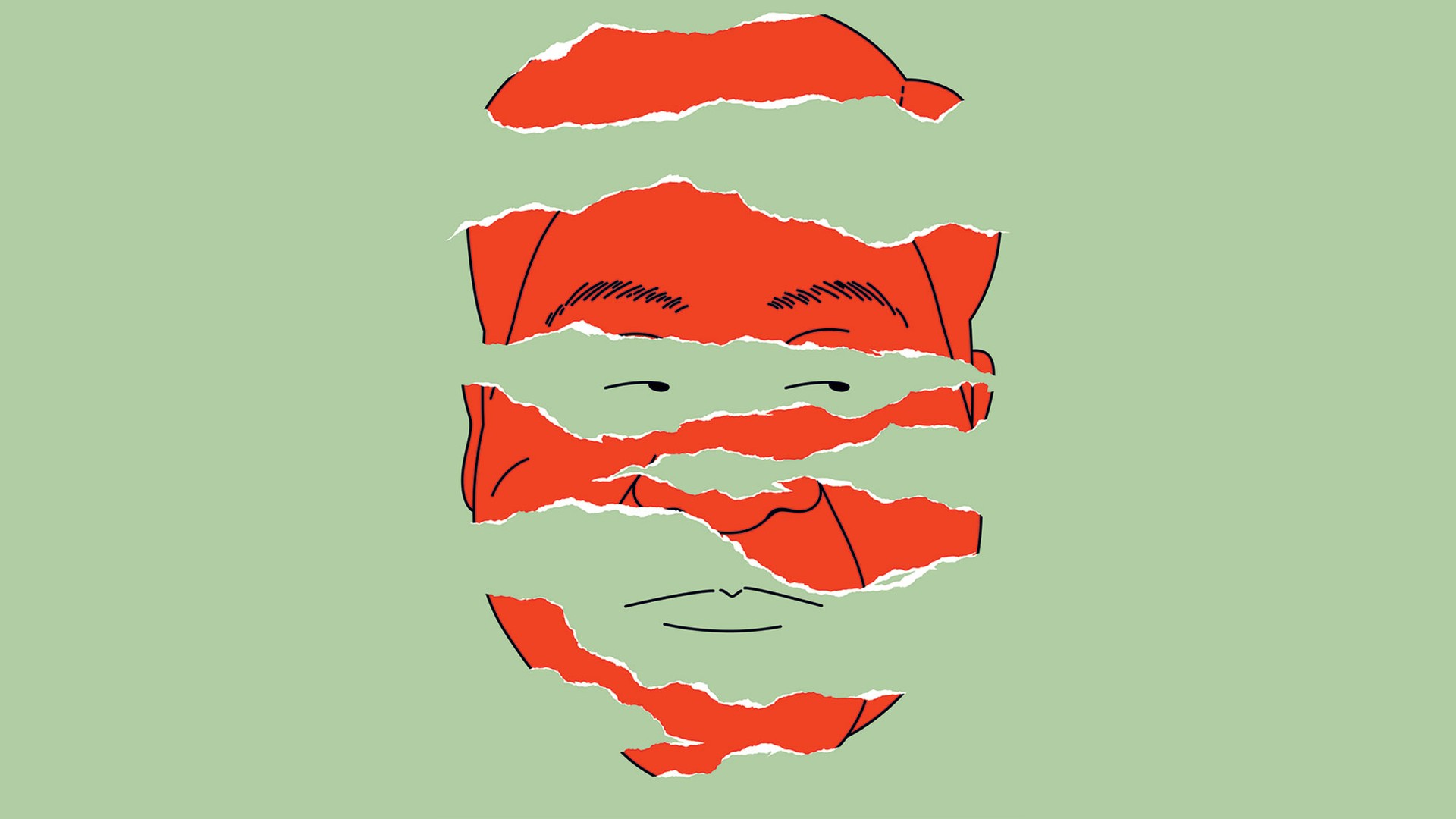
Photo: The portrait of China's President Xi Jinping appears during a military parade to celebrate the 70th anniversary of the founding of a nation at the Tiananmen Square in Beijing, China on October 1, 2019. New weapons were unveiled at the largest military parade ever. ( The Yomiuri Shimbun ) Credit: REUTERS

Edward Lucas

December 7, 2020

icon-pdf

DOWNLOAD PDF

In an era of geopolitical competition, the West — the U.S.-led countries of the transatlantic alliance and their East Asian allies — lacks a strategy for dealing with its most formidable competitor: the People’s Republic of China (henceforth China). But the Chinese Communist Party (CCP) has a strategy for dealing with the West. It involves a long-term goal of “national rejuvenation”1 — making China the world’s most powerful country by 2050 — implemented with decisive leadership; a clear-eyed appreciation of Western diplomatic, economic, political, and social weaknesses; and effective means of exploiting them. These tactics, best characterized as “sharp power,”2 include censorship and manipulation of the information system, cyber operations, divide-and-rule diplomacy, leverage of trade and investment, and propaganda, plus military bluff and intimidation.

Tiếp tục đọc “A China Strategy”

CSBA: SEIZING ON WEAKNESS – Allied Strategy for competing with China’s globalizing military

January 4, 2021  Toshi YoshiharaJack Bianchi
Resources: Strategy & Policy

China’s military is going global. In the coming decade, the People’s Liberation Army (PLA) could be well-positioned to influence events and conduct a wide range of missions, including limited warfighting, beyond the Western Pacific. The United States and its close allies, who have enjoyed largely unobstructed access to the world’s oceans for the last three decades, will need to adjust to new military realities as the PLA makes its presence felt in faraway theaters.

In this study, Senior Fellow Toshi Yoshihara and Research Fellow Jack Bianchi argue that a deep study of China’s weaknesses as they relate to its worldwide ambitions is required to formulate an effective allied response. These weaknesses offer insights into the costs that Beijing will have to pay to go global. Importantly, the United States and its close allies enjoy agency over certain Chinese weaknesses, furnishing them leverage that, if exercised, could yield strategic dividends. The report concludes with a range of allied options that exploit China’s weaknesses to constrain and complicate the PLA’s global expansion.  

AUTHORS Toshi Yoshihara Senior Fellow, Jack Blanchi, Research Fellow

DOWNLOAD PDF

Download full “Seizing on Weakness: Allied Strategy for Competing With China’s Globalizing Military” report.

READ FULL PUBLICATION

Read the full publication “Seizing on Weakness: Allied Strategy for Competing With China’s Globalizing Military” report using our online e-reader tool.

How China sees the world

How China Sees the World

And how we should see China

Illustration
Karan Singh

https://358afed383d4909496d2c7460875e850.safeframe.googlesyndication.com/safeframe/1-0-37/html/container.html

  • Link Copied

I. The Forbidden City

On November 8, 2017, Air Force One touched down in Beijing, marking the start of a state visit hosted by China’s president and Communist Party chairman, Xi Jinping. From my first day on the job as President Donald Trump’s national security adviser, China had been a top priority. The country figured prominently in what President Barack Obama had identified for his successor as the biggest immediate problem the new administration would face—what to do about North Korea’s nuclear and missile programs. But many other questions about the nature and future of the relationship between China and the United States had also emerged, reflecting China’s fundamentally different perception of the world.

Tiếp tục đọc “How China sees the world”

Atlantic Council: Global Strategy 2021: An allied strategy for China

Atlantic Council

DOWNLOAD PDF

This strategy was produced in collaboration with experts from ten leading democracies.

Foreword

Following World War II, the United States and its allies and partners established a rules-based international system. While never perfect, it contributed to decades without great-power war, extraordinary economic growth, and a reduction of world poverty. But this system today faces trials ranging from a global pandemic and climate change to economic disruptions and a revival of great-power competition.

Tiếp tục đọc “Atlantic Council: Global Strategy 2021: An allied strategy for China”

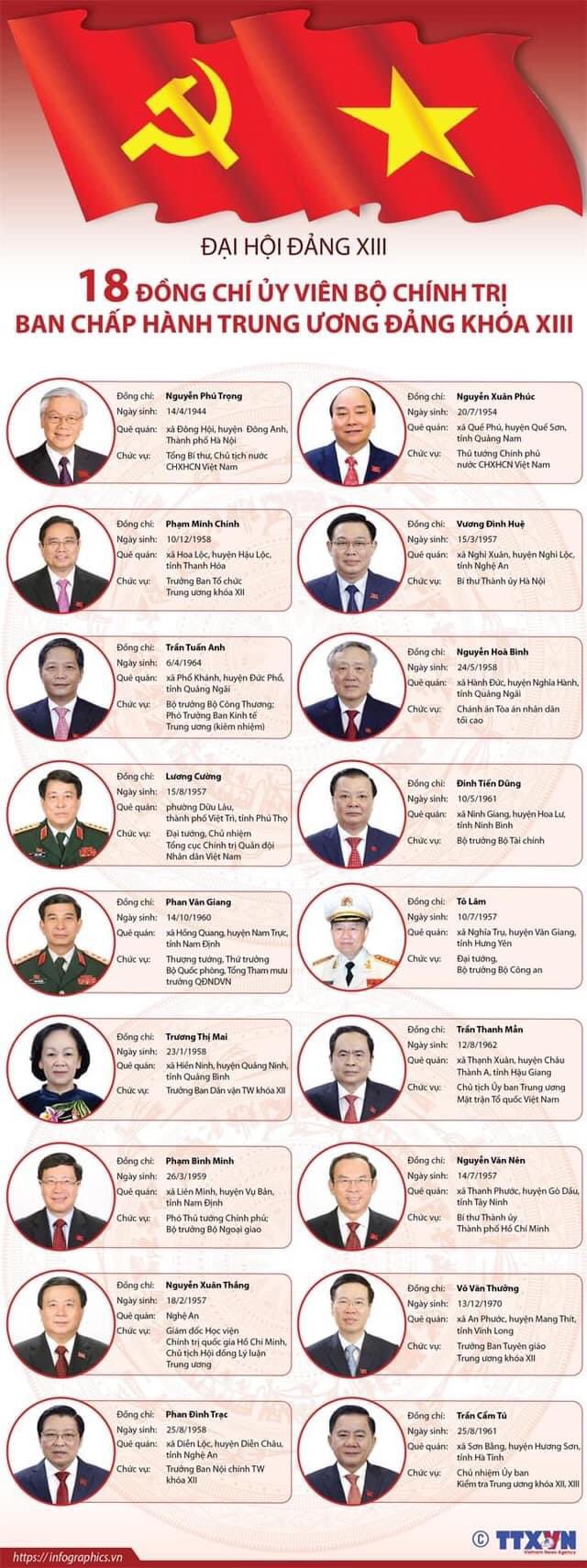
List of newly re(elected) members of the Politburo and the Central Committee of the Communist Party of Vietnam

Election results of 13th Party Central Committee announced

31/01/2021    00:41 GMT+7 vietnamnet

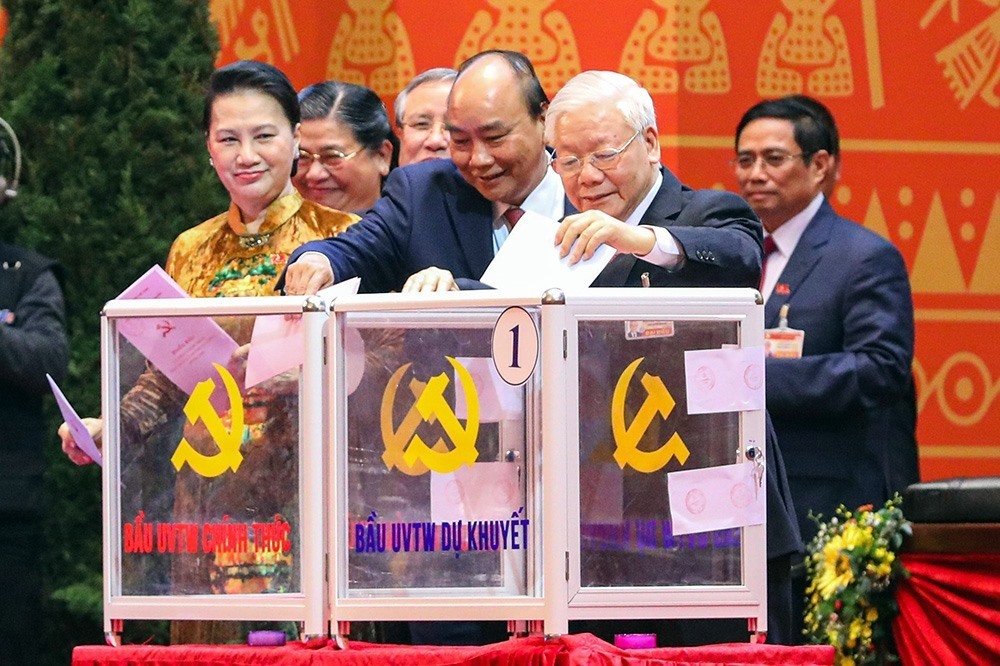
The Communist Party of Vietnam (CPV)’s Central Committee has been elected with 200 members for the 13th Congress (2021-26), unchanged from the previous term.

Election results of 13th Party Central Committee announced

Delegates cast ballots to elect 13th tenure Party Central Committee

The 13th National Congress of the Communist Party of Vietnam (CPV) on January 30 evening announced the results of the election and the list of the 200 elected to the 13th Party Central Committee, including 180 official members and 20 alternative members.

Immediately after completing the vote counting, the Congress announced the list of delegates elected to the 13th Party Central Committee.

Tiếp tục đọc “List of newly re(elected) members of the Politburo and the Central Committee of the Communist Party of Vietnam”

Myanmar leader Aung San Suu Kyi and other senior party figures detained by army

Aung San Suu Kyi
Aung San Suu KyiAung San Suu Kyi
File photo of Myanmar’s leader Aung San Suu Kyi, who was detained in the early morning of Feb 1, 2021. (Photo: Reuters/Yves Herman)  

01 Feb 2021 07:12AM(Updated: 01 Feb 2021 09:31AM)

YANGON: Myanmar’s de facto leader Aung San Suu Kyi and other senior figures from the ruling party have been detained in an early morning raid, the spokesman for the governing National League for Democracy said on Monday (Feb 1).

The move comes after days of escalating tension between the civilian government and the powerful military that stirred fears of a coup in the aftermath of an election the army says was fraudulent.

Tiếp tục đọc “Myanmar leader Aung San Suu Kyi and other senior party figures detained by army”

China ‘threatens war’ with Philippines as US pledges support to Manila

31 Jan, 2021 01:26 AM7 minutes to read Nzherald

China's President Xi Jinping 'threatened war' with the Philippines this week. Photo / AP
China’s President Xi Jinping ‘threatened war’ with the Philippines this week. Photo / AP

news.com.auBy: Jamie Seidel25

China is “threatening war” after it authorised its warships to open fire on fishers plying traditional waters, warns the Philippines. Now Washington says it has Manila’s back.

Beijing has passed legislation calling upon its military-controlled coast guard to open fire upon “foreign” vessels and destroy “illegal” structures within the East and South China seas.

Problem is, those territories don’t belong to it.

Read More

Which means the law represents a significant escalation in international tensions.

ADVERTISEMENT

https://4b158e7d15175961e4172c5d5efb4ced.safeframe.googlesyndication.com/safeframe/1-0-37/html/container.htmlAdvertise with NZME.

And that has Manila worried the region is about to erupt in violence.

Foreign Secretary Teodoro Locsin Jr. says the Chinese move “is a verbal threat of war to any country that defies the law”. Any nation not rejecting the law will be signalling its “submission”.https://platform.twitter.com/embed/index.html?creatorScreenName=nzherald&dnt=false&embedId=twitter-widget-0&frame=false&hideCard=false&hideThread=false&id=1354352774591389697&lang=en&origin=https%3A%2F%2Fwww.nzherald.co.nz%2Fworld%2Fchina-threatens-war-with-philippines-as-us-pledges-support-to-manila%2F3Y5CG364WQOCTY773AV42FWHIE%2F&siteScreenName=nzherald&theme=light&widgetsVersion=ed20a2b%3A1601588405575&width=550px

Beijing’s aggressive new legislation orders its coast guard to “take all necessary measures, including the use of weapons, when national sovereignty, sovereign rights, and jurisdiction are being illegally infringed upon by foreign organisations or individuals at sea”.

Hours after the new law was passed, a flight of H-6K strategic bombers escorted by advanced fighters made a dummy “attack run” on the USS Theodore Roosevelt battle group.

Filipino fishers operating out of Thitu (also known as Pag-asa) island in the Spratly Islands also reported Chinese coast guard and militia vessels forcing them out of traditional waters.

The aircraft carrier USS Theodore Roosevelt (CVN 71) pictured off the coast of England in 2015.

Making a stand

New US Secretary of State Antony Blinken has responded to Beijing’s intimidation by contacting Mr Locsin, telling him the longstanding defence agreement between the two nations would be honoured.