World leaders are facing crises on all fronts. Putin will be watching if they fail

Nic Robertson-Profile-Image

Analysis by Nic Robertson, CNN International Diplomatic Editor

Updated 0405 GMT (1205 HKT) June 25, 2022 CNN

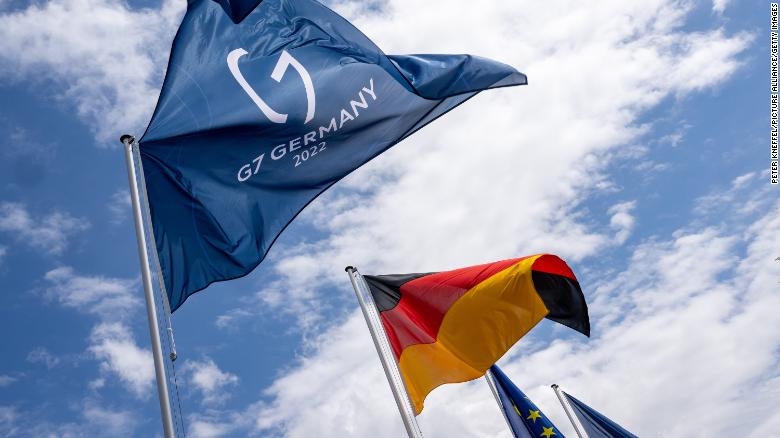
Flags representing the G7 Summit, Germany and the European Union fly ahead of the summit, scheduled to take place at Schloss Elmau in Germany's Bavaria region from June 26 to 28.

Flags representing the G7 Summit, Germany and the European Union fly ahead of the summit, scheduled to take place at Schloss Elmau in Germany’s Bavaria region from June 26 to 28.

(CNN)What a difference a year makes. Enormous challenges, some of them barely imaginable when the G7 leaders last met 12 months ago, are bearing down on the world’s most prosperous democratic nations as they prepare to meet in Germany.

Optimism was in the air at the Cornish beach resort of Carbis Bay in 2021 as the G7‘s presidents, prime ministers and chancellor met face-to-face for the first time since the Covid-19 pandemic began.

Together they vowed to “beat Covid-19 and build back better,” to “reinvigorate economies,” to “protect our planet” and to “strengthen partnerships.”

But global events have since overtaken their best efforts, and it is far from clear if they will be able to build on those goals this year. Russia’s unprompted invasion of Ukraine is a large and singular cloud, but other thunderheads are gathering too.

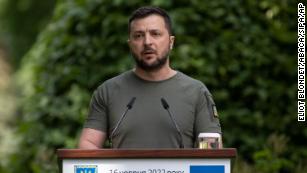
Zelensky will address G7 and NATO summits

Zelensky will address G7 and NATO summits

Over the next few days, the leaders of Japan, Canada, the United States, the United Kingdom, France, Italy, the European Union and host Germany will meet amid the seclusion of Bavaria’s luxurious Schloss Elmau retreat.

Tiếp tục đọc “World leaders are facing crises on all fronts. Putin will be watching if they fail”

China jettisons underdog tag to become space force

SCMP

 Andrew MullenDeputy Editor, Political Economy 25 June 2022

Dear Global Impact Readers, 

Space, they say, is the final frontier. But how far does that frontier go and what’s out there? 

China, has in recent years, accelerated all things space as part of its busy science programme we recapped a few weeks ago, from landing a rover on Mars to nearing completion of its Tiangong space station.

In this issue, the SCMP’Stephen Chen, the news editor for science with our China desk, is back to look at China’s exploits and gaze into what the future holds for its ambitious space programme.  Tiếp tục đọc “China jettisons underdog tag to become space force”

Monkeypox and the gay community

The New York Times newsletter

This weekend marks the end of Pride month, as cities across the country host events to celebrate the L.G.B.T.Q. community.
It is also a fraught moment in public health: A global outbreak of monkeypox is causing concern, with many of the cases clustered around men who have sex with men.
Experts are now trying to strike a delicate balance, warning people who may be at higher risk, without stigmatizing a community that has often been scapegoated for health scares in the past.

Tiếp tục đọc “Monkeypox and the gay community”

US Supreme Court overturns Roe v. Wade, ending 50 years of federal abortion rights

PUBLISHED FRI, JUN 24 202210:11 AM EDTUPDATED CNBC

thumbnail

Dan Mangan@_DANMANGAN

Kevin Breuninger@KEVINWILLIAMB

KEY POINTS

  • The Supreme Court in a 5-4 decision overturned Roe v. Wade, the landmark ruling that established the constitutional right to abortion.
  • Roe since 1973 had permitted abortions during the first two trimesters of pregnancy in the United States.
  • Almost half the states are expected to outlaw or severely restrict abortion as a result of the Supreme Court’s decision on a Mississippi case known as Dobbs v. Jackson Women’s Health Organization.
  • Justice Samuel Alito wrote the majority opinion. The court’s other five conservatives, including Chief Justice John Roberts, joined in the judgment, which was opposed by the three liberal justices.

Supreme Court overturns Roe v. Wade, ending decades of federal abortion rights

The Supreme Court in a 5-4 decision on Friday overturned Roe v. Wade, the landmark ruling that established the constitutional right to abortion in the U.S. in 1973.

The court’s controversial but expected ruling gives individual states the power to set their own abortion laws without concern of running afoul of Roe, which had permitted abortions during the first two trimesters of pregnancy.

Tiếp tục đọc “US Supreme Court overturns Roe v. Wade, ending 50 years of federal abortion rights”

ICSID Releases 2022 Versions of its Rules and Regulations

NEWS RELEASESJUNE 22, 2022

The International Centre for Settlement of Investment Disputes (ICSID) has published the 2022 ICSID Rules and Regulations for resolving international investment disputes, which come into effect on July 1, 2022.

View the Rules (2022 Version)

View the Regulations (2022 Version)

The updated rules for arbitration, mediation, conciliation, and fact-finding are the outcome of over 5 years of collaboration with State officials, legal counsel, adjudicators, businesses representatives, and civil society. They incorporate innovations designed to make ICSID cases more efficient for parties, to broaden access to ICSID’s facilities and services, and to ensure greater public transparency in the conduct and outcome of proceedings.

This is the first amendment to the ICSID rules since 2006, and the most extensive modernization of ICSID procedures in the Centre’s history.

Innovations introduced in the 2022 Rules and Regulations include:

Tiếp tục đọc “ICSID Releases 2022 Versions of its Rules and Regulations”

Starving civilians is an ancient military tactic, but today it’s a war crime in Ukraine, Yemen, Tigray and elsewhere

Grain warehouse destroyed by Russian attacks in Kopyliv, Kyiv province, Ukraine, May 28, 2022.
Dogukan Keskinkilic/Anadolu Agency via Getty Images“>

Published: June 21, 2022 12.51pm BST The Conversation

Authors

  1. Tom DannenbaumAssociate Professor of International Law, Tufts University
  2. Alex De WaalResearch Professor and Executive Director of the World Peace Foundation at The Fletcher School, Tufts University
  3. Daniel MaxwellHenry J. Leir Professor in Food Security, Friedman School of Nutrition Science and Policy, Tufts University

Disclosure statement

Alex de Waal is affiliated with the World Peace Foundation.

Daniel Maxwell receives funding from the US Agency for International Development (USAID) and the British Foreign, Commonwealth and Development Office (FCDO). He is a member of the Famine Review Committee for IPC analysis.

Tom Dannenbaum does not work for, consult, own shares in or receive funding from any company or organisation that would benefit from this article, and has disclosed no relevant affiliations beyond their academic appointment.

Partners

Tufts University provides funding as a founding partner of The Conversation US.

View all partners

CC BY NDWe believe in the free flow of information
Republish our articles for free, online or in print, under Creative Commons licence.

______

A hideous contradiction is playing out in war-torn Ukraine. Thousands of Ukrainians are starving in cities besieged by Russian forces. Meanwhile, the country’s grain stores are bursting with food, and the government is begging for international assistance to export Ukrainian grain to world markets.

Tiếp tục đọc “Starving civilians is an ancient military tactic, but today it’s a war crime in Ukraine, Yemen, Tigray and elsewhere”

Protecting Domestic Workers with the Blockchain

June 22, 2022

By Nguyen Thi Ngoc Anh, Asia Foundation

FacebookTwitterLinkedInEmailPrintShare

Migrant domestic workers and their challenges

Cooking, cleaning, laundry, childcare—domestic labor is essential labor in any society. In Vietnam, a rapidly growing middle class has produced skyrocketing demand for paid domestic workers—both live-in and hourly—particularly in large metropolises like Hanoi and Ho Chi Minh City, and domestic workers have become an important part of the gig economy.

Tiếp tục đọc “Protecting Domestic Workers with the Blockchain”

China cannot hinder international navigation through Taiwan Strait

By Tran Đinh Hoanh 
Tran Đinh Hoanh is an international litigator and writer in Washington DC.

[TĐH: I’ve tried to make this piece ultra-short, simple, and easy
to remember, with sufficient citations for those who’d like to dig
deeper into UNCLOS]

During China Foreign Ministry Spokesperson Wang Wenbin’s Regular Press Conference on June 13, he responded to a Bloomberg question concerning the legal status of the Taiwan Strait. Asked about Chinese military officials’ contention that the Taiwan Strait does not constitute “international waters,” he said that Taiwan is “an inalienable part of China’s territory. …According to UNCLOS and Chinese laws, the waters of the Taiwan Strait, extending from both shores toward the middle of the Strait, are divided into several zones including internal waters, territorial sea, contiguous zone, and the Exclusive Economic Zone. China has sovereignty, sovereign rights and jurisdiction over the Taiwan Strait.”

He went on to say that calling the strait international waters is “a false claim” by “certain countries” searching for a pretext for “threatening China’s sovereignty and security.”

However, while the United Nations Convention on the Law of the Sea (UNCLOS) does not use the phrase “international waters” most waters, even territorial seas and exclusive economic zones (EEZs), can be used for international navigation. Tiếp tục đọc “China cannot hinder international navigation through Taiwan Strait”

The Future of the Quad and the Emerging Architecture in the Indo-Pacific

Photo credit: YashSD / Shutterstock.com

JUNE 21, 2022 gmfus.org

Garima
Kristi Govella

by Garima Mohan, Kristi Govella

DOWNLOAD PDF

Summary

The Quadrilateral grouping of Australia, India, Japan, and the United States (the Quad) has come a long way from its origins, establishing itself as a crucial pillar of the Indo-Pacific regional architecture and significantly shifting in tone and focus from its early iterations. Since its revival in 2017, the Quad has been elevated to a leader-level dialogue, it has begun issuing joint statements, and it has developed a new working-group structure to facilitate cooperation. It has also significantly broadened and deepened its agenda to include vaccines, climate change, critical and emerging technologies, infrastructure, cyber, and space.

These recent changes to the Quad raise several questions about its future trajectory. What are the drivers of engagement, the domestic support, and the bureaucratic capacity in the four countries to continue investing in the Quad?  How well does the Quad’s new working-group structure function, and will the working groups be able to deliver tangible results? How has the Quad’s agenda evolved, and will it return to its initial focus on security challenges? Are the Quad countries open to cooperation with additional countries and, if so, what form will this take?

This paper analyzes these questions drawing on recent publications, official statements, and interviews with key experts and policymakers in the four countries. In doing so, it offers five key takeaways into the Quad as an evolving part of the Indo-Pacific architecture, as well as a vehicle for achieving the goals of its four member countries.

Since its revival in 2017, the Quad has been elevated to a leader-level dialogue, it has begun issuing joint statements, and it has developed a new working-group structure to facilitate cooperation

First, in terms of institutionalization and internal goals, there is little interest among the member countries in further institutionalizing the Quad by establishing a secretariat or adopting a charter. All four consider the flexible nature of the grouping to be an asset. At the same time, the Quad partners have increased their alignment on strategic issues and aim to continue doing so in the near future by solidifying ties within the grouping.

Tiếp tục đọc “The Future of the Quad and the Emerging Architecture in the Indo-Pacific”

Social media is rife with skin-whitening products. But little is being done to regulate the market

CNN

Skin-lightening products have exploded in their availability on major social media platforms where there are few rules about how they are promoted or sold. With some products containing potentially toxic ingredients, consumers could be at risk.

Written by:Jacqui Palumbo, CNN
Editors: Meera Senthilingam, Eliza Anyangwe; Illustrations: Kathy Kim; Data journalist: Carlotta Dotta; Researchers: Elizabeth Yee, Jacqui Palumbo

Updated 20th June 2022

Editor’s note: This story is part of ‘White lies‘, a series by CNN’s As Equals investigating skin whitening practices worldwide to expose the underlying drivers of colorism, the industry that profits from it and the cost to individuals and communities. For information about how CNN As Equals is funded and more, check out our FAQs.

Once primarily sold in markets and beauty stores, skin-lightening products have exploded in their availability online and today, they are pervasive on every major social media platform.

On Facebook and Instagram, vendors hawk creams and serums that promise lighter skin yet offer scant information about the products themselves, while on YouTube and TikTok you can find thousands of tutorials by people promoting potent products or home remedies without qualifications that support their claims. On TikTok alone, the hashtag #skinwhitening has over 254 million views, while #skinlightening has another 62 million.

“Social media has become the most powerful tool right now for the sale of skin-lightening products,” says Dr. Anita Benson, Nigeria-based dermatologist and founder of the Embrace Melanin Initiative to combat colorism and harmful skin-lightening practices in Africa.

Tiếp tục đọc “Social media is rife with skin-whitening products. But little is being done to regulate the market”

‘Day Zero’: This city is counting down the days until its water taps run dry

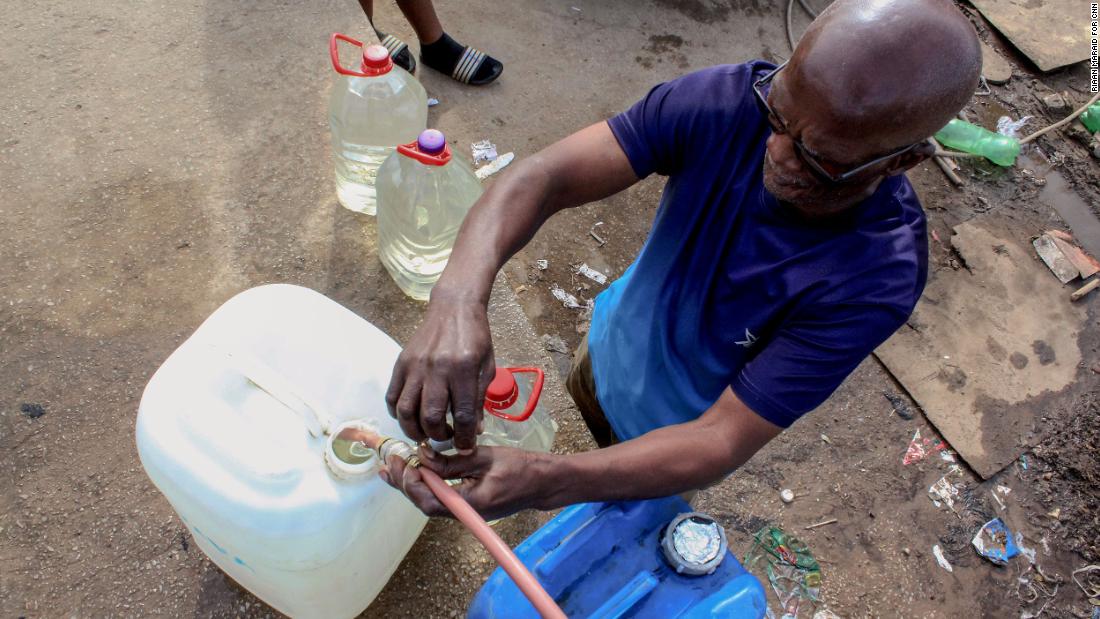
Leonard Matana. 69, filling up a plastic container with water at a communal tap in the township of Kwanobuhle in South Africa.

Leonard Matana. 69, filling up a plastic container with water at a communal tap in the township of Kwanobuhle in South Africa.

By Riaan Marais for CNN and Derek Van Dam, CNN
Photographs by Samantha Reinders and Riaan Marais for CNN

Updated 0055 GMT (0855 HKT) June 21, 2022

(CNN)Every day, Morris Malambile loads his wheelbarrow full of empty plastic containers and pushes it from his home to the nearest running tap. It’s much further than the usual walk to the kitchen sink — just a little under a mile away — but it’s not the distance that bothers him.

It’s the bumpy road — which runs between tightly packed shanty dwellings and beige public-funded houses — that makes balancing containers filled with 70 liters of water on his return a pain.

“Home feels far when you are pushing 70 kilograms of water in a wheelbarrow,” said the 49-year-old resident from the impoverished South African township of Kwanobuhle.

Tiếp tục đọc “‘Day Zero’: This city is counting down the days until its water taps run dry”

Human Rights NGOs: “Quis custodiet ipsos custodes?”

Council on Foreign Ralations, Pressure Points June 20, 2022

by Elliott Abrams

How much reliance should be placed on the major international human rights NGOs? Can they be trusted to work without bias? How are they governed?

These are subjects I discussed recently in a short paper done for the Council on Foreign Relations’ Diamonstein-Spielvogel Project on the Future of Democracy. It is entitled Human Rights NGOs: “Quis custodiet ipsos custodes?” and can be found here.
Tiếp tục đọc “Human Rights NGOs: “Quis custodiet ipsos custodes?””

Security and Economic Challenges for Taiwan in Cross-Strait Relations

Home » Security and Economic Challenges for Taiwan in Cross-Strait Relations

Taiwan

Security and Economic Challenges for Taiwan in Cross-Strait Relations

Chien-pin Li is Professor of Political Science and Dean of the College of Humanities and Social Sciences at Sam Houston State University. Before his current position, he taught at Kennesaw State University for 26 years, and was a founding member of the China Research Center. He received his Ph.D. in Political Science from the University of Iowa and was an Associate Research Fellow at Academia Sinica (Taipei, Taiwan), a Senior Fellow at the Atlantic Council of the United States (Washington, D.C.) and a Research Fellow at the Pacific Cultural Foundation (Taipei, Taiwan). His teaching and research interests focus on East Asian political economy, including trade disputes, trade negotiations, and regional integration. He is the author of Rising East Asia: The Quest for Governance, Prosperity, and Security (2020) and has published articles in Asian Survey, Pacific Review, Issues & Studies, International Studies Quarterly, and other journals. 

More articles by the Author »

Print Friendly, PDF & Email

The security and economic landscape in the Indo-Pacific is increasingly difficult to navigate. While trade agreements such as the Comprehensive and Progressive Agreement for Trans-Pacific Partnership, the successor to the Trans-Pacific Partnership or TPP, and the Regional Comprehensive Economic Partnership signal an interest to cooperate in a region full of economic vibrancy, competition and rivalry between great powers cast significant uncertainty over the peace and stability in the region. The paradoxical trends in economic and security affairs are particularly evident in cross-Strait relations between Taiwan and China.

Tiếp tục đọc “Security and Economic Challenges for Taiwan in Cross-Strait Relations”

What next? Ukraine’s allies divided over Russia endgame

People look at destroyed buildings in Irpin, outside Kyiv, as Russia's attacks on Ukraine continues
Russia's attack on Ukraine continues, in Lysychansk

1/3

People look at destroyed buildings in Irpin, outside Kyiv, as Russia’s attacks on Ukraine continues, June 9, 2022. REUTERS/Marko Djurica/File Photo

Reuters

PARIS/BERLIN/WASHINGTON, June 13 (Reuters) – Is it better to engage with Russian President Vladimir Putin over his invasion of Ukraine or to isolate him? Should Kyiv make concessions to end the war, or would that embolden the Kremlin? Are ramped up sanctions on Russia worth the collateral damage?

These are some of the questions testing the international alliance that swiftly rallied around Ukraine in the days after the Russian invasion but that, three months into the war, is straining, officials and diplomats told Reuters.

Tiếp tục đọc “What next? Ukraine’s allies divided over Russia endgame”

China’s Threat of Force in the Taiwan Strait

By Raul “Pete” PedrozoTuesday, September 29, 2020, 9:16 AM lawfareblog

A view of Taiwan’s Kaohsiung Harbor, which faces the Taiwan Strait. (Flick/Formosa Wandering, https://flic.kr/p/9aCnHR; CC BY-NC 2.0, https://creativecommons.org/licenses/by-nc/2.0/)

Raul "Pete" Pedrozo

Captain Raul (Pete) Pedrozo, U.S. Navy (Ret.), is the Howard S. Levie Chair on the Law of Armed Conflict and Professor of International Law in the Stockton Center for International Law at the U.S. Naval War College. He was a Peer Reviewer for the International Committee of the Red Cross Commentary of 2017 on the Convention (II) for the Amelioration of the Condition of Wounded, Sick and Shipwrecked Members Of the Armed Forces at Sea (1949) and is currently one of two U.S. representative to the International Group of Experts for the San Remo Manual on the Law Applicable to Armed Conflicts at Sea, produced by the International Institute of Humanitarian Law. Prior to his retirement from the Navy he served as the senior legal advisor to Commander, U.S. Pacific Command and was a Special Assistant to the Under Secretary of Defense for Policy, Office of the Secretary of Defense. Pedrozo is co-author of the forthcoming, “Emerging Technology and the Law of the Sea” (Oxford University Press).

________

On Sept. 18 and 19, People’s Liberation Army combat aircraft on 40 occasions intentionally crossed the median line in the Taiwan Strait that separates mainland China from the island of Taiwan. Taiwan President Tsai Ing-wen immediately condemned the provocation as a “threat of force.”

The center line in the Taiwan Strait (also known as the median line, middle line or Davis Line, named after Brig. Gen. Benjamin Davis, commander of Task Force 13 in Taipei and famed commander of the World War II Tuskegee Airmen) has its origins in the 1954 U.S.-Taiwan Mutual Defense Treaty. The treaty was one link in the chain of U.S. collective defense arrangements in the Western Pacific—which included agreements with the Republic of the Philippines, Australia, New Zealand, Japan and the Republic of Korea—designed to resist further communist subversive activities directed against their territorial integrity and political stability. Pursuant to Article V of the Mutual Defense Treaty, an armed attack in the treaty area, which included Taiwan and the Pescadores (or Penghu) Islands, directed against the territory of either party would be considered a danger “to its own peace and safety” and each party “would act to meet the common danger in accordance with its constitutional processes.” An addendum to the treaty established a buffer zone into which U.S. aircraft were not allowed to enter.

Tiếp tục đọc “China’s Threat of Force in the Taiwan Strait”